
Wristwatches · Wristwatch
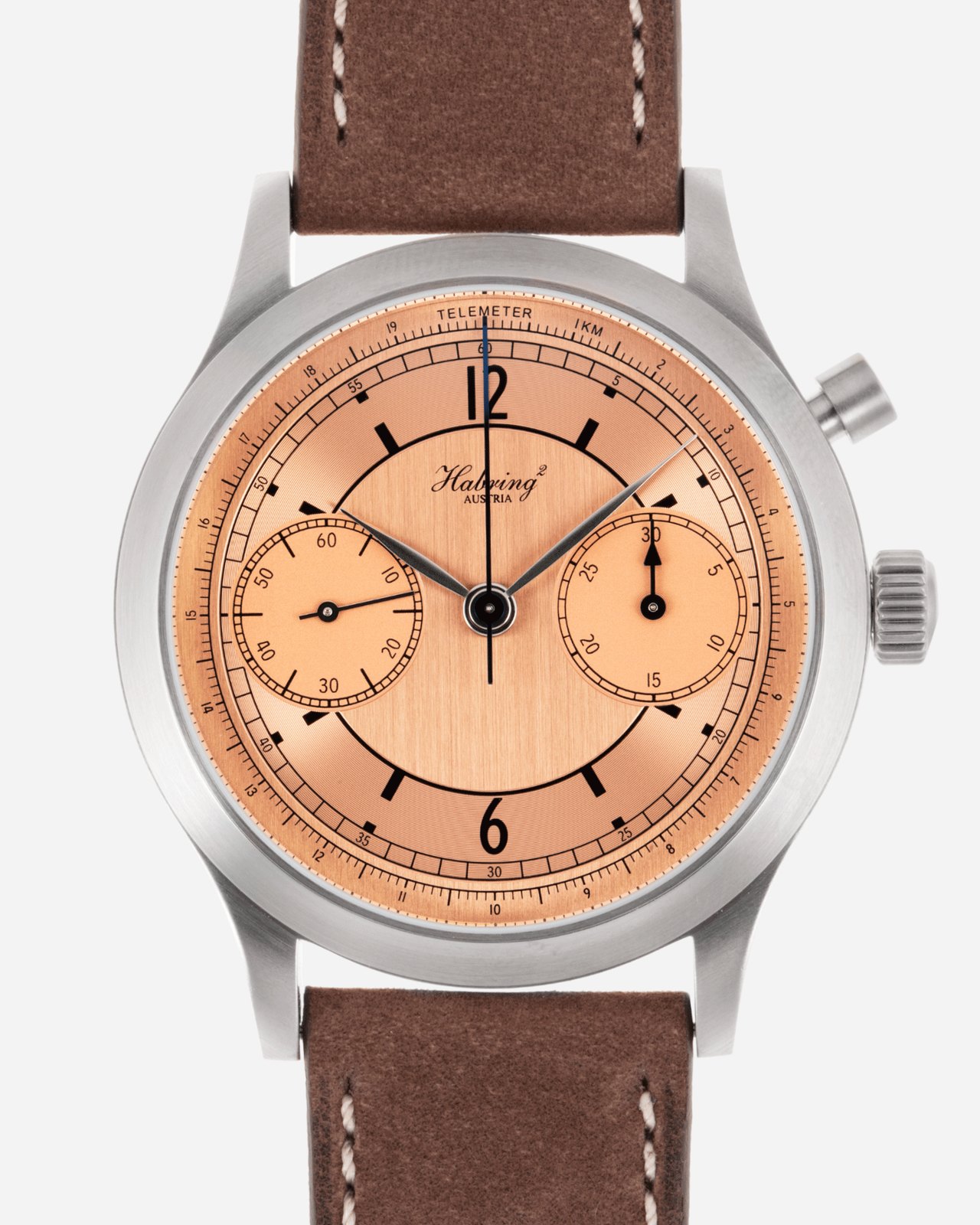
Habring Montre de Souscription 1 Monochrome Monopusher, 2021
- Maker / attribution
- Habring² (maker)
- Date
- 2021
- Historical period
- Contemporary Horology (2010 – Present)
- Country of origin
- Austria
- Object type
- Wristwatch
- Dimensions
- Case 38.5 mm
- Stock no.
- Product 6680962793559
- Credit line
- Dealer listing, S.Song Watches (product 6680962793559)
- Catalogue title (original)
- Habring Montre de Souscription 1 Monochrome Monopusher (English)
View the source record (dealer listing) ↗ (opens another website in a new tab)Suggest a correction
Record summary
Catalogued by S.Song Watches (dealer), Seattle (stock number Product 6680962793559), this is a wristwatch by Habring², made in Austria, dated 2021. The Atlas places it in the Contemporary Horology period (2010 – Present) of its Wristwatches collection. Recorded dimensions: Case 38.5 mm. The record is illustrated with 6 photographs.
Assembled from the source record's structured fields. Dates and attributions are given as the source states them; where a field is missing the Atlas leaves it blank rather than estimating.
Catalogue description
Dealer description — S.Song Watches
The world of horology is undoubtedly filled with its fair share of independent watchmakers and watch publications, but what happens when two of the best come together to launch a watch? This happens, the Habring Monochrome Montre de Souscription 1 Monopusher. Launched in 2021 as Monochrome's first collaboration watch, the Montre de Souscription 1 is a stunning, vintage-inspired watch. With a gorgeous two-textured salmon pink dial, the Montre de Souscription clearly draws inspiration from the chronographs of the 1940s with its classic two subdial layout, subtle mixing of surface finishes, and pieces of heritage like a railroad-style minute track and a telemeter scale. Beyond its dial, the Montre de Souscription's construction is also somewhat unique given the position of its single chronograph pusher, hence "monopusher," at 2 o'clock. Combined with its entirely brushed 38.5mm stainless steel case, this Montre de Souscription's construction is easy on the eye and reminiscent of watches of old. Acting as its final link to horology's past, the Montre de Souscription Is powered by the manual-wind cal. A11C-H1 movement, which sits proudly behind a sapphire crystal exhibition caseback. This movement is the result of Habring's work modifying and improving the legendary workhorse Valjoux cal. 7750 ébauche and converting it into a mono-pusher.
Historical context
Contemporary Horology (2010 – Present)
Silicon components, connected watches, optical-lattice research clocks and a thriving independent scene.
Smartwatches became the world's best-selling watches, while mechanical watchmaking focuses on craft, innovation (silicon components, new escapements) and independent makers.
Read the period in the timelineMore wristwatches from this periodEarlier: Mechanical Renaissance
Atlas type guide
Wristwatches
Bracelet watches were worn by women from the early nineteenth century — Breguet made one for Caroline Murat, Queen of Naples, in 1810–12 — but the wristwatch only became a man's instrument with military use and aviation in the early twentieth century. Between the World Wars it overtook the pocket watch; the 1920s and 1930s brought rectangular Art Deco cases, water-resistant cases and the first automatic winding systems.
After 1945 the wristwatch became a carrier of identity — dress watches, sports and dive watches, chronographs, calendars — produced by Swiss, American, Japanese, German, Soviet and Chinese industries. The quartz revolution after 1969 and the mechanical renaissance since the 1990s, including the rise of independent watchmakers, complete the story.
What to look for
- The reference number (between the lugs or inside the case back) and serial number, the starting point for dating.
- The calibre: its maker and number are often stamped under the dial or on the bridge.
- Originality of dial, hands and crown — refinished ('redial') dials are common.
- Case material marks: 18K/750, 14K/585, stainless steel, gold-filled, plated.
Dating clues
- Wire-lug cases: before c. 1925.
- Water-resistant screw-down cases: from 1926.
- Quartz movements: from 1969; sapphire crystals widespread after c. 1980.
General guidance written by the Atlas editors about this kind of object. It is not a statement about this particular piece; for that, rely on the source record above and on physical examination.
Related records
Wristwatches · 2021
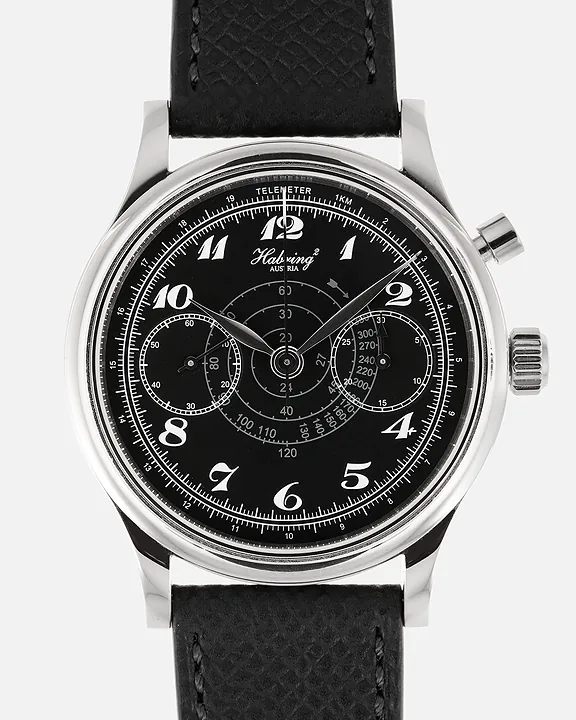
Habring Monopusher Chrono-Felix Custom, 2021
S.Song Watches (dealer), Seattle
Wristwatches · 2017
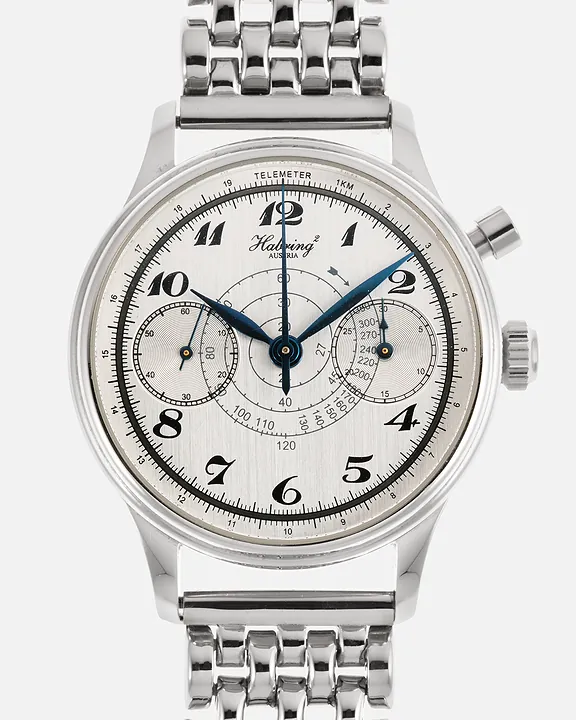
Habring Monopusher Chronograph Shellman Edition, 2017
S.Song Watches (dealer), Seattle
Wristwatches · 2020
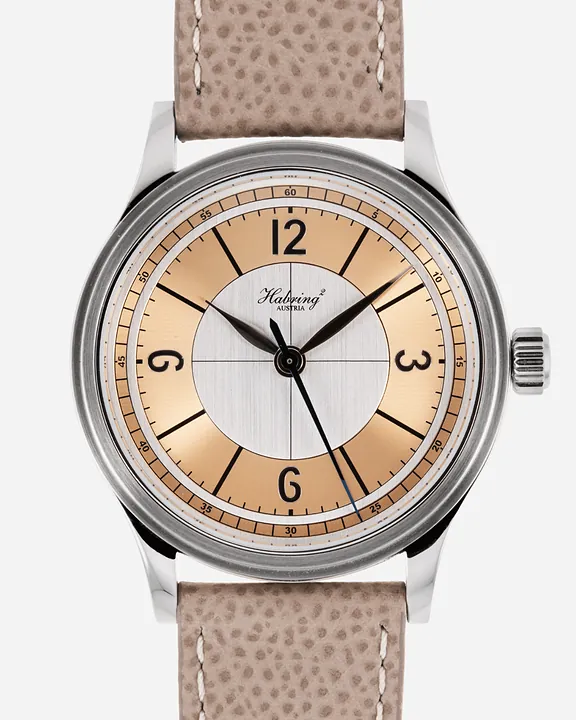
Habring Erwin LAB 02 Massena Lab, 2020
S.Song Watches (dealer), Seattle
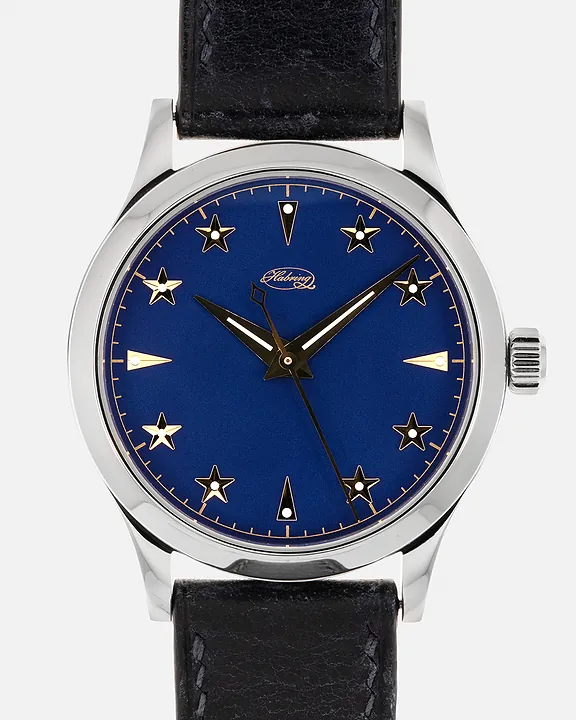
Wristwatches · 2021
Habring Erwin Star SJX, 2021
S.Song Watches (dealer), Seattle
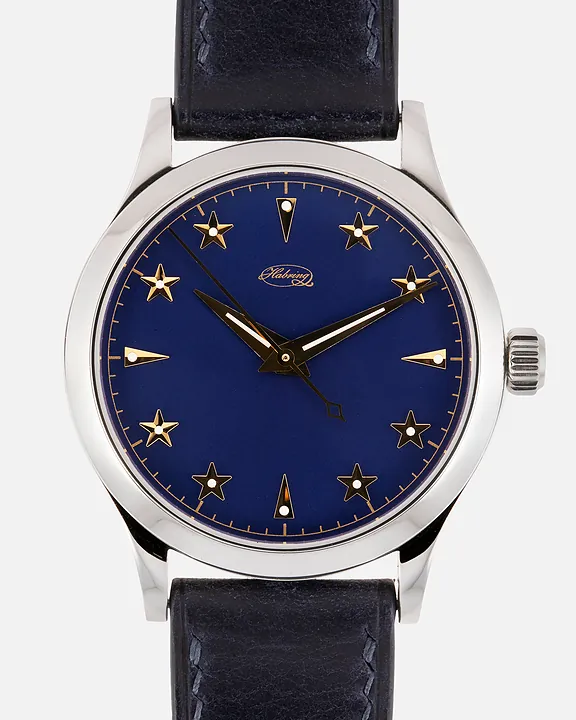
Wristwatches · 2021
Habring Erwin Star SJX, 2021
S.Song Watches (dealer), Seattle
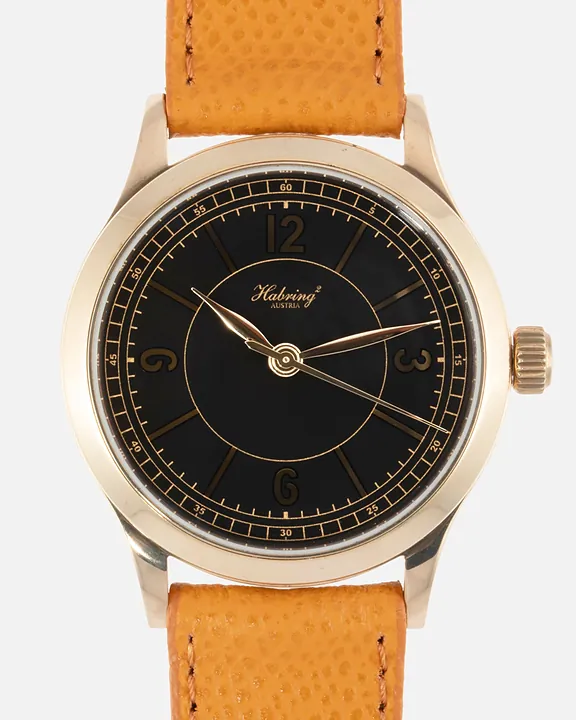
Wristwatches · 2018
Habring Erwin LAB 01 for Massena Lab, 2018
S.Song Watches (dealer), Seattle
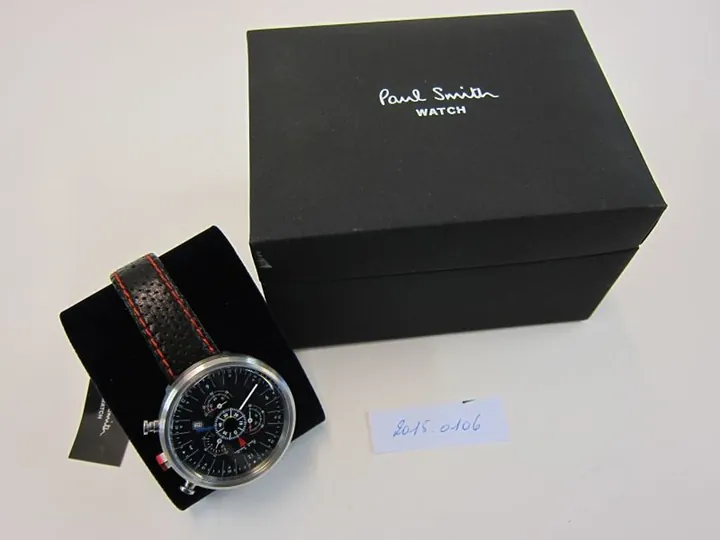
Wristwatches · 2010
Wristwatch, 2010
Modemuseum Hasselt
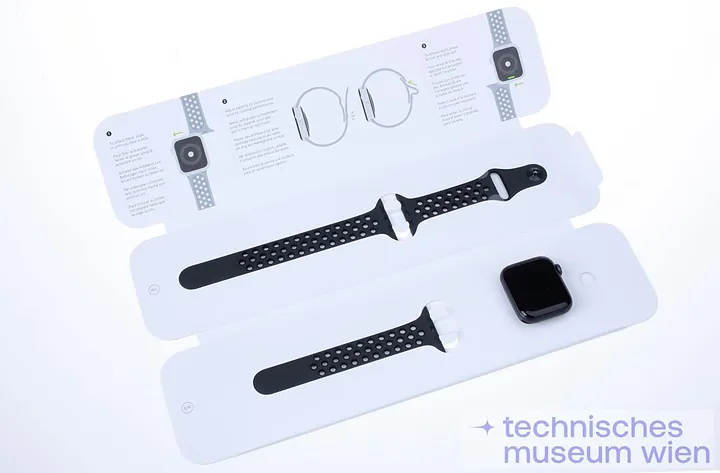
Wristwatches · 2018 (Series 4 released in September 2018; '1977' in the source is the model number A1977)
Apple Watch Series 4 (GPS, 40 mm, model A1977), 2018
Vienna Museum of Science and Technology