
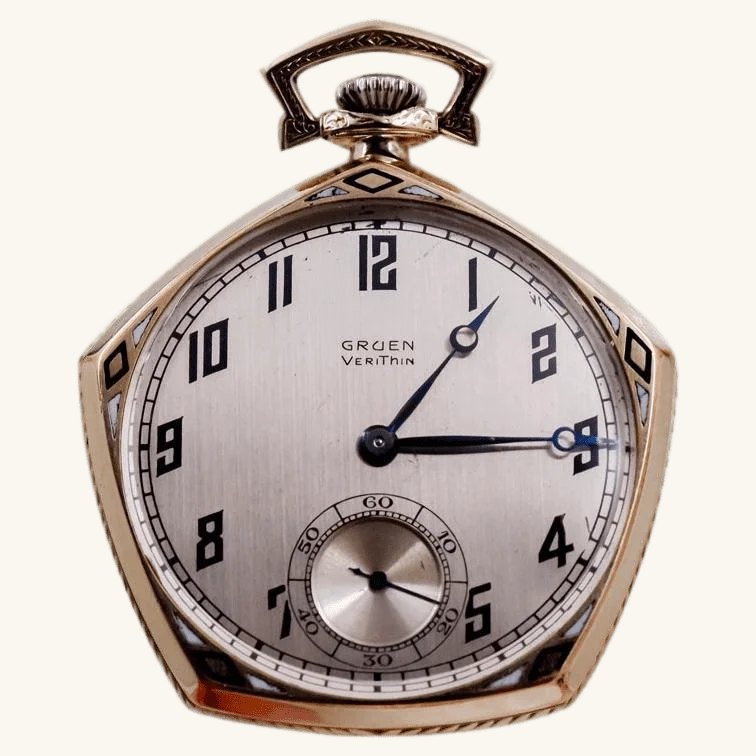
Pocket Watches · Pocket watch
Gruen Yellow Gold Filled Art Deco Pocket Watch with Original Stern Dial – 1920”s
- Maker / attribution
- Gruen (maker)
- Date
- 20th century
- Historical period
- Golden Age of Mechanical Watchmaking (1900 – 1945)
- Country of origin
- Unrecorded in source
- Object type
- Pocket watch
- Materials / technique
- gold
- Dealer
- WatchMuseum.org shop
- Stock no.
- Product 3125
- Credit line
- Dealer listing, WatchMuseum.org shop (product 3125)
- Catalogue title (original)
- Gruen Yellow Gold Filled Art Deco Pocket Watch with Original Stern Dial – 1920”s (English)
View the source record (dealer listing) ↗ (opens another website in a new tab)Suggest a correction
Record summary
Catalogued by WatchMuseum.org shop (stock number Product 3125), this is a pocket watch by Gruen, dated 20th century. The Atlas places it in the Golden Age of Mechanical Watchmaking period (1900 – 1945) of its Pocket Watches collection. Materials and techniques recorded by the source: gold. The record is illustrated with 6 photographs.
Assembled from the source record's structured fields. Dates and attributions are given as the source states them; where a field is missing the Atlas leaves it blank rather than estimating.
Catalogue description
Dealer description — WatchMuseum.org shop
Step back in time with the exquisite Gruen Yellow Gold Filled Art Deco Pocket Watch, a true masterpiece from the 1920s that embodies the elegance and innovation of its era. Crafted by the illustrious Gruen Watch Company, this pocket watch features a unique pentagonal case design, ensuring it remains upright in a waistcoat pocket for optimal accuracy. The manual winding movement, recently serviced by experts, showcases meticulous craftsmanship. The original Stern Freres dial is a sterling silver marvel, adorned with kiln-fired enamel printing, and complemented by blue steel moon hands inspired by 18th-century Breguet designs. The handcrafted case, embellished with intricate enamelling and hand-engraving, bears the enigmatic initials O F B or D F B. This rare and stylish timepiece is not just a collector’s item but a functional accessory that promises both timeless style and reliable punctuality. This stunning Art Deco Pocket Watch produced by the renowned Gruen Watch Company boasts a distinctive pentagonal case design. This clever design allows the watch to be positioned straight up in a waistcoat pocket, ensuring greater accuracy by remaining stationary. The manual winding movement is meticulously finished, and the watch has been recently serviced by our team. The original dial is an exceptional example of Stern Freres’ kiln-fired enamel printing in sterling silver, which was crafted for Gruen. The blue steel moon hands are inspired by Breguet’s designs from the 1700s. The case is handcrafted to include both enamelling and hand-engraving, and it appears to read either O F B or D F B. The combination of unique features makes this watch a rare gem that can be worn daily, guaranteeing both style and punctuality. Creator: Gruen Movement: Manual Wind Style: Art Deco Place of Origin: Switzerland Period: 1920-1929 Date of Manufacture: 1920”s Condition: Good
Historical context
Golden Age of Mechanical Watchmaking (1900 – 1945)
The wristwatch displaces the pocket watch; waterproof cases, self-winding and grand complications.
The pocket watch reached technical maturity and then began to give way to the wristwatch after the First World War. Complicated watches for collectors such as Henry Graves Jr. and James Ward Packard, railroad watches, and slim Art Deco dress watches are characteristic.
Read the period in the timelineMore pocket watches from this periodEarlier: Industrial Revolution
Atlas type guide
Pocket watches
The pocket watch was the dominant personal timekeeper from the late seventeenth century until the First World War. Its development tracks the history of the escapement: verge watches with fusees until the late eighteenth century; Thomas Mudge's lever escapement (c. 1755) and the cylinder escapement popularised by George Graham and later by Swiss makers; and the Swiss and English lever watches of the nineteenth century. Lépine's bar-bridge calibre and keyless winding made watches thinner and easier to use.
Industrialisation transformed the trade: American factories such as Waltham (from 1850) and Elgin produced interchangeable parts by machine, and Swiss makers responded with their own mechanisation after the 1876 Philadelphia Exhibition. By 1900 a reliable watch was affordable to millions; the finest makers continued to produce complications and precision watches.
What to look for
- The escapement: verge (crown wheel), cylinder, duplex, English or Swiss lever.
- Key winding (a square arbor in dial or back) or keyless crown winding.
- Signatures and serial numbers on the movement, dial and inside case back.
- Hallmarks, case maker's marks and gold or silver standards stamped in the case.
- Dial material: enamel, silver, gold, later printed metal.
Dating clues
- Verge watches dominate before c. 1800; cylinder watches c. 1770–1900; lever watches after c. 1820.
- Keyless winding: increasingly common after c. 1860.
- Manufacturer serial number lists exist for Waltham, Elgin, Longines, Omega, Patek Philippe and others.
General guidance written by the Atlas editors about this kind of object. It is not a statement about this particular piece; for that, rely on the source record above and on physical examination.
Read next:Verge escapementDetached lever escapementFuseeIdentification Centre
Related records
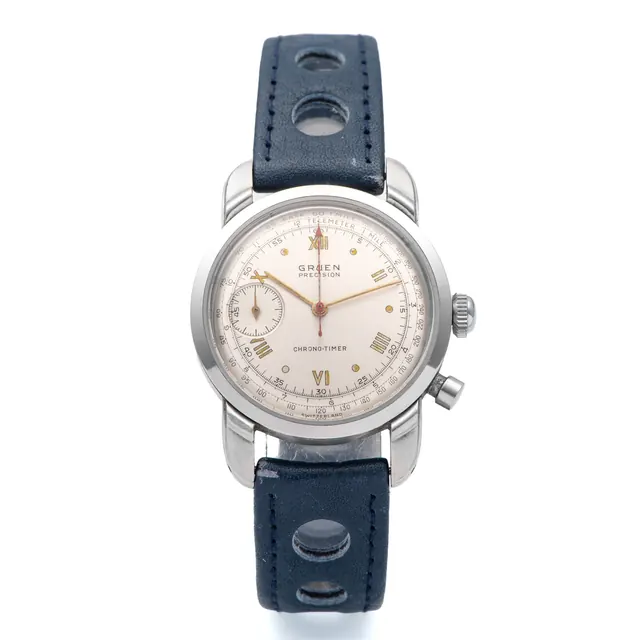
Wristwatches · c. 1950s
Gruen wristwatch, Chrono-Timer, circa 1950's
Antiquorum auction archive, Geneva
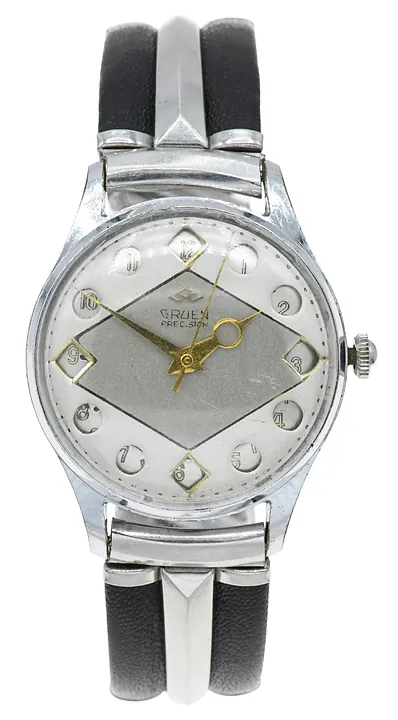
Wristwatches · c. 1960
Gruen Airflight Jump Hour Wristwatch, circa 1960's
LiveAuctioneers auction archive
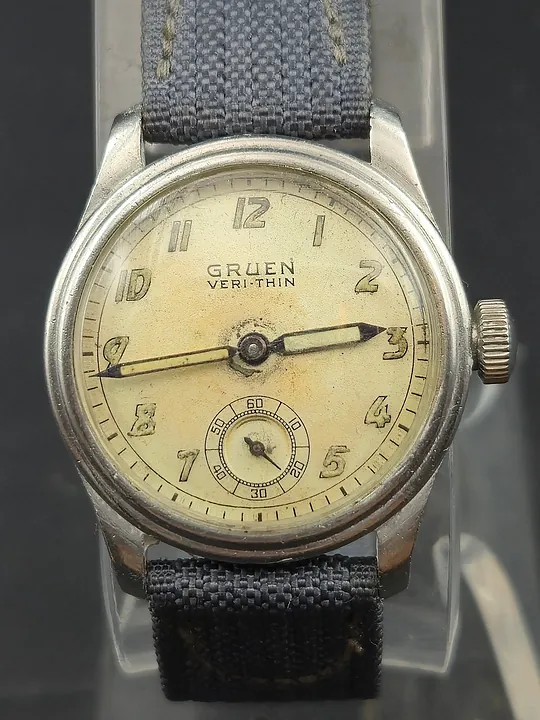
Wristwatches · 1940s
1940s Gruen Veri-Thin 15J Military-Style Swiss Wristwatch, Stainless Case w/ Sub-Seconds, Running
LiveAuctioneers auction archive
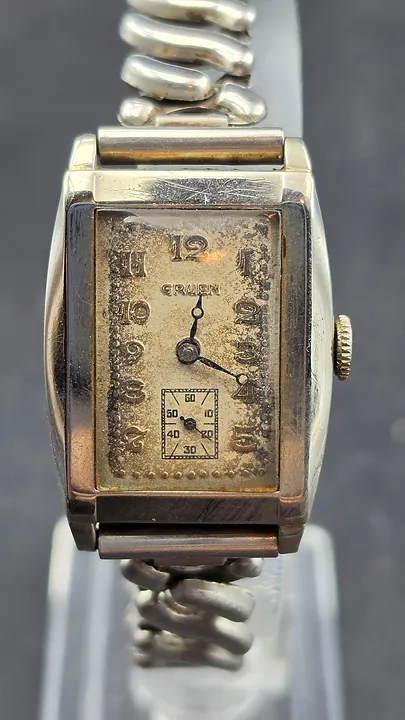
Wristwatches · c. 1940s
Vintage Gruen Art Deco Tank Watch Ref 705/95 14K White Gold Filled Sub-Seconds circa 1940s
LiveAuctioneers auction archive
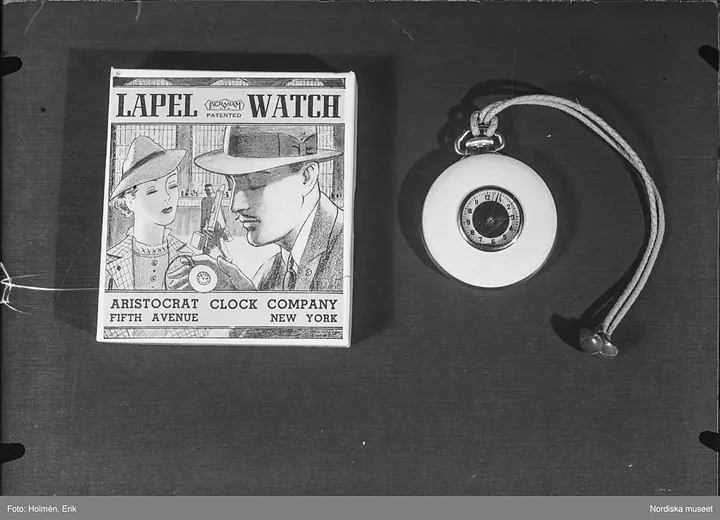
Pocket Watches · 1900–1999
Lapel watch by Erik Holmén, 1900–1999
Nordic Museum Foundation
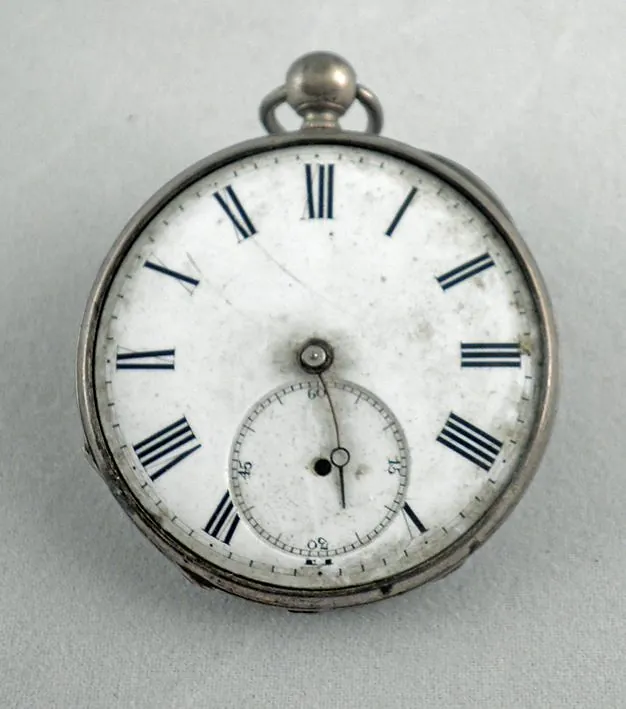
Pocket Watches · 1873–1930
Pocket watch, Lilla Malma socken, 1873–1930
Sörmland Museum
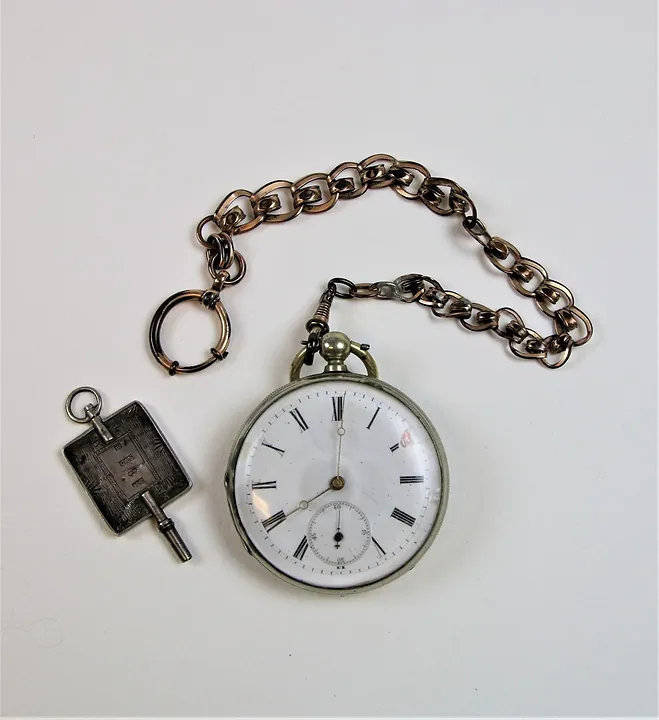
Pocket Watches · 1880–1920
Pocket watch, Sweden, 1880–1920
Sörmland Museum
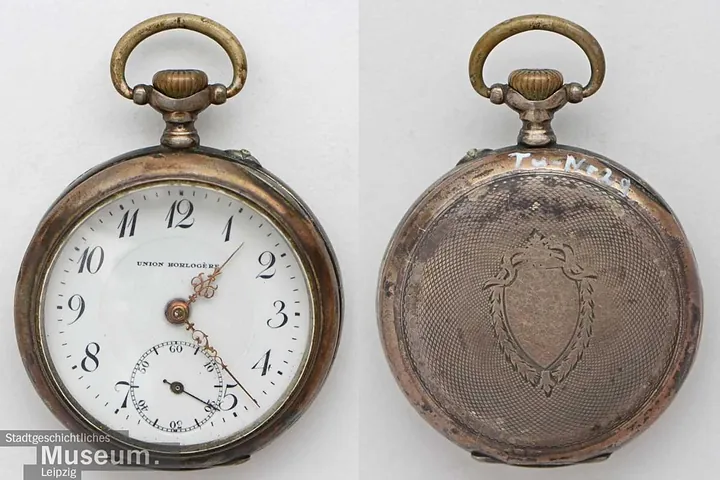
Pocket Watches · 1890–1910
Pocket watch by Union Horlogère, France, 1890–1910
Museum of City History Leipzig