
Wristwatches · Wristwatch
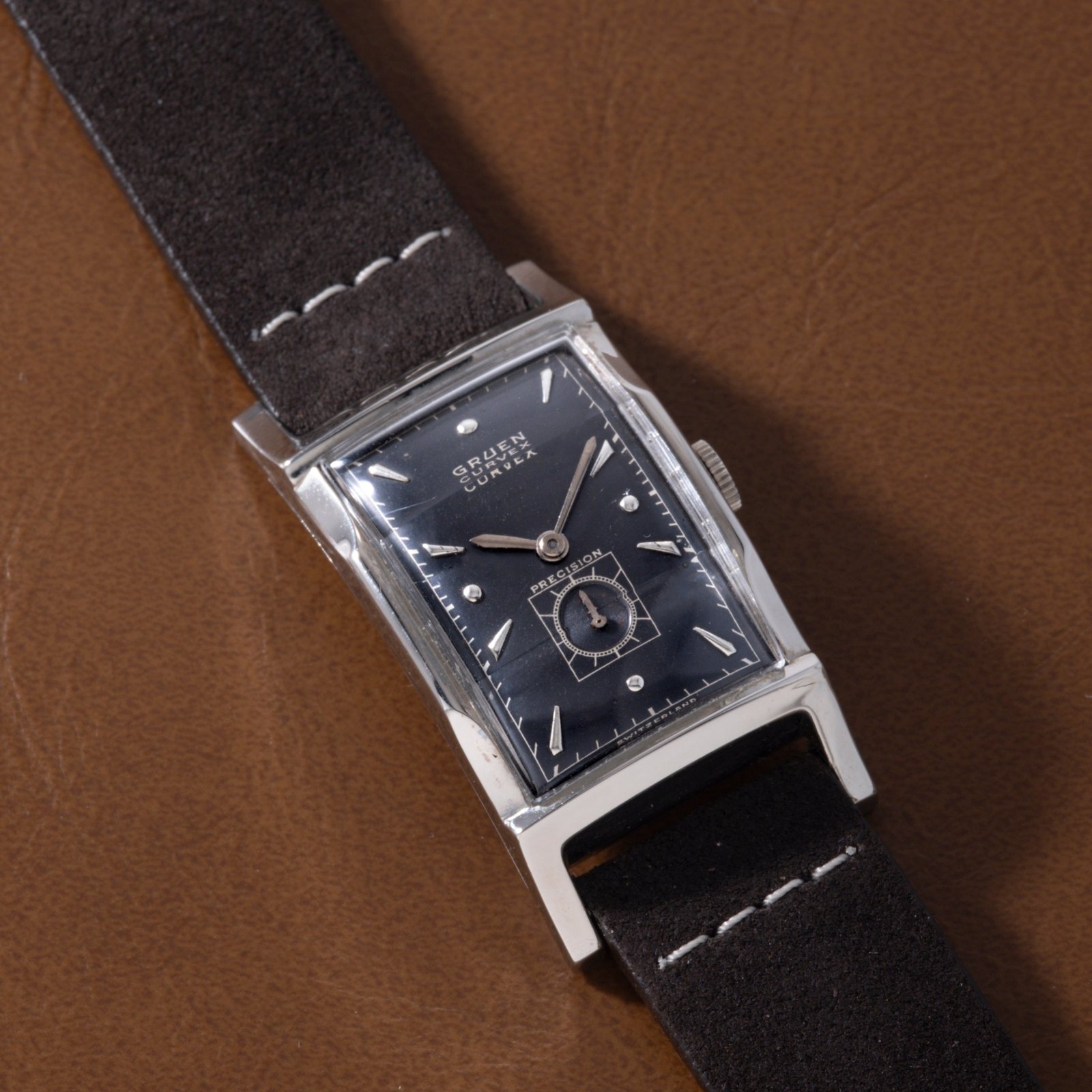
Gruen Curvex 'Count', c. 1940s
- Maker / attribution
- Gruen (maker)
- Date
- c. 1940s
- Historical period
- Golden Age of Mechanical Watchmaking (1900 – 1945)
- Country of origin
- Unrecorded in source
- Object type
- Wristwatch
- Stock no.
- 40993181
- Credit line
- Dealer listing, Analog/Shift (40993181)
- Catalogue title (original)
- Gruen Curvex 'Count' (English)
View the source record (dealer listing) ↗ (opens another website in a new tab)Suggest a correction
Record summary
Catalogued by Analog/Shift (dealer), New York (stock number 40993181), this is a wristwatch by Gruen, dated c. 1940s. The Atlas places it in the Golden Age of Mechanical Watchmaking period (1900 – 1945) of its Wristwatches collection. The record is illustrated with 6 photographs.
Assembled from the source record's structured fields. Dates and attributions are given as the source states them; where a field is missing the Atlas leaves it blank rather than estimating.
Catalogue description
Dealer description — Analog/Shift
One of the most famous curved wristwatch is without a doubt the Gruen Curvex, which was introduced in 1935 and almost single-handedly saw Gruen through the Great Depression. Thanks to strategic partnerships with Swiss companies like Rolex and movement manufacturer Aegler, Gruen had enjoyed success with its doctor’s watch, the Techni-Quadron (which Rolex marketed as the Prince in Europe and the British Empire). But the brand also earned a reputation for innovation in aesthetics. Throughout the 1920s, Gruen experimented with different movement and watch designs, including the Quadron, which housed a tonneau-shaped movement in a rectangular case. Despite the economic setbacks and political changeovers, the brand was poised for a comeback—which came in the form of this watch, the Curvex. Gruen had actually applied for a patent for a curved movement in 1929, through its Bienne-based agent, Emile Frey. It was granted to Frey in 1932, but assigned to Gruen. Accordingly, the movement designers at the Precision Factory set to work designing what would become a revolutionary watch movement: the Calibre 311. The Curvex that we offer here features the Calibre 370. The 36 hr power reserve movement has a unique scalloping to its profile that matches the case. This particular Curvex, the ‘Count’, dates to circa 1940s. Made from 10K filled gold case, the case has aged to a lovely tone. At its time, this watch was the peak of fashion and trend, but today, it constitutes a wonderful heritage callback to a bygone era. This beautiful piece features a stunning 'Breguet' dial and handset, and is in exceptional condition for its age. The piece features scalloping on the vertical brancards that carries through the full design visually partitioning the piece into three main segments. There's no other watch that looks like this. Own a piece of horological history with this Gruen!
Historical context
Golden Age of Mechanical Watchmaking (1900 – 1945)
The wristwatch displaces the pocket watch; waterproof cases, self-winding and grand complications.
The wristwatch overtook the pocket watch. Military use in the First World War, aviation, water-resistant cases (1926), automatic winding (1923–31), rectangular Art Deco designs and early chronographs and calendars defined the period.
Read the period in the timelineMore wristwatches from this periodEarlier: Industrial Revolution
Atlas type guide
Wristwatches
Bracelet watches were worn by women from the early nineteenth century — Breguet made one for Caroline Murat, Queen of Naples, in 1810–12 — but the wristwatch only became a man's instrument with military use and aviation in the early twentieth century. Between the World Wars it overtook the pocket watch; the 1920s and 1930s brought rectangular Art Deco cases, water-resistant cases and the first automatic winding systems.
After 1945 the wristwatch became a carrier of identity — dress watches, sports and dive watches, chronographs, calendars — produced by Swiss, American, Japanese, German, Soviet and Chinese industries. The quartz revolution after 1969 and the mechanical renaissance since the 1990s, including the rise of independent watchmakers, complete the story.
What to look for
- The reference number (between the lugs or inside the case back) and serial number, the starting point for dating.
- The calibre: its maker and number are often stamped under the dial or on the bridge.
- Originality of dial, hands and crown — refinished ('redial') dials are common.
- Case material marks: 18K/750, 14K/585, stainless steel, gold-filled, plated.
Dating clues
- Wire-lug cases: before c. 1925.
- Water-resistant screw-down cases: from 1926.
- Quartz movements: from 1969; sapphire crystals widespread after c. 1980.
General guidance written by the Atlas editors about this kind of object. It is not a statement about this particular piece; for that, rely on the source record above and on physical examination.
Related records
Wristwatches · c. 1950s
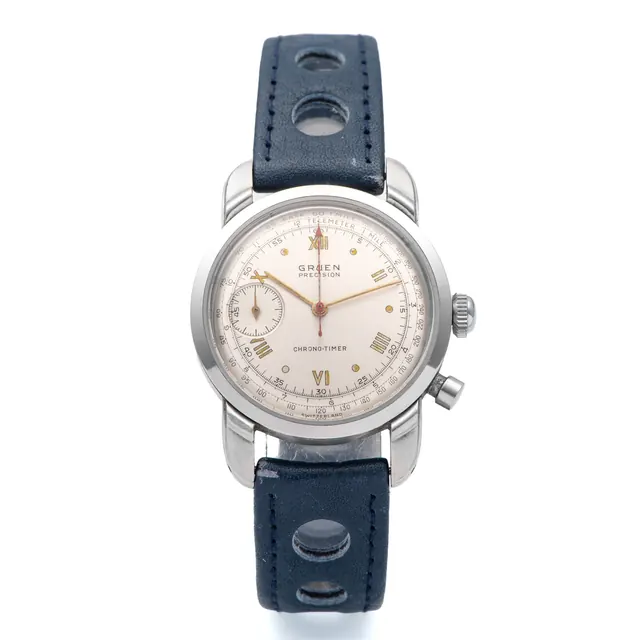
Gruen wristwatch, Chrono-Timer, circa 1950's
Antiquorum auction archive, Geneva
Pocket Watches · 20th century
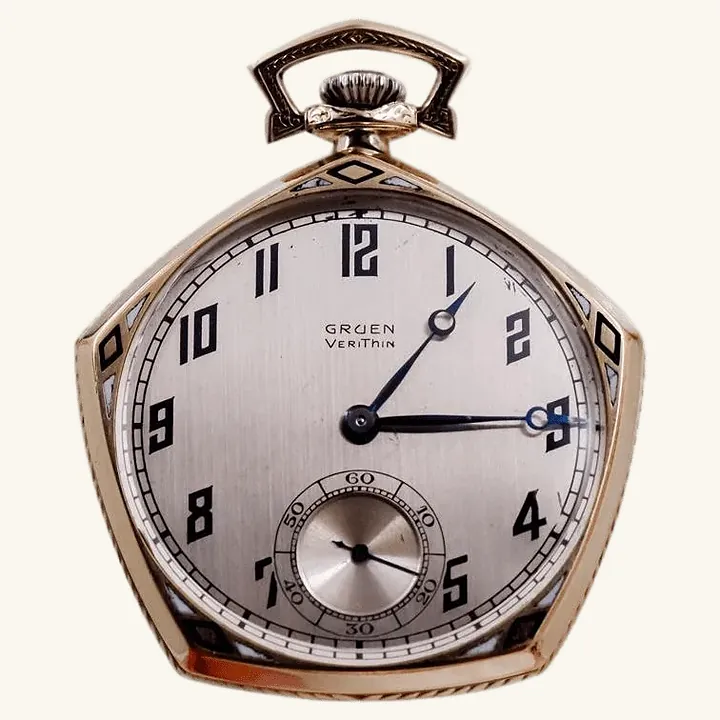
Gruen Yellow Gold Filled Art Deco Pocket Watch with Original Stern Dial – 1920”s
WatchMuseum.org shop
Wristwatches · c. 1960
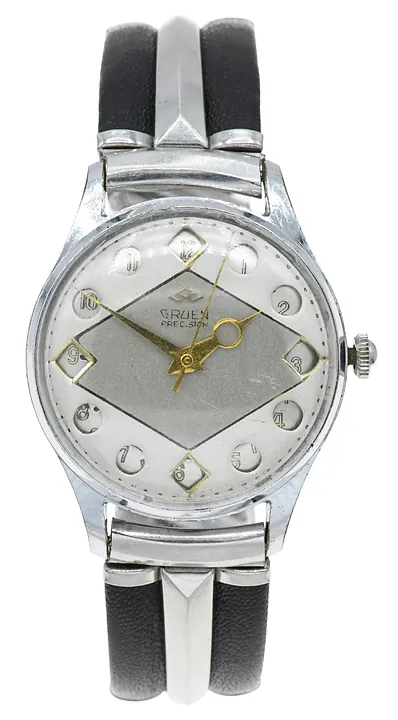
Gruen Airflight Jump Hour Wristwatch, circa 1960's
LiveAuctioneers auction archive
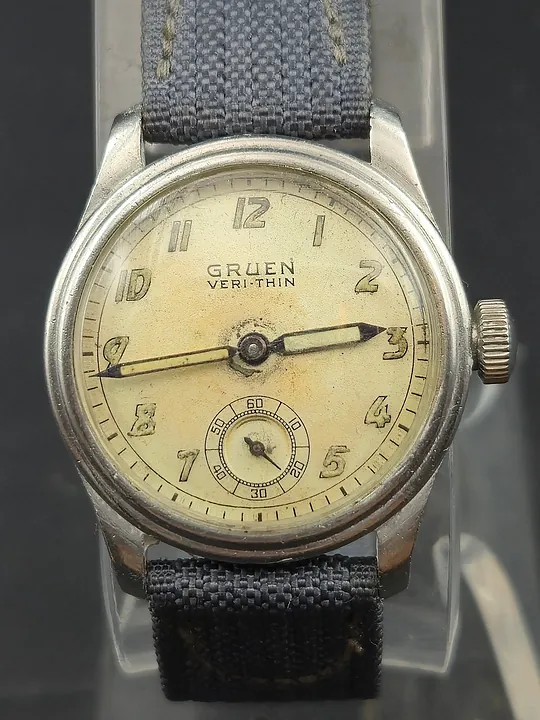
Wristwatches · 1940s
1940s Gruen Veri-Thin 15J Military-Style Swiss Wristwatch, Stainless Case w/ Sub-Seconds, Running
LiveAuctioneers auction archive
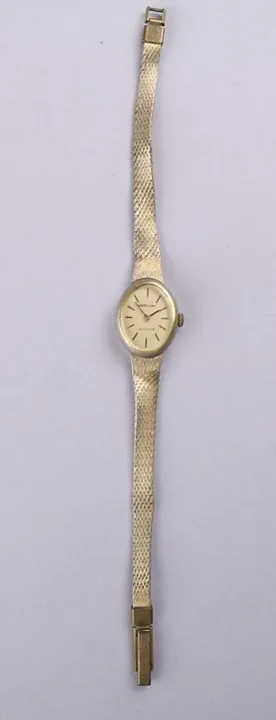
Wristwatches · 1900–1999
Wristwatch by Mercury, 1900–1999
Modemuseum Hasselt
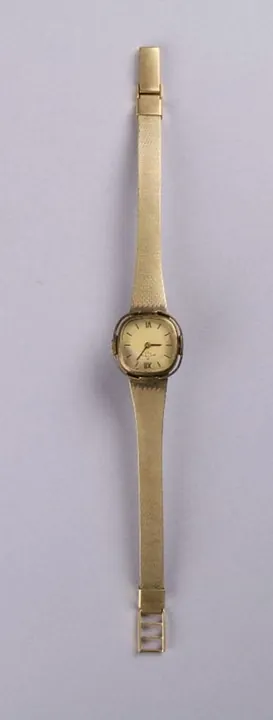
Wristwatches · 1900–1999
Wristwatch by Nutrix, 1900–1999
Modemuseum Hasselt

Wristwatches · 1920
Wristwatch, 1920
Modemuseum Hasselt

Wristwatches · 1931
Rolex 'Oyster Perpetual' rotor self-winding wrist-watch, lever escapement, in steel case with glass in back, Montres Rolex SA, Geneva, Switzerland, 1931
Science Museum Group, London