
Wristwatches · Wristwatch
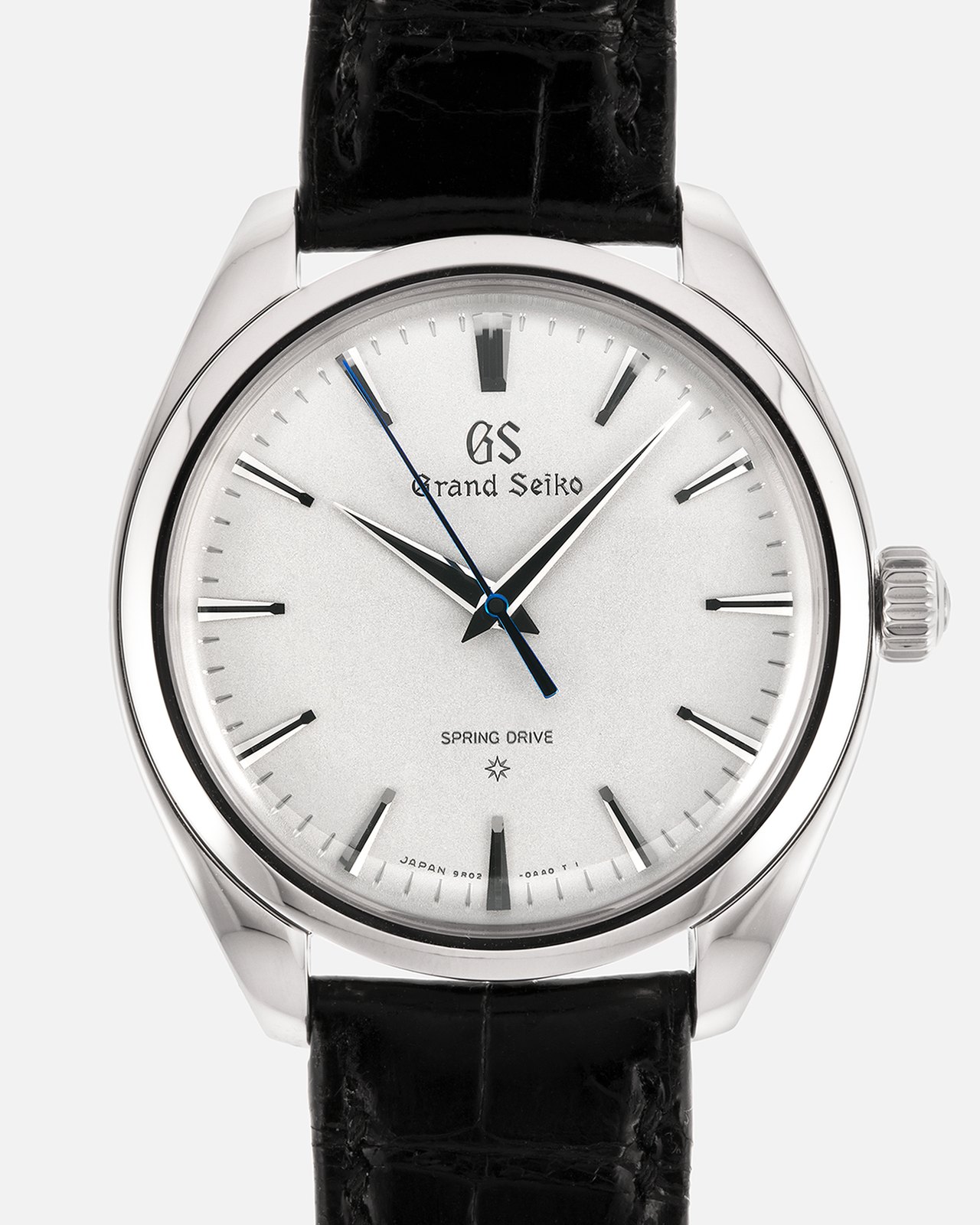
Grand Seiko Masterpiece Collection SBGZ003 Micro Artist Studio Platinum, 2025
- Maker / attribution
- Grand Seiko (maker)
- Date
- 2025
- Historical period
- Contemporary Horology (2010 – Present)
- Country of origin
- Japan
- Object type
- Wristwatch
- Materials / technique
- platinum
- Dimensions
- Case 38.5 mm
- Stock no.
- Product 7739312635991
- Credit line
- Dealer listing, S.Song Watches (product 7739312635991)
- Catalogue title (original)
- Grand Seiko Masterpiece Collection SBGZ003 Micro Artist Studio Platinum (English)
View the source record (dealer listing) ↗ (opens another website in a new tab)Suggest a correction
Record summary
Catalogued by S.Song Watches (dealer), Seattle (stock number Product 7739312635991), this is a wristwatch by Grand Seiko, made in Japan, dated 2025. The Atlas places it in the Contemporary Horology period (2010 – Present) of its Wristwatches collection. Materials and techniques recorded by the source: platinum. Recorded dimensions: Case 38.5 mm. The record is illustrated with 6 photographs.
Assembled from the source record's structured fields. Dates and attributions are given as the source states them; where a field is missing the Atlas leaves it blank rather than estimating.
Catalogue description
Dealer description — S.Song Watches
Over the last decade, Grand Seiko has gone from being something of an insider's secret to one of the most respected names in modern watchmaking. While the brand is perhaps best known for its incredible dials, Zaratsu-polished cases, and exceptional value for money, at the very top of its collection exists something altogether different. The SBGZ003 comes from Grand Seiko's Masterpiece Collection and is produced by the legendary Micro Artist Studio, a small workshop in Shiojiri responsible for some of the finest watches ever to come out of Japan. Established in 2000, the studio has produced masterpieces such as the Credor Eichi, Eichi II, Sonnerie, and Minute Repeater, with its philosophy centred around traditional hand craftsmanship and an almost obsessive pursuit of finishing. Introduced in 2019 to celebrate the 20th anniversary of Spring Drive, the SBGZ003 represents one of the purest expressions of this philosophy. Housed in a 38.5mm case made entirely from platinum, the proportions are wonderfully restrained, measuring just 9.8mm thick and wearing much more like a classical dress watch than what one might expect from a modern Grand Seiko. The case itself is deceptively simple but beautifully executed. Its broad, flowing surfaces are painstakingly Zaratsu-polished to an almost perfect mirror finish, something made considerably more difficult by the softness and unforgiving nature of platinum. There are no unnecessary lines or embellishments here. Instead, the quality comes from the precision of the form and the almost liquid appearance of the polished surfaces. The dial follows much the same philosophy. Finished in a subtle silver tone, it features razor-sharp applied hour markers, beautifully faceted hands, and a heat-blued seconds hand that glides continuously around the dial. Even the Grand Seiko signature, GS logo, and minute track are engraved rather than printed, giving the otherwise minimal dial a subtle sense of depth. It is an incredibly restrained design, but the closer you look, the more there is to appreciate. As beautiful as the front is, however, the real highlight is found behind the watch. Powering the SBGZ003 is the manual-winding Spring Drive Cal. 9R02, developed and finished entirely by the Micro Artist Studio. The movement offers an impressive 84-hour power reserve through two mainsprings housed within a single barrel, together with a Torque Return System that recycles excess energy back into the mainspring. Technically impressive as it may be, it is the finishing that really sets the 9R02 apart. The large bridges feature beautifully executed hand-polished bevels, including an incredibly sharp internal angle, while the movement is finished with polished jewel and screw sinks, heat-blued screws, and fine hairline brushing across the bridges. Even the barrel is openworked in the shape of the bellflower, the symbol of the Micro Artist Studio. The power reserve is also discreetly placed on the back, allowing the dial to remain completely untouched. There is an interesting connection here with Philippe Dufour, whose work had a profound influence on the philosophy of the Micro Artist Studio. Before the studio was established, members of the team travelled to Europe to study some of the finest examples of traditional watchmaking, with Dufour's approach to hand finishing leaving a particularly strong impression. Looking at the Cal. 9R02 today, that pursuit of traditional finishing is obvious, yet the end result remains distinctly Japanese in both execution and character. For me, watches like the SBGZ003 are important because they show just how far Grand Seiko is capable of going. This isn't simply a more expensive Grand Seiko with a platinum case. It is a genuine piece of high-end independent-style watchmaking produced within one of the world's largest watch companies, combining a completely unique movement architecture with finishing that can stand alongside some of the very best in Switzerland. The SBGZ003 is quiet, understated, and probably easy to overlook if you don't know what you are looking at. But perhaps that is exactly the point. For those who do, it represents Grand Seiko at its absolute best and is, in my opinion, one of the finest watches the brand has ever produced.
Historical context
Contemporary Horology (2010 – Present)
Silicon components, connected watches, optical-lattice research clocks and a thriving independent scene.
Smartwatches became the world's best-selling watches, while mechanical watchmaking focuses on craft, innovation (silicon components, new escapements) and independent makers.
Read the period in the timelineMore wristwatches from this periodEarlier: Mechanical Renaissance
Atlas type guide
Wristwatches
Bracelet watches were worn by women from the early nineteenth century — Breguet made one for Caroline Murat, Queen of Naples, in 1810–12 — but the wristwatch only became a man's instrument with military use and aviation in the early twentieth century. Between the World Wars it overtook the pocket watch; the 1920s and 1930s brought rectangular Art Deco cases, water-resistant cases and the first automatic winding systems.
After 1945 the wristwatch became a carrier of identity — dress watches, sports and dive watches, chronographs, calendars — produced by Swiss, American, Japanese, German, Soviet and Chinese industries. The quartz revolution after 1969 and the mechanical renaissance since the 1990s, including the rise of independent watchmakers, complete the story.
What to look for
- The reference number (between the lugs or inside the case back) and serial number, the starting point for dating.
- The calibre: its maker and number are often stamped under the dial or on the bridge.
- Originality of dial, hands and crown — refinished ('redial') dials are common.
- Case material marks: 18K/750, 14K/585, stainless steel, gold-filled, plated.
Dating clues
- Wire-lug cases: before c. 1925.
- Water-resistant screw-down cases: from 1926.
- Quartz movements: from 1969; sapphire crystals widespread after c. 1980.
General guidance written by the Atlas editors about this kind of object. It is not a statement about this particular piece; for that, rely on the source record above and on physical examination.
Related records
Wristwatches · 1967
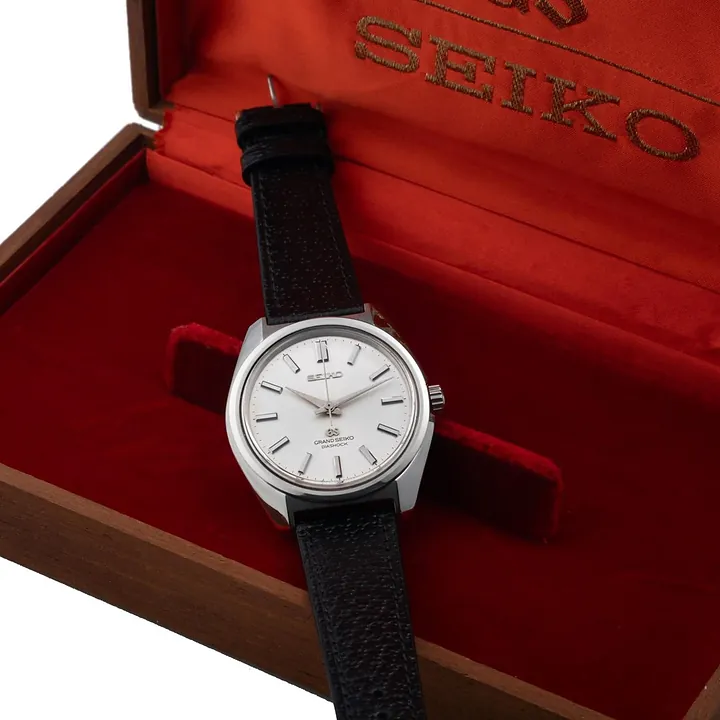
Grand Seiko 44 GS, ref. 4420-9000, 1967
Antiquorum auction archive, Geneva
Wristwatches · c. 1967
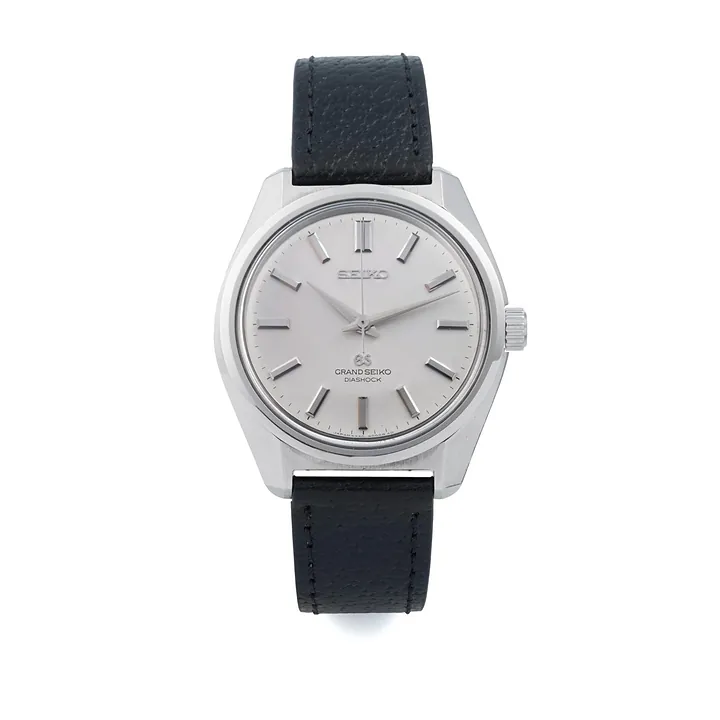
Grand Seiko 44 GS, ref. 4420-9000, c. 1967
Antiquorum auction archive, Geneva
Wristwatches · c. 2020s
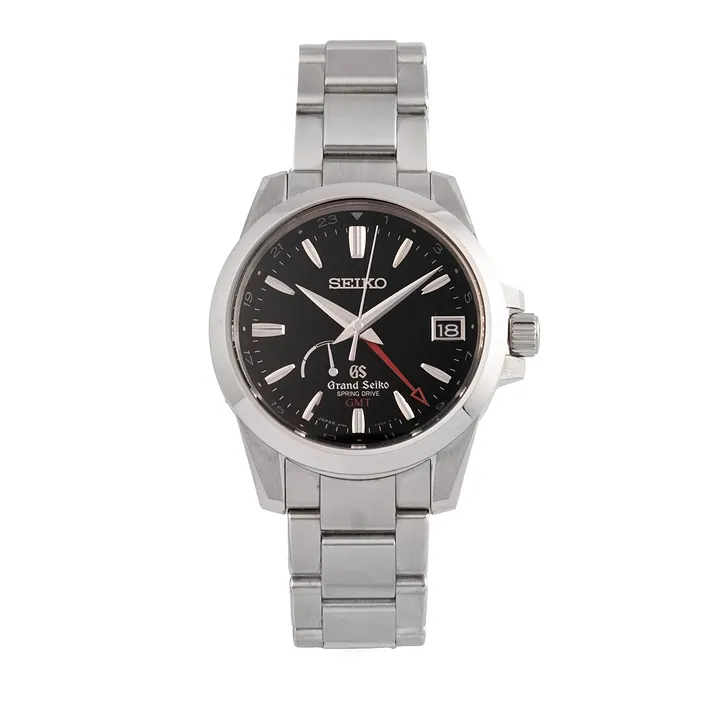
Grand Seiko Spring Drive GMT, ref. 9R66-0AE0, c. 2020s
Antiquorum auction archive, Geneva
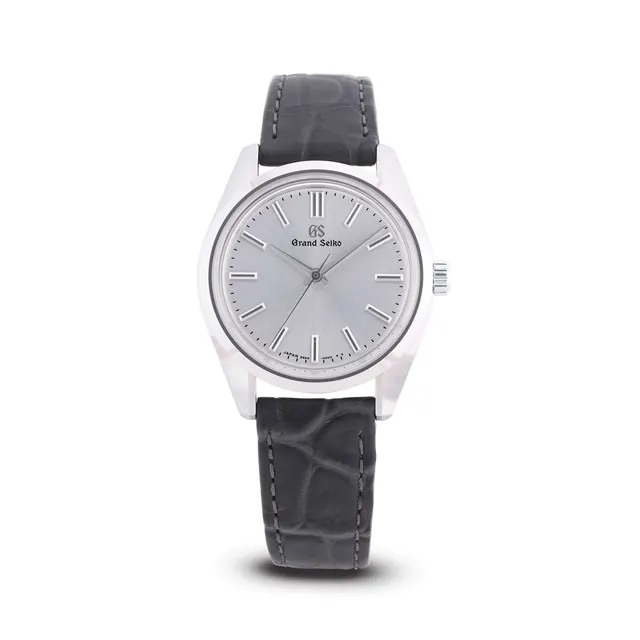
Wristwatches · originally sold in September 2022 (per the lot record)
Grand Seiko wristwatch, ref. SBGW291, Heritage Collection, originally sold in September 2022
Antiquorum auction archive, Geneva
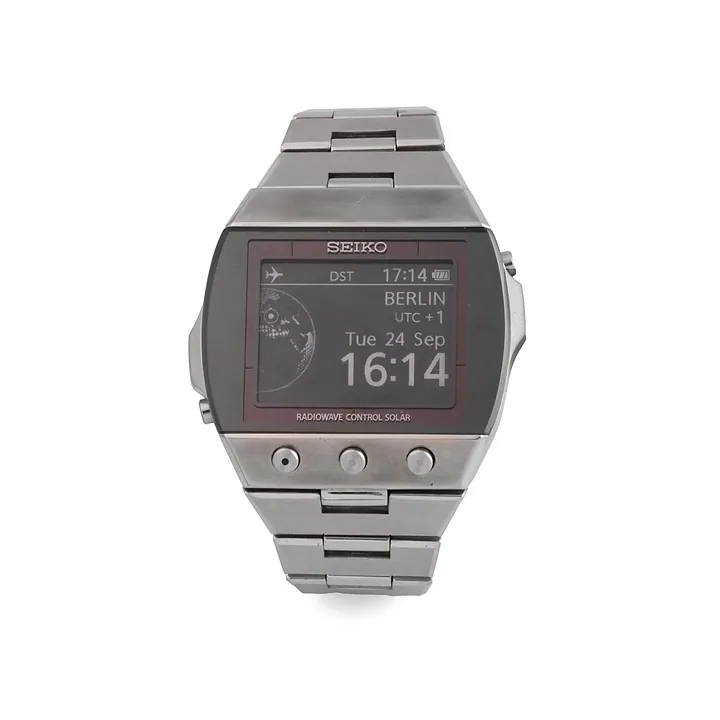
Wristwatches · Sold in 2011
Seiko Brights Spirit, ref. S770, Sold in 2011
Antiquorum auction archive, Geneva
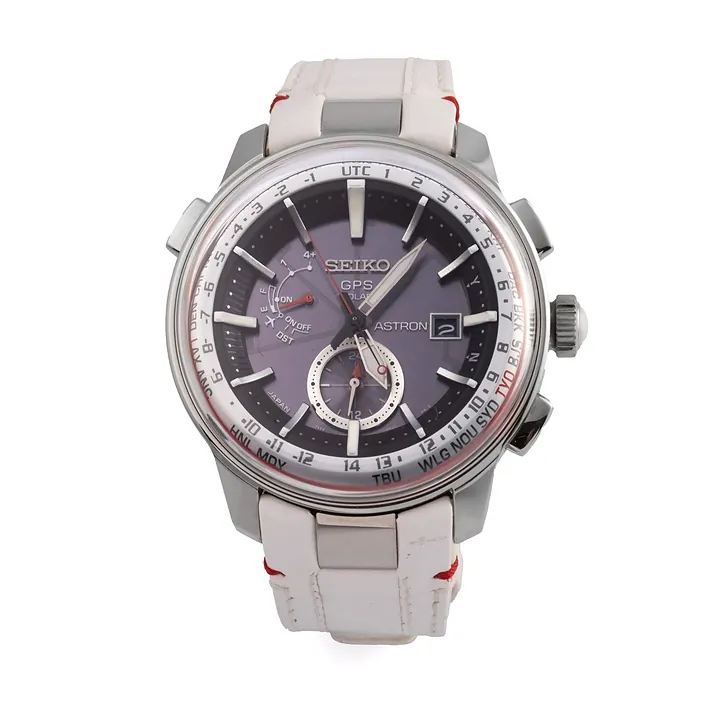
Wristwatches · originally sold in 2014 (per the lot record)
Seiko Astron GPS Solar, ref. SBXA045, originally sold in 2014
Antiquorum auction archive, Geneva
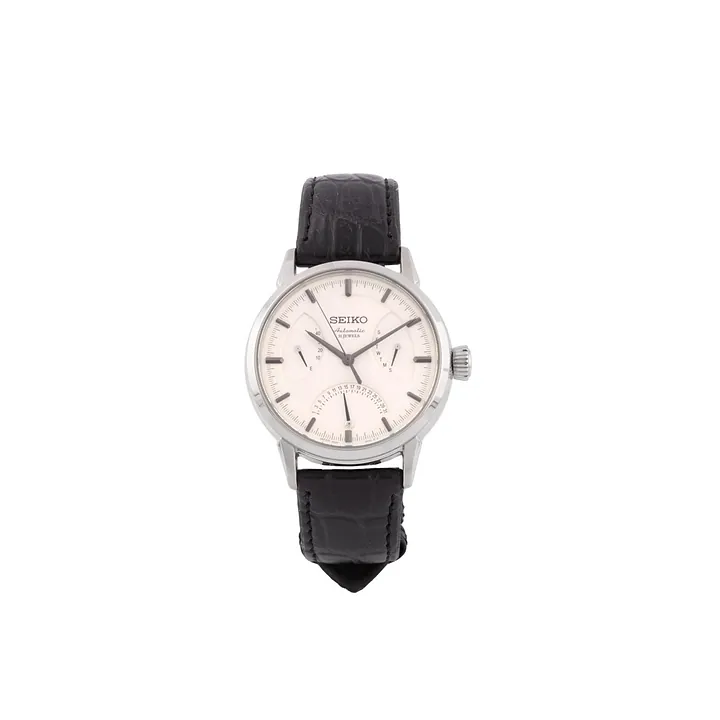
Wristwatches · c. 2015
Seiko Presage, c. 2015
Antiquorum auction archive, Geneva

Wristwatches · originally sold in 2018 (per the lot record)
Seiko Prospex Padi Special Edition, ref. SBDC055, originally sold in 2018
Antiquorum auction archive, Geneva