
Wristwatches · Wrist-watch
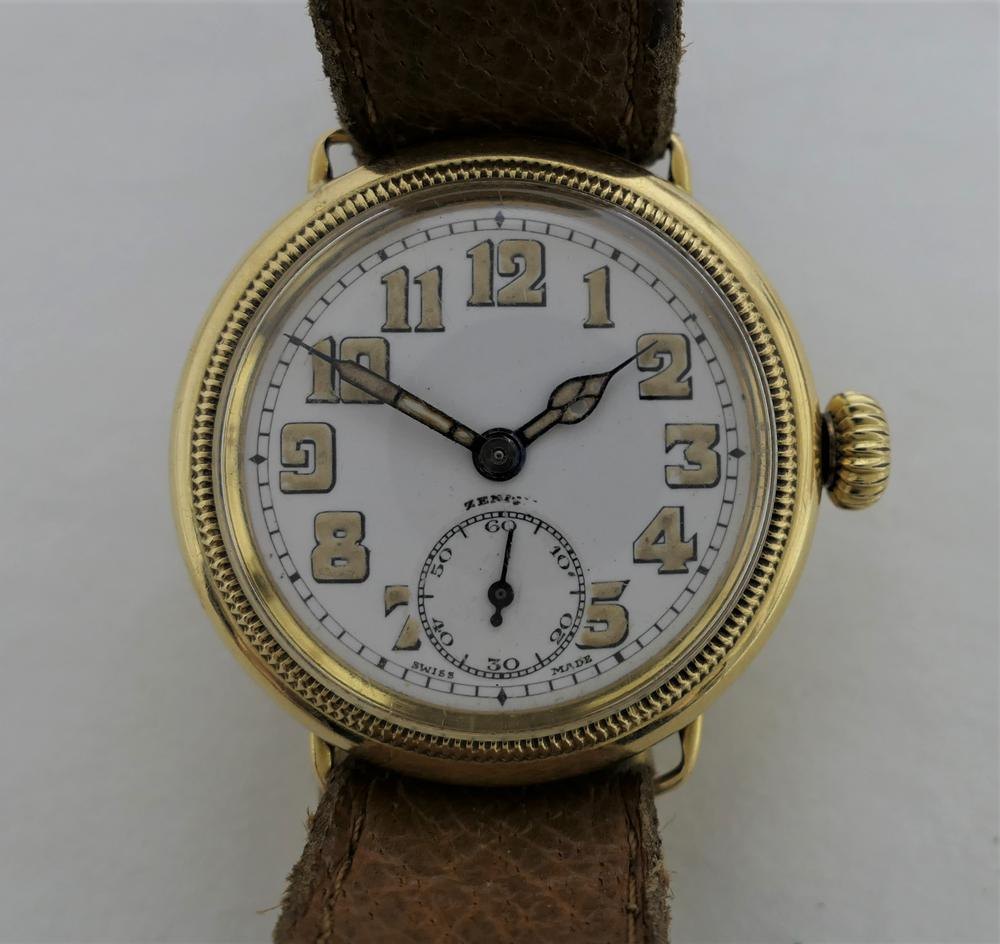
Gold cased wristwatch with brown leather strap
- Maker / attribution
- Dennison Watch Case Company (Case made by); Zenith Watch Company (Movement made by)
- Date
- 1929 (case hallmark)
- Historical period
- Golden Age of Mechanical Watchmaking (1900 – 1945)
- Country of origin
- British Isles
- Place
- Birmingham (West Midlands), Switzerland
- Object type
- Wrist-watch
- Materials / technique
- gold, radium, leather, enamel, steel, brass
- Dimensions
- Diameter: 30.50 millimetres (case exc. crown) Width: 34 millimetres (case inc. crown) Depth: 10 millimetres (case)
- Holding institution
- British Museum
- Accession / object no.
- 2021,8015.1
- Credit line
- British Museum, London
- Catalogue title (original)
- Gold cased wristwatch with brown leather strap (English)
View the source record ↗ (opens another website in a new tab)Suggest a correction
Record summary
Held and catalogued by British Museum (object number 2021,8015.1), this is a wrist-watch by Dennison Watch Case Company, made in Birmingham (West Midlands), Switzerland, British Isles, dated 1929 (case hallmark). The Atlas places it in the Golden Age of Mechanical Watchmaking period (1900 – 1945) of its Wristwatches collection. Materials and techniques recorded by the source: gold, radium, leather, enamel, steel, brass. Recorded dimensions: Diameter: 30.50 millimetres (case exc. crown) Width: 34 millimetres (case inc. crown) Depth: 10 millimetres (case). The record is illustrated with 6 photographs.
Assembled from the source record's structured fields. Dates and attributions are given as the source states them; where a field is missing the Atlas leaves it blank rather than estimating.
Catalogue description
Description — British Museum
Gold cased wristwatch with brown leather strap Case 18 carat gold case with screwed bezel opening to reveal dial and movement in white metal holder hinged in case. Dial White enamel dial with outer minute track, diamond quarter hour markers and block 5 minute markers. Arabic hour humerals (1-5, 7-12) with radium paint. Subsidiary seconds dial at 6 o'clock position with Arabic numerals (10-60). Poire squelette hour and minute hands with radium paint, black seconds hand. Movement 17 jewel hand-wound movement with club-tooth lever escapement.
Curator's comments — British Museum
This watch was the wristwatch owned and worn by noted horological collector Courtenay Adrian Ilbert, whose collection now resides at the British Museum. It is likely (based on the Ledger number Ilbert gave it in his records) that it was purchased c1931. The position of the makers name 'Zenith' on the dial is unsusual, this being more commonly found below the 12 and above the hand arbor. The letters are partly worn away, indicating it was painted on and not part of the enamel.
Inscriptions & marks
inscription; dial; ZENITH; SWISS MADE; inscription; Inside case back; DENNISON; A.L.D; 471159; hallmark; Inside case back; crown; 18; anchor E; 18 carat gold, Birmingham, 1929; inscription; movement holder; 1; 5; 9; inscription; movement; ZENITH; 17 JEWELS; 2955329; SWISS MADE
Provenance
Previous owner/ex-collection:, Courtenay Adrian Ilbert, (Ilberts personal wristwatch); Bequeathed by:, Charlotte Amanda Jane Inchbald
Historical context
Golden Age of Mechanical Watchmaking (1900 – 1945)
The wristwatch displaces the pocket watch; waterproof cases, self-winding and grand complications.
The wristwatch overtook the pocket watch. Military use in the First World War, aviation, water-resistant cases (1926), automatic winding (1923–31), rectangular Art Deco designs and early chronographs and calendars defined the period.
Read the period in the timelineMore wristwatches from this periodEarlier: Industrial Revolution
Atlas type guide
Wristwatches
Bracelet watches were worn by women from the early nineteenth century — Breguet made one for Caroline Murat, Queen of Naples, in 1810–12 — but the wristwatch only became a man's instrument with military use and aviation in the early twentieth century. Between the World Wars it overtook the pocket watch; the 1920s and 1930s brought rectangular Art Deco cases, water-resistant cases and the first automatic winding systems.
After 1945 the wristwatch became a carrier of identity — dress watches, sports and dive watches, chronographs, calendars — produced by Swiss, American, Japanese, German, Soviet and Chinese industries. The quartz revolution after 1969 and the mechanical renaissance since the 1990s, including the rise of independent watchmakers, complete the story.
What to look for
- The reference number (between the lugs or inside the case back) and serial number, the starting point for dating.
- The calibre: its maker and number are often stamped under the dial or on the bridge.
- Originality of dial, hands and crown — refinished ('redial') dials are common.
- Case material marks: 18K/750, 14K/585, stainless steel, gold-filled, plated.
Dating clues
- Wire-lug cases: before c. 1925.
- Water-resistant screw-down cases: from 1926.
- Quartz movements: from 1969; sapphire crystals widespread after c. 1980.
General guidance written by the Atlas editors about this kind of object. It is not a statement about this particular piece; for that, rely on the source record above and on physical examination.
Read next:Identification Centre
Related records
Wristwatches · 1928 (case)
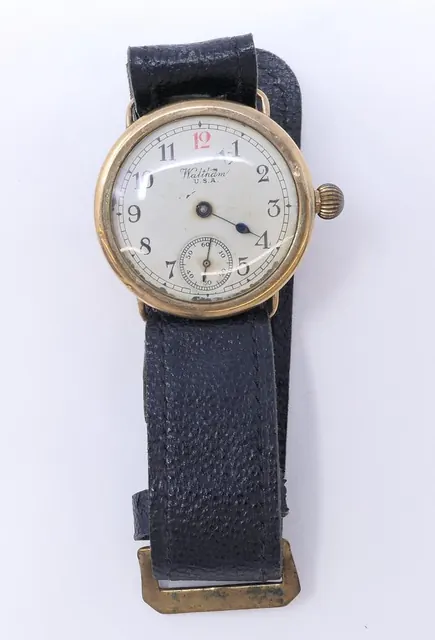
Club-tooth lever wrist-watch in a gold case with black leather strap
British Museum
Wristwatches · 1900–1999
Wristwatch by Mercury, 1900–1999
Modemuseum Hasselt
Wristwatches · 1900–1999
Wristwatch by Nutrix, 1900–1999
Modemuseum Hasselt

Wristwatches · 1920
Wristwatch, 1920
Modemuseum Hasselt

Wristwatches · 1931
Rolex 'Oyster Perpetual' rotor self-winding wrist-watch, lever escapement, in steel case with glass in back, Montres Rolex SA, Geneva, Switzerland, 1931
Science Museum Group, London
Wristwatches · c. 1936
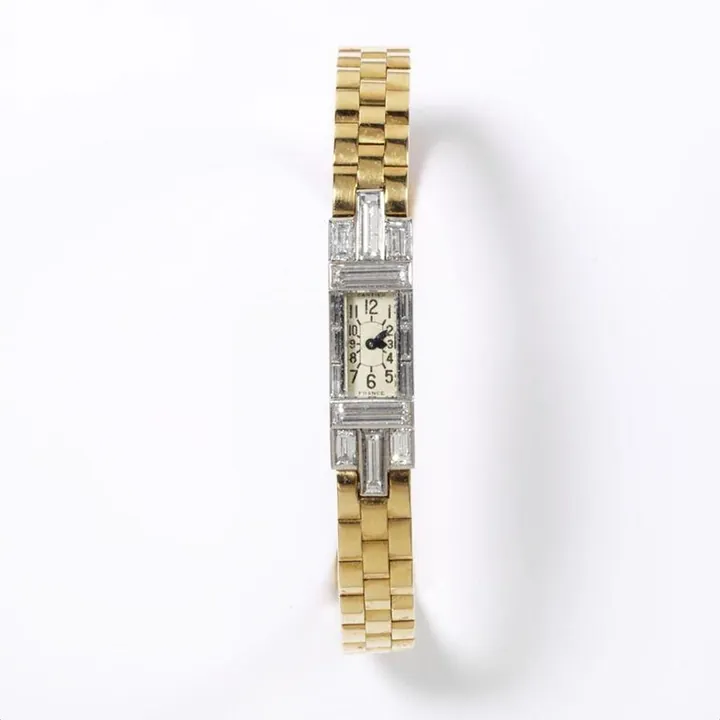
Watch with diamond-set platinum case and gold link bracelet, Cartier, Paris, c. 1936.
Victoria and Albert Museum, London
Wristwatches · early to mid 20th century
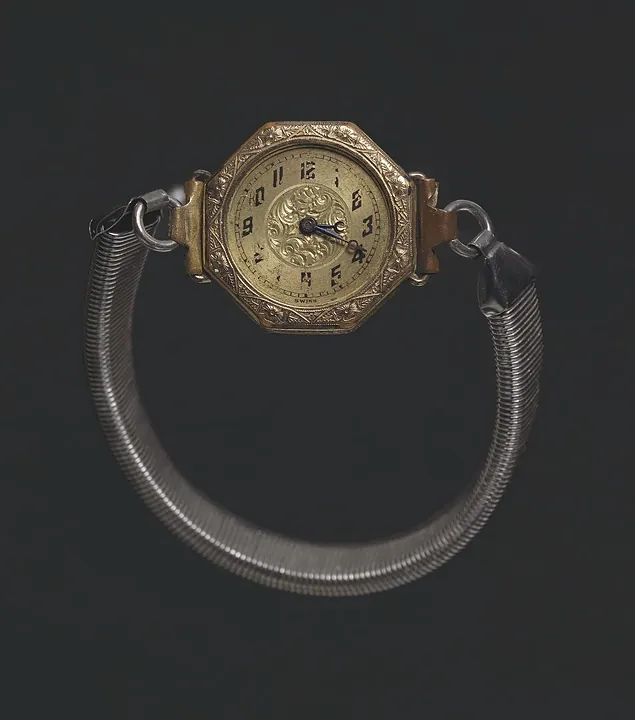
Woman's wristwatch worn by Harriette Vyda Simms Moore, early to mid 20th century
National Museum of African American History and Culture, Smithsonian Institution, Washington DC

Wristwatches · 1900–1999
Wristwatch by Certina, Switzerland, 1900–1999
Nordic Museum Foundation