
Pocket Watches · Pocket watch
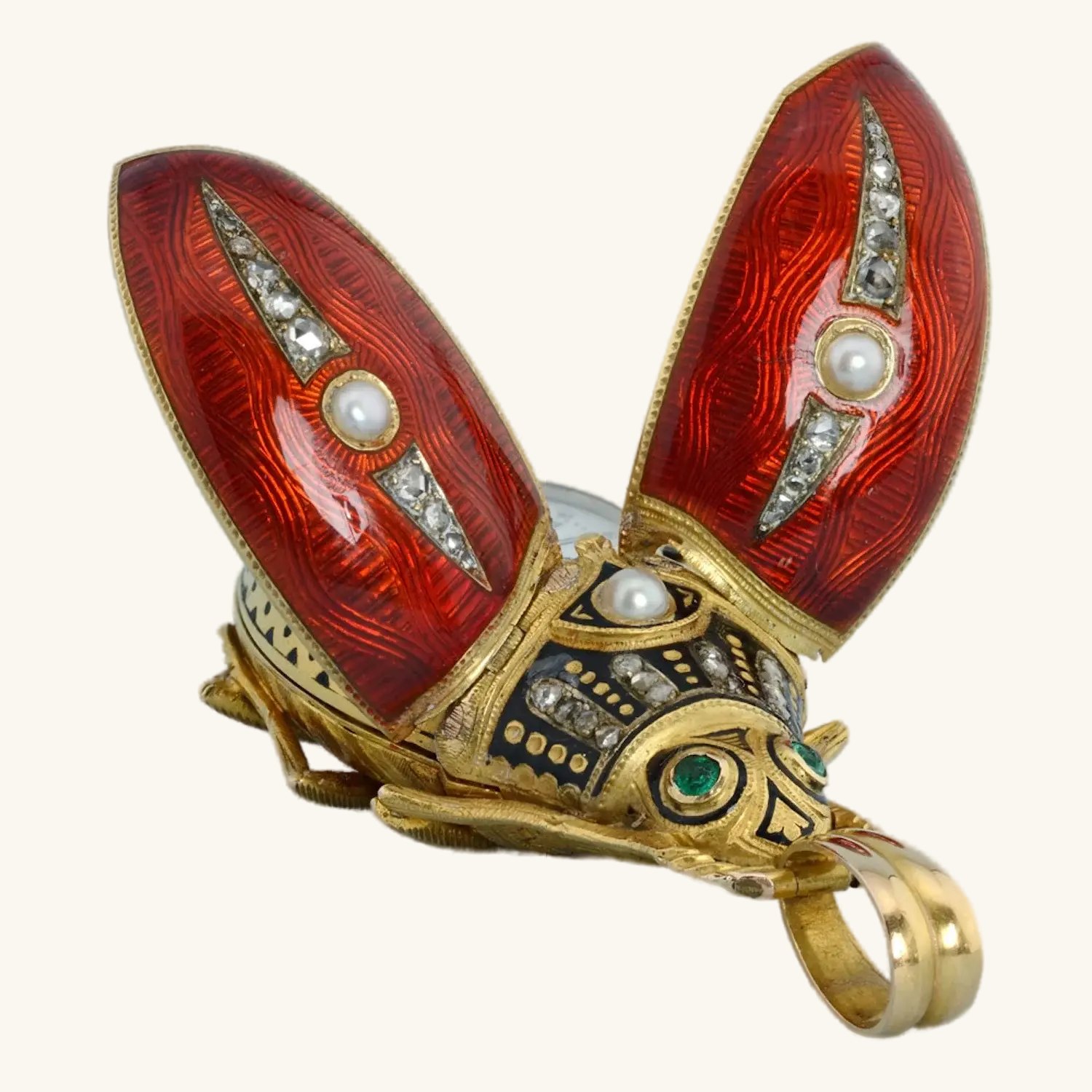
Gold and Enamel Beetle Form Watch, 1880
- Maker / attribution
- Unrecorded in source
- Date
- 1880
- Historical period
- Industrial Revolution (1850 – 1900)
- Country of origin
- Unrecorded in source
- Object type
- Pocket watch
- Materials / technique
- gold, enamel
- Dealer
- WatchMuseum.org shop
- Stock no.
- Product 1381
- Credit line
- Dealer listing, WatchMuseum.org shop (product 1381)
- Catalogue title (original)
- Gold and Enamel Beetle Form Watch (English)
View the source record (dealer listing) ↗ (opens another website in a new tab)Suggest a correction
Record summary
Catalogued by WatchMuseum.org shop (stock number Product 1381), this is a pocket watch, dated 1880. The Atlas places it in the Industrial Revolution period (1850 – 1900) of its Pocket Watches collection. Materials and techniques recorded by the source: gold, enamel. The record is illustrated with 6 photographs.
Assembled from the source record's structured fields. Dates and attributions are given as the source states them; where a field is missing the Atlas leaves it blank rather than estimating.
Catalogue description
Dealer description — WatchMuseum.org shop
Step back in time with the exquisite “Gold and Enamel Beetle Form Watch - 1880,” a stunning testament to the craftsmanship of late 19th Century Swiss watchmaking. This brooch watch is not merely a timepiece but a work of art, meticulously designed in the shape of a beetle. The heart-shaped keywind mechanism features a gilt bar movement, polished steel cylinder, and a steel escape wheel, all complementing the small white enamel dial adorned with Roman and Arabic numerals. The three-arm gilt balance, blue steel spiral hairspring, and polished steel regulator enhance its precision and elegance. Encased in fine gold and enamel, the beetle’s wings, set with diamonds and pearls, unveil the watch’s dial with a simple press of a button located in the tail. The beetle’s head is intricately chased and engraved with champlevé black enamel, while its eyes gleam with green stones. The underside is equally captivating, with finely chased and engraved legs applied to the hinged cover, adding to its lifelike appearance. In excellent overall condition, this brooch watch also features an oval gold loop for a chain, making it a versatile addition to any collection. A similar piece is showcased in color plate 30 of “The Technique and History of the Swiss Watch,” underscoring its historical and aesthetic significance. Crafted anonymously in Switzerland around 1880, this watch measures 28 x 51 x 17 mm and is a high-quality, attractive piece that embodies the elegance and ingenuity of its era. This is a beautiful and intricately designed late 19th Century Swiss brooch watch in the shape of a beetle. The watch has a heart-shaped keywind with a gilt bar movement, a polished steel cylinder, a steel escape wheel, and a small white enamel dial with Roman and Arabic numerals. The watch’s three-arm gilt balance has a blue steel spiral hairspring and a plain cock with a polished steel regulator. The beetle-shaped case is made of fine gold and enamel and features diamond and pearl-set translucent red enamel wings. The wings can be opened by pressing a button in the tail to reveal the watch’s dial. The head of the beetle is chased and engraved with champleve black enamel, and the eyes are represented by green stones. The underside of the beetle is realistically portrayed with finely chased and engraved legs that are applied to the hinged cover. This brooch watch is in excellent overall condition and comes with an oval gold loop for a chain. A similar watch can be found in colour plate 30 of The Technique and History of the Swiss Watch. Overall, this is a high-quality and attractive piece that would make a wonderful addition to any collection. Anonymous Swiss Circa 1880 Dimensions 28 x 51 x 17 mm Materials Enamel Gold
Historical context
Industrial Revolution (1850 – 1900)
American interchangeable-parts manufacture; railroad time standards; Swiss and German factory systems.
Machine production with interchangeable parts, pioneered by Waltham (1850s) and adopted by Elgin, Longines, Omega and others, made reliable lever watches widely affordable. Keyless winding became standard, railroad watch standards were introduced (1890s), and Swiss and American industries competed globally.
Read the period in the timelineMore pocket watches from this periodEarlier: Precision & Scientific Horology
Atlas type guide
Early spring-driven watches
Portable spring-driven timepieces appeared in southern Germany, France and Italy in the early sixteenth century; Peter Henlein of Nuremberg is traditionally credited, although the historical record is complex. These early watches were worn as pendants or carried, had iron or brass movements with a verge escapement and a foliot or small balance, and used a stackfreed or fusee to equalise spring force. They indicated hours only and were notoriously inaccurate.
From the later sixteenth century watches were made in Blois, Paris, Geneva, London and Augsburg in oval, octagonal, cruciform, skull and other 'form' cases of rock crystal, gilt brass, silver and enamel. They were jewellery and status objects as much as timekeepers.
What to look for
- A single hour hand and often a touch-pin hour ring for feeling the time.
- Stackfreed (a cam and spring) instead of a fusee on German watches.
- Pierced and engraved cocks over the balance, fine gut fusee lines.
- Rock-crystal, enamelled or engraved form cases.
Dating clues
- Drum-shaped German watches: c. 1530–1580.
- Oval and form watches: c. 1580–1650.
- Before c. 1675 there is no balance spring; watches can vary by many minutes a day.
General guidance written by the Atlas editors about this kind of object. It is not a statement about this particular piece; for that, rely on the source record above and on physical examination.
Related records
Pocket Watches · 1880
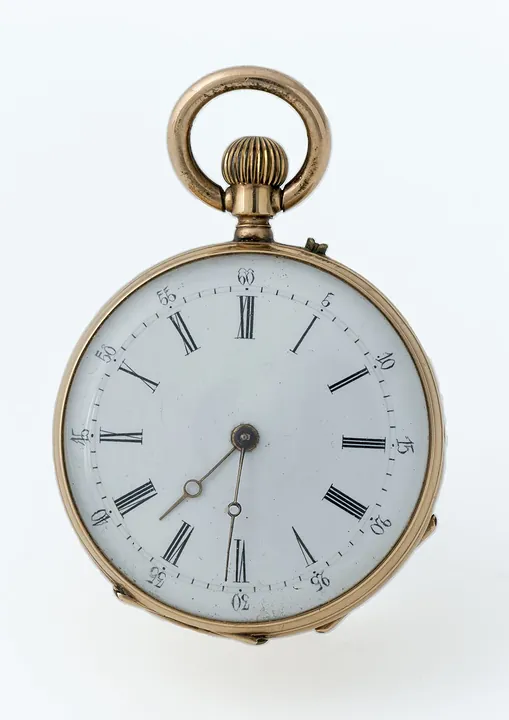
Pocket watch, 1880
Museum Rotterdam
Pocket Watches · mid 19th century
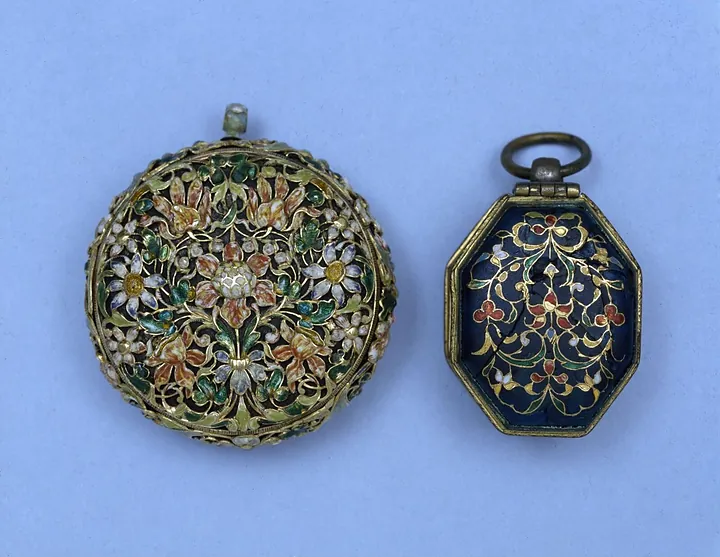
Watch, enamelled gilt brass of floral design, signed 'A Bloys.', France, in an early 17th century style but possibly mid 19th century
Victoria and Albert Museum, London
Pocket Watches · 1835–1875
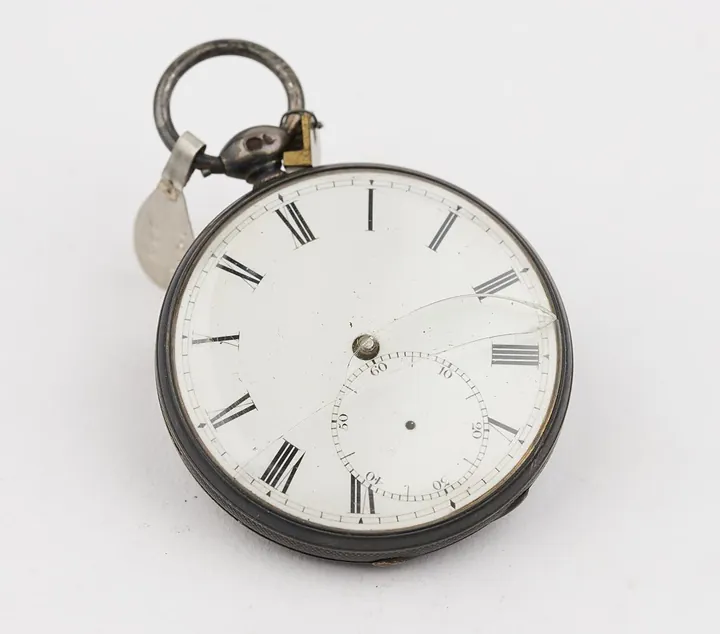
Pocket watch by Cornelius Brooks Holliday, England, 1835–1875
Science Museum Group, London
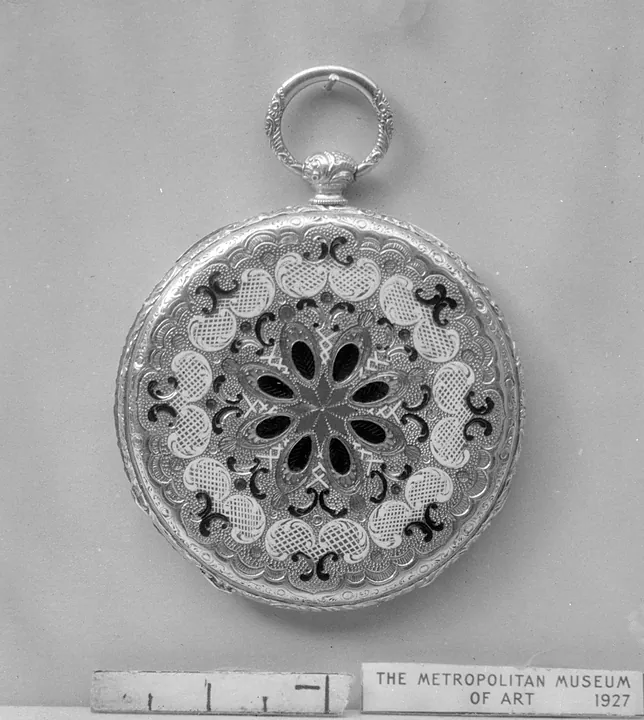
Pocket Watches · c. 1840–60
Watch by Callaud, c. 1840–60
The Metropolitan Museum of Art, New York
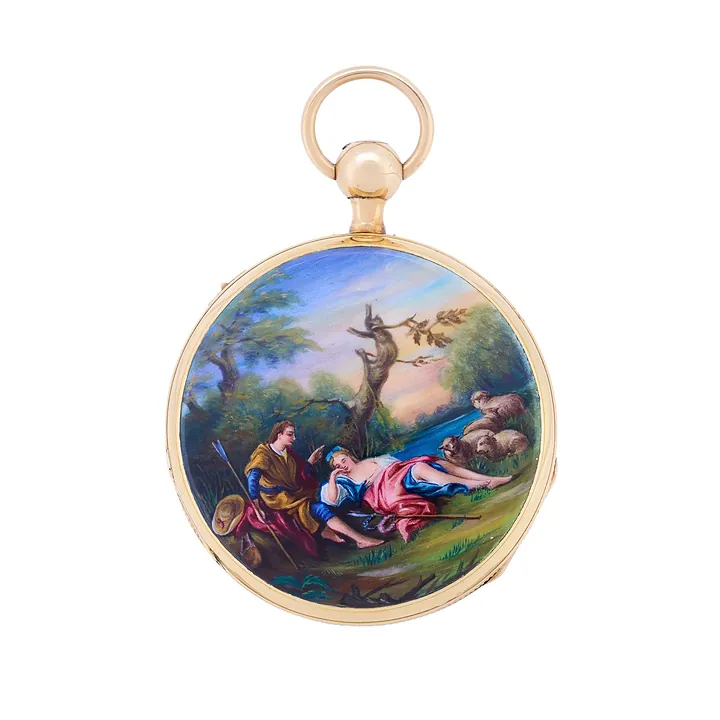
Pocket Watches · c. 1840-1860s
G.H. Berblinger pocket watch, c. 1840-1860s
Antiquorum auction archive, Geneva
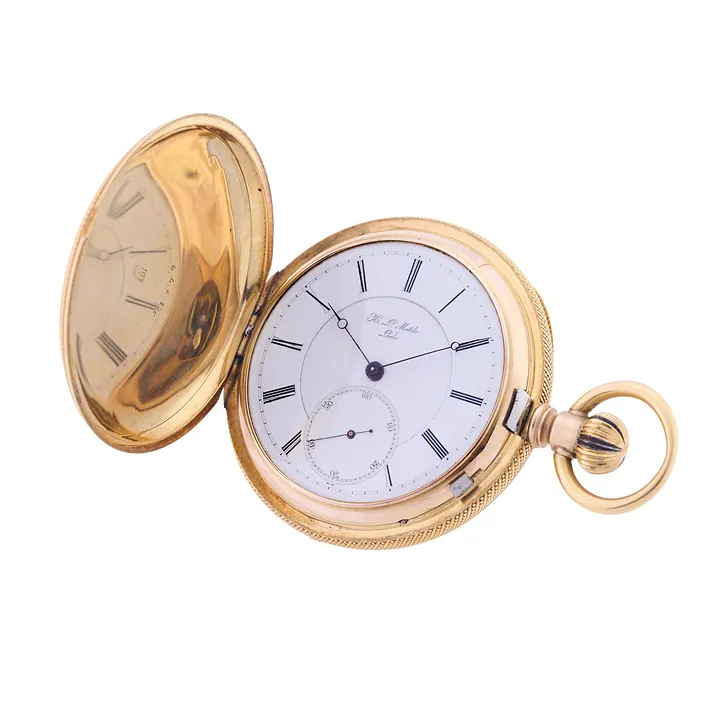
Pocket Watches · c. 1840-1860s
H.L Matile Locle pocket watch, c. 1840-1860s
Antiquorum auction archive, Geneva
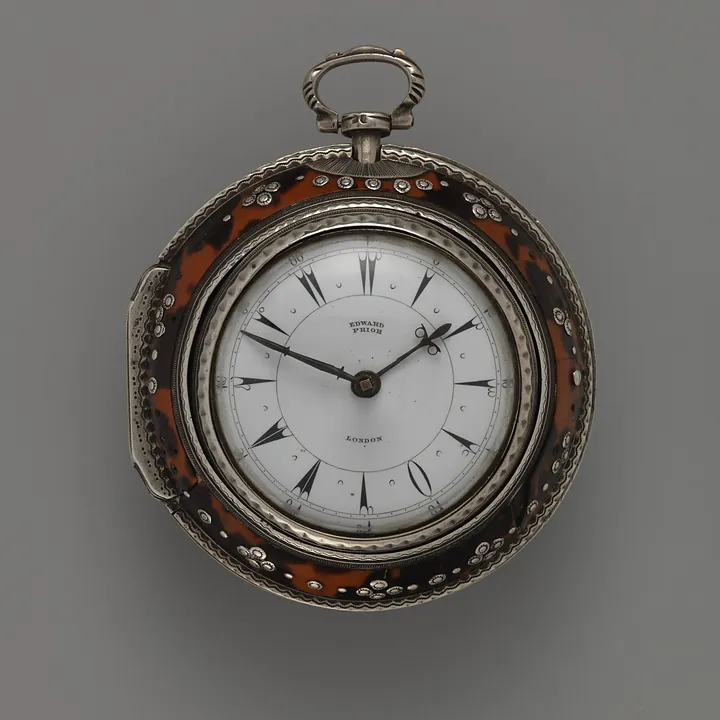
Pocket Watches · c. 1849–50
Watch by Edward Prior, England, c. 1849–50
The Metropolitan Museum of Art, New York
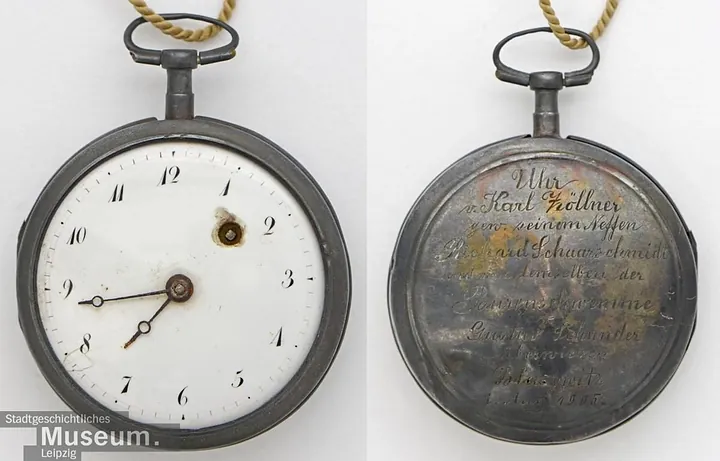
Pocket Watches · 1845–1855
Pocket watch, 1845–1855
Museum of City History Leipzig