
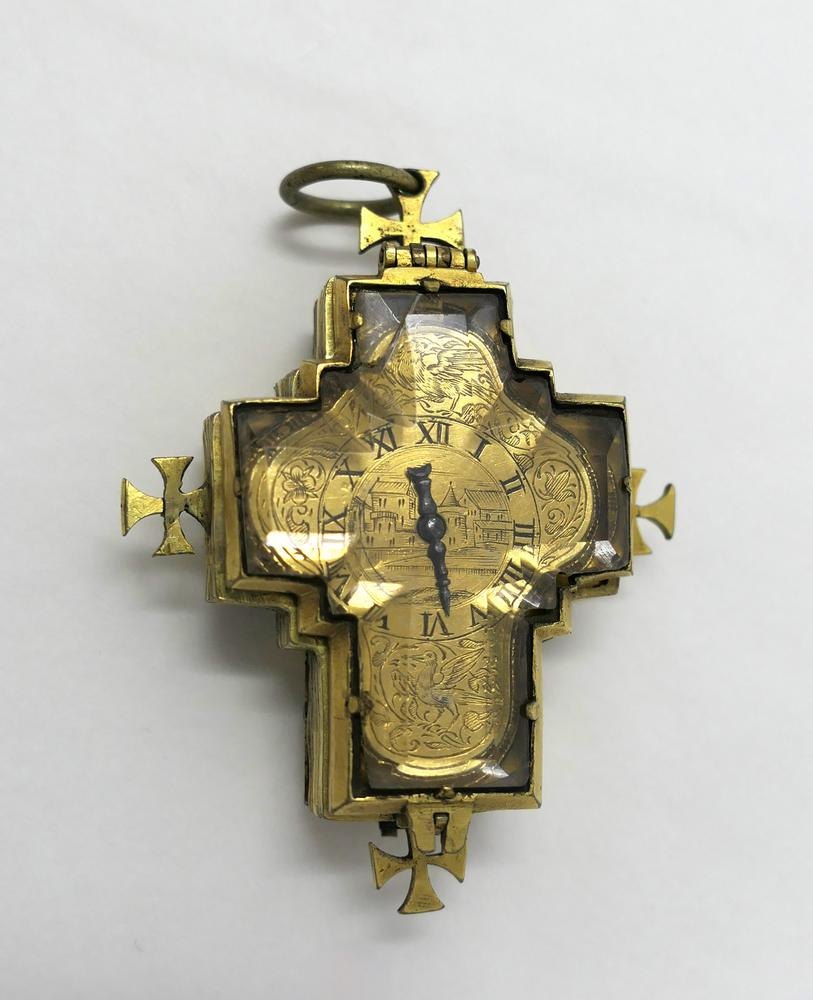
Pocket Watches · Cruciform watch
Gilt-brass and rock crystal cased verge watch in the form of a crucifix
- Maker / attribution
- Carl Schmidt (possibly) (Claimed to be by)
- Date
- 1630–1640
- Historical period
- Early Modern Horology (1600 – 1750)
- Country of origin
- Germany
- Place
- Augsburg (possibly)
- Object type
- Cruciform watch
- Materials / technique
- brass, gold, rock crystal
- Dimensions
- Length: 66.20 millimetres (case overall) Width: 49.50 millimetres (case)
- Holding institution
- British Museum
- Accession / object no.
- 1958,1201.3072
- Credit line
- British Museum, London
- Catalogue title (original)
- Gilt-brass and rock crystal cased verge watch in the form of a crucifix (English)
View the source record ↗ (opens another website in a new tab)Suggest a correction
Record summary
Held and catalogued by British Museum (object number 1958,1201.3072), this is a cruciform watch by Carl Schmidt (possibly), made in Augsburg (possibly), Germany, dated 1630–1640. The Atlas places it in the Early Modern Horology period (1600 – 1750) of its Pocket Watches collection. Materials and techniques recorded by the source: brass, gold, rock crystal. Recorded dimensions: Length: 66.20 millimetres (case overall) Width: 49.50 millimetres (case). The record is illustrated with 4 photographs.
Assembled from the source record's structured fields. Dates and attributions are given as the source states them; where a field is missing the Atlas leaves it blank rather than estimating.
Catalogue description
Description — British Museum
Movement frame: Cruciform plates, the corners rounded, with four baluster pillars. Riveted potence and riveted counter-potence. The potence plate engraved with flowers around the regulation index and a label containing the signature. A recess in the pillar-plate with a separate screwed-on bridge. Mainspring barrel: Gilt-brass barrel with upper and lower flange, dovetailed cap and rectangular hole for the mainspring hook. The ratchet and click set-up is modern. Fusee & stop-work: Gilt-brass fusee for gut line and with standard stop-work. Train: Four wheel train, the third and contrate wheels replaced. Escapement & balance: Verge escapement with all the components replaced. Pinned-on balance-cock, pierced and engraved with foliate scrolls. Engraved on the potence-plate is a scale for a hog's bristle regulator which now has a modern steel arm with a steel pin. Motion work/duration: Pinion of report replaced now has 10 . Dial wheel: 30 Fusee: 6.5 Duration : 25.6 hours. : DIAL: Cruciform gilt-brass dial with rounded corners. The edge of the dial is bevelled and is engraved with a beaded decoration. Engraved around the outside with foliate scrolls and birds. Engraved chapter-ring with Roman hours I-XII within two circles. In the centre an engraved townscape. The dial is very thick with a deep recess for the dial wheel. Blued-steel hand. : CASE: Undecorated gilt-brass case in the form of a quadrate cross with a small maltese cross at the end of each limb. Moulded band with hinges for the lid and bezel which contain rock crystals with bevelled edges. Pendant in the form of a maltese cross with a loose ring. On the inside of the upper band is a gilt-brass screen which changes the shape from the quadrate form of the case to the latin cross with rounded corners of the dial and movement. : Possibly fake.
Curator's comments — British Museum
This watch is something of a puzzle. On the one hand the movement shows elements which could well be of 17th century date. The dial on the other hand appears to be modern. It is not logical to have a cruciform case matched with a dial engraved with secular subjects. The engraved decoration is also in a style more likely to be modern. It is also illogical to have a quadrate cross case with the rounded latin cross dial and movement. It is possible that the watch represents a 20th century marriage of a 17th century case to a 17th century movement, poorly restored and attached to the case by the fitting of a new dial and an inset panel in the case to support it. The dial does not fit down in the case but is raised above it by the closing lugs at the bottom which overlap the case band.
Inscriptions & marks
signature; Carl Schmidt [potence-plate]
Provenance
Previous owner/ex-collection:, Courtenay Adrian Ilbert; Purchased through:, Christie's; Acquired 1958
Historical context
Early Modern Horology (1600 – 1750)
Huygens' pendulum and balance spring transform accuracy; English makers develop the anchor and deadbeat escapements.
The balance spring (c. 1675) improved watches dramatically and introduced the minute hand. English pair-cased verge watches with pierced balance cocks and French oignons were typical; enamel painting at Blois and Geneva, and the repeating watch (1680s), made watches objects of great refinement.
Read the period in the timelineMore pocket watches from this periodEarlier: Renaissance Horology
Atlas type guide
Early spring-driven watches
Portable spring-driven timepieces appeared in southern Germany, France and Italy in the early sixteenth century; Peter Henlein of Nuremberg is traditionally credited, although the historical record is complex. These early watches were worn as pendants or carried, had iron or brass movements with a verge escapement and a foliot or small balance, and used a stackfreed or fusee to equalise spring force. They indicated hours only and were notoriously inaccurate.
From the later sixteenth century watches were made in Blois, Paris, Geneva, London and Augsburg in oval, octagonal, cruciform, skull and other 'form' cases of rock crystal, gilt brass, silver and enamel. They were jewellery and status objects as much as timekeepers.
What to look for
- A single hour hand and often a touch-pin hour ring for feeling the time.
- Stackfreed (a cam and spring) instead of a fusee on German watches.
- Pierced and engraved cocks over the balance, fine gut fusee lines.
- Rock-crystal, enamelled or engraved form cases.
Dating clues
- Drum-shaped German watches: c. 1530–1580.
- Oval and form watches: c. 1580–1650.
- Before c. 1675 there is no balance spring; watches can vary by many minutes a day.
General guidance written by the Atlas editors about this kind of object. It is not a statement about this particular piece; for that, rely on the source record above and on physical examination.
Read next:FoliotThe Melanchthon watch
Related records
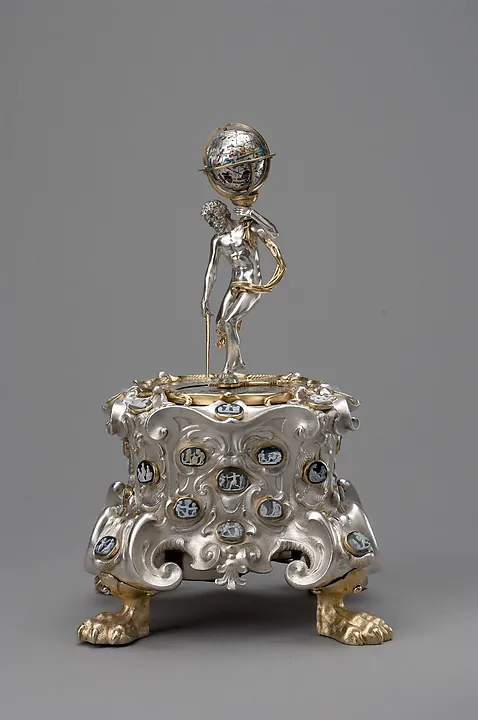
Pocket Watches · 1600–1699
Pocket watch by Georg Ernst, Germany, 1600–1699
Fine Arts Museum Vienna
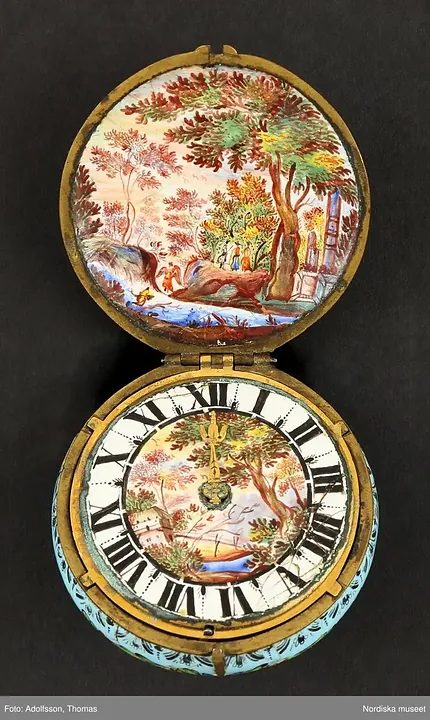
Pocket Watches · 1600–1699
Pocket watch by Johan Etmiller, Germany, 1600–1699
Nordic Museum Foundation
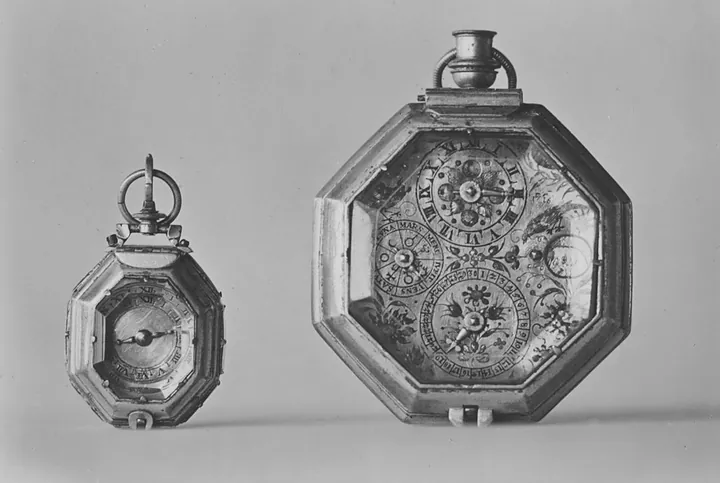
Pocket Watches · early 17th century
Watch with gilt brass case, crystal and blue glass panels signed 'Conradt Kreizer', Germany, early 17th century
Victoria and Albert Museum, London
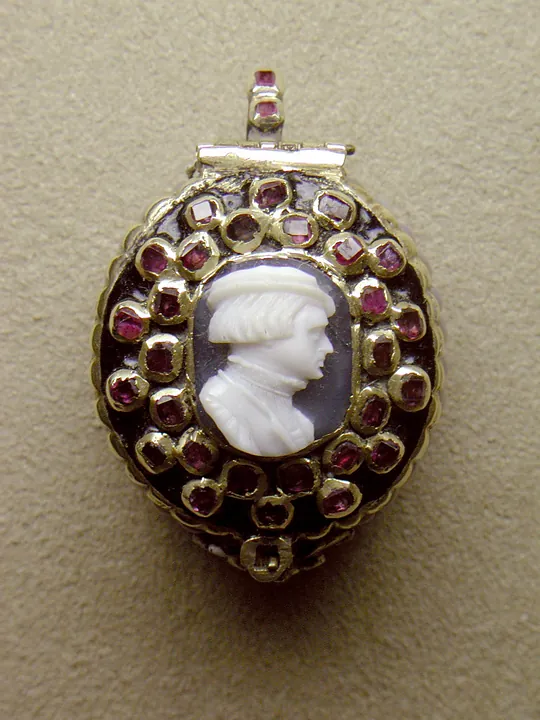
Pocket Watches · watch c. 1650, cameo 16th–17th century
Watch by Wilhelm Peffenhauser, Germany, watch c. 1650, cameo 16th–17th century
The Metropolitan Museum of Art, New York
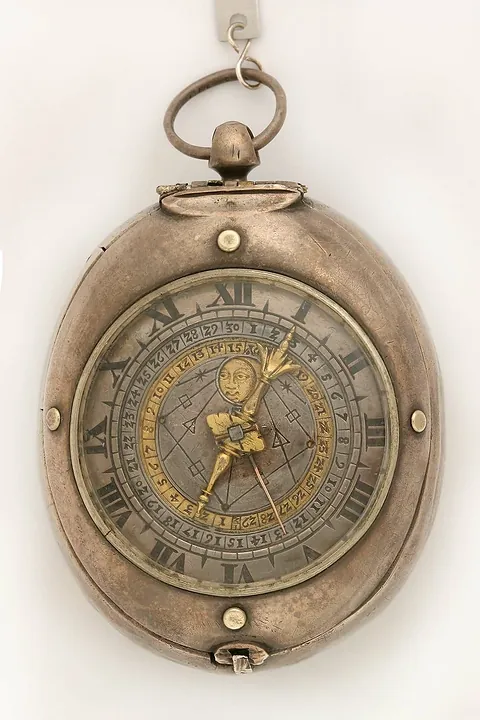
Pocket Watches · c. 1650
Pocket watch by Johann Sayller, Germany, c. 1650
German Clock Museum
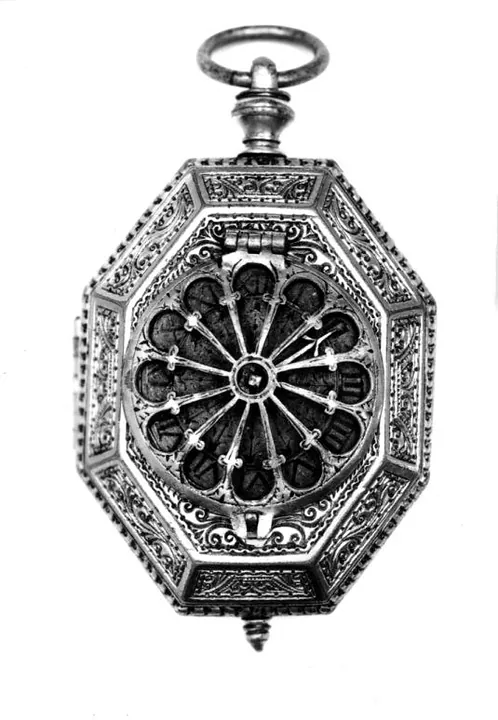
Pocket Watches · 1650–1699
Pocket watch, Germany, 1650–1699
Badisches Landesmuseum Karlsruhe
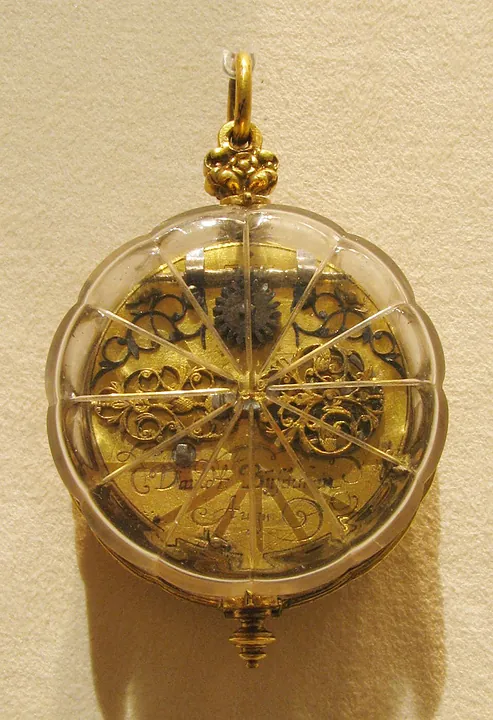
Pocket Watches · probably after 1657
Watch by David Buschman, Germany, probably after 1657
The Metropolitan Museum of Art, New York
Pocket Watches · c. 1670
Watch by Nicolaus Rugendas the Younger, Germany, c. 1670
The Metropolitan Museum of Art, New York