
Wristwatches · Wristwatch
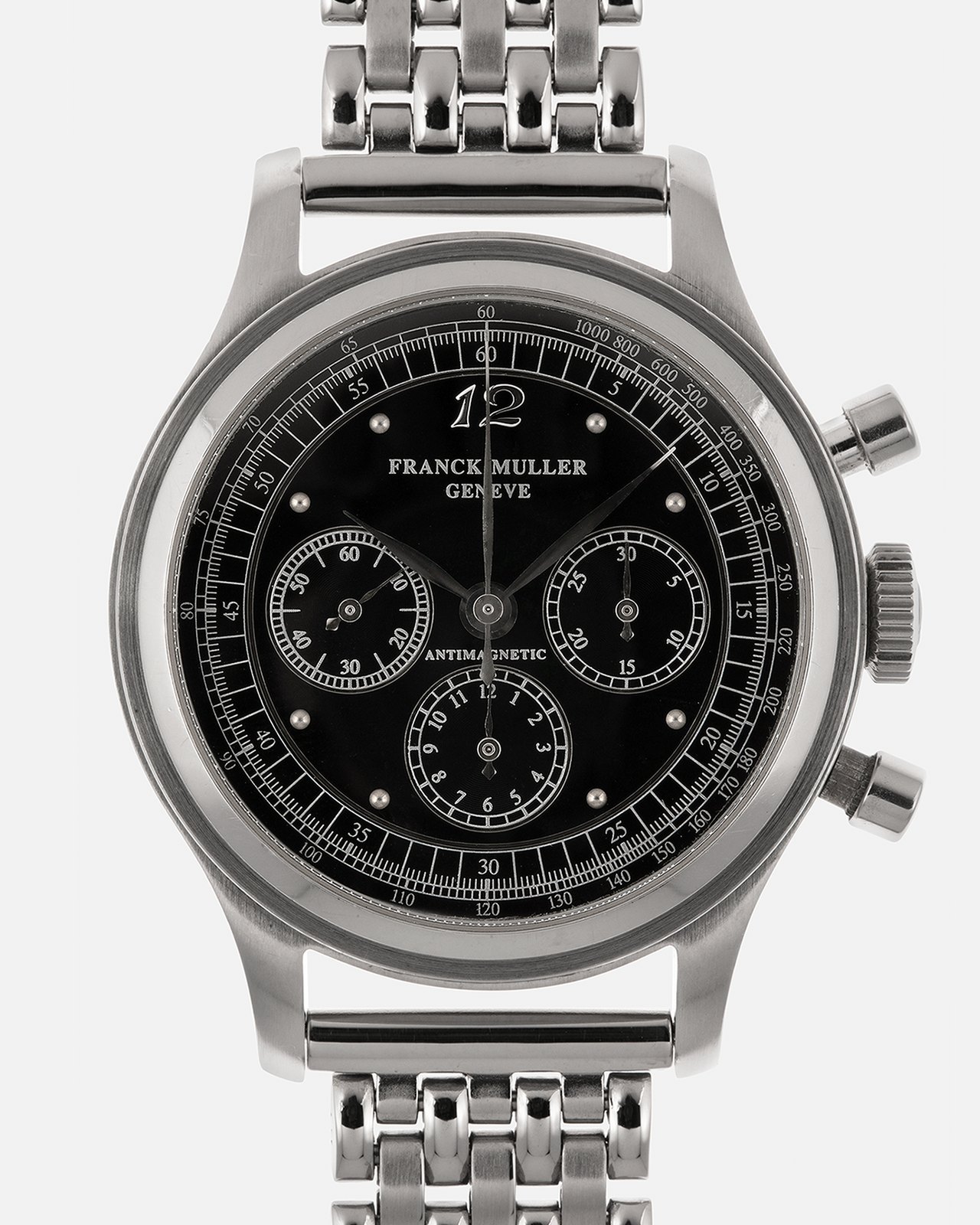
Franck Muller Sport Limited Edition Chronograph, 1990s
- Maker / attribution
- Franck Muller (maker)
- Date
- 1990s
- Historical period
- Mechanical Renaissance (1990 – 2010)
- Country of origin
- Switzerland
- Object type
- Wristwatch
- Dimensions
- Case 37 mm
- Stock no.
- Product 7665822859351
- Credit line
- Dealer listing, S.Song Watches (product 7665822859351)
- Catalogue title (original)
- Franck Muller Sport Limited Edition Chronograph (English)
View the source record (dealer listing) ↗ (opens another website in a new tab)Suggest a correction
Record summary
Catalogued by S.Song Watches (dealer), Seattle (stock number Product 7665822859351), this is a wristwatch by Franck Muller, made in Switzerland, dated 1990s. The Atlas places it in the Mechanical Renaissance period (1990 – 2010) of its Wristwatches collection. Recorded dimensions: Case 37 mm. The record is illustrated with 6 photographs.
Assembled from the source record's structured fields. Dates and attributions are given as the source states them; where a field is missing the Atlas leaves it blank rather than estimating.
Catalogue description
Dealer description — S.Song Watches
This is not a watch I expected to enjoy as much as I did. Truthfully, I approached it with fairly low expectations, largely because modern Franck Muller as a brand feels far removed from what it once represented. Like many influential independent watchmakers of the 1990s, Franck Muller eventually lost control of the company he built, and with that came a gradual shift away from the character and originality that made the brand so important in the first place. Co-founded in 1991 by Franck Muller and Vartan Sirmakes, the self-proclaimed “Master of Complications” quickly became one of the biggest names in watchmaking. Muller became known for his distinctive and often eccentric designs, from exploding numerals to expressive tonneau-shaped cases. Love them or hate them, these watches stood out immediately. The brand became a favourite among celebrities and collectors alike. At a time when the Swiss watch industry was still recovering from the quartz crisis, Franck Muller also played an important role in restoring excitement to mechanical watchmaking. Beyond the flamboyant image, Franck Muller himself was an accomplished watchmaker. Before founding his eponymous brand, he became respected for restoring historically important pieces for Patek Philippe, an experience that clearly shaped his understanding of vintage watch design and classical proportions. That being said, while the brand’s more extravagant creations dominate public perception today, they also obscure a very different side of Franck Muller’s early work. What you see here is one of the earliest Franck Muller models produced: the Sport Limited Edition. Released in a run of just 50 pieces, this example features a far more classical 37mm round case. In photographs, it can appear like a fairly standard chronograph, but in person, the watch is strikingly reminiscent of mid-century chronographs from the 1940s and 1950s. The stainless steel stepped case, long lugs, pump pushers, and screw-down case back all reinforce that impression. More than anything, the design feels heavily informed by Muller’s years handling vintage Patek Philippe chronographs during his restoration work. The glossy black dial reinforces that vintage character beautifully. Its silver printed multi-scale chapter ring, Breguet numerals, and restrained monochromatic palette strongly recall gilt dial chronographs from the mid-20th century. Unlike the loud and highly stylised Franck Muller pieces most people associate with the brand today, this watch appears refined, measured, and surprisingly understated. On the wrist, the watch wears exceptionally well. The proportions are thoughtful, the stepped case adds depth without visual excess, and the overall design reveals a level of nuance that is difficult to appreciate through photographs alone. With only 50 examples produced, these rarely surface on the market. As collectors continue to rediscover high-quality independent and neo-vintage watches from the 1990s, pieces like this are finally beginning to receive the attention they deserve: not as novelty Franck Mullers, but as genuinely well-considered chronographs from one of the era’s most important independent watchmakers.
Historical context
Mechanical Renaissance (1990 – 2010)
Mechanical watches return as cultural objects; independent watchmaking flourishes.
Mechanical watches returned as cultural and luxury objects. Complications, tourbillons and new materials proliferated; independent watchmakers such as George Daniels, F.P. Journe and Philippe Dufour revived artisanal watchmaking; collecting vintage watches became a major field.
Read the period in the timelineMore wristwatches from this periodEarlier: Quartz Revolution
Atlas type guide
Chronographs and split-seconds watches
A chronograph is a watch with an additional seconds hand that can be started, stopped and returned to zero independently of the timekeeping. Louis Moinet built an early example in 1816 and Nicolas Rieussec a recording 'chronographe' in 1821; Adolphe Nicole's heart-shaped reset cam (patented 1862) made the modern return-to-zero possible. Split-seconds (rattrapante) chronographs add a second hand that can be stopped for intermediate times; flyback chronographs restart instantly.
Chronographs were essential tools for doctors (pulsometer scales), artillery (telemeter), engineers and sport. In wristwatches, Valjoux, Venus, Lemania and later the automatic chronographs of 1969 (Zenith El Primero, the Chronomatic Calibre 11 group and Seiko 6139) are milestones.
What to look for
- Push-pieces on the case band or a single button in the crown (monopusher).
- Subsidiary registers for minutes and hours; tachymeter, telemeter or pulsometer scales.
- Column wheel versus cam control visible in the movement.
- Calibre markings of specialist makers (Valjoux, Lemania, Venus, Landeron).
Dating clues
- Pocket chronographs with heart cam reset: after 1862.
- Wrist chronographs: from c. 1910; two-button designs from the 1930s.
- Automatic chronographs: from 1969.
General guidance written by the Atlas editors about this kind of object. It is not a statement about this particular piece; for that, rely on the source record above and on physical examination.
Read next:Flyback chronographChronograph
Related records
Wristwatches · c. 1996-99
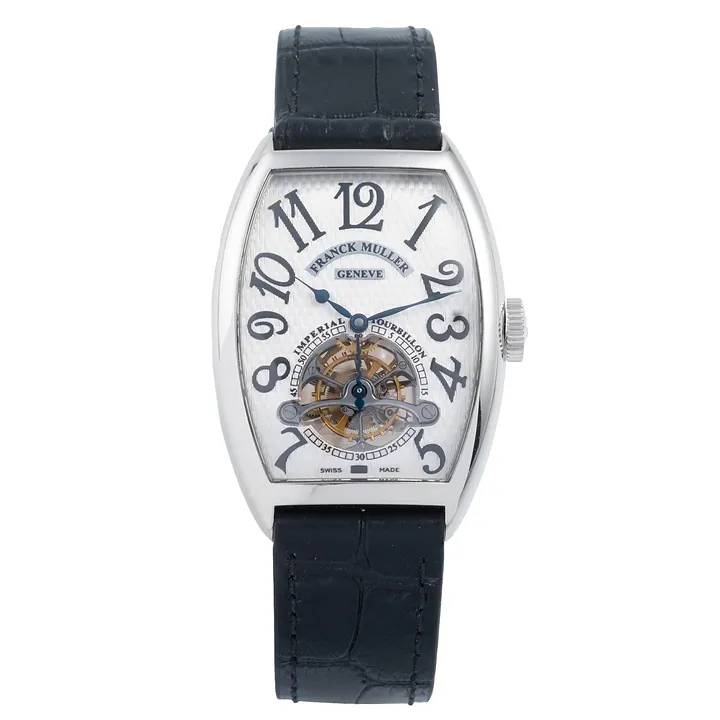
Franck Muller Imperial Tourbillon, ref. 5850T, c. 1996-99
Antiquorum auction archive, Geneva
Wristwatches · c. 2005
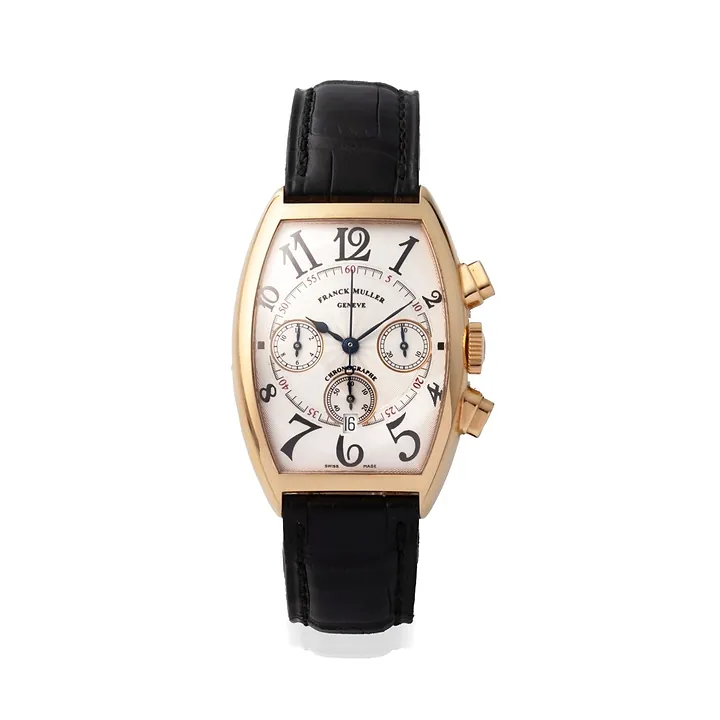
Franck Muller Casablanca Chronograph, ref. 5850 CC AT, c. 2005
Antiquorum auction archive, Geneva
Wristwatches · c. 2010-2020
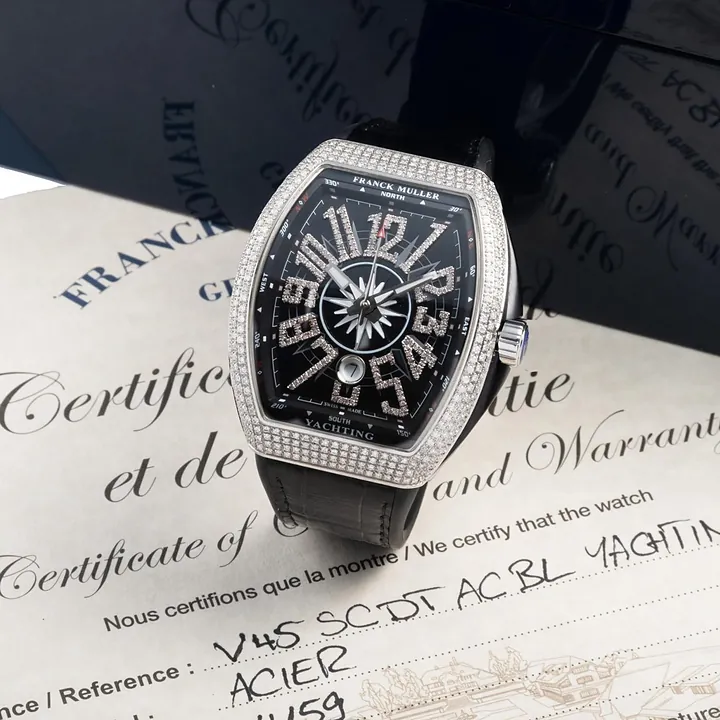
Franck Muller Vanguard Yachting, ref. V45SCDT, c. 2010-2020
Antiquorum auction archive, Geneva
Wristwatches · Sold in August 2016
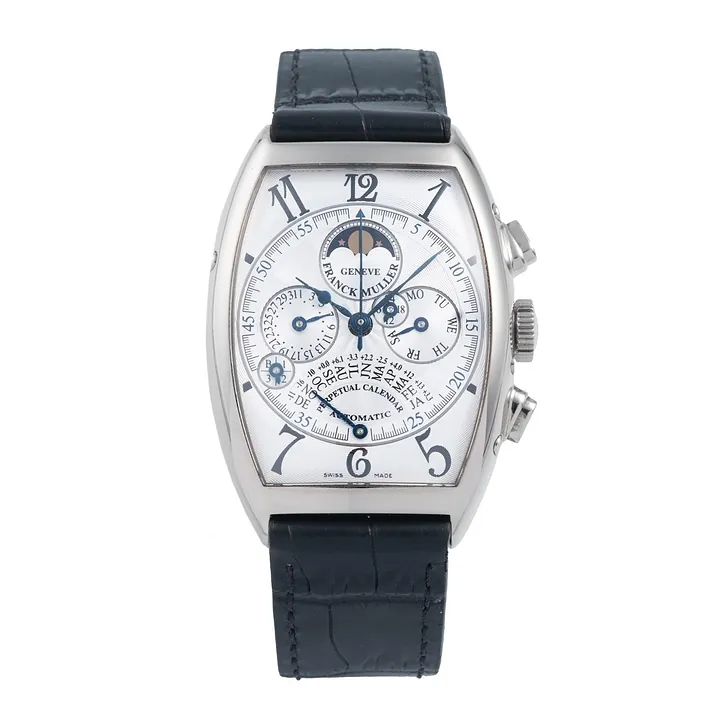
Franck Muller wristwatch, ref. 6850 QPE, Sold in August 2016
Antiquorum auction archive, Geneva

Wristwatches · 2008
Wristwatch by Breitling?, 2008
Museum Rotterdam

Wristwatches · c. 1990s
Audemars Piguet Bamboo, c. 1990s
Antiquorum auction archive, Geneva

Wristwatches · c. 1990
Audemars Piguet Huitieme Perpetual Calendar, ref. 25696PT, c. 1990
Antiquorum auction archive, Geneva

Wristwatches · c. 1990
Breitling Chronomat, ref. b13050.1, c. 1990
Antiquorum auction archive, Geneva