
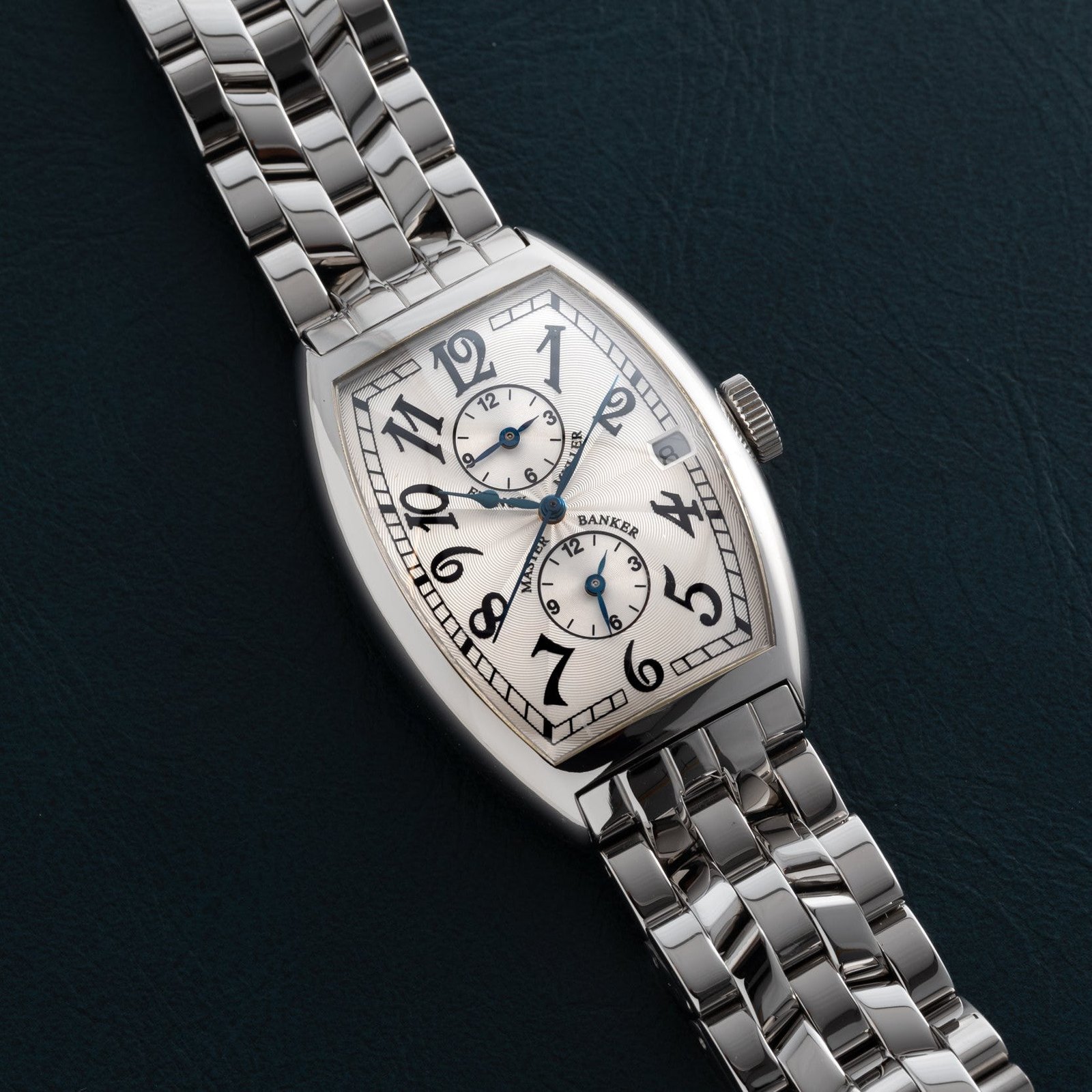
Wristwatches · Wristwatch
Franck Muller Master Banker, 1990s
- Maker / attribution
- Franck Muller (maker)
- Date
- 1990s
- Historical period
- Mechanical Renaissance (1990 – 2010)
- Country of origin
- Switzerland
- Object type
- Wristwatch
- Dimensions
- Case 32 mm
- Stock no.
- 40991555
- Credit line
- Dealer listing, Analog/Shift (40991555)
- Catalogue title (original)
- Franck Muller Master Banker (English)
View the source record (dealer listing) ↗ (opens another website in a new tab)Suggest a correction
Record summary
Catalogued by Analog/Shift (dealer), New York (stock number 40991555), this is a wristwatch by Franck Muller, made in Switzerland, dated 1990s. The Atlas places it in the Mechanical Renaissance period (1990 – 2010) of its Wristwatches collection. Recorded dimensions: Case 32 mm. The record is illustrated with 6 photographs.
Assembled from the source record's structured fields. Dates and attributions are given as the source states them; where a field is missing the Atlas leaves it blank rather than estimating.
Catalogue description
Dealer description — Analog/Shift
Franck Muller is a brand that doesn't get a lot of attention in today's steel sportwatch-centric consumer mindset. And we think that's a damn shame. Muller the man and Muller the brand have brought a lot to the world of modern horology, and his colorful, mid-1990s/early-2000s tonneau-shaped dress watch collection perfectly exhibits a design language that walks a fine line between classical and whimsical. The Master Banker line was designed ‘for businessmen who are constantly on the move,’ and as such, is a particularly useful dress watch that can display three separate time zones. This example, a Reference 5850 MB, dates to the 1990s and is housed in a 32mm x 44mm stainless steel Tonneau case with a sapphire crystal and a signed crown. It features a silver guilloche dial with printed gloss-black stylized Arabic indices, a 'feuille' handset, a secondary time zone subdial at 12 o’clock, a third time zone dial at 6 o’clock and a date window at 3 o’clock. Extremely well balanced, handsome and practical, it’s powered by a specially developed automatic movement from Frank Muller that allows each time zone to be controlled via the crown — an innovation that took several years to develop. Paired to its factory multi-link stainless steel bracelet with a signed hidden deployant clasp, this is a supremely cool and under-the-radar timepiece that is at once decidedly retro and suggestive of a dressier, funkier future for wristwear beyond the oversized sports watch that have dominated the horological landscape for over 30 years.
Historical context
Mechanical Renaissance (1990 – 2010)
Mechanical watches return as cultural objects; independent watchmaking flourishes.
Mechanical watches returned as cultural and luxury objects. Complications, tourbillons and new materials proliferated; independent watchmakers such as George Daniels, F.P. Journe and Philippe Dufour revived artisanal watchmaking; collecting vintage watches became a major field.
Read the period in the timelineMore wristwatches from this periodEarlier: Quartz Revolution
Atlas type guide
Wristwatches
Bracelet watches were worn by women from the early nineteenth century — Breguet made one for Caroline Murat, Queen of Naples, in 1810–12 — but the wristwatch only became a man's instrument with military use and aviation in the early twentieth century. Between the World Wars it overtook the pocket watch; the 1920s and 1930s brought rectangular Art Deco cases, water-resistant cases and the first automatic winding systems.
After 1945 the wristwatch became a carrier of identity — dress watches, sports and dive watches, chronographs, calendars — produced by Swiss, American, Japanese, German, Soviet and Chinese industries. The quartz revolution after 1969 and the mechanical renaissance since the 1990s, including the rise of independent watchmakers, complete the story.
What to look for
- The reference number (between the lugs or inside the case back) and serial number, the starting point for dating.
- The calibre: its maker and number are often stamped under the dial or on the bridge.
- Originality of dial, hands and crown — refinished ('redial') dials are common.
- Case material marks: 18K/750, 14K/585, stainless steel, gold-filled, plated.
Dating clues
- Wire-lug cases: before c. 1925.
- Water-resistant screw-down cases: from 1926.
- Quartz movements: from 1969; sapphire crystals widespread after c. 1980.
General guidance written by the Atlas editors about this kind of object. It is not a statement about this particular piece; for that, rely on the source record above and on physical examination.
Related records
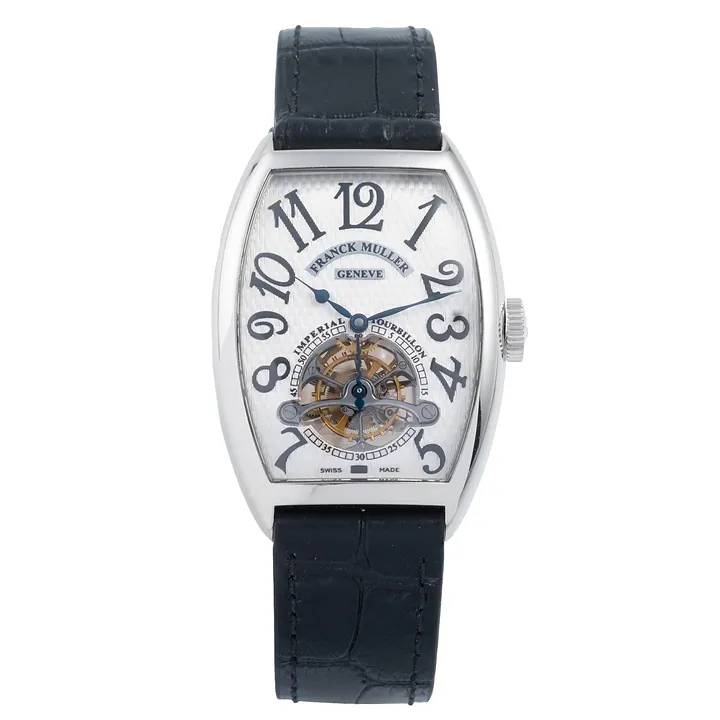
Wristwatches · c. 1996-99
Franck Muller Imperial Tourbillon, ref. 5850T, c. 1996-99
Antiquorum auction archive, Geneva
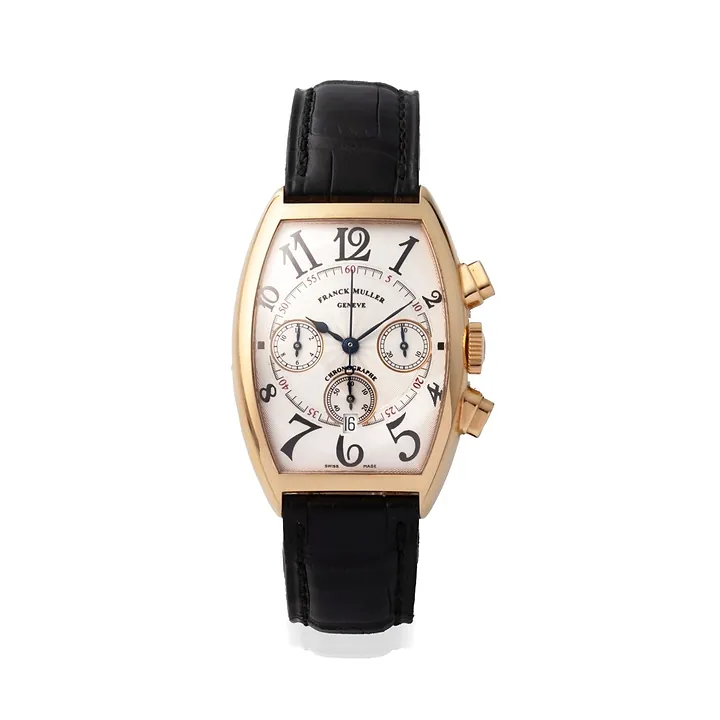
Wristwatches · c. 2005
Franck Muller Casablanca Chronograph, ref. 5850 CC AT, c. 2005
Antiquorum auction archive, Geneva
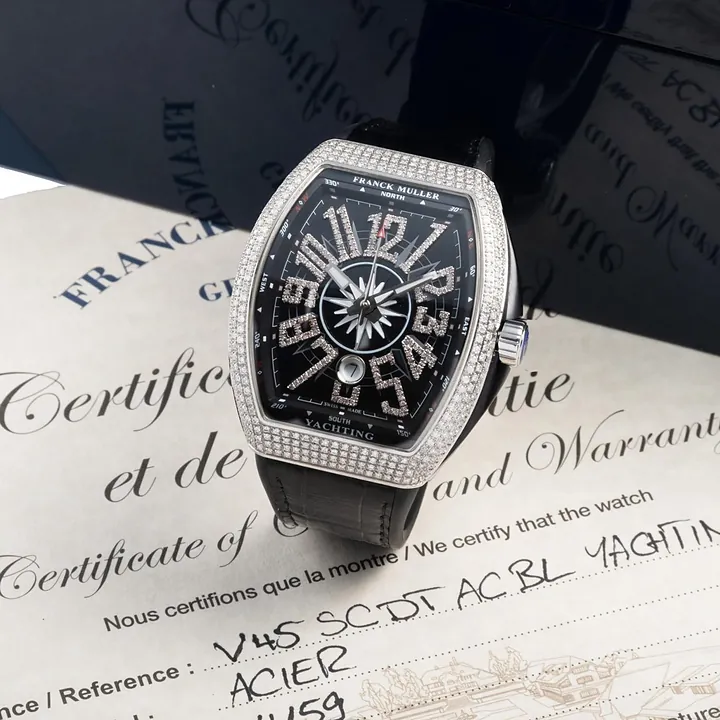
Wristwatches · c. 2010-2020
Franck Muller Vanguard Yachting, ref. V45SCDT, c. 2010-2020
Antiquorum auction archive, Geneva
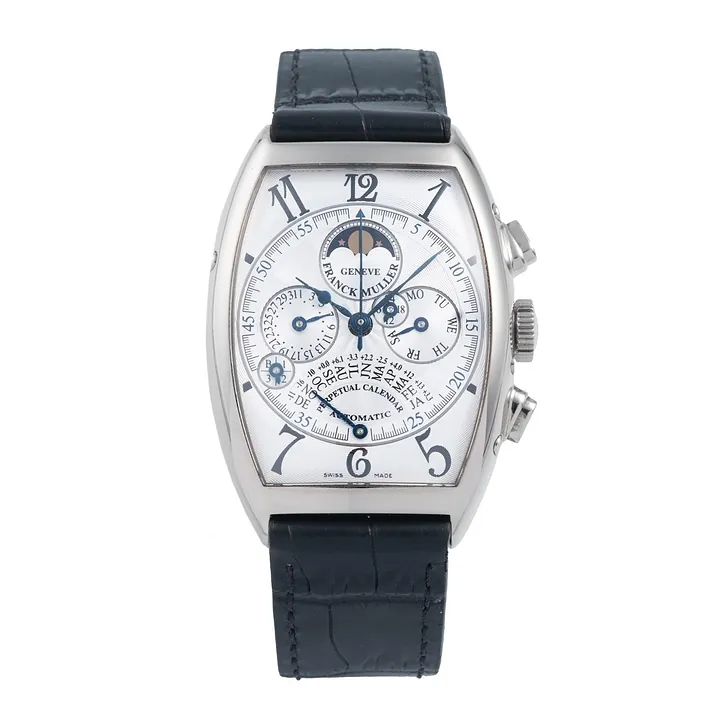
Wristwatches · Sold in August 2016
Franck Muller wristwatch, ref. 6850 QPE, Sold in August 2016
Antiquorum auction archive, Geneva

Wristwatches · 2008
Wristwatch by Breitling?, 2008
Museum Rotterdam

Wristwatches · c. 1990s
Audemars Piguet Bamboo, c. 1990s
Antiquorum auction archive, Geneva

Wristwatches · c. 1990
Audemars Piguet Huitieme Perpetual Calendar, ref. 25696PT, c. 1990
Antiquorum auction archive, Geneva

Wristwatches · c. 1990
Breitling Chronomat, ref. b13050.1, c. 1990
Antiquorum auction archive, Geneva