
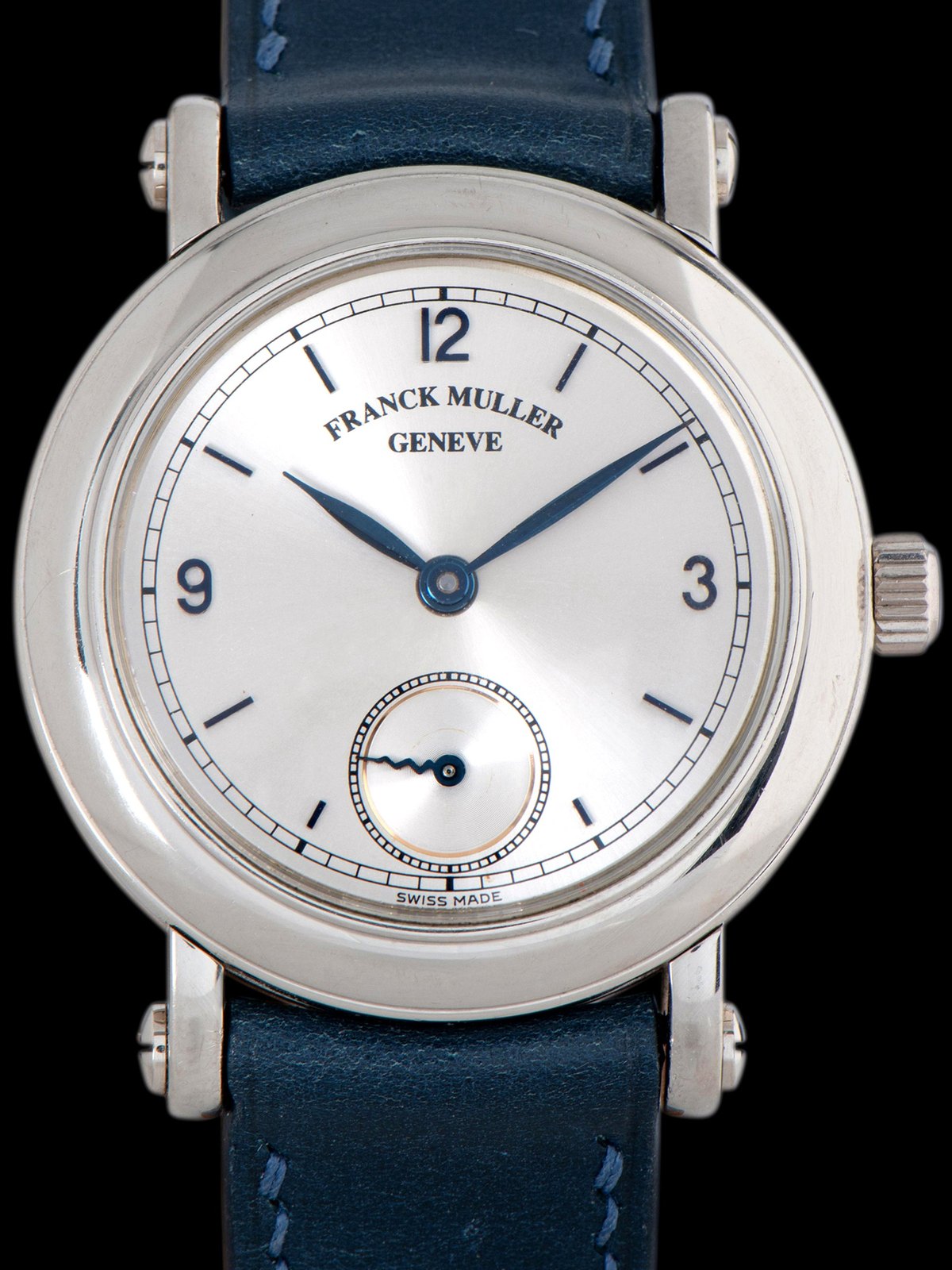
Wristwatches · Wristwatch
Franck Muller Classique 18K WG (Ref. 2801 S6GM), 1990s
- Maker / attribution
- Franck Muller (maker)
- Date
- 1990s
- Historical period
- Mechanical Renaissance (1990 – 2010)
- Country of origin
- Switzerland
- Object type
- Wristwatch
- Dimensions
- Case 35 mm
- Stock no.
- FKMC2801
- Credit line
- Dealer listing, Craft & Tailored (FKMC2801)
- Catalogue title (original)
- 1990s Franck Muller Classique 18K WG (Ref. 2801 S6GM) (English)
View the source record (dealer listing) ↗ (opens another website in a new tab)Suggest a correction
Record summary
Catalogued by Craft & Tailored (dealer), Los Angeles (stock number FKMC2801), this is a wristwatch by Franck Muller, made in Switzerland, dated 1990s. The Atlas places it in the Mechanical Renaissance period (1990 – 2010) of its Wristwatches collection. Recorded dimensions: Case 35 mm. The record is illustrated with 6 photographs.
Assembled from the source record's structured fields. Dates and attributions are given as the source states them; where a field is missing the Atlas leaves it blank rather than estimating.
Catalogue description
Dealer description — Craft & Tailored
As polarizing as the brand may be today, it's hard not to be captivated by the early works from Franck Muller, also known as "The Master of Complications". Franck Muller began his career at the age of 15 when he enrolled in the Watchmaking School of Geneva, and would later go on to do high-end independent restoration and repair work for pocket watches and wristwatches for The Patek Philippe Collection as well as individual collectors and auction houses. During this time Franck Muller amassed an incredible knowledge and appreciation for complicated timepieces, which led him to create the first "exposed" tourbillon watch, a feat never before accomplished. In 1991, the Franck Muller brand was born. Today, the early works from the brand remain celebrated for the innovative interpretation of classically designed, and truly beautiful timepieces. The Classique model is the most traditional design to come from the Franck Muller brand and was a versatile platform from which some of the most iconic and complicated, or simple timepieces were produced. The ref. 2801 S6GM is a beautiful display of the early work from the brand, featuring a modest 35mm 18K white gold case, a sophisticated dial with applied blue markers and hands. Powering this watch is a modified ETA Cal. 2892-2 automatic movement that features the Franck Muller signature platinum rotor. Stock # FKMC2801 Brand Franck Muller Style Classique Model 2801 S6GM Serial US 0X Size Men's Material 18K White Gold Dial Silver Millimeters 35 Strap 2pc Handmade Leather Strap W/ 18K WG Franck Muller Western Tang Buckle CASE & BRACELET The well-preserved 18K white gold case exhibits minimal signs of previous wear and strong factory dimensions throughout, with no notable evidence of previous polishing present. The case retains its original unsigned winding crown. The snap-on case back retains the factory markings and hallmarks in very crisp condition. the watch comes supplied on a 2pc handmade leather strap with the original 18K white gold Franck Muller western-style tang buckle. The watch also comes with the original Franck Muller strap which is in lightly worn condition. DIAL & HANDS The original silver dial with applied blue numerals and markers is in beautifully preserved condition, showing no damage and only nominal elements of age that are invisible to the naked eye. The original blued hands are in perfect condition. ACCESSORIES None. The watch is keeping time perfectly, but the service history is unknown. A movement service can be provided upon request.
Historical context
Mechanical Renaissance (1990 – 2010)
Mechanical watches return as cultural objects; independent watchmaking flourishes.
Mechanical watches returned as cultural and luxury objects. Complications, tourbillons and new materials proliferated; independent watchmakers such as George Daniels, F.P. Journe and Philippe Dufour revived artisanal watchmaking; collecting vintage watches became a major field.
Read the period in the timelineMore wristwatches from this periodEarlier: Quartz Revolution
Atlas type guide
Wristwatches
Bracelet watches were worn by women from the early nineteenth century — Breguet made one for Caroline Murat, Queen of Naples, in 1810–12 — but the wristwatch only became a man's instrument with military use and aviation in the early twentieth century. Between the World Wars it overtook the pocket watch; the 1920s and 1930s brought rectangular Art Deco cases, water-resistant cases and the first automatic winding systems.
After 1945 the wristwatch became a carrier of identity — dress watches, sports and dive watches, chronographs, calendars — produced by Swiss, American, Japanese, German, Soviet and Chinese industries. The quartz revolution after 1969 and the mechanical renaissance since the 1990s, including the rise of independent watchmakers, complete the story.
What to look for
- The reference number (between the lugs or inside the case back) and serial number, the starting point for dating.
- The calibre: its maker and number are often stamped under the dial or on the bridge.
- Originality of dial, hands and crown — refinished ('redial') dials are common.
- Case material marks: 18K/750, 14K/585, stainless steel, gold-filled, plated.
Dating clues
- Wire-lug cases: before c. 1925.
- Water-resistant screw-down cases: from 1926.
- Quartz movements: from 1969; sapphire crystals widespread after c. 1980.
General guidance written by the Atlas editors about this kind of object. It is not a statement about this particular piece; for that, rely on the source record above and on physical examination.
Related records
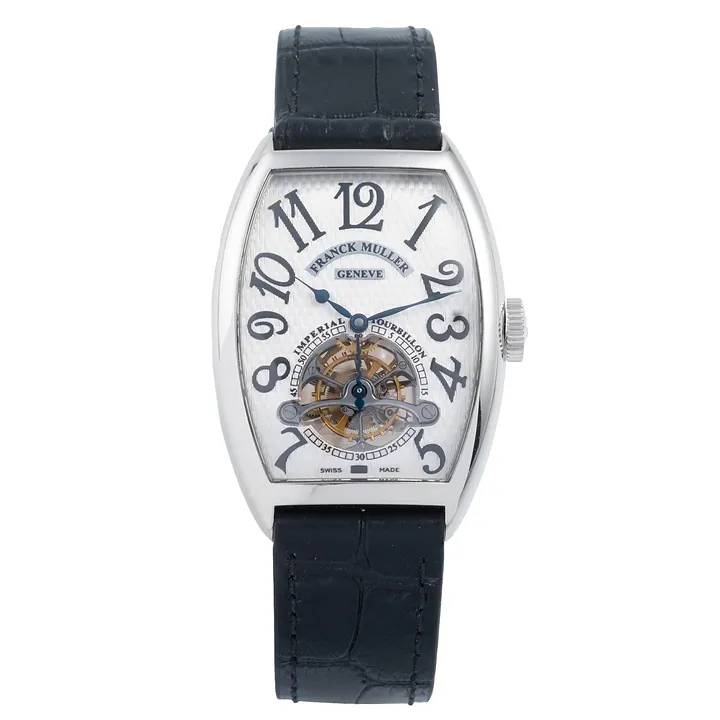
Wristwatches · c. 1996-99
Franck Muller Imperial Tourbillon, ref. 5850T, c. 1996-99
Antiquorum auction archive, Geneva
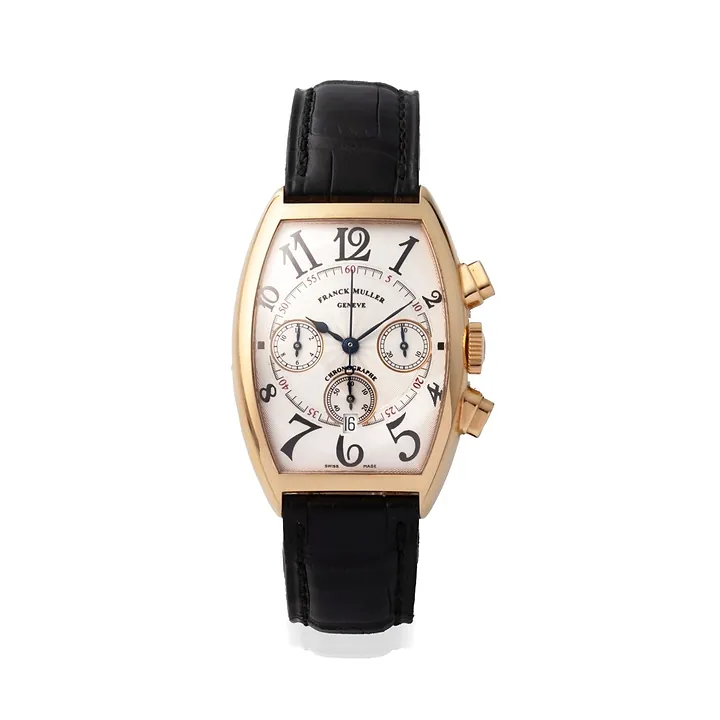
Wristwatches · c. 2005
Franck Muller Casablanca Chronograph, ref. 5850 CC AT, c. 2005
Antiquorum auction archive, Geneva
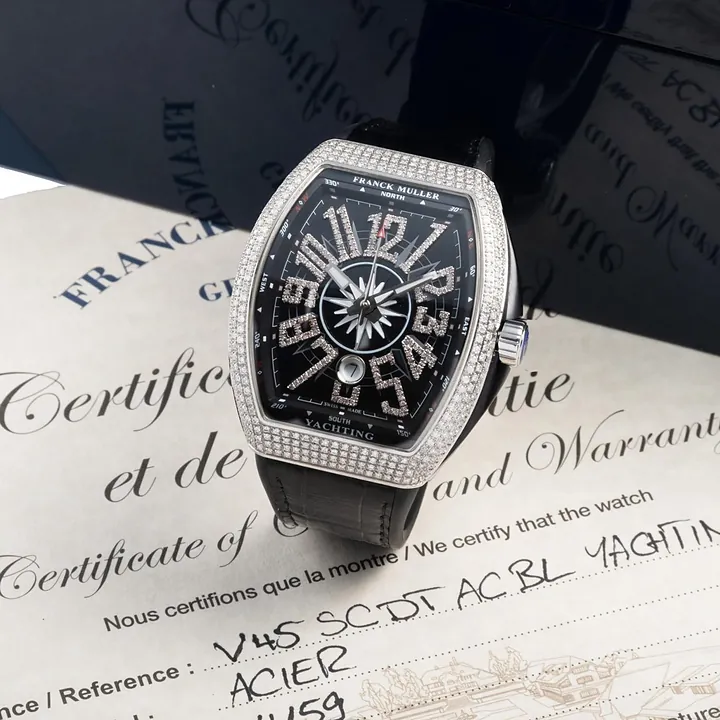
Wristwatches · c. 2010-2020
Franck Muller Vanguard Yachting, ref. V45SCDT, c. 2010-2020
Antiquorum auction archive, Geneva
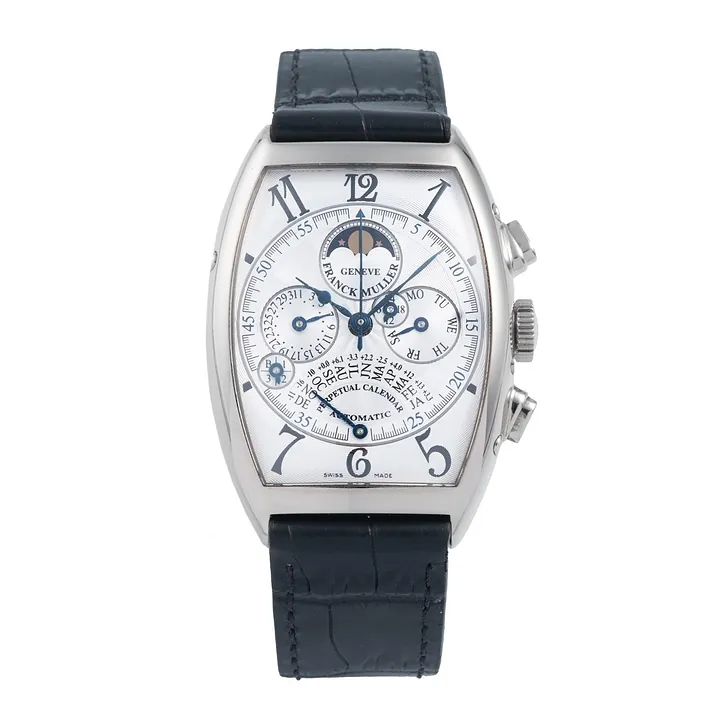
Wristwatches · Sold in August 2016
Franck Muller wristwatch, ref. 6850 QPE, Sold in August 2016
Antiquorum auction archive, Geneva

Wristwatches · 2008
Wristwatch by Breitling?, 2008
Museum Rotterdam

Wristwatches · c. 1990s
Audemars Piguet Bamboo, c. 1990s
Antiquorum auction archive, Geneva

Wristwatches · c. 1990
Audemars Piguet Huitieme Perpetual Calendar, ref. 25696PT, c. 1990
Antiquorum auction archive, Geneva

Wristwatches · c. 1990
Breitling Chronomat, ref. b13050.1, c. 1990
Antiquorum auction archive, Geneva