
Wristwatches · Wristwatch
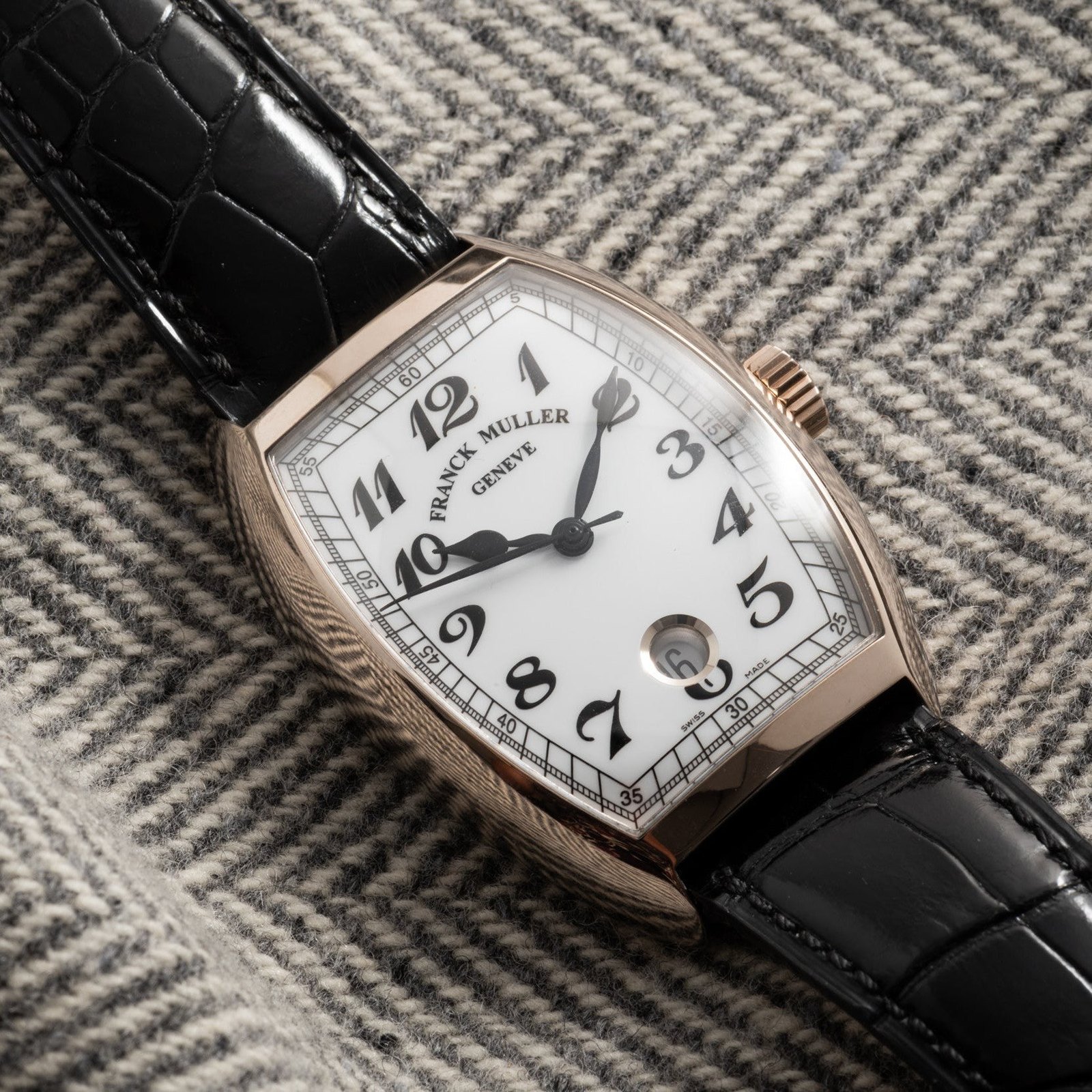
Franck Muller Cintree Curvex 'Vintage Automatic', 2000s
- Maker / attribution
- Franck Muller (maker)
- Date
- 2000s
- Historical period
- Mechanical Renaissance (1990 – 2010)
- Country of origin
- Switzerland
- Object type
- Wristwatch
- Dimensions
- Case 35 mm
- Stock no.
- 40991515
- Credit line
- Dealer listing, Analog/Shift (40991515)
- Catalogue title (original)
- Franck Muller Cintree Curvex 'Vintage Automatic' (English)
View the source record (dealer listing) ↗ (opens another website in a new tab)Suggest a correction
Record summary
Catalogued by Analog/Shift (dealer), New York (stock number 40991515), this is a wristwatch by Franck Muller, made in Switzerland, dated 2000s. The Atlas places it in the Mechanical Renaissance period (1990 – 2010) of its Wristwatches collection. Recorded dimensions: Case 35 mm. The record is illustrated with 6 photographs.
Assembled from the source record's structured fields. Dates and attributions are given as the source states them; where a field is missing the Atlas leaves it blank rather than estimating.
Catalogue description
Dealer description — Analog/Shift
In the world of haute horlogerie , where time is not just measured but celebrated , Franck Muller stands as an overlooked luminary. Established in 1991, the brand's vision was clear –– to create timepieces that transcend the mundane, leaning on expressions of individuality and above all, elevating timekeeping to an art form. Muller the man and Muller the brand have brought a lot to the world of modern horology, and his colorful, mid-1990s/early-2000s tonneau-shaped dress watch collection perfectly exhibits a design language that walks a fine line between classical and whimsical. This particular Franck Muller Reference 7851 SC DT VIN dates to the 2000s, and is housed in a 35mm x 48mm 18k, white gold tonneau case featuring a curved sapphire crystal, a signed crown and an engraved, numbered caseback. For a Franck Muller, the dial feels more restrained, but that doesn’t take anything away from it –– it’s perfectly executed. The enamel dial features a ‘Breguet’ numerals as opposed to the traditional ‘crazy-hour’ configuration, a charming ‘railroad’ minute track at the dial’s periphery, and a circular date aperture at 6 o’clock paired with a matching ‘spade’ handset This piece features an FM Calibre automatic winding movement and is accompanied on a signed black alligator strap with a matching white gold pin buckle. Simple and elegant, this piece is left-of-center from the wildly fun pieces we’re used to seeing from FM, but we’re not complaining one bit –– we’re sure you’re not complaining either.
Historical context
Mechanical Renaissance (1990 – 2010)
Mechanical watches return as cultural objects; independent watchmaking flourishes.
Mechanical watches returned as cultural and luxury objects. Complications, tourbillons and new materials proliferated; independent watchmakers such as George Daniels, F.P. Journe and Philippe Dufour revived artisanal watchmaking; collecting vintage watches became a major field.
Read the period in the timelineMore wristwatches from this periodEarlier: Quartz Revolution
Atlas type guide
Automatic (self-winding) watches
Self-winding watches use the wearer's motion to wind the mainspring. Abraham-Louis Perrelet and Breguet made 'perpétuelle' pocket watches with oscillating weights in the late eighteenth century, but the principle only became practical in the wristwatch. John Harwood patented a bumper automatic in 1923; Rolex's Perpetual rotor (1931) winding in one direction, and later bidirectional rotors (Eterna, Felsa Bidynator), established the modern form. Micro-rotors (Universal Genève, Buren) and peripheral rotors made automatic watches thinner.
What to look for
- A semicircular rotor turning 360° over the movement, or a 'bumper' weight that rebounds between springs.
- 'Automatic', 'Perpetual' or 'Self-winding' on the dial.
- A sealed screw-back case, since automatic watches are wound less often by the crown.
Dating clues
- Bumper automatics: 1923–c. 1955.
- Full rotors: from 1931 (Rolex); widespread after c. 1950.
- Micro-rotors: from 1954–1958.
General guidance written by the Atlas editors about this kind of object. It is not a statement about this particular piece; for that, rely on the source record above and on physical examination.
Related records
Wristwatches · c. 1996-99
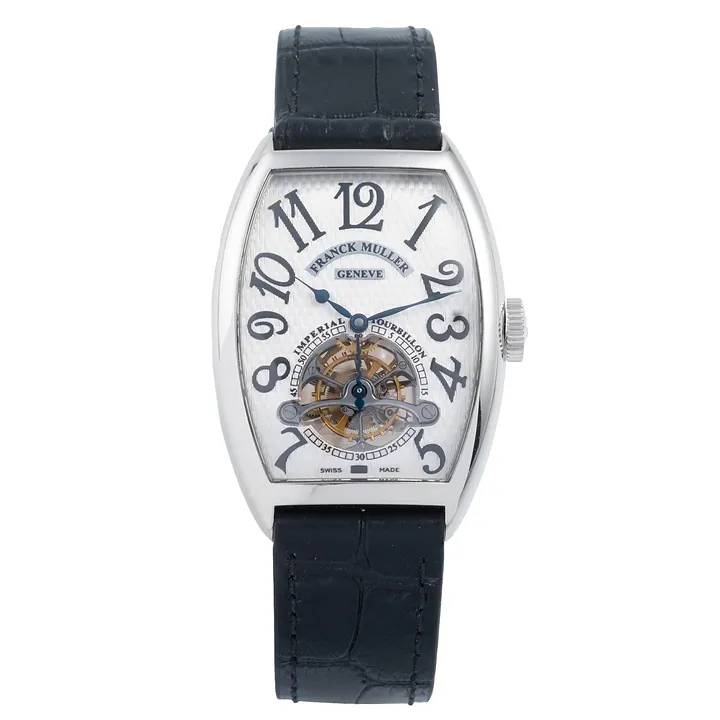
Franck Muller Imperial Tourbillon, ref. 5850T, c. 1996-99
Antiquorum auction archive, Geneva
Wristwatches · c. 2005
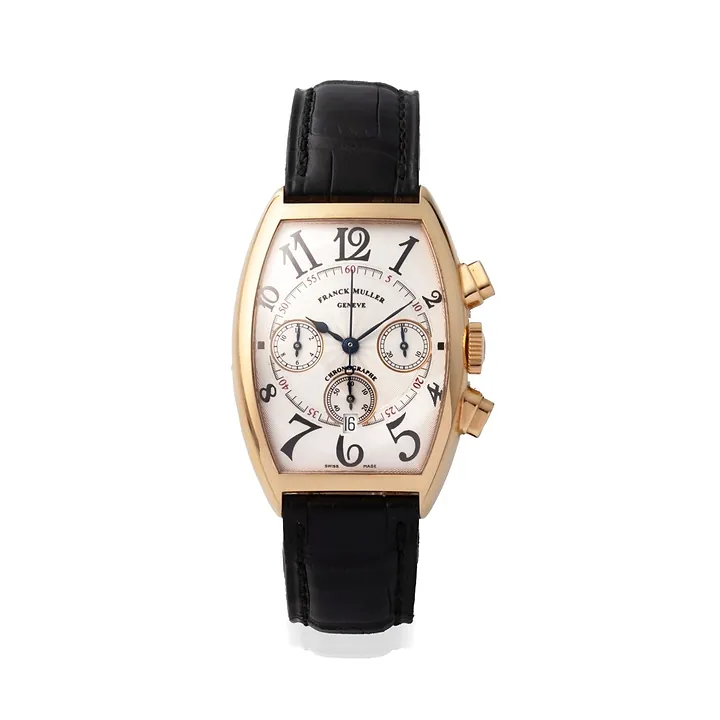
Franck Muller Casablanca Chronograph, ref. 5850 CC AT, c. 2005
Antiquorum auction archive, Geneva
Wristwatches · c. 2010-2020
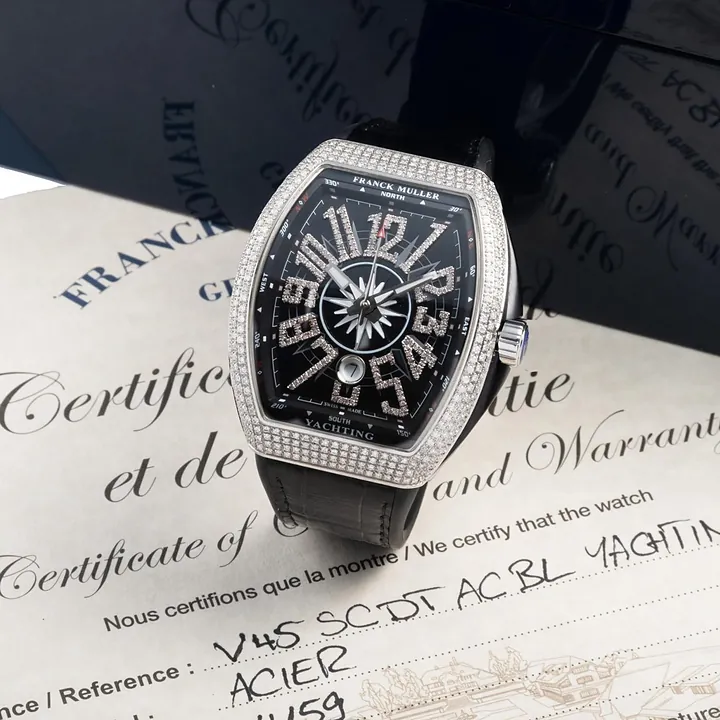
Franck Muller Vanguard Yachting, ref. V45SCDT, c. 2010-2020
Antiquorum auction archive, Geneva
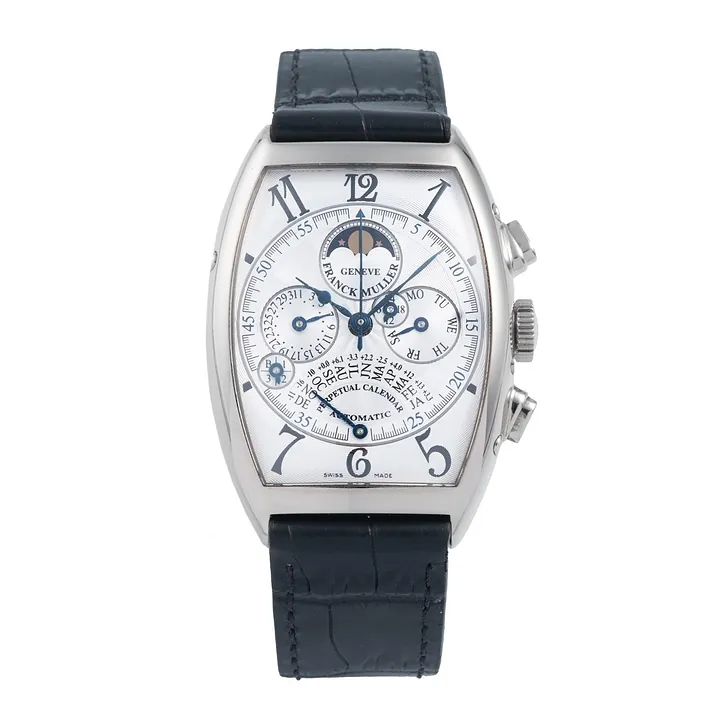
Wristwatches · Sold in August 2016
Franck Muller wristwatch, ref. 6850 QPE, Sold in August 2016
Antiquorum auction archive, Geneva

Wristwatches · 2008
Wristwatch by Breitling?, 2008
Museum Rotterdam

Wristwatches · c. 1990s
Audemars Piguet Bamboo, c. 1990s
Antiquorum auction archive, Geneva

Wristwatches · c. 1990
Audemars Piguet Huitieme Perpetual Calendar, ref. 25696PT, c. 1990
Antiquorum auction archive, Geneva

Wristwatches · c. 1990
Breitling Chronomat, ref. b13050.1, c. 1990
Antiquorum auction archive, Geneva