
Wristwatches · Wristwatch
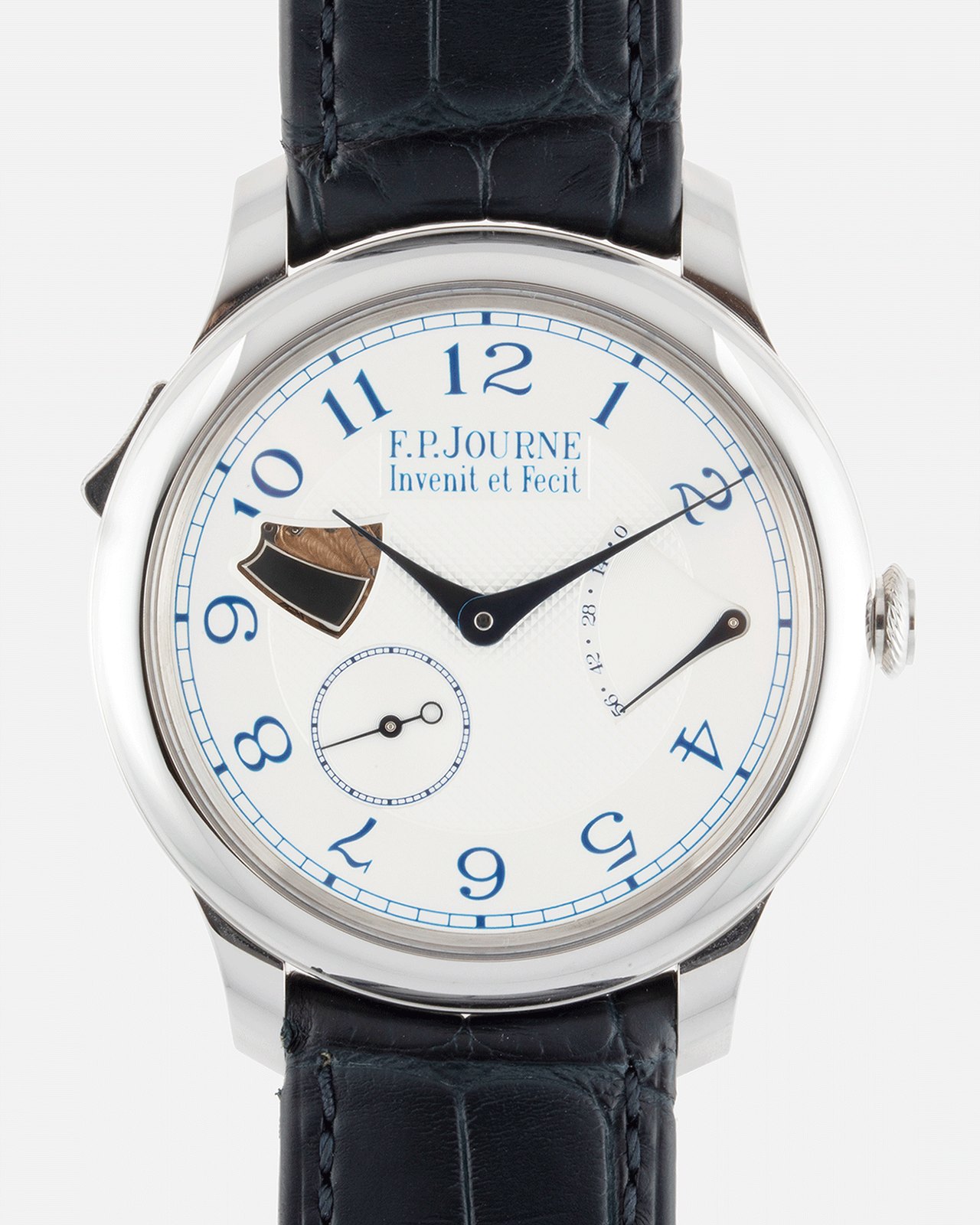
F.P. Journe Souveraine Repetition Minutes, 2012
- Maker / attribution
- F.P. Journe (maker)
- Date
- 2012
- Historical period
- Contemporary Horology (2010 – Present)
- Country of origin
- Switzerland
- Object type
- Wristwatch
- Dimensions
- Case 65 mm
- Stock no.
- Product 4552029765719
- Credit line
- Dealer listing, S.Song Watches (product 4552029765719)
- Catalogue title (original)
- F.P. Journe Souveraine Repetition Minutes (English)
View the source record (dealer listing) ↗ (opens another website in a new tab)Suggest a correction
Record summary
Catalogued by S.Song Watches (dealer), Seattle (stock number Product 4552029765719), this is a wristwatch by F.P. Journe, made in Switzerland, dated 2012. The Atlas places it in the Contemporary Horology period (2010 – Present) of its Wristwatches collection. Recorded dimensions: Case 65 mm. The record is illustrated with 6 photographs.
Assembled from the source record's structured fields. Dates and attributions are given as the source states them; where a field is missing the Atlas leaves it blank rather than estimating.
Catalogue description
Dealer description — S.Song Watches
Where to begin with F.P. Journe. Started by the man himself in 1999, Journe had previously spent quite a few years restoring and producing movements and also made a couple of pocket watches during that time. It took quite a few years before his brand went from something only a hardcore collector could appreciate to being appreciated by a more mainstream audience and today, he is considered by many as one of the most successful and important independent brands to have emerged. In my opinion, F.P. Journe has hit the sweet spot, producing around 900 pieces a year only. This ensures that they are exclusive enough that people consider any Journe a rare piece, but not so rare that it becomes esoteric. There are brands like Roger Smith and Philippe Dufour, both of who are considered godfathers of high horology, but they make so few pieces a year that the average watch collector would not know about them. Mention F.P. Journe though, and you’ll have collectors jumping with joy. The F.P. Journe Souveraine Repetition Minutes is one of the most complicated timepieces that come out of the manufacture and features quite a few technical marvels. Aesthetically, it has the DNA of the Chronometre Souverain, with its familiar stylized Arabic numerals and hobnail guilloche center. What is unique about this reference is that it features a white opaline dial with navy blue numerals. The subtle blue is really beautiful and is reminiscent of the color scheme of antique chinaware. Topping it off, there is an aperture around the 10 o’clock marker that showcases the chiming gongs. A minute repeater has traditionally been seen as the pinnacle of watchmaking and is no easy feat. It was invented back in the day when it was hard to read the time at night and also for times when it was inappropriate to look at your clock. So as a way to tell time, a minute repeater would chime the time with the first singular chimes telling you the hour of the day, the second dual chimes telling you which quarter it was (15, 30, 45) and the final singe chimes telling you how many minutes after the quarter it was, hence giving you the exact time. When the Souveraine Minute Repeater was first released in 2008, it was the thinnest minute repeater ever produced at 8.65mm, so you can imagine how well this sits on the wrist, despite its complication. While it is housed in a traditional F.P. Journe case, what sets it apart is the little lever you see at 10 o’clock, which of course is how you activate the minute repeating function. What is different about this minute repeater is that F.P. Journe adopted flat hammers that he invented so that it can be more compact within the movement. The chimes are louder than your typical repeater as a result and this is further assisted by the fact that it is housed in a stainless steel case as it has a lower density than gold, meaning the sound can be amplified louder. F.P. Journe has carved a very interesting niche in the independent watch world where he has managed to blend traditional watchmaking and design cues with modern technology and an unmistakably Journe aesthetic. Despite using very traditional elements like his serif’d Arabic numerals, a knurled winding crown, and a standard round case, the way it has been laid out combines to create a look that is F.P. Journe through and through. It is for this reason that he is today, one of the most sought after and successful independent watchmakers in the industry. The F.P. Journe Souveraine Repetition Minutes is a truly elegant timepiece and packs a hugely complicated mechanism in a seemingly simple layout. While Journe’s timepieces have skyrocketed in value, this minute repeater has yet to reach those heights, perhaps as not many examples were made at all and it has yet to be discovered.
Historical context
Contemporary Horology (2010 – Present)
Silicon components, connected watches, optical-lattice research clocks and a thriving independent scene.
Smartwatches became the world's best-selling watches, while mechanical watchmaking focuses on craft, innovation (silicon components, new escapements) and independent makers.
Read the period in the timelineMore wristwatches from this periodEarlier: Mechanical Renaissance
Atlas type guide
Repeating watches
Before electric light, telling the time in the dark was a real problem. Repeating watches strike the time on demand when a slide or push-piece is operated: quarter repeaters sound hours and quarters, minute repeaters hours, quarters and minutes. Edward Barlow and Daniel Quare disputed the invention in London in the 1680s. Early repeaters struck on a bell inside the case; Abraham-Louis Breguet introduced the gong (a coiled steel wire) around 1780, allowing thinner watches.
Repeaters require a separate train with racks, snails and a governor to control the striking speed, and are among the most demanding complications to make and adjust. Swiss makers of the Vallée de Joux specialised in repeating ébauches in the nineteenth century.
What to look for
- A slide on the case band or a push-piece through the pendant.
- Gongs encircling the movement (after c. 1780) or a bell in the case (earlier); pierced case for sound.
- The racks, snails and governor visible under the dial or on the movement.
- Terms such as 'Minutes', 'Quarts' or 'Répétition' on the dial or cuvette.
Dating clues
- Bell-striking quarter repeaters: c. 1690–1800.
- Gong repeaters and dumb repeaters (striking on the case): after c. 1780.
- Minute repeaters became more common after c. 1830 with Vallée de Joux ébauches.
General guidance written by the Atlas editors about this kind of object. It is not a statement about this particular piece; for that, rely on the source record above and on physical examination.
Read next:Minute repeater
Related records
Wristwatches · 2012
F.P. Journe Résonance "Parking Meter" 18K RG (Ref. RT) Grey Dial, 2012
Craft & Tailored (dealer), Los Angeles
Wristwatches · 2003
F.P. Journe Chronomètre à Résonance 'Brass Movement', 2003
Analog/Shift (dealer), New York
Wristwatches · 2019
F.P. Journe Chronométre Souverain Boutique Edition, 2019
Analog/Shift (dealer), New York
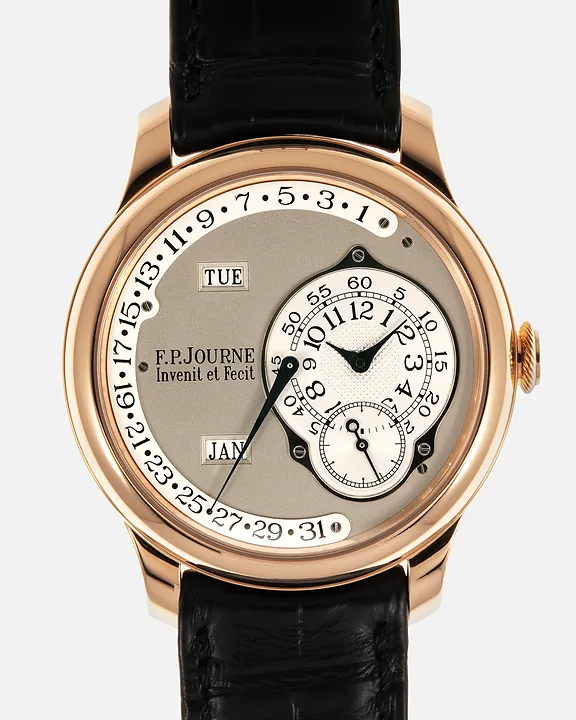
Wristwatches · 2006
F.P. Journe Octa Calendrier RG Grey 40mm, 2006
S.Song Watches (dealer), Seattle

Wristwatches · c. 2010s
Breguet Type XXI, ref. 3810, c. 2010s (Antiquorum Lot 381-24)
Antiquorum auction archive, Geneva

Wristwatches · c. 2010s
Breguet Type XXI, ref. 3810, c. 2010s (Antiquorum Lot 386-229)
Antiquorum auction archive, Geneva

Wristwatches · Sold in September 2010
Breitling Cosmonaute, ref. A 22322, Sold in September 2010
Antiquorum auction archive, Geneva

Wristwatches · c. 2010
Corum Bubble Chrono, ref. 396.150.20, c. 2010
Antiquorum auction archive, Geneva