
Wristwatches · Wristwatch
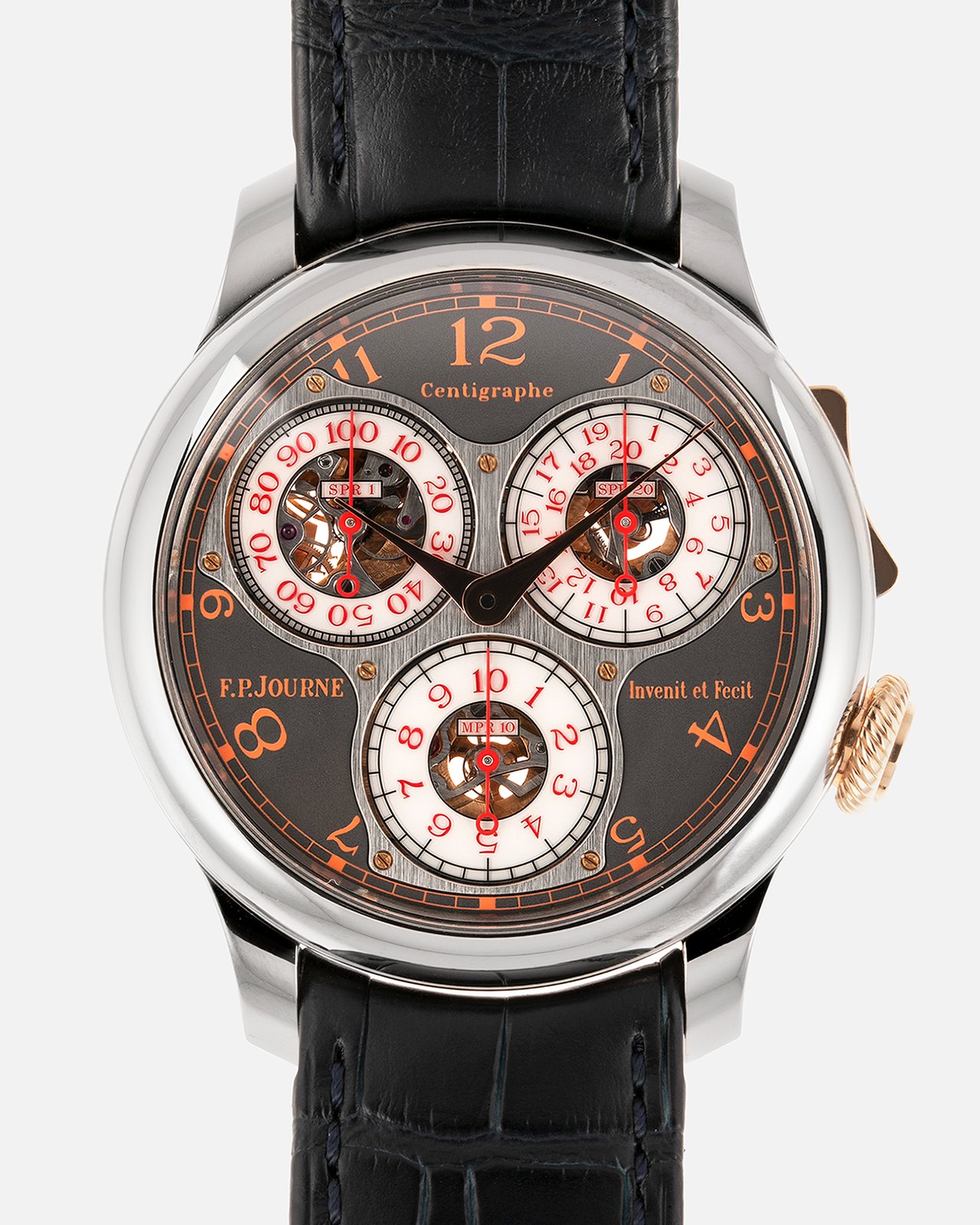
F.P. Journe Centigraphe Souverain 10th Anniversary Boutique Edition 'Hong Kong', 2016
- Maker / attribution
- F.P. Journe (maker)
- Date
- 2016
- Historical period
- Contemporary Horology (2010 – Present)
- Country of origin
- Switzerland
- Object type
- Wristwatch
- Dimensions
- Case 40 mm
- Stock no.
- Product 6767089582167
- Credit line
- Dealer listing, S.Song Watches (product 6767089582167)
- Catalogue title (original)
- F.P. Journe Centigraphe Souverain 10th Anniversary Boutique Edition 'Hong Kong' (English)
View the source record (dealer listing) ↗ (opens another website in a new tab)Suggest a correction
Record summary
Catalogued by S.Song Watches (dealer), Seattle (stock number Product 6767089582167), this is a wristwatch by F.P. Journe, made in Switzerland, dated 2016. The Atlas places it in the Contemporary Horology period (2010 – Present) of its Wristwatches collection. Recorded dimensions: Case 40 mm. The record is illustrated with 6 photographs.
Assembled from the source record's structured fields. Dates and attributions are given as the source states them; where a field is missing the Atlas leaves it blank rather than estimating.
Catalogue description
Dealer description — S.Song Watches
Where to begin with F.P. Journe. Started by the man himself in 1999, Journe had previously spent quite a few years restoring and producing movements and also made a couple of pocket watches during that time. It took quite a few years before his brand went from something only a hardcore collector could appreciate to being appreciated by a more mainstream audience and today, he is considered by many as one of the most successful and important independent brands to have emerged. In my opinion, F.P. Journe has hit the sweet spot, producing around 900 pieces a year only. This ensures that they are exclusive enough that people consider any Journe a rare piece, but not so rare that it becomes esoteric. There are brands like Roger Smith and Philippe Dufour, both who are considered godfathers of high horology, but they make so few pieces a year that the average watch collector would not know about them. Mention F.P. Journe though, and you’ll have collectors jumping with joy. What you see here today is one of Journe’s most iconic models- the Centigraphe. Designed to time 1/100th of a second, you can already imagine how complicated this is going to get. There are pushers on the top right-hand side of the case to activate the chronograph, prompting the 10 o’clock sub-dial to start running. Watching this is something very special as you see the foudroyant (flying seconds) run and when you stop the chronograph it can stop anywhere on the sub-dial, allowing the user to record exactly to 1/100th of a second. The other two sub dials act as a 20 second and 10 minute counter. While any Centigraphe is a sight to behold, this example is made even more special and rare by the fact that it is an Anniversaire Boutique Edition. With only a handful of F.P. Journe boutiques around the world, the brand decided that for every shop’s 10th year anniversary, a small number of this particular Centigraphe will be released to the public to commemorate the achievement. This piece we have today was part of the first batch released in 2016, with the Hong Kong boutique being the oldest Journe boutique and the first to hit 10 years. Housed in a unique 40mm titanium and rose gold case configuration, it is unlike any Centigraphe made and certainly feels far more special than the others. Furthermore, this watch features a ruthenium dial with sapphire registers, making it semi-open-worked and revealing the moving mechanism beneath. With only 20 pieces released for this series, and 10 pieces released for the other boutiques that hit their 10-year mark, only Geneva, Tokyo, Boca Raton, Paris, New York, and Bal Harbour have done this so far, meaning there are only 80 pieces in existence. F.P. Journe has carved a very interesting niche in the independent watch world where he has managed to blend traditional watchmaking and design cues with modern technology and an unmistakably Journe aesthetic. Despite using very traditional elements like his serif’d Arabic numerals, a knurled winding crown and a standard round case, the way it has been laid out combines to create a look that is F.P. Journe through and through. The purists really love Journe because of his motto ‘Invenit et Fecit’, which translates from Latin to Invent and Create. To this day, F.P. Journe has stuck to this mantra, where he continues to invent his own in-house movements. Furthermore, everything else is also in-house, even to the point of owning his own case-maker and dial-maker. For a small brand that makes less than 1000 pieces a year, it is really impressive. Now, of course timing to 1/100th of a second is not something we need in our lives, but just like art, it is the complexity and the ingenuity that we appreciate. After all, isn’t the wristwatch in itself an archaic tool? So why not, just go all out? It is for that reason, I think that the Cenitgraphe is one of the greatest watches that has come out of this century with this example being the cream of the crop.
Historical context
Contemporary Horology (2010 – Present)
Silicon components, connected watches, optical-lattice research clocks and a thriving independent scene.
Smartwatches became the world's best-selling watches, while mechanical watchmaking focuses on craft, innovation (silicon components, new escapements) and independent makers.
Read the period in the timelineMore wristwatches from this periodEarlier: Mechanical Renaissance
Atlas type guide
Wristwatches
Bracelet watches were worn by women from the early nineteenth century — Breguet made one for Caroline Murat, Queen of Naples, in 1810–12 — but the wristwatch only became a man's instrument with military use and aviation in the early twentieth century. Between the World Wars it overtook the pocket watch; the 1920s and 1930s brought rectangular Art Deco cases, water-resistant cases and the first automatic winding systems.
After 1945 the wristwatch became a carrier of identity — dress watches, sports and dive watches, chronographs, calendars — produced by Swiss, American, Japanese, German, Soviet and Chinese industries. The quartz revolution after 1969 and the mechanical renaissance since the 1990s, including the rise of independent watchmakers, complete the story.
What to look for
- The reference number (between the lugs or inside the case back) and serial number, the starting point for dating.
- The calibre: its maker and number are often stamped under the dial or on the bridge.
- Originality of dial, hands and crown — refinished ('redial') dials are common.
- Case material marks: 18K/750, 14K/585, stainless steel, gold-filled, plated.
Dating clues
- Wire-lug cases: before c. 1925.
- Water-resistant screw-down cases: from 1926.
- Quartz movements: from 1969; sapphire crystals widespread after c. 1980.
General guidance written by the Atlas editors about this kind of object. It is not a statement about this particular piece; for that, rely on the source record above and on physical examination.
Related records
Wristwatches · 2012
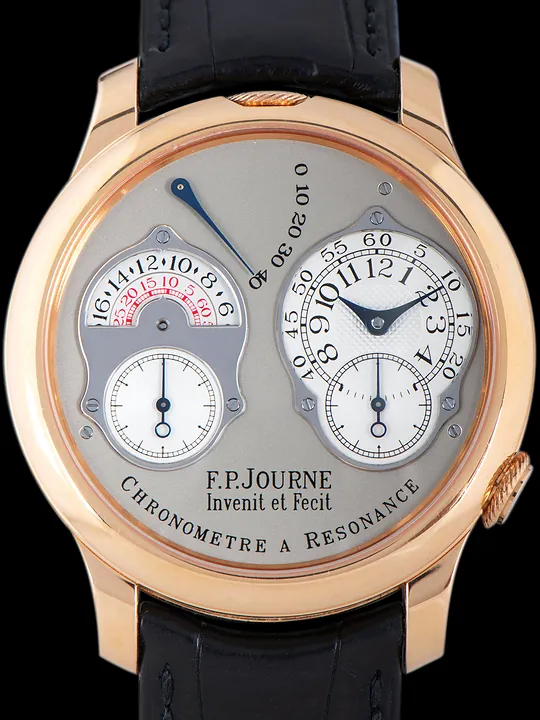
F.P. Journe Résonance "Parking Meter" 18K RG (Ref. RT) Grey Dial, 2012
Craft & Tailored (dealer), Los Angeles
Wristwatches · 2003
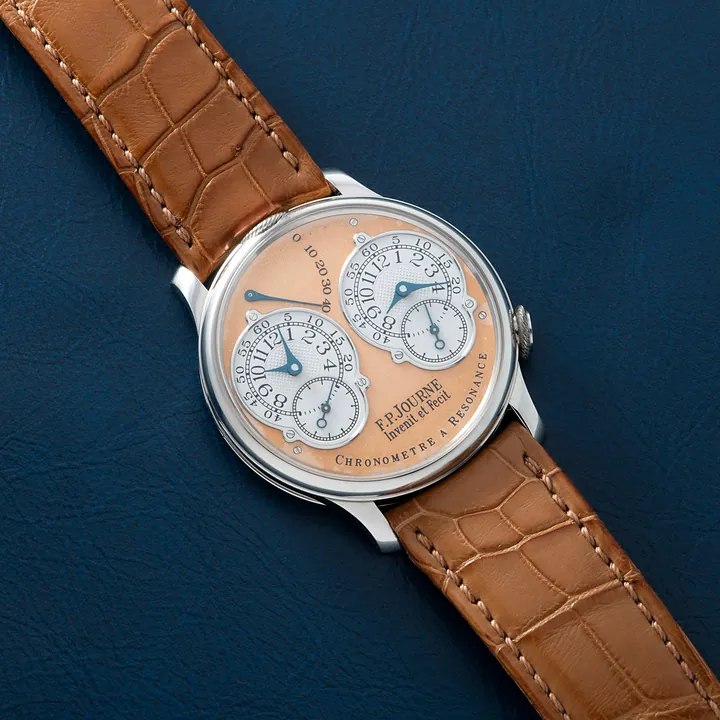
F.P. Journe Chronomètre à Résonance 'Brass Movement', 2003
Analog/Shift (dealer), New York
Wristwatches · 2019
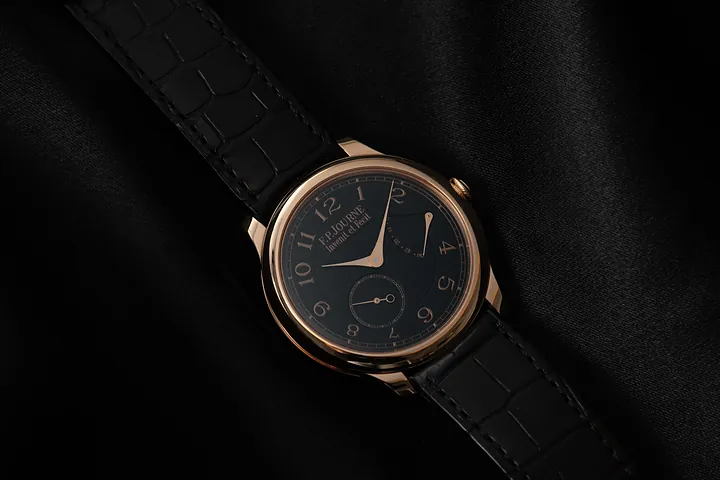
F.P. Journe Chronométre Souverain Boutique Edition, 2019
Analog/Shift (dealer), New York
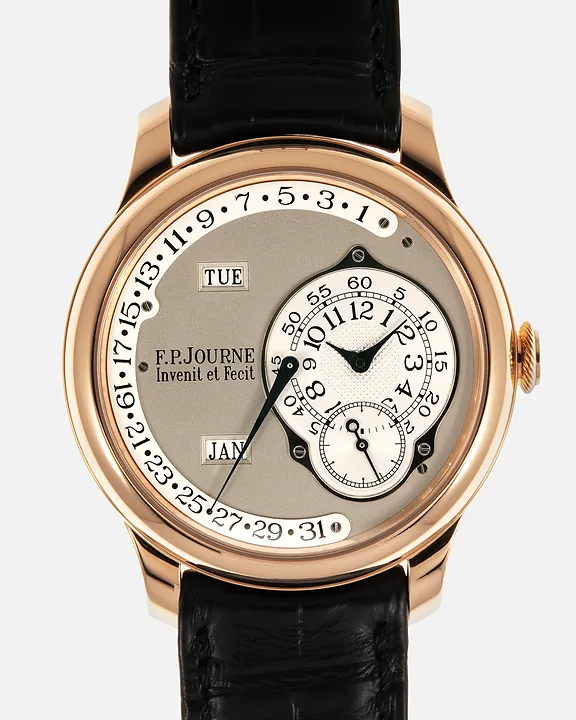
Wristwatches · 2006
F.P. Journe Octa Calendrier RG Grey 40mm, 2006
S.Song Watches (dealer), Seattle

Wristwatches · c. 2010s
Breguet Type XXI, ref. 3810, c. 2010s (Antiquorum Lot 381-24)
Antiquorum auction archive, Geneva

Wristwatches · c. 2010s
Breguet Type XXI, ref. 3810, c. 2010s (Antiquorum Lot 386-229)
Antiquorum auction archive, Geneva

Wristwatches · Sold in September 2010
Breitling Cosmonaute, ref. A 22322, Sold in September 2010
Antiquorum auction archive, Geneva

Wristwatches · c. 2010
Corum Bubble Chrono, ref. 396.150.20, c. 2010
Antiquorum auction archive, Geneva