
Wristwatches · Wristwatch
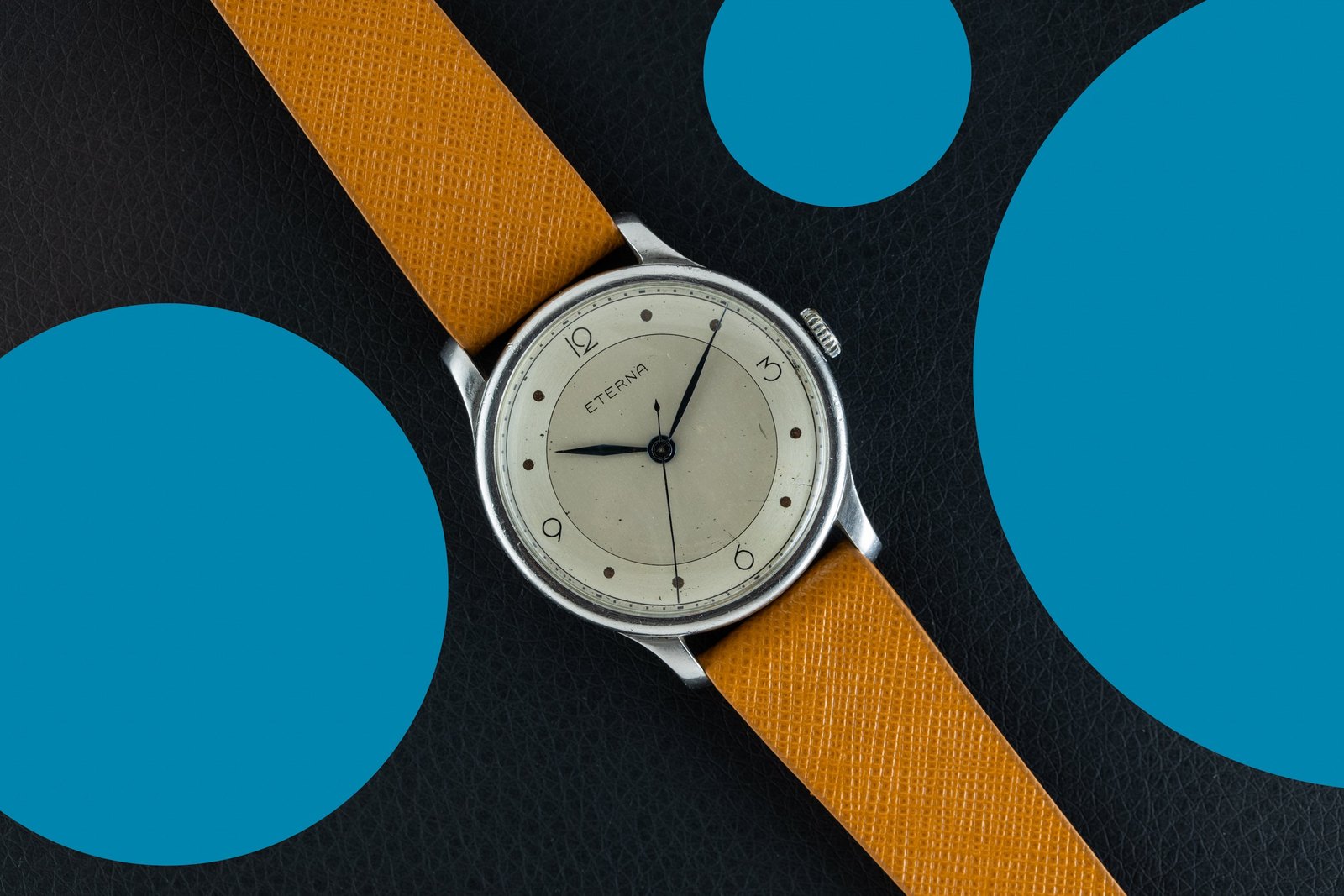
Eterna Oversized Calatrava, 1930s
- Maker / attribution
- Eterna (maker)
- Date
- 1930s
- Historical period
- Golden Age of Mechanical Watchmaking (1900 – 1945)
- Country of origin
- Switzerland
- Object type
- Wristwatch
- Dimensions
- Case 38.5 mm
- Stock no.
- 40990023
- Credit line
- Dealer listing, Analog/Shift (40990023)
- Catalogue title (original)
- Eterna Oversized Calatrava (English)
View the source record (dealer listing) ↗ (opens another website in a new tab)Suggest a correction
Record summary
Catalogued by Analog/Shift (dealer), New York (stock number 40990023), this is a wristwatch by Eterna, made in Switzerland, dated 1930s. The Atlas places it in the Golden Age of Mechanical Watchmaking period (1900 – 1945) of its Wristwatches collection. Recorded dimensions: Case 38.5 mm. The record is illustrated with 6 photographs.
Assembled from the source record's structured fields. Dates and attributions are given as the source states them; where a field is missing the Atlas leaves it blank rather than estimating.
Catalogue description
Dealer description — Analog/Shift
Why We Love It In a marketplace bursting at the seams with sporty tool watches, it is sometimes easy to forget that timepieces can also be elegant, artistic expressions of the wearer's style. This stunning Eterna dates to the 1930s and features a beautiful two tone silver dial with Art Deco indices with blued steel 'feuille' hands. Powered by the Eterna Calibre 852 manually wound mechanical movement, this snap-back case is oversized at 38.5mm, a behemoth for the time and absolutely perfect for today's modern style. It also features fixed bars, indicating it was designed for use in the field. This lovely piece harkens to a time when personal style wasn't dictated by social media influencers or celebrity endorsements, and legendary manufacturers like Eterna were designing watches to near-perfection. Absolutely lovely. The Story Eterna is known by collectors for two main reasons: Their contribution to the development of the automatic winding movement, and a man named Thor who wore one on his wrist while traversing the Pacific on a hand-made balsa wood raft! The latter is a story for another time, but their help in developing the modern automatic movement is nothing short of legendary. Their contribution to the technology was the implementation of five ball bearings used in attaching the rotor to the movement, helping reduce friction and maintain accuracy while being worn and used. The layout of these bearings, a pentagonal shape, was adopted by the brand as their logo in the 1950s, and remains to this day. But the history of the brand goes back nearly 100 years before the introduction of the automatic movement, and the range of vintage Eterna pocket watches and wristwatches from the 1850s to today is about as diverse as one can imagine, with petite, ultra-thin gold dress pieces on one end of the spectrum, and large steel divers on the other. Regardless of your taste, the history and design of Eterna watches is rich and there's almost certainly something for every collector to enjoy.
Historical context
Golden Age of Mechanical Watchmaking (1900 – 1945)
The wristwatch displaces the pocket watch; waterproof cases, self-winding and grand complications.
The wristwatch overtook the pocket watch. Military use in the First World War, aviation, water-resistant cases (1926), automatic winding (1923–31), rectangular Art Deco designs and early chronographs and calendars defined the period.
Read the period in the timelineMore wristwatches from this periodEarlier: Industrial Revolution
Atlas type guide
Wristwatches
Bracelet watches were worn by women from the early nineteenth century — Breguet made one for Caroline Murat, Queen of Naples, in 1810–12 — but the wristwatch only became a man's instrument with military use and aviation in the early twentieth century. Between the World Wars it overtook the pocket watch; the 1920s and 1930s brought rectangular Art Deco cases, water-resistant cases and the first automatic winding systems.
After 1945 the wristwatch became a carrier of identity — dress watches, sports and dive watches, chronographs, calendars — produced by Swiss, American, Japanese, German, Soviet and Chinese industries. The quartz revolution after 1969 and the mechanical renaissance since the 1990s, including the rise of independent watchmakers, complete the story.
What to look for
- The reference number (between the lugs or inside the case back) and serial number, the starting point for dating.
- The calibre: its maker and number are often stamped under the dial or on the bridge.
- Originality of dial, hands and crown — refinished ('redial') dials are common.
- Case material marks: 18K/750, 14K/585, stainless steel, gold-filled, plated.
Dating clues
- Wire-lug cases: before c. 1925.
- Water-resistant screw-down cases: from 1926.
- Quartz movements: from 1969; sapphire crystals widespread after c. 1980.
General guidance written by the Atlas editors about this kind of object. It is not a statement about this particular piece; for that, rely on the source record above and on physical examination.
Related records

Wristwatches · 1945
Wristwatch by Eterna, 1945
Museum Rotterdam
Wristwatches · 1900–1999
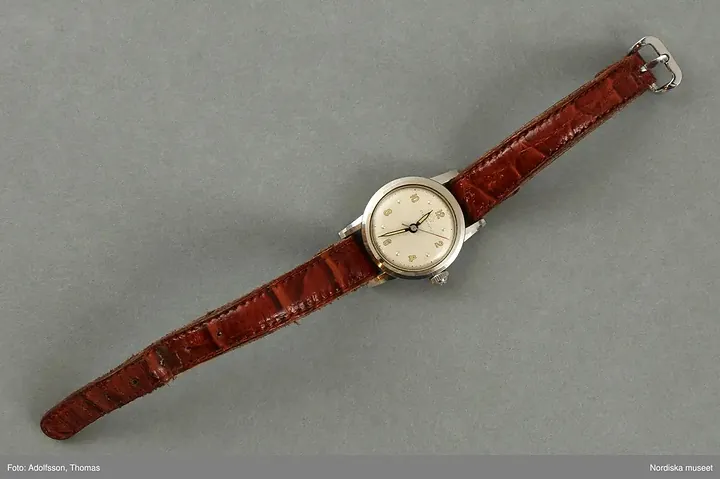
Wristwatch by Eterna, Sweden, 1900–1999
Nordic Museum Foundation
Wristwatches · c. 1930s
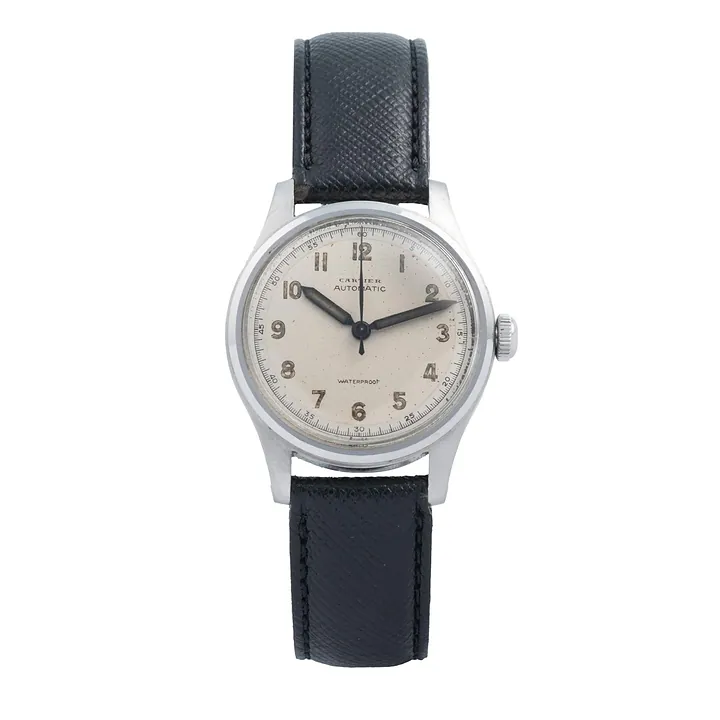
Eterna wristwatch, c. 1930s
Antiquorum auction archive, Geneva
Pocket Watches · 1934
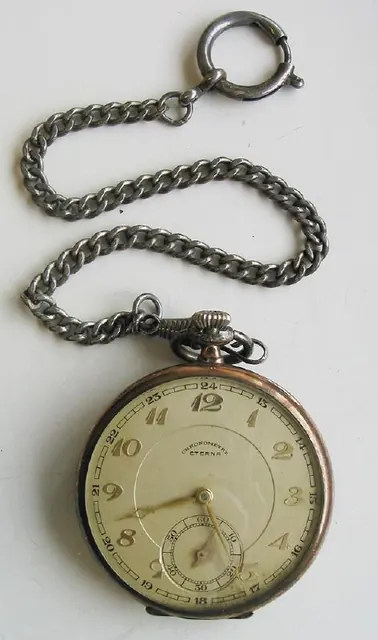
Pocket watch by Eterna, Switzerland, 1934
Turun kaupunginmuseo

Wristwatches · 1931
Rolex 'Oyster Perpetual' rotor self-winding wrist-watch, lever escapement, in steel case with glass in back, Montres Rolex SA, Geneva, Switzerland, 1931
Science Museum Group, London

Wristwatches · 1900–1999
Wristwatch by Certina, Switzerland, 1900–1999
Nordic Museum Foundation

Wristwatches · 1900–1999
Wristwatch by Omega, Västerås, 1900–1999
Nordic Museum Foundation

Wristwatches · 1900–1999
Wristwatch by Universal, Switzerland, 1900–1999
Nordic Museum Foundation