
Wristwatches · Cocktail watch
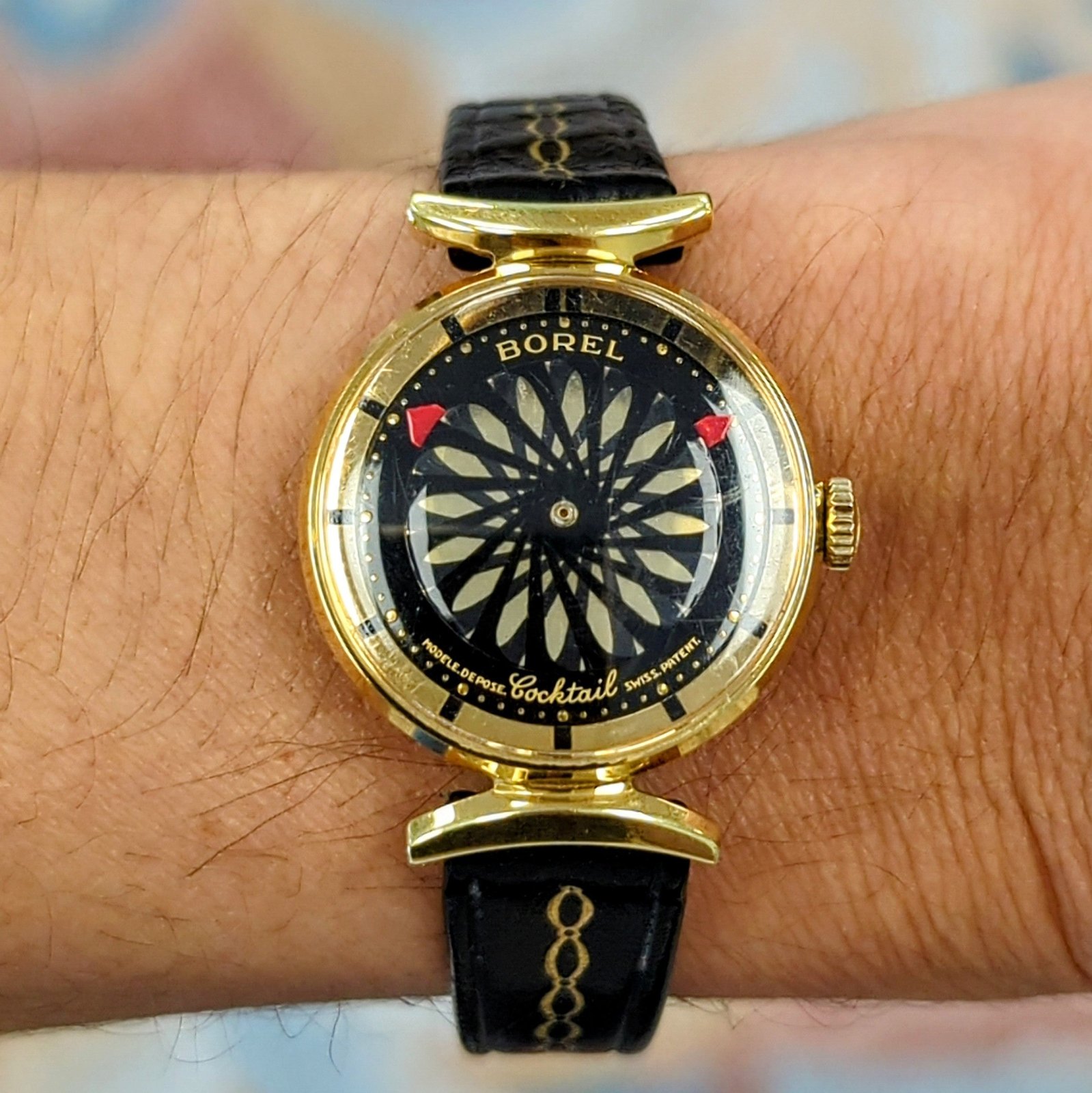
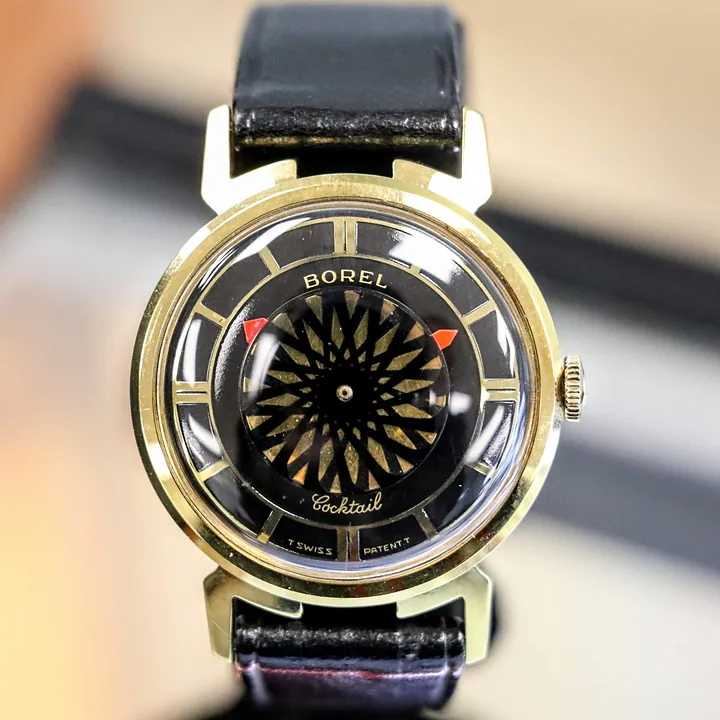
Ernest Borel Ladies Cocktail Kaleidoscope Dial Wristwatch
- Maker / attribution
- Ernest Borel (source attribution)
- Date
- 1950s
- Historical period
- Modern Mechanical Horology (1945 – 1969)
- Country of origin
- Switzerland
- Object type
- Cocktail watch
- Dimensions
- 25 mm
- Holding institution
- Secondhand Horology
- Accession / object no.
- WA-3987
- Credit line
- Secondhand Horology
- Catalogue title (original)
- 1950s ERNEST BOREL Ladies Cocktail Watch Kaleidoscope Dial 25mm Swiss – SECOND HAND HOROLOGY (English)
View the source record ↗ (opens another website in a new tab)Suggest a correction
Record summary
Held and catalogued by Secondhand Horology (object number WA-3987), this is a cocktail watch attributed to Ernest Borel, made in Switzerland, dated 1950s. The Atlas places it in the Modern Mechanical Horology period (1945 – 1969) of its Wristwatches collection. Recorded dimensions: 25 mm. The record is illustrated with 1 photograph.
Assembled from the source record's structured fields. Dates and attributions are given as the source states them; where a field is missing the Atlas leaves it blank rather than estimating.
Catalogue description
Original object description
Encased in a gold-toned circular body with curved fancy lugs, this Ernest Borel Cocktail wristwatch for women measures 25 mm in diameter, 32.6 mm from lug to lug, 9.7 mm in thickness, and 11 mm across the lug spacing. The case side is engraved "ERNEST BOREL SWISS". The dial is fitted with a rotating black and gold petal-motif kaleidoscope disc read against two red boundary arrow pointers, surrounded by the words "BOREL", "Cocktail", "MODELE DEPOSE", and "SWISS PATENT". Attached to the watch is an attributed original two-piece black leather band bearing gold-colored interlocking loops, fitting wrists measuring up to 17.2 cm (6 3/4 inches). The dealer suggests a 1950s production date based on the 1952 patent, 1953 market introduction, and the model's prolonged manufacturing run through circa 1980. However, this early attribution directly conflicts with the vendor's report of a visible, unadjusted 17-jewel Swiss movement inscribed "Synchron 26" beneath an exhibition case back—a moniker from the later Synchron holding period—an anomaly left unresolved due to the lack of case serial numbers. Additionally, the listing provides contradictory statements regarding the winding system, variously identifying it as a manual-wind and an automatic mechanism.
Historical context
Modern Mechanical Horology (1945 – 1969)
Tool watches for divers, pilots and astronauts; electric watches anticipate the electronic age.
The classic era of the mechanical wristwatch: dive watches, chronographs for motor racing and space flight, GMT watches for jet travel, slim dress watches, automatic calendars, and the rise of Japanese manufacturers alongside Swiss, American, German and Soviet industries.
Read the period in the timelineMore wristwatches from this periodEarlier: Golden Age of Mechanical Watchmaking
Atlas type guide
Wristwatches
Bracelet watches were worn by women from the early nineteenth century — Breguet made one for Caroline Murat, Queen of Naples, in 1810–12 — but the wristwatch only became a man's instrument with military use and aviation in the early twentieth century. Between the World Wars it overtook the pocket watch; the 1920s and 1930s brought rectangular Art Deco cases, water-resistant cases and the first automatic winding systems.
After 1945 the wristwatch became a carrier of identity — dress watches, sports and dive watches, chronographs, calendars — produced by Swiss, American, Japanese, German, Soviet and Chinese industries. The quartz revolution after 1969 and the mechanical renaissance since the 1990s, including the rise of independent watchmakers, complete the story.
What to look for
- The reference number (between the lugs or inside the case back) and serial number, the starting point for dating.
- The calibre: its maker and number are often stamped under the dial or on the bridge.
- Originality of dial, hands and crown — refinished ('redial') dials are common.
- Case material marks: 18K/750, 14K/585, stainless steel, gold-filled, plated.
Dating clues
- Wire-lug cases: before c. 1925.
- Water-resistant screw-down cases: from 1926.
- Quartz movements: from 1969; sapphire crystals widespread after c. 1980.
General guidance written by the Atlas editors about this kind of object. It is not a statement about this particular piece; for that, rely on the source record above and on physical examination.
Related records
Wristwatches · 1970s
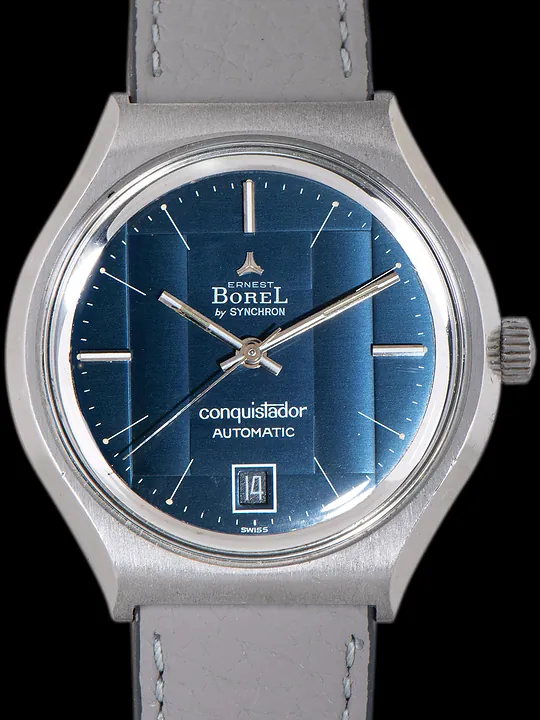
Ernest Borel By Synchron Conquistador (Ref. 58.013.56) Blue Fume Dial, 1970s
Craft & Tailored (dealer), Los Angeles
Wristwatches · Mid-20th century
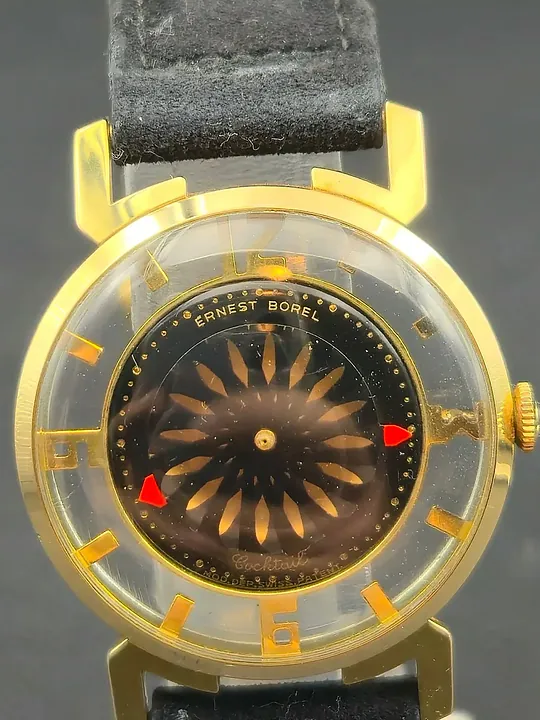
Ernest Borel Kaleidoscope “Cocktail” Dial Wristwatch
Sphere Auctions LLC
Wristwatches · 1950s
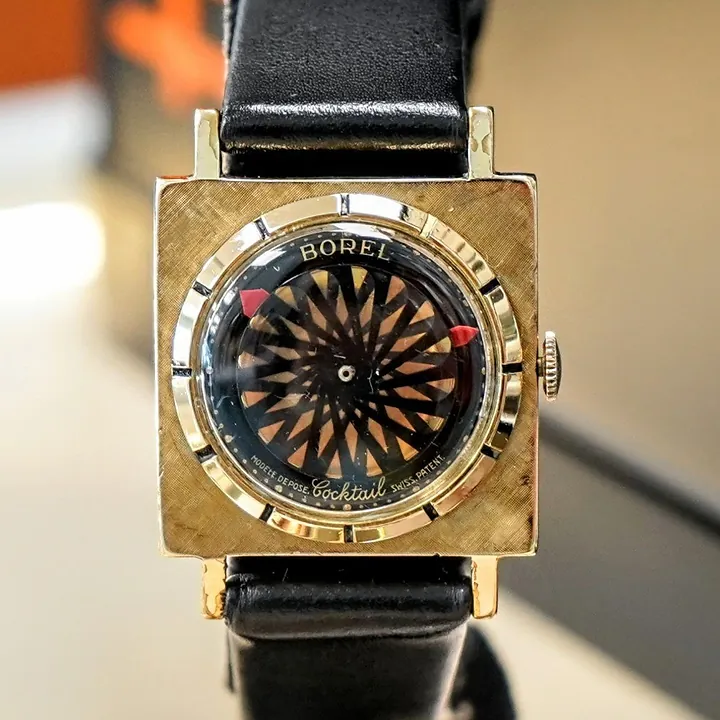
Ernest Borel Cocktail Kaleidoscope Dial Wristwatch
Second Hand Horology
Wristwatches · 1960s (sold May 27, 1967)
Ernest Borel Cocktail Watch Kaleidoscope Dial 32mm
SECOND HAND HOROLOGY

Wristwatches · 1945
Wristwatch by Eterna, 1945
Museum Rotterdam

Wristwatches · c. 1945
Breitling Premier, ref. 790, c. 1945
Antiquorum auction archive, Geneva

Wristwatches · c. 1945
Universal Genève Uni-Compax, ref. 22492, c. 1945
Antiquorum auction archive, Geneva

Wristwatches · c. 1950s
Baume & Mercier wristwatch, c. 1950s
Antiquorum auction archive, Geneva