
Wristwatches · Wristwatch
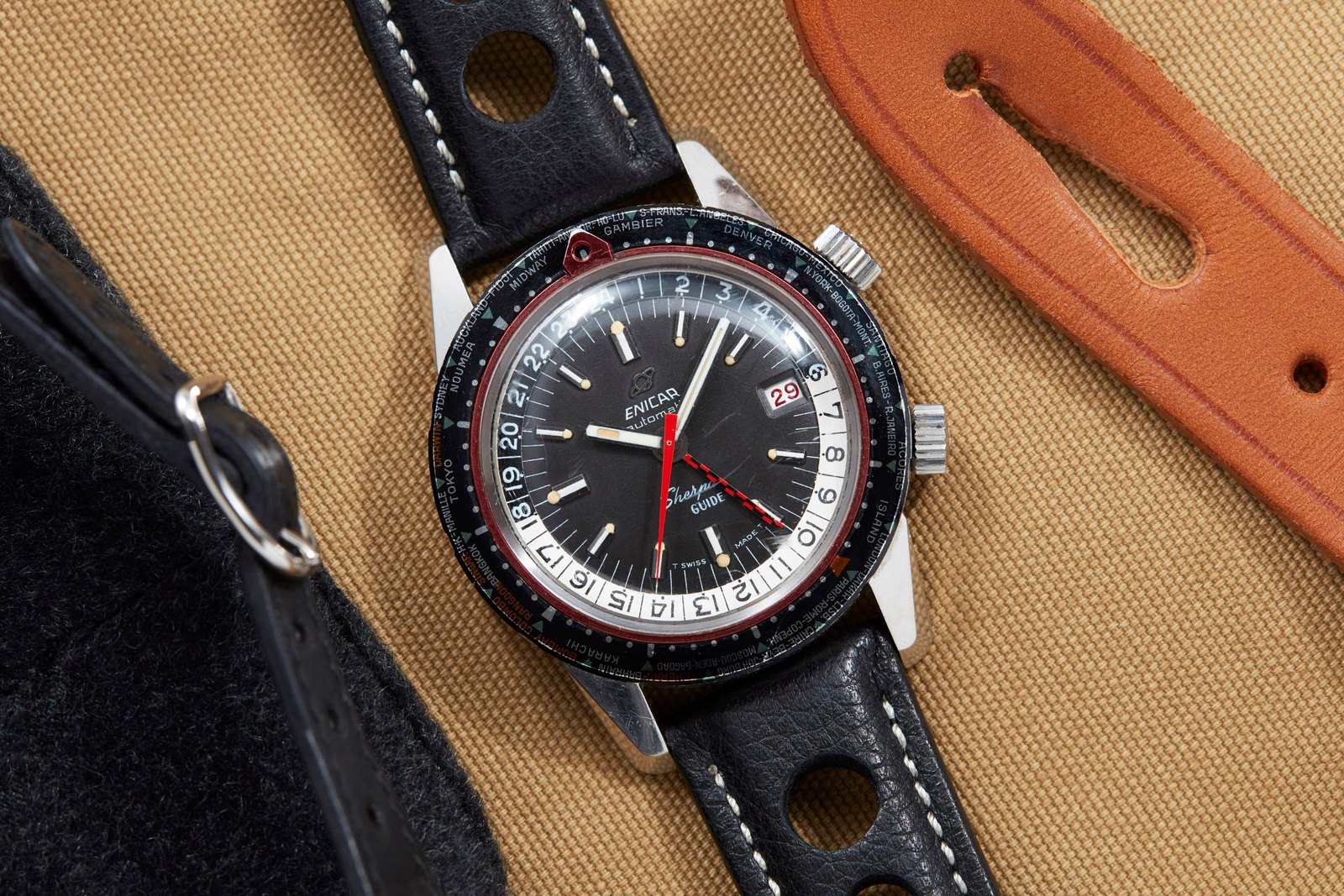
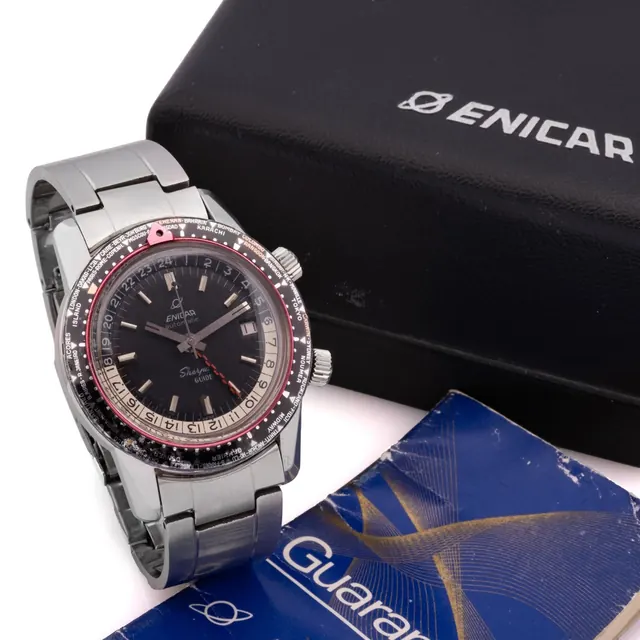
Enicar Sherpa Guide 600 GMT, late 1960s
- Maker / attribution
- Enicar (maker)
- Date
- late 1960s
- Historical period
- Modern Mechanical Horology (1945 – 1969)
- Country of origin
- Switzerland
- Object type
- Wristwatch
- Stock no.
- Product 363178623006
- Credit line
- Dealer listing, Analog/Shift (product 363178623006)
- Catalogue title (original)
- Enicar Sherpa Guide 600 GMT (English)
View the source record (dealer listing) ↗ (opens another website in a new tab)Suggest a correction
Record summary
Catalogued by Analog/Shift (dealer), New York (stock number Product 363178623006), this is a wristwatch by Enicar, made in Switzerland, dated late 1960s. The Atlas places it in the Modern Mechanical Horology period (1945 – 1969) of its Wristwatches collection. The record is illustrated with 6 photographs.
Assembled from the source record's structured fields. Dates and attributions are given as the source states them; where a field is missing the Atlas leaves it blank rather than estimating.
Catalogue description
Dealer description — Analog/Shift
In May of 1956, a team of Swiss mountaineers summited Mount Everest after conquering nearby Lhotse. This was only the second time in history that the mountain, once thought unconquerable, was conquered. Moreover, it was a first for the Swiss, mighty alpine explorers who had left no peak in their native land untouched. Additionally, this marked the first time that climbers of any nationality had summited Lhotse, the fourth-highest mountain in the world. The Sherpas who accompanied them—leading them to the summit and digging out tents that had been covered in overnight snowfall—carried over over ten tons of supplies and equipment. Since the expedition received media attention, naturally the world was curious about what was included. Upon their return, the Bally reindeer boots that they wore, along with the Ovomaltine they drank, became desirable. And the Enicar watches that they wore were renamed “Sherpa” after their intrepid guides. The name conjured images of a desolate wilderness surmounted by snow-capped peaks, but also the redoubtable and courageous men who made that wilderness their home—all perfect qualities for a watch. Over the next decade, Enicar would release over 100 different varieties of Sherpa watches for all sports, not just the mountaineers who made them famous. The Sherpa dive watches, in particular, became some of the most attractive to consumers. So Enicar adapted the sturdy steel cases—capped with rotating bezels—for less aquatic pursuits. Like SCUBA diving, jet travel was on the rise, and watch brands raced against each other to create pilot’s watches that marked time in more than one time zone. The Sherpa GMT at first had only one crown and a rotating bezel, which was, like the Rolex GMT Master, painted in two different colors to delineate AM and PM. However, it’s the later dual-crown models known as the Sherpa Guide GMT that would become the most popular. The Sherpa Guide 600 GMT was released in the early 1960s, and went through three different variations throughout the 1960s. The watch that we offer here is an example of the third variation, Mark III, dating from the late 1960s, which is notable for its thin triangular-shaped seconds hand (here a vibrant red). A beefy tool watch, the Sherpa Guide 600 incorporates date, GMT and 24-hour timing functions that, when used in conjunction with the world-time bezel, enabled the wearer to calculate the time in major cities across the world. Though complex in looks, the Enicar Sherpa Guide is fairly simple to use. Suppose you're in London and it's 2PM and you would like to know the time in San Francisco. First, convert the local time to 24-hour time, making it 1400. Next, rotate the outer world-time bezel so that London (denoted on this bezel as GMT) lines up with the 14 on the inner bezel. Now, locate Los Angeles on the bezel and read the 24-hour time that lines up with it on the inner bezel, and voilà! In addition to the world-time functionality, the Sherpa Guide has a standard GMT complication which, when used with the two tone inner rotating bezel operated by the upper crown, allows the wearer to easily keep track of two time zones simultaneously. Colorful and a touch crazy, this Sherpa Guide is exactly what we love about vintage watches. Functionality and playful looks are rolled up into a package that was designed for rugged every-day wear. A sort of time capsule, where the contemporary cities of Yangon and Mumbai appear as their defunct names—Rangoon and Bombay respectively—make it a charming, wearable reminder of the past.
Historical context
Modern Mechanical Horology (1945 – 1969)
Tool watches for divers, pilots and astronauts; electric watches anticipate the electronic age.
The classic era of the mechanical wristwatch: dive watches, chronographs for motor racing and space flight, GMT watches for jet travel, slim dress watches, automatic calendars, and the rise of Japanese manufacturers alongside Swiss, American, German and Soviet industries.
Read the period in the timelineMore wristwatches from this periodEarlier: Golden Age of Mechanical Watchmaking
Atlas type guide
Military, pilot and travel watches
The wristwatch owes much of its adoption by men to warfare and aviation. Wristlets — small pocket watches soldered with lugs and worn on a strap — were used in colonial campaigns and became standard equipment in the First World War, with protective grilles over the crystal ('shrapnel guards'). Louis Cartier's Santos (1904), designed for the aviator Alberto Santos-Dumont, is often cited as an early purpose-made pilot's watch.
In the Second World War governments specified watches in detail: the German B-Uhr observation watches, the American A-11, and the British 'W.W.W.' (the 'Dirty Dozen' set of 1945). After the war, jet travel brought GMT and world-time watches, which show two or more time zones at once — Louis Cottier's world-time mechanism and the Rolex GMT-Master (1955) are examples.
What to look for
- Military markings on the case back: broad arrow, issue numbers, 'W.W.W.', 'A.T.P.'
- High-legibility black dials with luminous Arabic numerals; oversized crowns for gloved hands.
- 24-hour hands and rotating 24-hour bezels or city rings on GMT/world-time watches.
- Wire lugs on early wristlets converted from pocket watches.
Dating clues
- Wire-lug wristlets: c. 1900–1925.
- Military specifications of the Second World War: 1939–1945.
- GMT and world-time wristwatches: mainly after 1950.
General guidance written by the Atlas editors about this kind of object. It is not a statement about this particular piece; for that, rely on the source record above and on physical examination.
Related records
Wristwatches · 2000
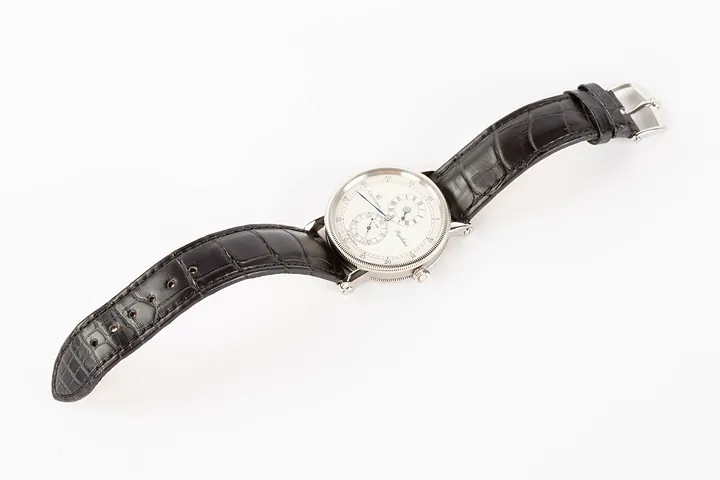
Wristwatch by Enicar, Switzerland, 2000
German Clock Museum
Wristwatches · c. 1960s
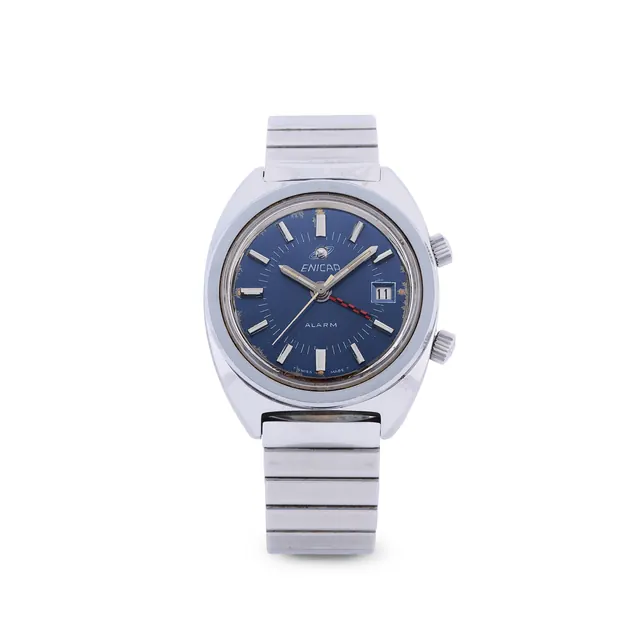
Enicar wristwatch, ref. 477-01-02, circa 1960s
Antiquorum auction archive, Geneva
Wristwatches · c. 1970s
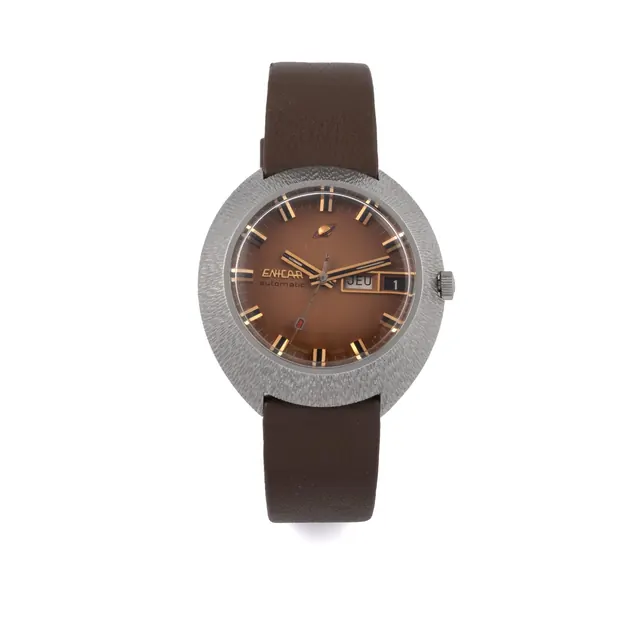
Enicar wristwatch, ref. 144-62-02, Sherpa Star Brown Dial, circa 1970's
Antiquorum auction archive, Geneva
Wristwatches · c. 1970s
Enicar wristwatch, ref. 148-35-01, Sherpa Guide Box and Blank Warranty Booklet, circa 1970's
Antiquorum auction archive, Geneva

Wristwatches · 1945
Wristwatch by Eterna, 1945
Museum Rotterdam

Wristwatches · c. 1945
Breitling Premier, ref. 790, c. 1945
Antiquorum auction archive, Geneva

Wristwatches · c. 1945
Universal Genève Uni-Compax, ref. 22492, c. 1945
Antiquorum auction archive, Geneva

Wristwatches · c. 1950s
Baume & Mercier wristwatch, c. 1950s
Antiquorum auction archive, Geneva