
Wristwatches · Wristwatch
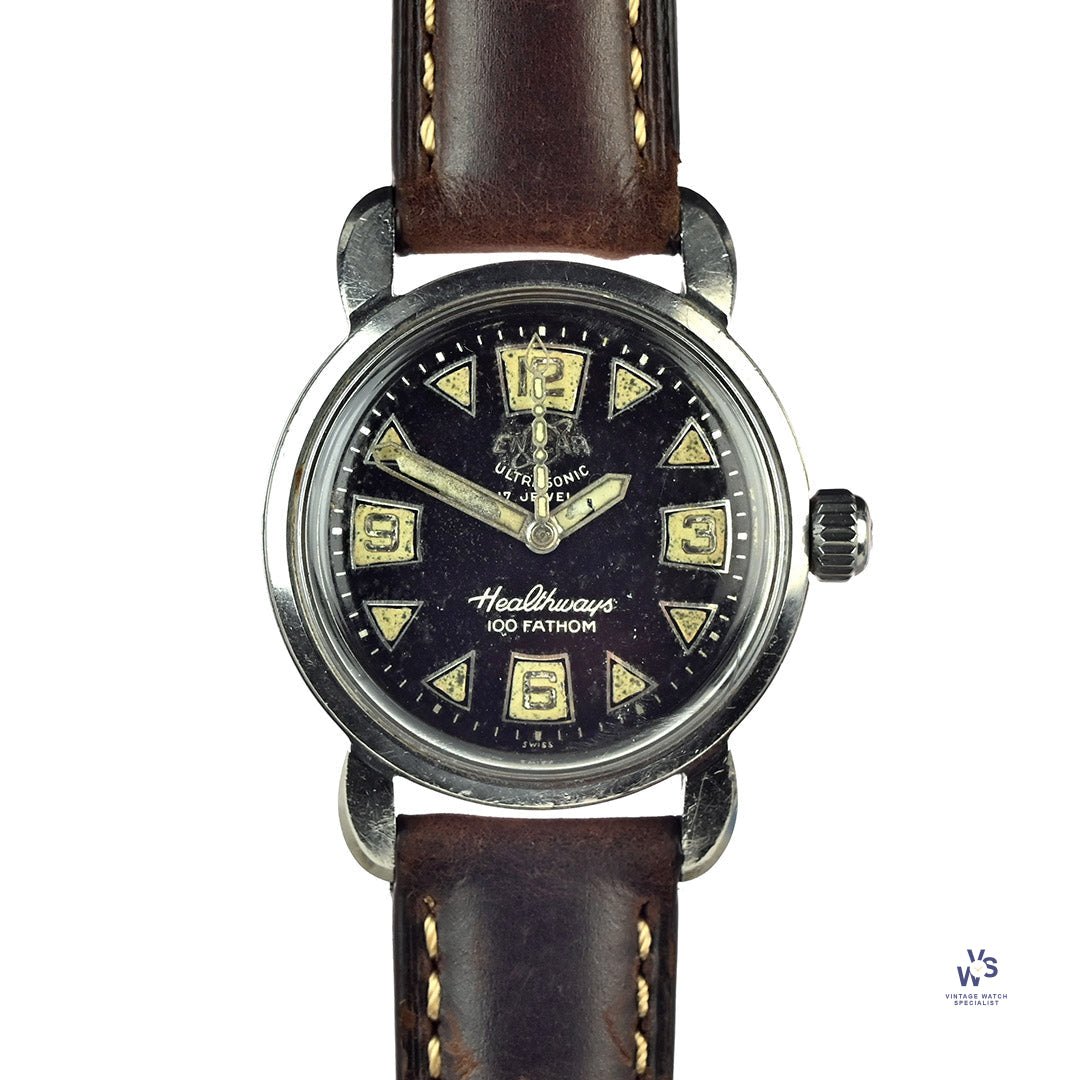
Enicar 100 Fathoms Healthways Dive Watch, circa 1955
- Maker / attribution
- Enicar (maker)
- Date
- c. 1955
- Historical period
- Modern Mechanical Horology (1945 – 1969)
- Country of origin
- Switzerland
- Object type
- Wristwatch
- Dimensions
- Case 34 mm
- Stock no.
- VWS3256
- Credit line
- Dealer listing, Vintage Watch Specialist (VWS3256)
- Catalogue title (original)
- Enicar 100 Fathoms Healthways Dive Watch - c.1955 (English)
View the source record (dealer listing) ↗ (opens another website in a new tab)Suggest a correction
Record summary
Catalogued by Vintage Watch Specialist (dealer), United Kingdom (stock number VWS3256), this is a wristwatch by Enicar, made in Switzerland, dated c. 1955. The Atlas places it in the Modern Mechanical Horology period (1945 – 1969) of its Wristwatches collection. Recorded dimensions: Case 34 mm. The record is illustrated with 6 photographs.
Assembled from the source record's structured fields. Dates and attributions are given as the source states them; where a field is missing the Atlas leaves it blank rather than estimating.
Catalogue description
Dealer description — Vintage Watch Specialist
A Fantastic Enicar Ultrasonic 100 Fathoms Dive Watch, Co-Branded with Iconic Scuba Gear Brand Healthways, In Superb Condition and Quite Rare, c.1955 Enicar Watches, a Swiss brand with roots dating back to 1913, is synonymous with precision and innovation in horology. Founded by Ariste Racine, the name "Enicar" is simply "Racine" spelled backwards. The brand gained prominence for its robust and reliable timepieces, catering to adventurers and professionals alike. Enicar’s pivotal moment came in the 1950s and 60s with the introduction of their Sherpa series, designed for extreme conditions and famously used during Himalayan expeditions. Renowned for their rugged construction and distinctive designs, Enicar watches often featured automatic movements encased in durable materials. The brand's meticulous craftsmanship ensured longevity and accuracy, making them sought-after by collectors today. Despite facing challenges in the quartz revolution era, Enicar remains an emblem of Swiss watchmaking heritage. Their timepieces continue to be celebrated for combining functional excellence with a touch of vintage charm. Whats on Offer This watch is pretty rare as Enicar's go and this one is in fantastic vintage condition. An iconic dive watch, the dial bears the 100 Fathoms denotation which equates to a depth of 600ft, a decent depth for a 1950s watch. The dial also bears the co-branding 'Healthways', which was a pioneering scuba equipment brand which began its journey in the early 1950s. Originally a health and wellness company, Healthways recognized the growing interest in underwater exploration and shifted focus to meet this burgeoning demand. In 1954, they introduced their first scuba regulator, the "Scuba," which became an industry standard and revolutionized underwater breathing apparatuses. Throughout the 1960s, Healthways continued to innovate by producing a range of diving equipment including masks, fins, snorkels, and buoyancy compensators. Their gear was known for its reliability and affordability, making scuba diving more accessible to the general public. Despite fierce competition from other emerging brands like U.S. Divers (now Aqua Lung), Healthways maintained a strong market presence. The dial is superb, those chunky lumed hour plots and corresponding hands give a striking aesthetic and a real presence. The case and unusual crab leg lugs are also in great shape and even though the watch is mid-size at 34mm, it is robust and wears larger on the wrist. To the case back you will note the Enicar emblem, antimagnetic and incabloc, there is also a brevet/patent number. The watch is paired with a beautiful leather strap with contrast stitch and looks fantastic, this is a great buy and a very worthy addition to any collection but particularly for those with an interest in historic dive watches.
Historical context
Modern Mechanical Horology (1945 – 1969)
Tool watches for divers, pilots and astronauts; electric watches anticipate the electronic age.
The classic era of the mechanical wristwatch: dive watches, chronographs for motor racing and space flight, GMT watches for jet travel, slim dress watches, automatic calendars, and the rise of Japanese manufacturers alongside Swiss, American, German and Soviet industries.
Read the period in the timelineMore wristwatches from this periodEarlier: Golden Age of Mechanical Watchmaking
Atlas type guide
Dive and water-resistant watches
Keeping water and dust out of a wristwatch was a long-standing challenge. Rolex's screw-down Oyster case (1926) and Omega's Marine (1932) were landmarks; in the early 1950s Blancpain's Fifty Fathoms and Rolex's Submariner defined the professional dive watch with rotating bezels for timing dives, luminous dials and high water resistance. The ISO 6425 standard (1982) later codified what a 'diver's watch' must do.
Dive watches became icons of post-war design and exploration, and their evolution — helium escape valves, ceramic bezels, saturation-diving depth ratings — records the history of underwater work.
What to look for
- Unidirectional or bidirectional rotating bezel with minute markings.
- Screw-down crown and case back; depth rating printed on the dial.
- Luminous hands and markers (radium before c. 1960, tritium c. 1960–1998, then Super-LumiNova).
- Reference numbers on the case between the lugs or inside the back.
Dating clues
- Screw-down Oyster cases: from 1926.
- Professional dive watches: from 1953.
- Tritium 'T' marks on dials: c. 1960–1998.
General guidance written by the Atlas editors about this kind of object. It is not a statement about this particular piece; for that, rely on the source record above and on physical examination.
Related records
Wristwatches · 2000
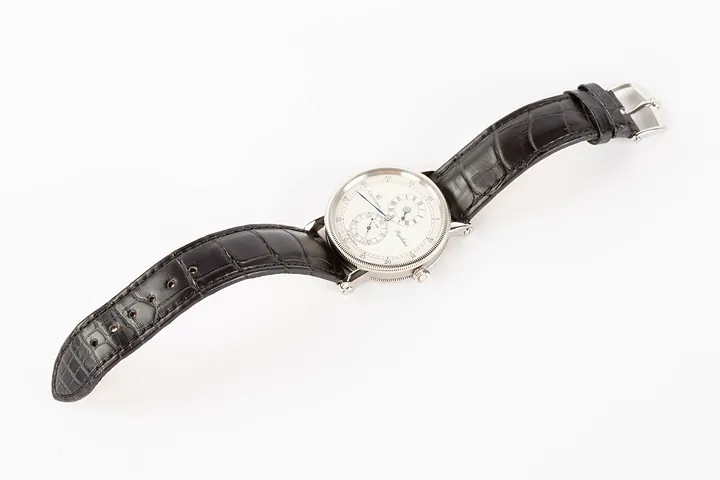
Wristwatch by Enicar, Switzerland, 2000
German Clock Museum
Wristwatches · c. 1960s
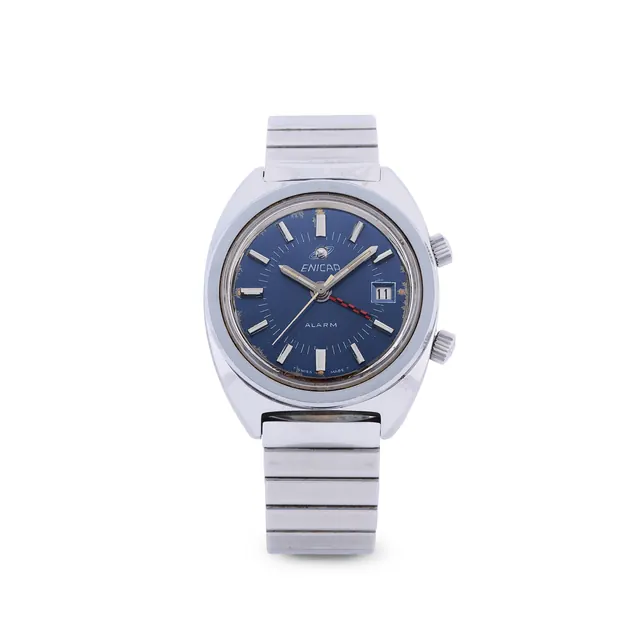
Enicar wristwatch, ref. 477-01-02, circa 1960s
Antiquorum auction archive, Geneva
Wristwatches · c. 1970s
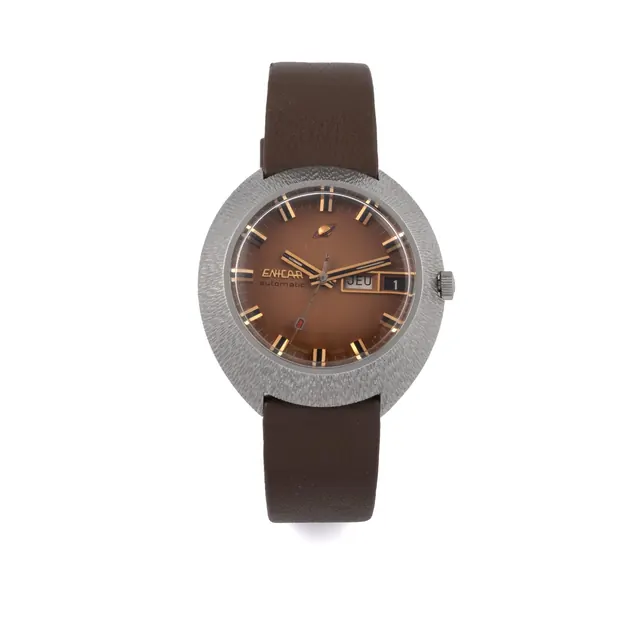
Enicar wristwatch, ref. 144-62-02, Sherpa Star Brown Dial, circa 1970's
Antiquorum auction archive, Geneva
Wristwatches · c. 1970s
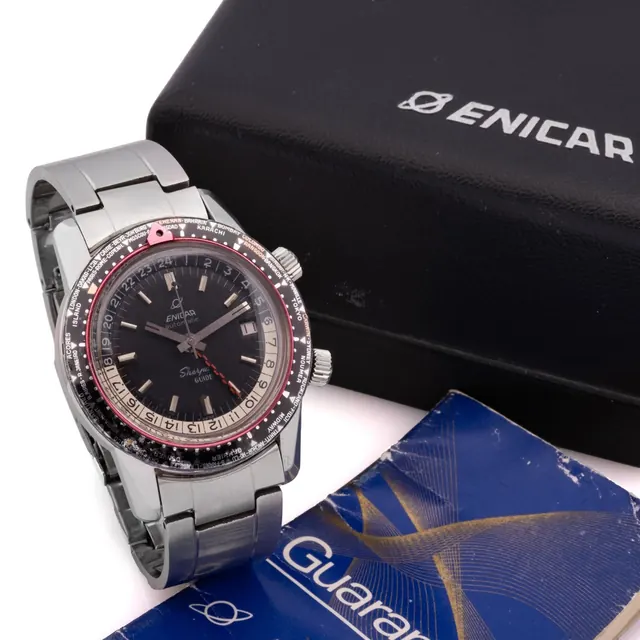
Enicar wristwatch, ref. 148-35-01, Sherpa Guide Box and Blank Warranty Booklet, circa 1970's
Antiquorum auction archive, Geneva

Wristwatches · 1945
Wristwatch by Eterna, 1945
Museum Rotterdam

Wristwatches · c. 1945
Breitling Premier, ref. 790, c. 1945
Antiquorum auction archive, Geneva

Wristwatches · c. 1945
Universal Genève Uni-Compax, ref. 22492, c. 1945
Antiquorum auction archive, Geneva

Wristwatches · c. 1950s
Baume & Mercier wristwatch, c. 1950s
Antiquorum auction archive, Geneva