
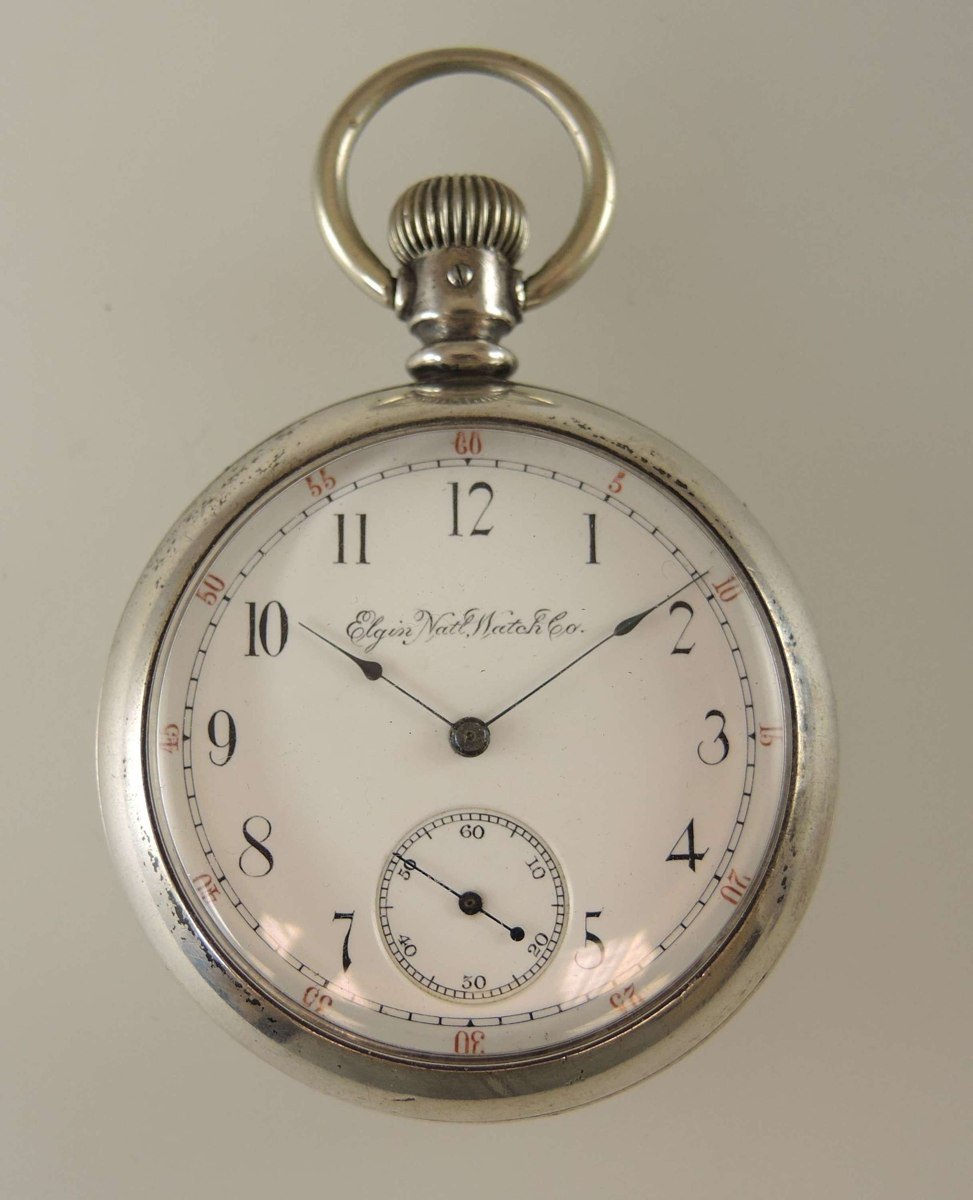
Pocket Watches · Open-face pocket watch
Elgin 16-size convertible pocket watch
- Maker / attribution
- Elgin National Watch Co. (source attribution)
- Date
- c. 1891
- Historical period
- Industrial Revolution (1850 – 1900)
- Country of origin
- United States
- Object type
- Open-face pocket watch
- Dimensions
- 50mm wide x 18mm deep
- Holding institution
- Atlam Watches / Antiques Boutique
- Accession / object no.
- AB-47804
- Credit line
- Atlam Watches / Antiques Boutique
- Catalogue title (original)
- Rare Elgin pocket watch with a convertible movement. c1891 in Antique Pocket Watches (English)
View the source record ↗ (opens another website in a new tab)Suggest a correction
Record summary
Held and catalogued by Atlam Watches / Antiques Boutique (object number AB-47804), this is an open-face pocket watch attributed to Elgin National Watch Co., made in United States, dated c. 1891. The Atlas places it in the Industrial Revolution period (1850 – 1900) of its Pocket Watches collection. Recorded dimensions: 50mm wide x 18mm deep. The record is illustrated with 1 photograph.
Assembled from the source record's structured fields. Dates and attributions are given as the source states them; where a field is missing the Atlas leaves it blank rather than estimating.
Catalogue description
Original object description
Attributed by vendor documentation to circa 1891, this American open-face pocket watch is stated to run on an Elgin National Watch Company 16-size, Model 2, Grade 86 movement featuring 15 jewels and a three-finger bridge. The caliber was engineered to switch between hunting and open-face formats using a specialized lever-setting system, giving it a deeper profile than standard 16-size mechanisms and demanding a custom-proportioned case. The 50 mm wide, 18 mm deep Fahys Coin silver threaded case with matching bezel is fitted with a mineral glass crystal, fluted crown, and curved bow; it shows minor surface handling and is noted to have a replaced bow alongside light bruising and scratching. Its white enamel dial displays black Arabic numerals, an outer ring of red five-minute intervals, a subsidiary seconds track at 6 o'clock, and blued steel spade hands, signed at the top register with "Elgin Natl. Watch Co." in cursive script. The vendor reports the movement is damascened, contains a lever escapement and micrometer regulator, and is engraved "Elgin Nat’l Watch Co, Adjusted, 4329351". Engaging the setting lever reportedly lifts the larger lower wheel by the mainspring to mesh with the center wheel for hand adjustment, disengaging when reset. The case back is stamped "Fahys Coin, Pat Feb 19th 1884". Because the supplied photograph shows only the exterior face, internal details such as the three-finger bridge, damascening, convertible wheel mechanism, movement number 4329351, and the Fahys marking are unverified.
Inscriptions & marks
4329351
Historical context
Industrial Revolution (1850 – 1900)
American interchangeable-parts manufacture; railroad time standards; Swiss and German factory systems.
Machine production with interchangeable parts, pioneered by Waltham (1850s) and adopted by Elgin, Longines, Omega and others, made reliable lever watches widely affordable. Keyless winding became standard, railroad watch standards were introduced (1890s), and Swiss and American industries competed globally.
Read the period in the timelineMore pocket watches from this periodEarlier: Precision & Scientific Horology
Atlas type guide
Hunter, half-hunter and open-face watches
In the nineteenth century the pocket watch case settled into a few standard forms. The hunter (French savonnette) has a hinged front lid protecting the crystal — reputedly for riders who could not risk broken glass — and is opened by pressing the crown or a push-piece. The half-hunter has a small window in the lid so the hands can be read when closed. The open-face (lépine) watch has no front cover, with the crown at 12; hunters normally carry the crown at 3.
Case types also changed with winding: key-wound watches gave way to keyless (stem-wound) mechanisms after Adrien Philippe's and others' designs of the 1840s, with pendant setting or lever setting.
What to look for
- Crown position relative to the seconds dial: at 3 for hunters, at 12 for open-face watches.
- Spring-loaded front cover with a push-piece in the pendant.
- Half-hunter chapter ring enamelled on the lid.
- Key holes in the inner dome (cuvette) versus keyless winding.
Dating clues
- Keyless winding spread after c. 1850 and became standard by c. 1890.
- English hallmarks inside gold and silver cases give the year of assay.
General guidance written by the Atlas editors about this kind of object. It is not a statement about this particular piece; for that, rely on the source record above and on physical examination.
Related records
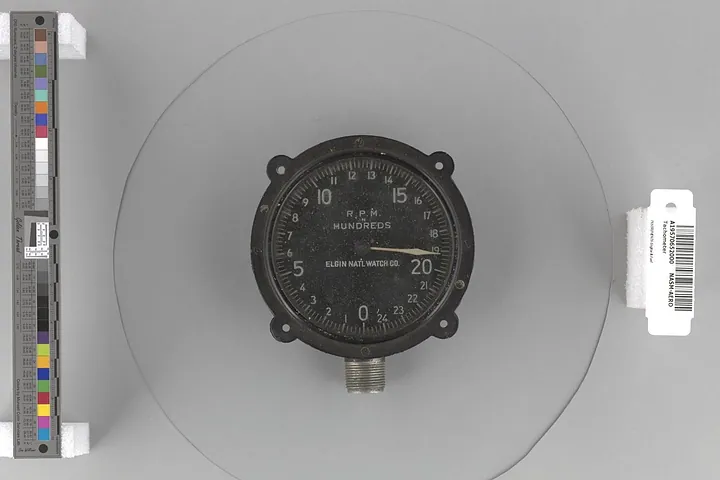
Pocket Watches · 1918
Instruments-engine & fuel by Elgin National Watch Co., United States, 1918
National Air and Space Museum, Smithsonian Institution, Washington DC
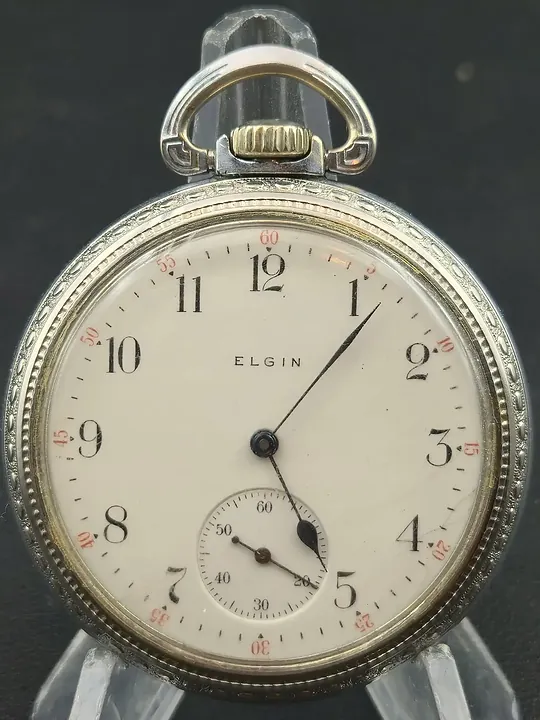
Pocket Watches · 1908
1908 Elgin Grade 291 16s Open-Face Pocket Watch
Sphere Auctions LLC
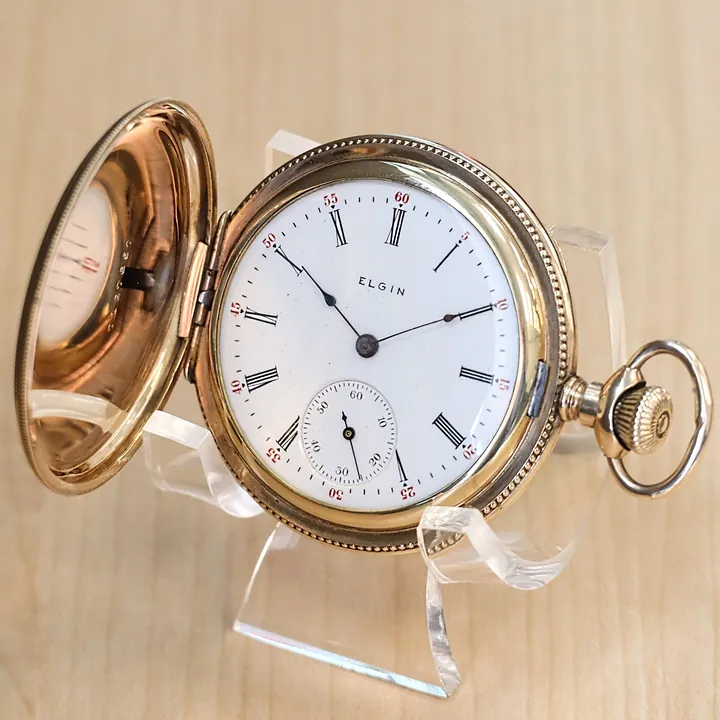
Pocket Watches · 1905
1905 Elgin Grade 289 Hunter Case Pocket Watch
Second Hand Horology
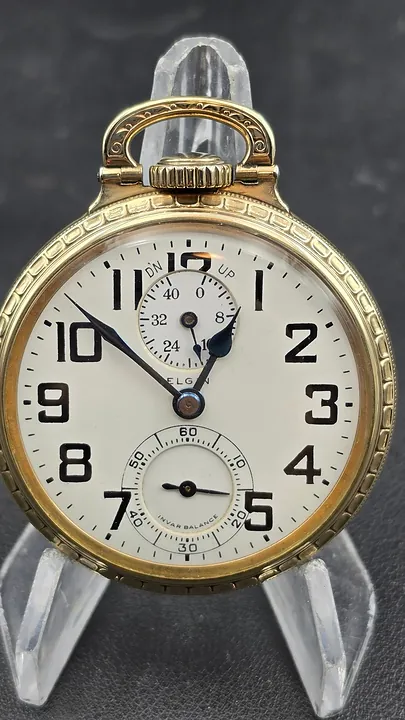
Pocket Watches · 1924
1924 Elgin B.W. Raymond Railroad Grade Pocket Watch, Grade 472
Sphere Auctions LLC
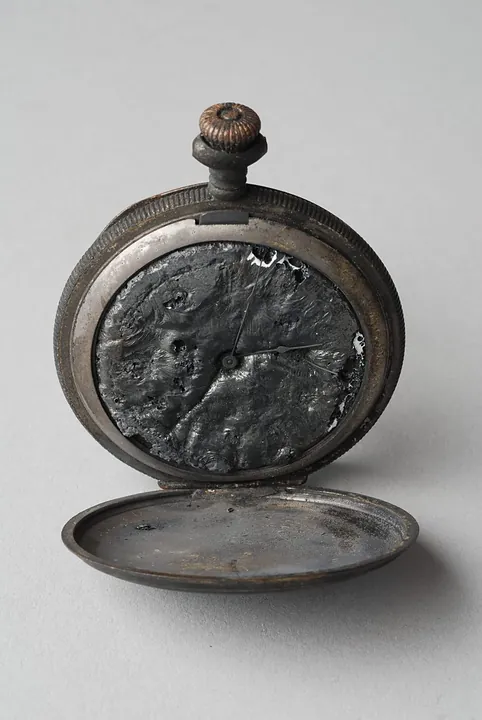
Pocket Watches · 1850
Pocket watch by Standard Watch, United States, 1850
Museum Rotterdam
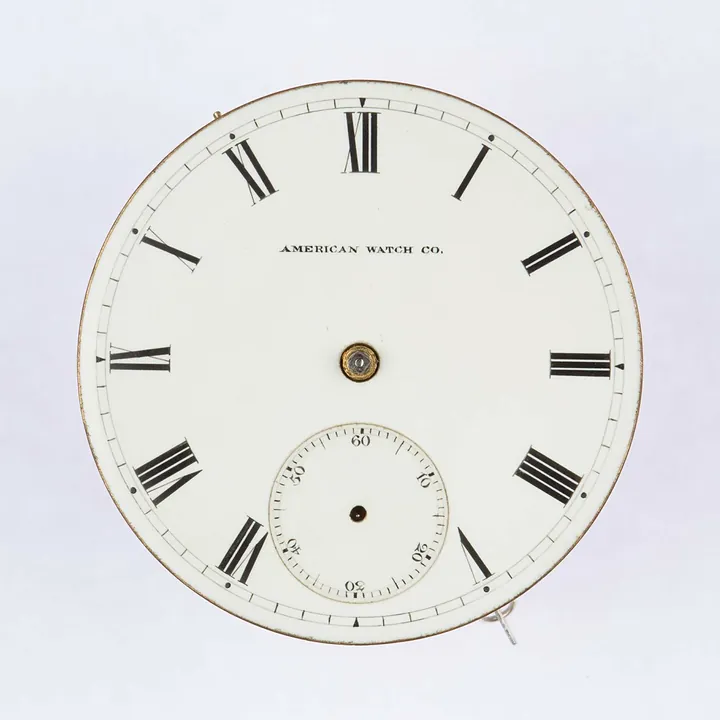
Pocket Watches · 1877
Pocket watch by Waltham A. W. W. Co., United States, 1877
German Clock Museum
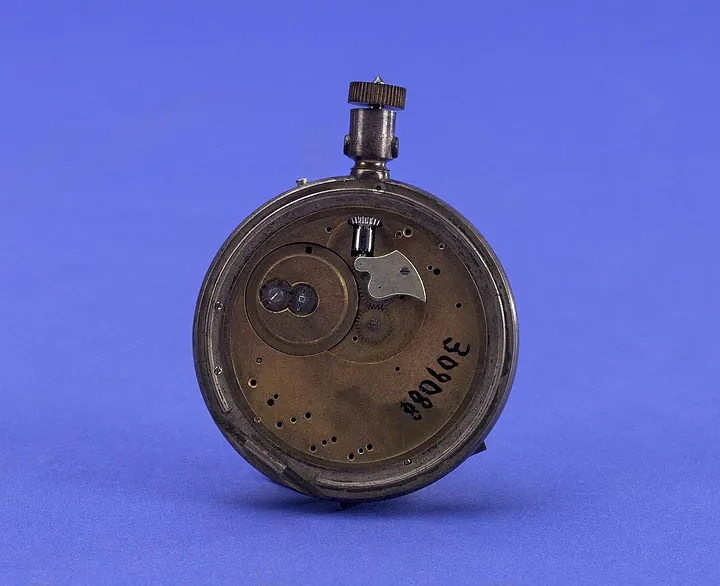
Pocket Watches · 1879
Watch by P. H. Gontard, United States, 1879
National Museum of American History, Smithsonian Institution, Washington DC
Pocket Watches · c. 1882
Pocket watch, United States, c. 1882
German Clock Museum