
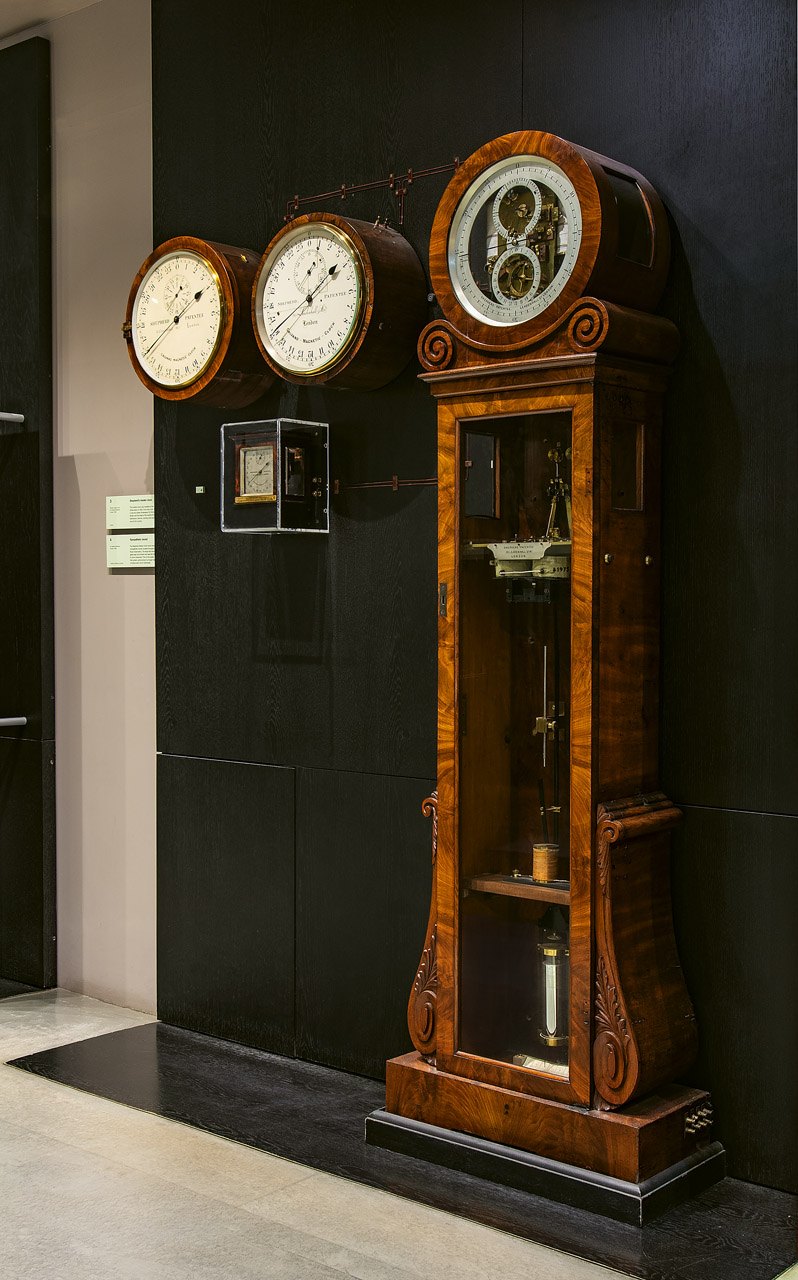
Clocks · Electrical motor clock
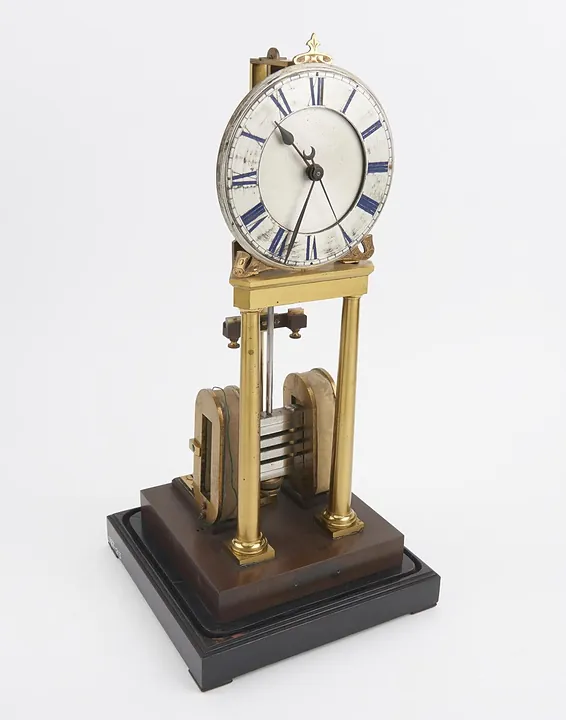
Electrical motor clock by Charles Shepherd
- Maker / attribution
- Charles Shepherd (maker)
- Date
- c. 1852
- Historical period
- Industrial Revolution (1850 – 1900)
- Country of origin
- Unrecorded in source
- Object type
- Electrical motor clock
- Materials / technique
- metal; wood; glass; mercury
- Dimensions
- Overall: 1900 x 590 x 260 mm
- Holding institution
- Royal Museums Greenwich
- Accession / object no.
- ZAA0531
- Credit line
- National Maritime Museum, Greenwich, London
- Catalogue title (original)
- Electrical motor clock (English)
View the source record ↗ (opens another website in a new tab)Suggest a correction
Record summary
Held and catalogued by Royal Museums Greenwich (object number ZAA0531), this is an electrical motor clock by Charles Shepherd, dated c. 1852. The Atlas places it in the Industrial Revolution period (1850 – 1900) of its Clocks collection. Materials and techniques recorded by the source: metal; wood; glass; mercury. Recorded dimensions: Overall: 1900 x 590 x 260 mm. The record is illustrated with 5 photographs.
Assembled from the source record's structured fields. Dates and attributions are given as the source states them; where a field is missing the Atlas leaves it blank rather than estimating.
Catalogue description
Catalogue description — Royal Museums Greenwich
From 1852 to 1893, this motor clock was the heart of Britain's time system. Its time was sent by telegraph wires to London, Edinburgh, Glasgow, Dublin, Belfast and many other cities. By 1866, time signals were sent from this clock to Harvard University in Cambridge, Massachusetts via the new transatlantic submarine cable. In terms of the distribution of accurate time into everyday life, this is one of the most important clocks ever made. A sympathetic dial connected to this clock, at the gates of the Royal Observatory, was the first clock ever to show Greenwich Mean Time (GMT) directly to the public. In 1851 at the famous Great Exhibition held in Hyde Park, London, one of the world's first ever connected clock systems was installed by Charles Shepherd of Leadenhall Street. It consisted of a central 'motor clock' sending regular electrical impulses to a number of ancillary 'sympathetic' dials. George Airy, the seventh Astronomer Royal, saw the potential advantages of such a system and ordered one to be made for the Royal Observatory in Greenwich. Airy's report to the Observatory's Board of Visitors in 1853 explains the function of the Shepherd motor clock, or 'Normal Clock': ‘This clock keeps in motion a sympathetic galvanic clock in the Chronometer-room, which, therefore, is sensibly correct; and thus the chronometers are compared with a clock which requires no numerical correction. [...] The same Normal Clock maintains in sympathetic movement the large clock at the entrance-gate, two other clocks in the Observatory, and a clock at the London Bridge Terminus of the South-Eastern Railway. [...] It sends galvanic signals every day along all the principal railways diverging from London. It drops the Greenwich Ball and the Ball on the Offices of the Eastern Telegraph Company in the Strand [...] All these various effects are produced without sensible error of time; and I cannot but feel a satisfaction in thinking that the Royal Observatory is thus quietly contributing to the punctuality of business through a large portion of this busy country.’ Charles Shepherd was the son of another noted watchmaker, also called Charles. In 1849 Charles Shepherd Junior (described in the 1851 census as an ‘engineer’), who was just 19 years old, submitted his first patent for ‘Improvements in Working clocks and other timekeepers Telegraphs and Machinery by Electricity’. His developments of this principle were to have profound effects on the history of horology. The electric clock system he exhibited at the Great Exhibition in 1851 and which was supplied to Greenwich Observatory the following year, was to be the basis of Britain’s time-distribution system for the following 70 years. In 1853 Charles Junior was appointed ‘1st Class assistant to the Electric Telegraph Establishment’ working for the East India Company and responsible for overseeing the establishment of a telegraph network for the Indian Government. After an initially good start, Charles Junior’s service became increasingly unsatisfactory and he was dismissed from his post in 1856, presumably returning to England directly, though no certain evidence has been found as yet.
Historical context
Industrial Revolution (1850 – 1900)
American interchangeable-parts manufacture; railroad time standards; Swiss and German factory systems.
Factory production transformed the clock into an everyday object. American makers (Seth Thomas, Ansonia, Waterbury) and German factories (Junghans, Gustav Becker, Lenzkirch) sold millions of shelf, wall and alarm clocks worldwide; France produced standardised Paris movements and carriage clocks; electric time distribution began.
Read the period in the timelineMore clocks from this periodEarlier: Precision & Scientific Horology
Atlas type guide
Electric and synchronous clocks
Alexander Bain patented the electric clock in 1841, and through the later nineteenth century electricity was used both to drive pendulums and to distribute time. Master clocks sent impulses every half-minute or minute to subsidiary ('slave') dials across factories, schools, railway stations and post offices; Matthäus Hipp's toggle (1842) kept pendulums swinging with minimal interference. William Hamilton Shortt's free-pendulum clock (1921), with a slave pendulum doing the mechanical work, became the most accurate mechanical clock ever made in series.
In the 1920s and 1930s synchronous motor clocks, which count the alternating-current cycles of the mains supply (50 or 60 Hz), arrived in homes; Telechron in the United States and Smiths 'Sectric' and Ferranti in Britain made them in great numbers. Battery clocks such as the Bulle, Eureka and ATO used electromagnetic impulsing of balances or pendulums.
What to look for
- Electromagnets, contacts and coils in place of springs or weights.
- Cables, terminal blocks and labels for voltage or frequency.
- Master/subsidiary systems: a subsidiary dial has a stepping mechanism and no escapement.
- Brand names such as Synchronome, Gent, Magneta, Telechron, Smiths, Ferranti.
Dating clues
- Bain and Hipp clocks: from the 1840s.
- Synchronome master clocks: from 1895.
- Synchronous mains clocks: from the late 1920s (UK grid frequency standardised in the 1930s).
General guidance written by the Atlas editors about this kind of object. It is not a statement about this particular piece; for that, rely on the source record above and on physical examination.
Related records
Instruments · 1840–1850
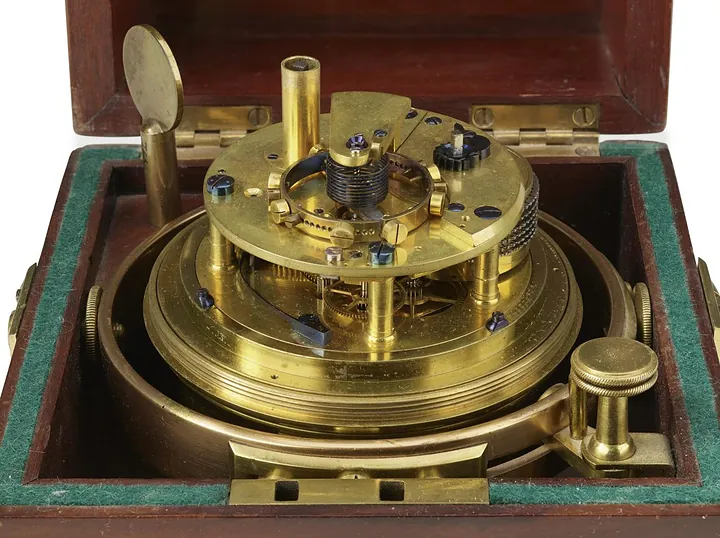
Marine chronometer by Charles Shepherd, England, 1840–1850
Science Museum Group, London
Clocks · 1852
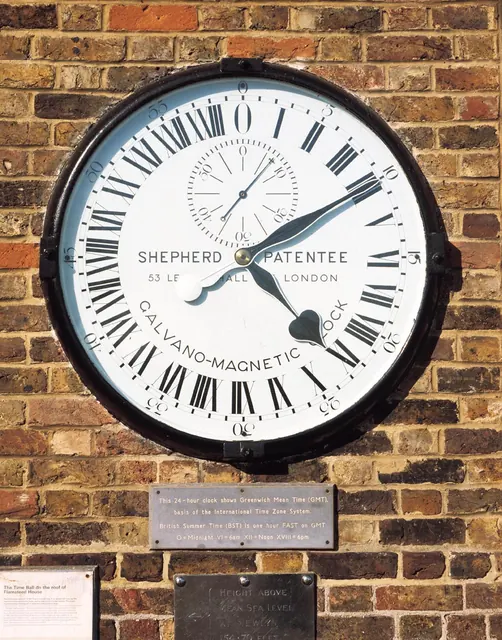
Sympathetic clock and dial by Charles Shepherd
Royal Museums Greenwich
Clocks · c. 1852
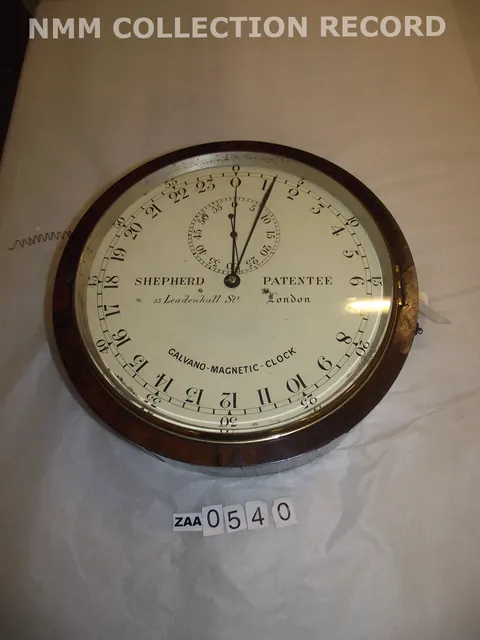
Clock by Charles Shepherd
Royal Museums Greenwich
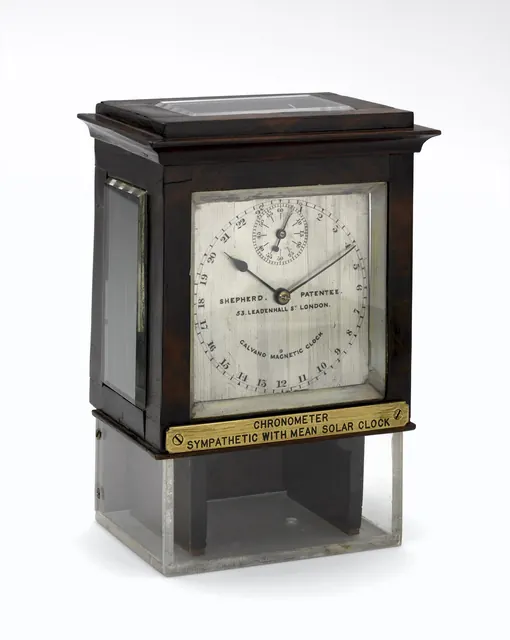
Instruments · c. 1852
Sympathetic chronometer by Charles Shepherd
Royal Museums Greenwich
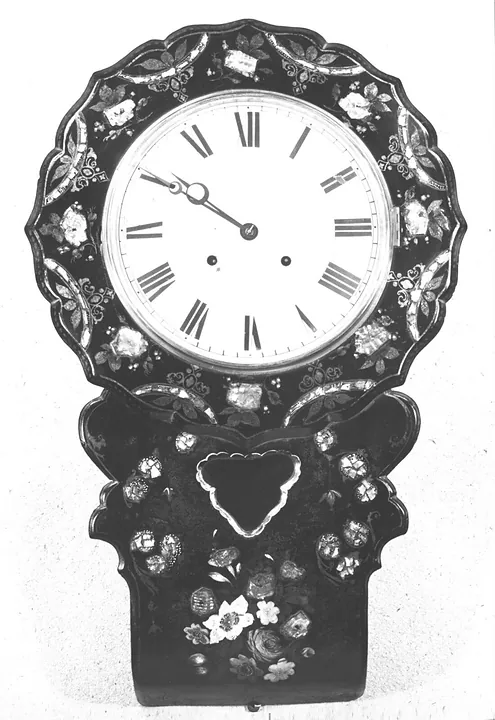
Clocks · 1830–1870
Wall clock in a papier mâché case with painted decoration. English, mid 19th century.
Victoria and Albert Museum, London
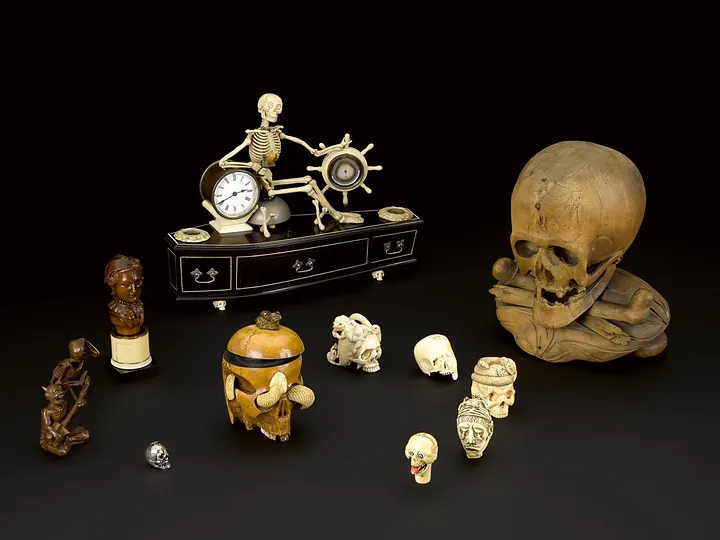
Clocks · 1840–1900
Alarm clock, mounted on model of coffin with skeleton, probably English, 1840–1900
Science Museum Group, London
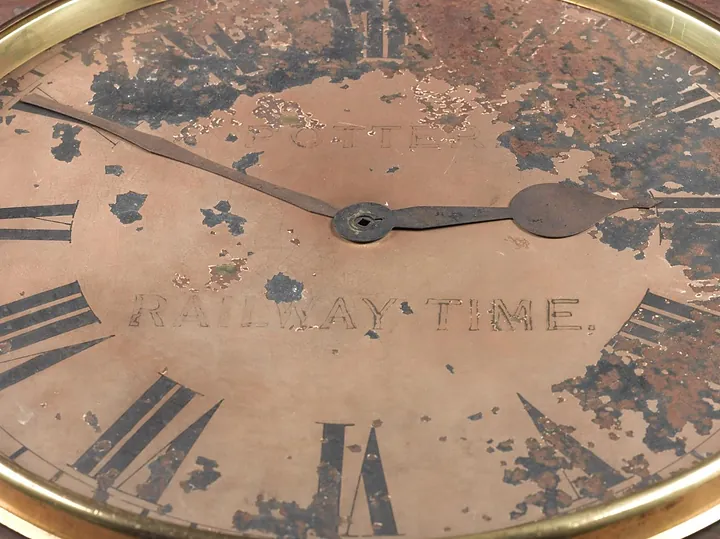
Clocks · 1840–1880
Clock dial marked "Potter, Railway Time" with two hands, unknown maker, British, 1840–1880
Science Museum Group, London
Clocks · 1840–1877
Electric clock of the Bain type
Science Museum Group, London