
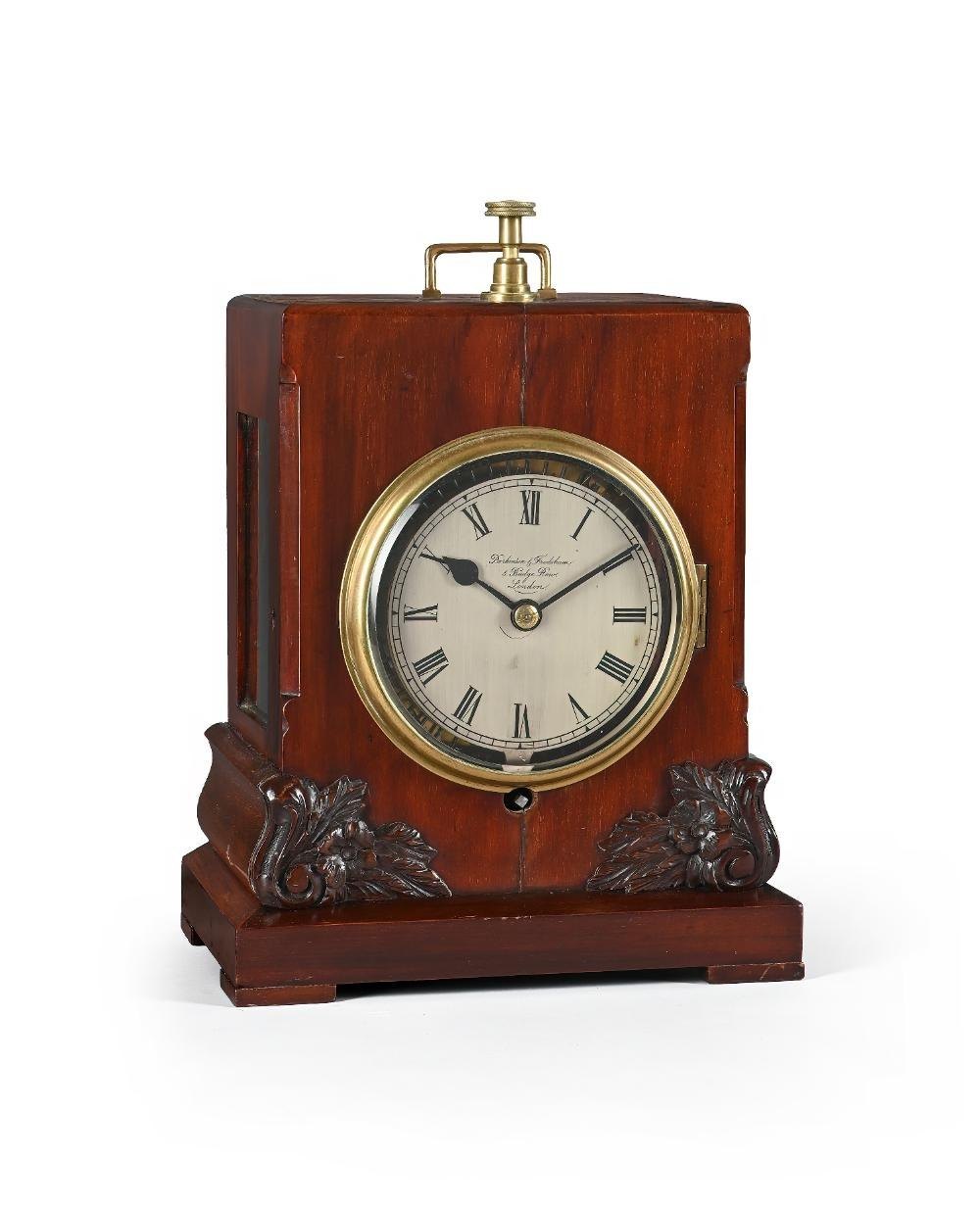
Clocks · Nightwatchman's tell-tale bracket clock
Edwardian mahogany nightwatchman's tell-tale bracket clock
- Maker / attribution
- Parkinson & Frodsham (source attribution)
- Date
- Early 20th century
- Historical period
- Golden Age of Mechanical Watchmaking (1900 – 1945)
- Country of origin
- Unrecorded in source
- Object type
- Nightwatchman's tell-tale bracket clock
- Dimensions
- 36cm high, 26cm wide, 18.5cm deep
- Holding institution
- Dreweatts 1759 Fine Sales, via Invaluable
- Accession / object no.
- edwardian-mahogany-nightwatchman-s-tell-tale-bracket-clock-d815a66ec7
- Credit line
- Dreweatts 1759 Fine Sales, via Invaluable
- Catalogue title (original)
- Edwardian mahogany nightwatchman's tell-tale bracket clock (English)
View the source record ↗ (opens another website in a new tab)Suggest a correction
Record summary
Held and catalogued by Dreweatts 1759 Fine Sales, via Invaluable (object number edwardian-mahogany-nightwatchman-s-tell-tale-bracket-clock-d815a66ec7), this is a nightwatchman's tell-tale bracket clock attributed to Parkinson & Frodsham, dated Early 20th century. The Atlas places it in the Golden Age of Mechanical Watchmaking period (1900 – 1945) of its Clocks collection. Recorded dimensions: 36cm high, 26cm wide, 18.5cm deep. The record is illustrated with 1 photograph.
Assembled from the source record's structured fields. Dates and attributions are given as the source states them; where a field is missing the Atlas leaves it blank rather than estimating.
Catalogue description
Original object description
Dating to the early 20th century, this Edwardian bracket clock functions as a nightwatchman's tell-tale, or noctuary, devised to log the rounds of security patrols. The rectangular case is crafted from mahogany and measures 36 cm in height, 26 cm in width, and 18.5 cm in depth. Supported by squab feet, the case base displays carved floral scroll ornamentation, while glazed side apertures allow observation of the movement within. Time is indicated on a 4.75-inch circular dial of silvered brass marked with Roman numerals and inscribed by the makers "Parkinson & Frodsham, 5 Budge Row, London." Surrounding the central display, an inner silvered band is incised with inverted Roman figures and fitted with radial push-pins placed at 30-minute intervals; depressing an exterior plunger pushes the appropriate pin to verify the guard's presence. Protecting the dial is a circular, hinged brass bezel fitted with bevelled glass. Internally, the mechanism relies on a four-pillar, single chain fusee layout governed by an anchor escapement and a lenticular-shaped pendulum bob, featuring a passing strike mechanism that chimes against a bell inside the housing.
Historical context
Golden Age of Mechanical Watchmaking (1900 – 1945)
The wristwatch displaces the pocket watch; waterproof cases, self-winding and grand complications.
Between 1900 and 1945 clocks were electrified: master-clock systems ran factories and offices, synchronous mains clocks entered homes, and the Shortt free-pendulum clock set new standards of accuracy before the first quartz clocks (1927). Art Deco design reshaped mantel and table clocks.
Read the period in the timelineMore clocks from this periodEarlier: Industrial Revolution
Atlas type guide
Timers, stopwatches, chronoscopes and time recorders
Instruments for measuring short intervals or recording when something happened form a large and practical branch of horology. Sports stopwatches and split-seconds timers, laboratory chronoscopes (such as Hipp's, which measured thousandths of a second for psychology and ballistics experiments), metronomes for music, watchmen's clocks that recorded patrol rounds, and the time recorders that clocked factory workers in and out all derive from clock and watch technology.
These objects matter historically because they show timekeeping leaving the observatory and the drawing room and entering industry, science and sport. Many were mass-produced, and their dials, scales and patents chart the rise of electrification and industrial management.
What to look for
- Scales graduated in fifths, tenths or hundredths of a second, or decimal minutes for industrial use.
- Start, stop and reset push-pieces; a second hand that can be stopped independently (split seconds).
- Recording devices: paper discs or tapes, printing mechanisms, keys or punches.
- Patent numbers and dates on the dial or case, which give a terminus post quem.
Dating clues
- Hipp chronoscopes were made from the 1840s into the twentieth century.
- Employee time recorders spread from the 1890s (Bundy, IBM, International Time Recording Co.).
- Quartz and electronic timers replaced mechanical stopwatches in sport from the 1970s.
General guidance written by the Atlas editors about this kind of object. It is not a statement about this particular piece; for that, rely on the source record above and on physical examination.
Read next:ChronographFlyback chronograph
Related records
Instruments · c. 1821–1822
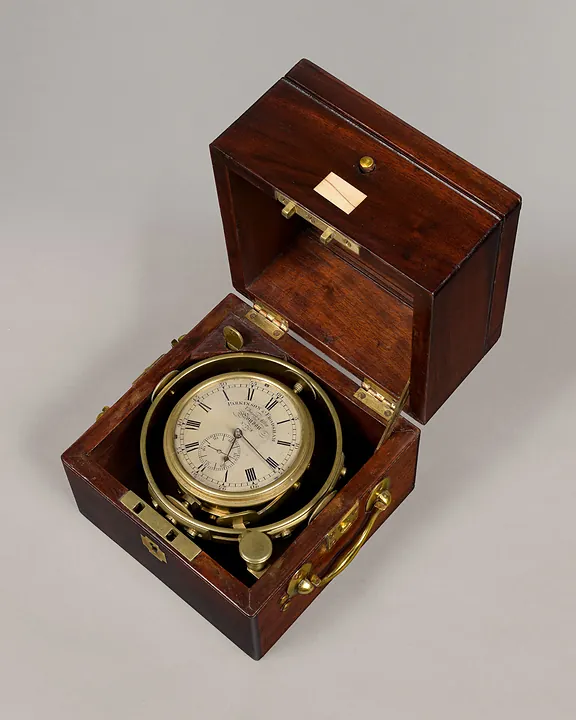
Marine chronometer by Parkinson & Frodsham, c. 1821–1822
Howard Walwyn Fine Antique Clocks (dealer), London
Clocks · c. 1830–1835
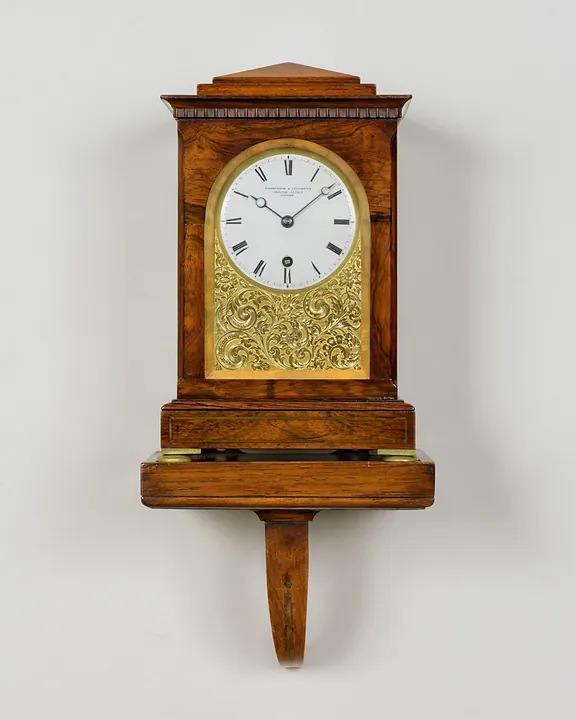
Bracket clock by Parkinson & Frodsham, Change Alley, London, c. 1830–1835
Howard Walwyn Fine Antique Clocks (dealer), London
Instruments · c. 1840
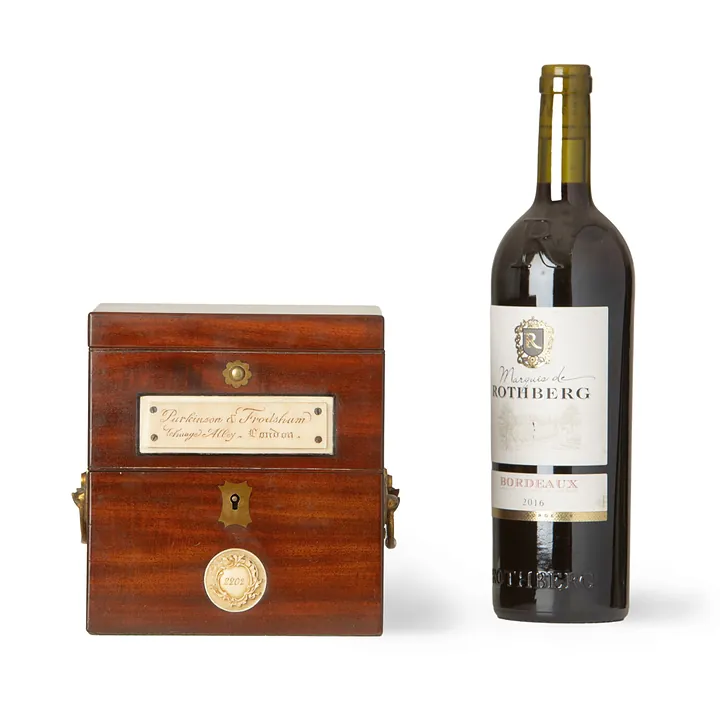
Marine chronometer by Parkinson & Frodsham
The Antique Clock Company (dealer), Dorset
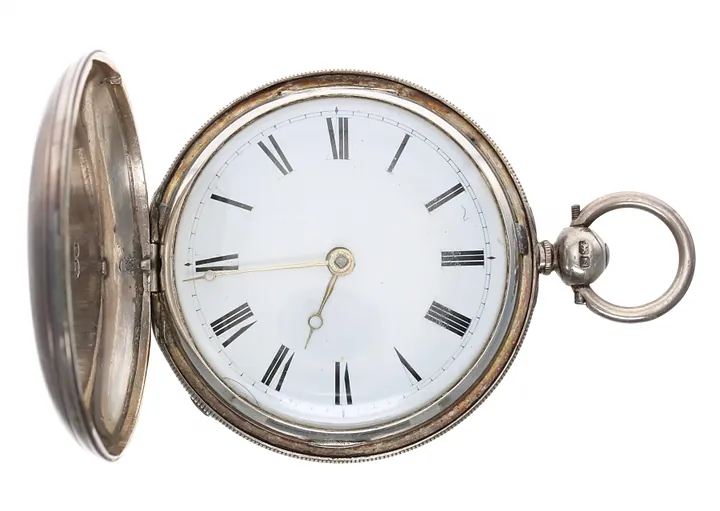
Pocket Watches · 19th century
19th century silver verge hunter pocket watch by Parkinson & Frodsham, London
Gardiner Houlgate (auction house), Corsham
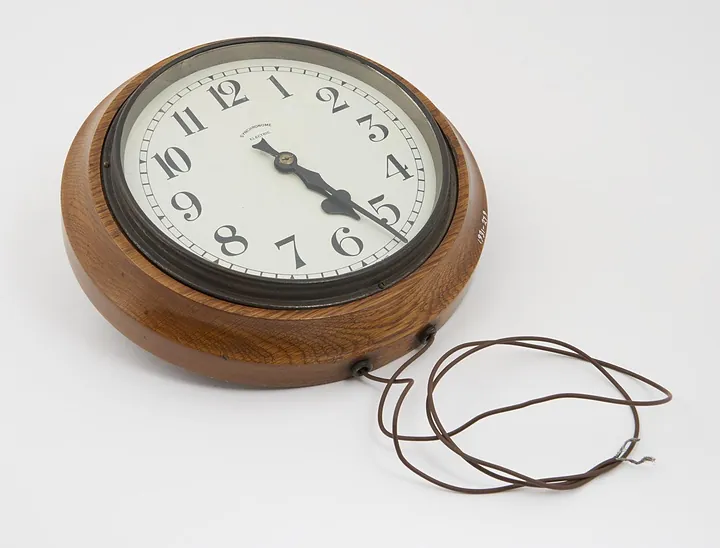
Clocks · 1890–1930
Clock with 8-inch impulse dial, by the Synchronome Company Limited, England, 1890–1930.
Science Museum Group, London
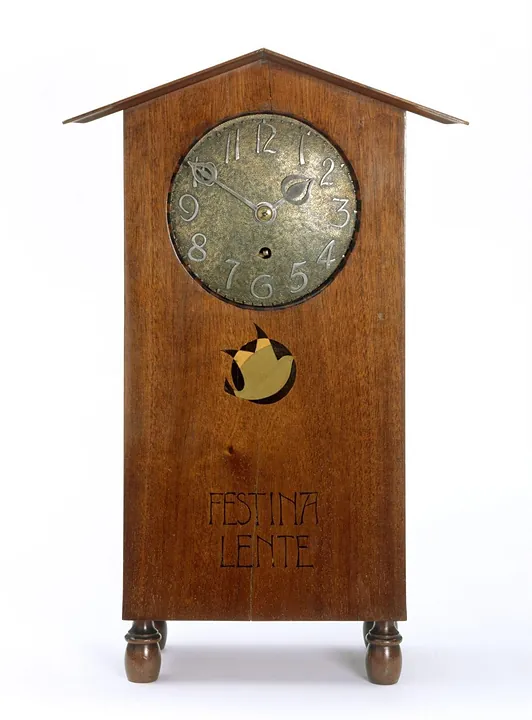
Clocks · c.1900
Clock by Mackay Hugh Baillie Scott, Bedfordshire, c.1900
Victoria and Albert Museum, London
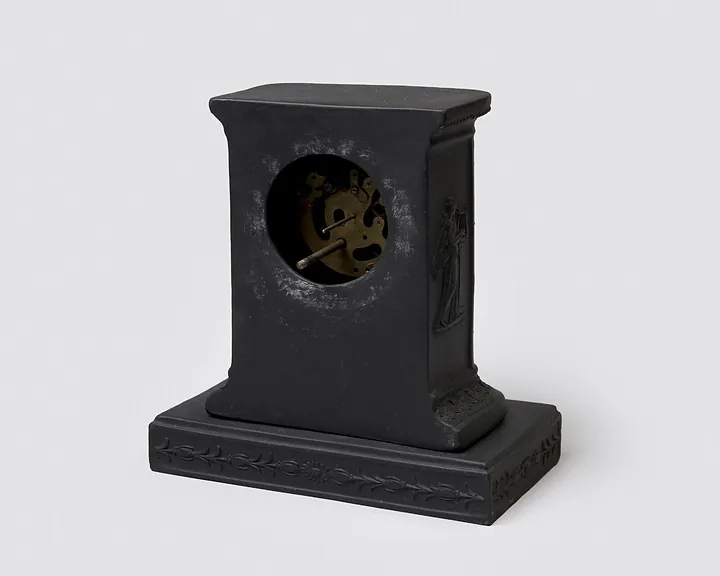
Clocks · c. 1900
Clock, black basalt, brass, Josiah Wedgwood and Sons, Etruria, c. 1900
Victoria and Albert Museum, London
Clocks · c.1903-1904
Clock, pewter, made for Liberty& Co., England. 1903-4.
Victoria and Albert Museum, London