
Clocks · Table clock
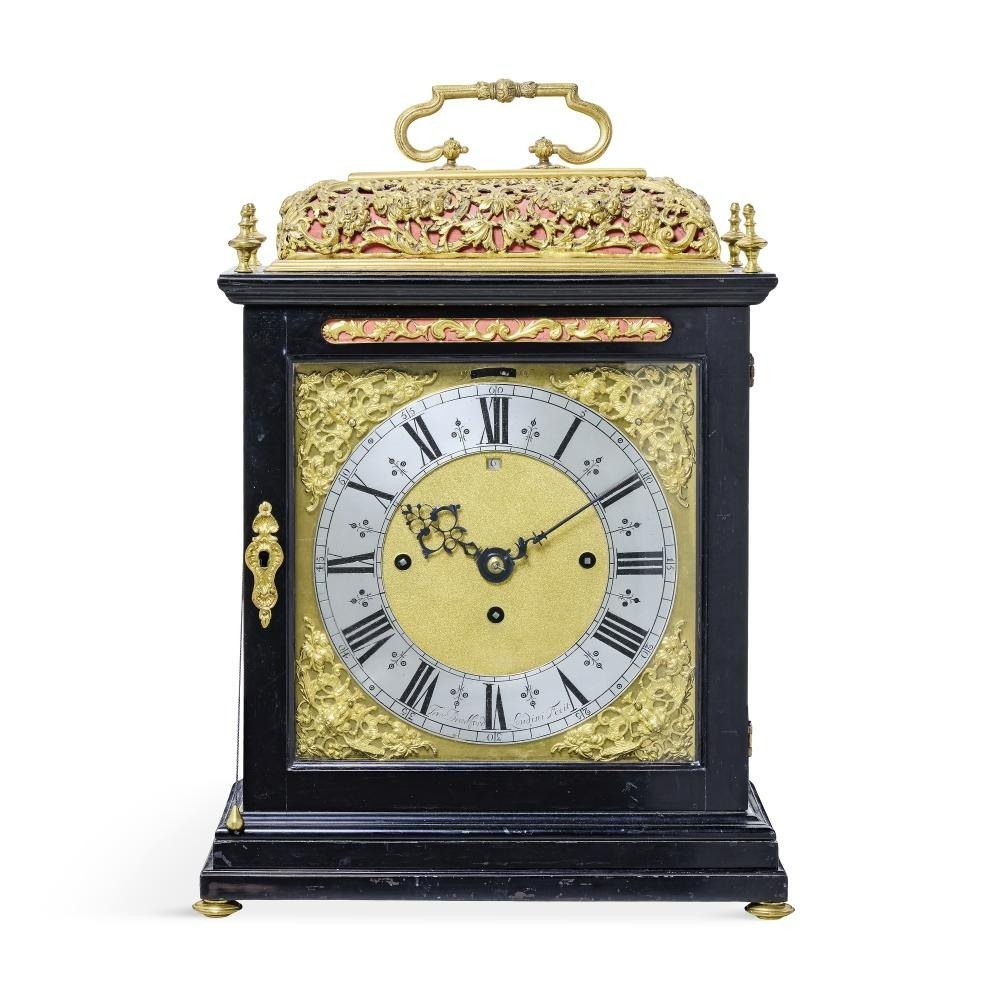
Ebony quarter-chiming basket-top table clock by Thomas Bradford
- Maker / attribution
- Thomas Bradford (source attribution)
- Date
- early 18th century
- Historical period
- Early Modern Horology (1600 – 1750)
- Country of origin
- England
- Object type
- Table clock
- Dimensions
- 52cms
- Holding institution
- Bonhams / Invaluable
- Accession / object no.
- 204825940
- Credit line
- Bonhams / Invaluable
- Catalogue title (original)
- Ebony quarter chiming basket top table clock (English)
View the source record ↗ (opens another website in a new tab)Suggest a correction
Record summary
Held and catalogued by Bonhams / Invaluable (object number 204825940), this is a table clock attributed to Thomas Bradford, made in England, dated early 18th century. The Atlas places it in the Early Modern Horology period (1600 – 1750) of its Clocks collection. Recorded dimensions: 52cms. The record is illustrated with 1 photograph.
Assembled from the source record's structured fields. Dates and attributions are given as the source states them; where a field is missing the Atlas leaves it blank rather than estimating.
Catalogue description
Original object description
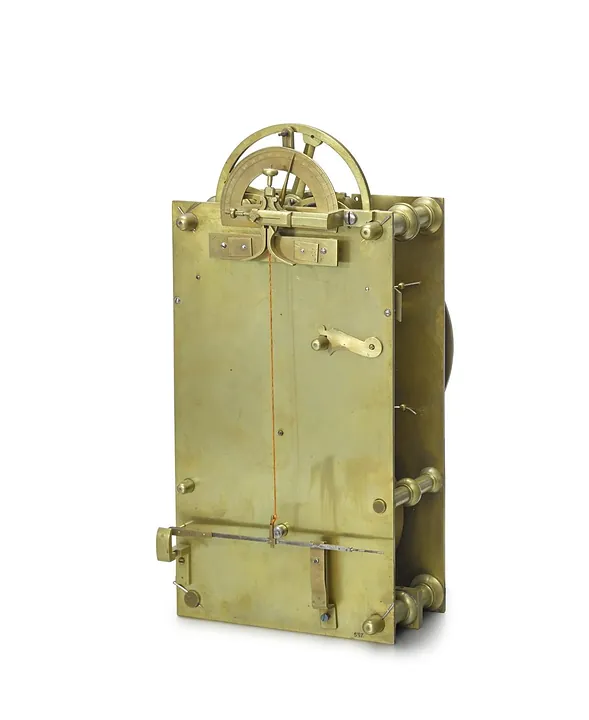
Enclosed in an ebony case dating to the early 18th century, this bracket clock is detailed with four corner finials, glazed flanks, a moulded cornice, and an overhead carrying handle with a tied-bud knop atop a repoussé basket decorated with fruit and floral swags, complemented by a detached revolving turntable plinth. Its 10-inch square brass dial incorporates winged-cherub spandrel mounts, a matted dial centre, a date window above XII, and blued steel hands, surrounded by a silvered chapter ring with Roman hours, Arabic minute figures, dotted half-quarter divisions, and fleur-de-lys half-hour marks, inscribed 'Tho: Bradford Londini, Fecit' along the bottom. The movement features a triple gut-line fusee regulated by a knife-edge verge escapement, ten knopped and latched pillars—including one later steel replacement—external click springs, and an intricately engraved backplate with symmetrical blossoms and scrolling leafage. Striking is managed by a rack-and-snail system on an upright hammer, while the quarter chimes sound upon a six-bell nest; both chiming and striking trains function, yet a broken gut line on the time train renders the clock inoperative, and its exact classification and date remain subject to verification.
Historical context
Early Modern Horology (1600 – 1750)
Huygens' pendulum and balance spring transform accuracy; English makers develop the anchor and deadbeat escapements.
Huygens's pendulum (1656–57) improved clock accuracy from about a quarter of an hour to under a minute a day. The anchor escapement (c. 1670) and the long seconds pendulum created the longcase clock; London makers such as Fromanteel, Knibb, Tompion and Quare led European clockmaking, and French makers created the Boulle pendule.
Read the period in the timelineMore clocks from this periodEarlier: Renaissance Horology
Atlas type guide
Bracket, table and spring-driven clocks
Spring-driven clocks freed timekeeping from the hanging weight. The coiled mainspring, documented from the fifteenth century, made portable table clocks possible; to even out its declining force, makers used the fusee, a conical pulley connected to the barrel by a gut line or chain. Renaissance table clocks from Augsburg and Nuremberg — drum-shaped, square or tower-shaped in gilt brass — were luxury scientific objects, often with astronomical dials and alarms.
After the pendulum, English makers developed the bracket clock: a wooden case with a carrying handle, a short pendulum with a verge escapement, and often repeating work to sound the hours on demand at night. Later examples use the anchor escapement. In the nineteenth century, 'table clock' became a broad term for spring clocks of every nationality.
What to look for
- A fusee in the movement (cone-shaped pulley) and the type of line — gut or chain.
- Verge escapement with a short bob pendulum, often with a decoratively engraved backplate.
- Repeat cords or buttons that make the clock strike again on demand.
- Gilt-brass engraved cases and horizontal dials on Renaissance pieces.
- Case shapes: inverted bell, bell top, break-arch, lancet or balloon.
Dating clues
- Drum and tower table clocks: c. 1520–1650.
- Ebony veneered English bracket clocks with verge escapements: c. 1670–1800.
- Engraved backplates were usual on English clocks until c. 1800, then generally plain.
General guidance written by the Atlas editors about this kind of object. It is not a statement about this particular piece; for that, rely on the source record above and on physical examination.
Read next:Anchor (recoil) escapement
Related records
Movements & Components · 1690–1695
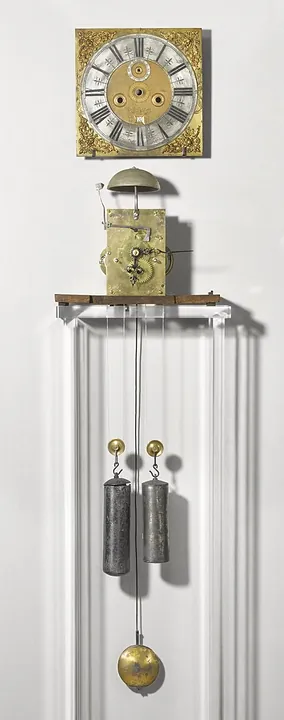
Clock movement by Thomas Bradford, England, 1690–1695
Science Museum Group, London
Clocks · 1598–1603
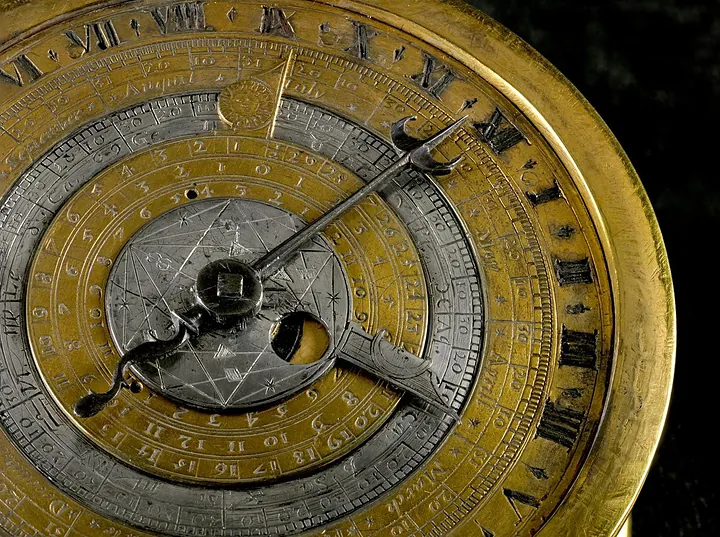
Circular table-clock with calendrical and lunar indications made by Nicholas Vallin in London between 1598 and 1603.
Science Museum Group, London
Clocks · 1611
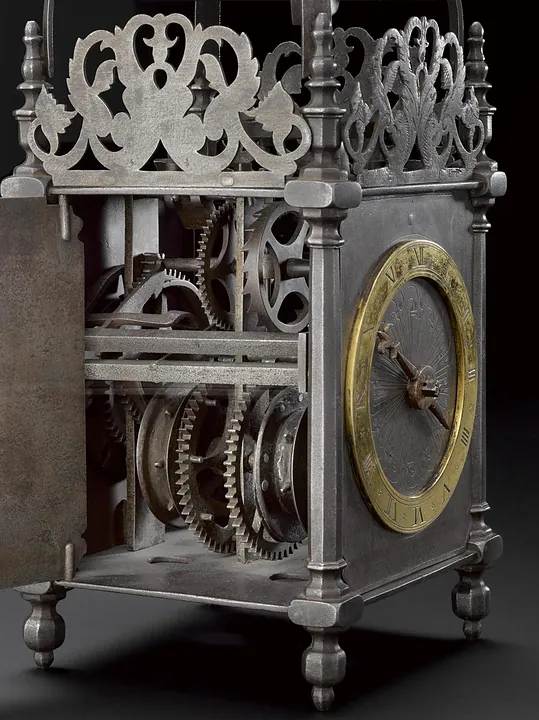
English iron lantern clock, with wheel balance, by John Holloway, Market Lavington, Wiltshire, England, 1611.
Science Museum Group, London
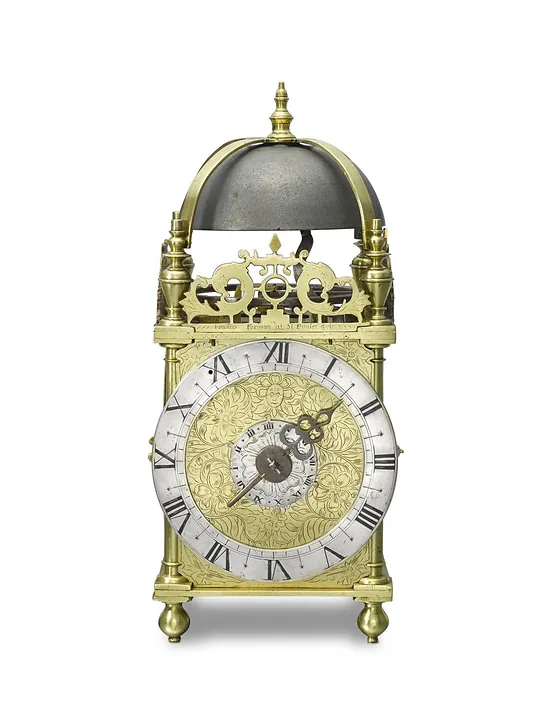
Clocks · 1630
Lantern clock by Francis Forman, England, 1630
Science Museum Group, London
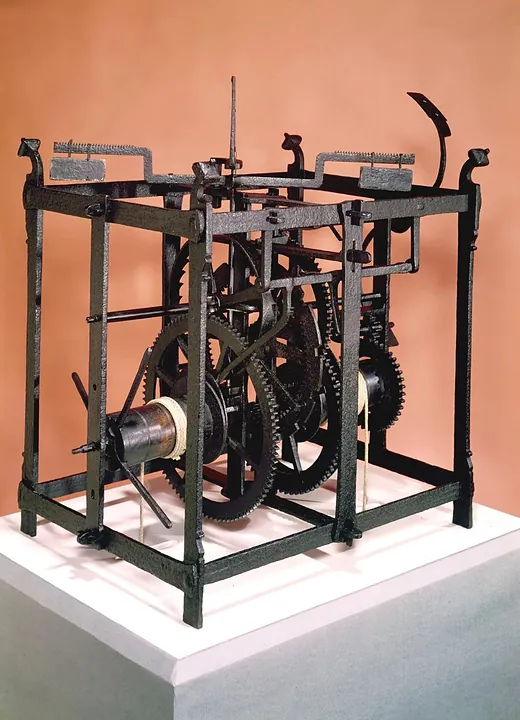
Clocks · 1632–1640
Turret clock, England, 1632–1640
Science Museum Group, London
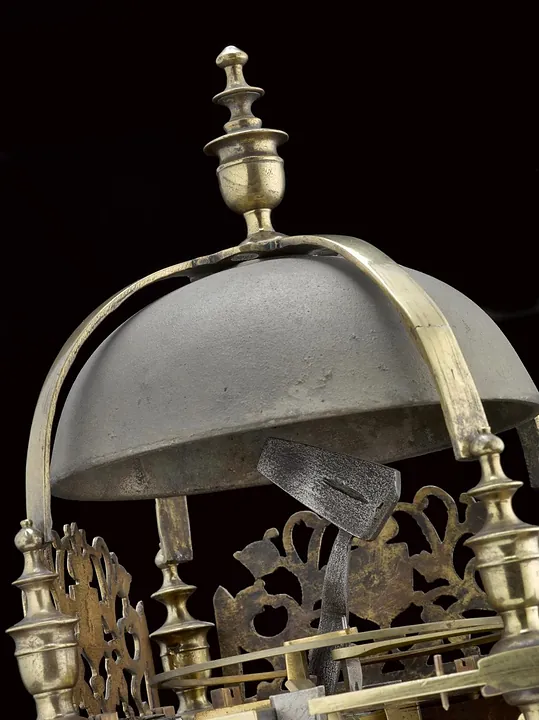
Clocks · 1645–1655
Balance-wheel brass lantern clock, with two driving weights and one counterweight, by Thomas Knifton, Cross Keys, Lothbury, London, England, 1645–1655.
Science Museum Group, London
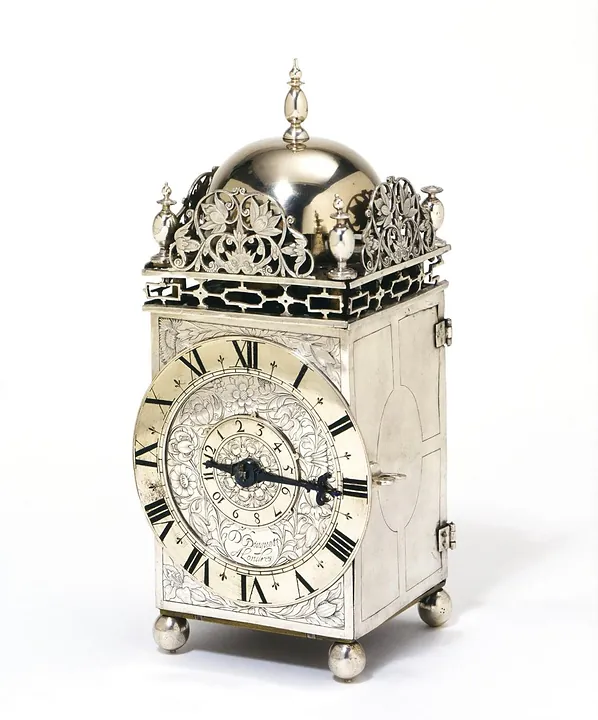
Clocks · c. 1650
Lantern alarm clock, silver, by David Bouquet, circa 1650
Victoria and Albert Museum, London
Clocks · 1650–1660
Lantern clock by Peter Closon, England, 1650–1660
Science Museum Group, London