
Wristwatches · Wristwatch
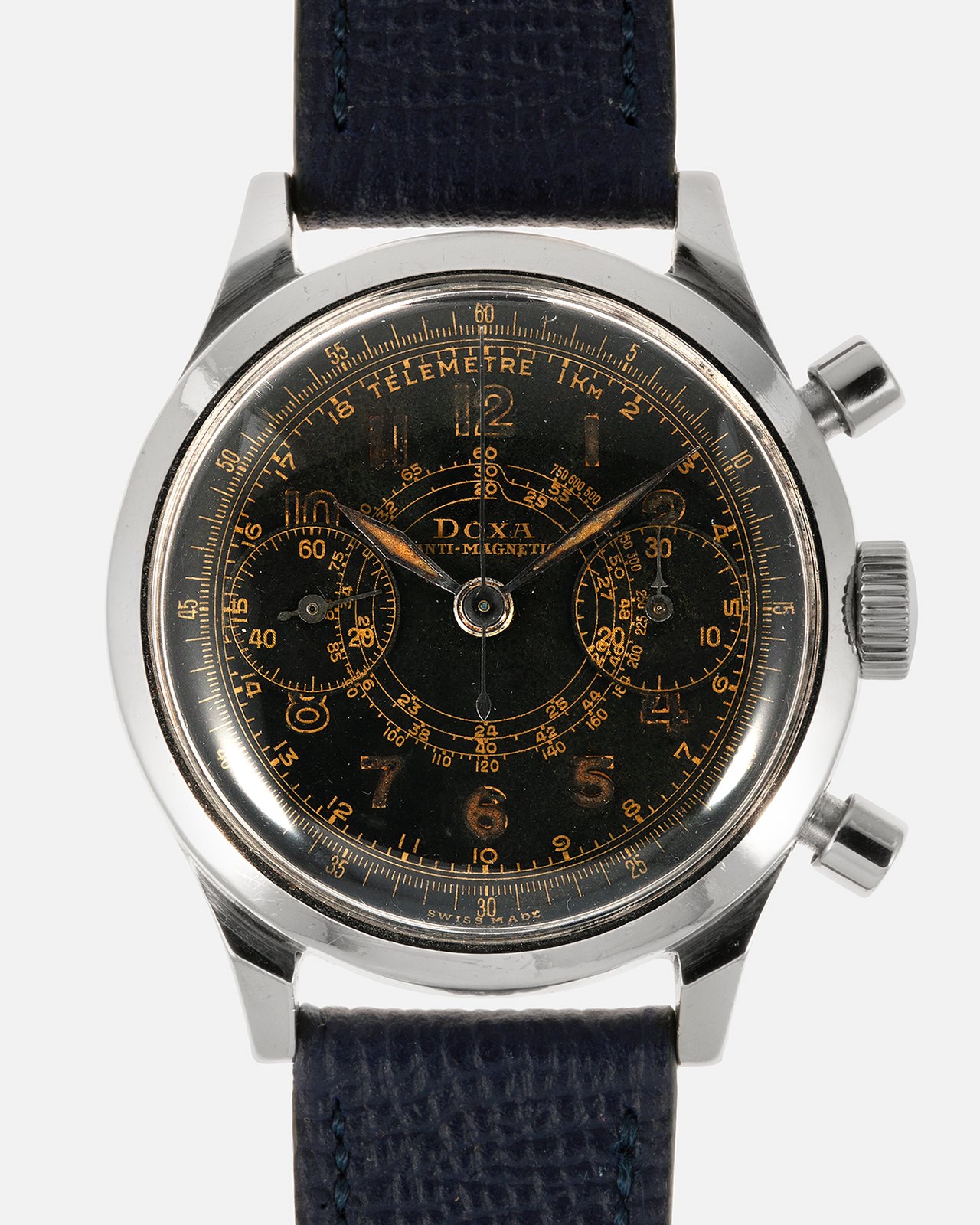
Doxa Anti-Magnetic Chronograph Spillman Case, 1940s
- Maker / attribution
- DOXA (maker)
- Date
- 1940s
- Historical period
- Golden Age of Mechanical Watchmaking (1900 – 1945)
- Country of origin
- Switzerland
- Object type
- Wristwatch
- Stock no.
- Product 7346420056151
- Credit line
- Dealer listing, S.Song Watches (product 7346420056151)
- Catalogue title (original)
- Doxa Anti-Magnetic Chronograph Spillman Case (English)
View the source record (dealer listing) ↗ (opens another website in a new tab)Suggest a correction
Record summary
Catalogued by S.Song Watches (dealer), Seattle (stock number Product 7346420056151), this is a wristwatch by DOXA, made in Switzerland, dated 1940s. The Atlas places it in the Golden Age of Mechanical Watchmaking period (1900 – 1945) of its Wristwatches collection. The record is illustrated with 6 photographs.
Assembled from the source record's structured fields. Dates and attributions are given as the source states them; where a field is missing the Atlas leaves it blank rather than estimating.
Catalogue description
Dealer description — S.Song Watches
When it comes to vintage chronographs, Doxa chronographs from the 1940s hold a particularly intriguing appeal for collectors and enthusiasts alike. In recent times, they have gained quite a following among the most ardent vintage chronograph enthusiasts. Judging by the example offered here today, it’s not hard to see why. Founded in 1889 in Le Locle by Georges Ducommun, Doxa originally specialized in dress watches. Over the years, the company has diversified its offerings significantly. During the early 20th century, Doxa introduced a wide array of timepieces, ranging from simple time-only watches for everyday use to alarm clocks, intricate ladies' cocktail watches, ultra-precise cockpit instruments, and even wristwatches issued specifically for military use. The 1940s and 50s was a particularly notable period for Doxa, as they unveiled a series of sophisticated chronographs that combined stylish designs with the stringent standards of accuracy and precision that had become synonymous with the brand. Offered here today is a remarkable example of a Doxa anti-magnetic chronograph from the 1940s, which showcases the pinnacle of Doxa's technical and design expertise during the mid-20th century. If you haven’t noticed from the photographs, this is quite a special example as it is fitted with a Spillmann case, which is widely considered by many to be one of the best waterproof case makers of its era. The case is characterized by its distinctive, angular, downward-turning lugs that give it a muscular look. The example we have here features one such masculine screw-down case, flanked with pump pushers, and is powered by the venerable manual-winding Valjoux Cal. 22, a high-quality, column-wheel movement that was used only on higher-end chronographs from that era. Moving on, the glossy black dial seen here in our example is truly remarkable. When a vintage watch incorporates a glossy black dial alongside a multi-scale chronograph layout, it typically creates the recipe for a stunning vintage chronograph, provided it ages gracefully—and our featured example certainly lives up to this expectation. Its intricate telemeter scales are still in great condition, with very consistent ageing throughout the dial, as well as on the Arabic numerals and the hands. It's hard to dispute the timeless allure of a well-crafted, multi-scale chronograph, particularly when it has a lustrous black dial with well-balanced sub-dials within a beautifully executed Spillmann-style steel case. Again, speaking as a big fan of vintage chronographs, trust me when I say, this one is pretty special.
Historical context
Golden Age of Mechanical Watchmaking (1900 – 1945)
The wristwatch displaces the pocket watch; waterproof cases, self-winding and grand complications.
The wristwatch overtook the pocket watch. Military use in the First World War, aviation, water-resistant cases (1926), automatic winding (1923–31), rectangular Art Deco designs and early chronographs and calendars defined the period.
Read the period in the timelineMore wristwatches from this periodEarlier: Industrial Revolution
Atlas type guide
Chronographs and split-seconds watches
A chronograph is a watch with an additional seconds hand that can be started, stopped and returned to zero independently of the timekeeping. Louis Moinet built an early example in 1816 and Nicolas Rieussec a recording 'chronographe' in 1821; Adolphe Nicole's heart-shaped reset cam (patented 1862) made the modern return-to-zero possible. Split-seconds (rattrapante) chronographs add a second hand that can be stopped for intermediate times; flyback chronographs restart instantly.
Chronographs were essential tools for doctors (pulsometer scales), artillery (telemeter), engineers and sport. In wristwatches, Valjoux, Venus, Lemania and later the automatic chronographs of 1969 (Zenith El Primero, the Chronomatic Calibre 11 group and Seiko 6139) are milestones.
What to look for
- Push-pieces on the case band or a single button in the crown (monopusher).
- Subsidiary registers for minutes and hours; tachymeter, telemeter or pulsometer scales.
- Column wheel versus cam control visible in the movement.
- Calibre markings of specialist makers (Valjoux, Lemania, Venus, Landeron).
Dating clues
- Pocket chronographs with heart cam reset: after 1862.
- Wrist chronographs: from c. 1910; two-button designs from the 1930s.
- Automatic chronographs: from 1969.
General guidance written by the Atlas editors about this kind of object. It is not a statement about this particular piece; for that, rely on the source record above and on physical examination.
Read next:Flyback chronographChronograph
Related records
Wristwatches · 2002
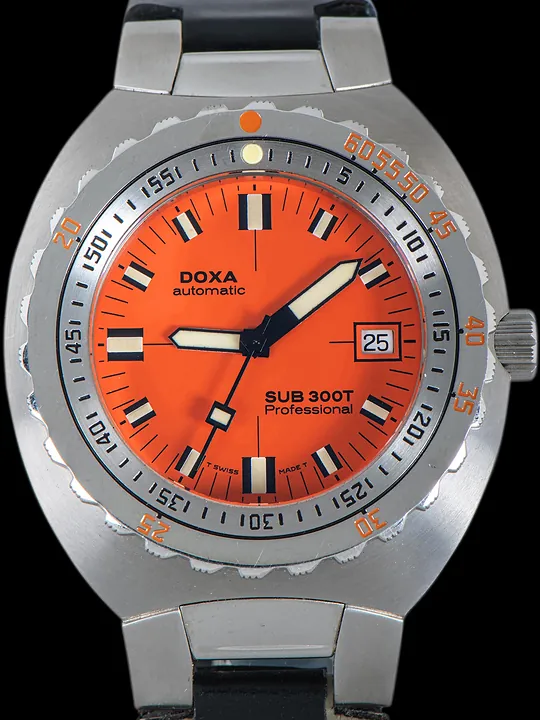
Doxa Sub 300T Professional (Ref. 30010), 2002
Craft & Tailored (dealer), Los Angeles
Wristwatches · 1970s
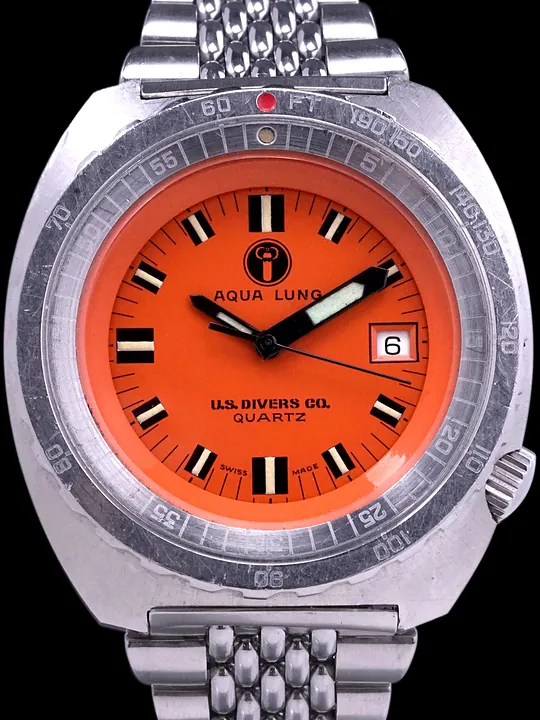
Aqua Lung Quartz Diver (Ref. 7336-000) "U.S Divers Co.", 1970s
Craft & Tailored (dealer), Los Angeles
Wristwatches · 1983
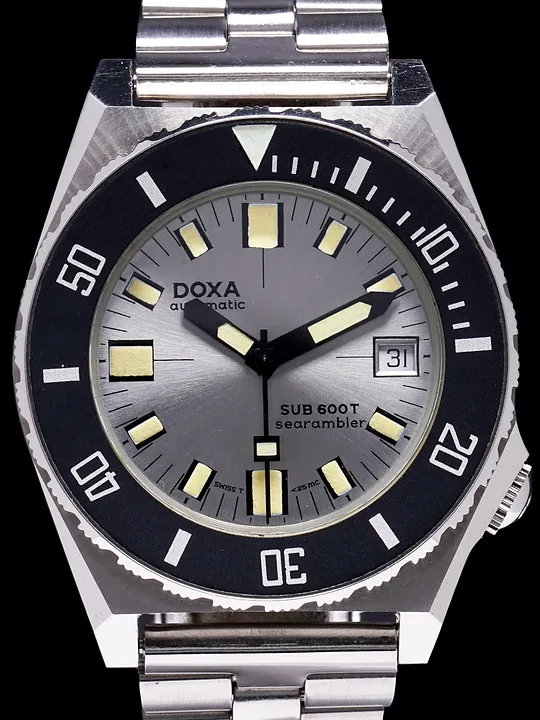
Doxa Sub 600T Searambler Silver Dial (Aubry Era), 1983
Craft & Tailored (dealer), Los Angeles
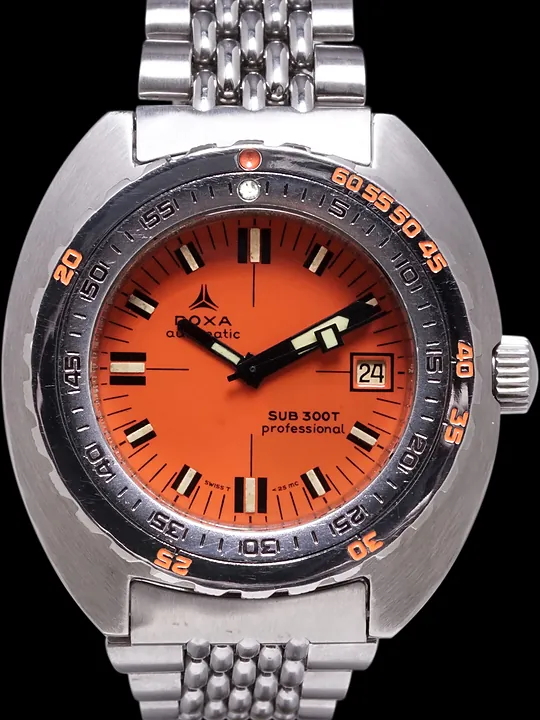
Wristwatches · 1970s
Doxa Sub 300T Professional (Synchron Era), 1970s
Craft & Tailored (dealer), Los Angeles

Wristwatches · 1931
Rolex 'Oyster Perpetual' rotor self-winding wrist-watch, lever escapement, in steel case with glass in back, Montres Rolex SA, Geneva, Switzerland, 1931
Science Museum Group, London

Wristwatches · 1900–1999
Wristwatch by Certina, Switzerland, 1900–1999
Nordic Museum Foundation

Wristwatches · 1900–1999
Wristwatch by Omega, Västerås, 1900–1999
Nordic Museum Foundation

Wristwatches · 1900–1999
Wristwatch by Universal, Switzerland, 1900–1999
Nordic Museum Foundation