Wristwatches · Bracelet watch
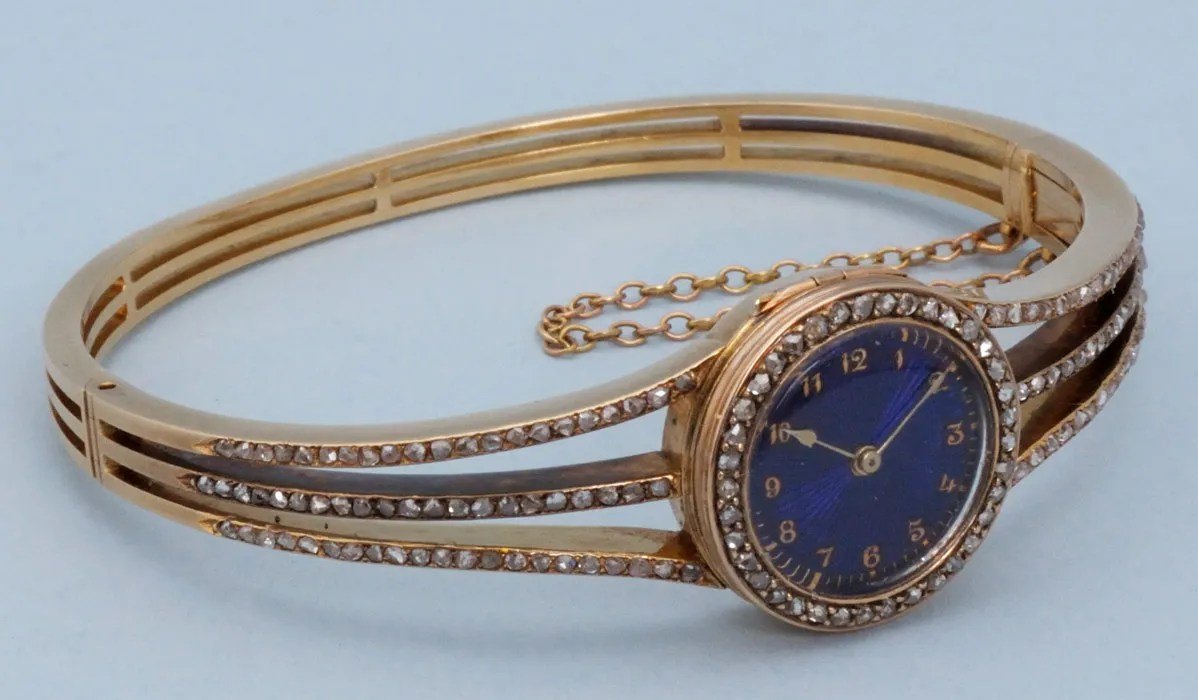
Diamond Set Gold Bracelet Watch, circa 1880
- Maker / attribution
- Unrecorded in source
- Date
- c. 1880
- Historical period
- Industrial Revolution (1850 – 1900)
- Country of origin
- Unrecorded in source
- Object type
- Bracelet watch
- Materials / technique
- gold
- Stock no.
- A9526
- Credit line
- Dealer listing, Pieces of Time (A9526)
- Catalogue title (original)
- Diamond Set Gold Bracelet Watch (English)
View the source record (dealer listing) ↗ (opens another website in a new tab)Suggest a correction
Record summary
Catalogued by Pieces of Time (dealer), London (stock number A9526), this is a bracelet watch, dated c. 1880. The Atlas places it in the Industrial Revolution period (1850 – 1900) of its Wristwatches collection. Materials and techniques recorded by the source: gold. The record is illustrated with 4 photographs.
Assembled from the source record's structured fields. Dates and attributions are given as the source states them; where a field is missing the Atlas leaves it blank rather than estimating.
Catalogue description
Dealer description — Pieces of Time
A late 19 th Century Swiss cylinder in an unusual diamond set gold bracelet. Keywind gilt bar movement with going barrel. Plain cock with polished steel regulator. Plain three arm gilt balance with blue steel spiral hairspring. Polished steel cylinder, steel escape wheel. Translucent dark blue enamel over an engine turned ground for the dial, gilt Arabic numerals, gilt hands. Circular diamond set bezel hinges from the bracelet with the movement and gold cuvette fitted with a small turnbuckle to wind the watch. The band of the bracelet formed from three tapered rectangular strands partly set with small diamonds. Hinged at the side, gold clasp with fine safety chain. An elegant attractive watch which could still be worn on formal occasions
Historical context
Industrial Revolution (1850 – 1900)
American interchangeable-parts manufacture; railroad time standards; Swiss and German factory systems.
Wristlets for women and early military wristlets — small pocket watch movements in cases with wire lugs — appeared towards the end of the century.
Read the period in the timelineMore wristwatches from this periodEarlier: Precision & Scientific Horology
Atlas type guide
Wristwatches
Bracelet watches were worn by women from the early nineteenth century — Breguet made one for Caroline Murat, Queen of Naples, in 1810–12 — but the wristwatch only became a man's instrument with military use and aviation in the early twentieth century. Between the World Wars it overtook the pocket watch; the 1920s and 1930s brought rectangular Art Deco cases, water-resistant cases and the first automatic winding systems.
After 1945 the wristwatch became a carrier of identity — dress watches, sports and dive watches, chronographs, calendars — produced by Swiss, American, Japanese, German, Soviet and Chinese industries. The quartz revolution after 1969 and the mechanical renaissance since the 1990s, including the rise of independent watchmakers, complete the story.
What to look for
- The reference number (between the lugs or inside the case back) and serial number, the starting point for dating.
- The calibre: its maker and number are often stamped under the dial or on the bridge.
- Originality of dial, hands and crown — refinished ('redial') dials are common.
- Case material marks: 18K/750, 14K/585, stainless steel, gold-filled, plated.
Dating clues
- Wire-lug cases: before c. 1925.
- Water-resistant screw-down cases: from 1926.
- Quartz movements: from 1969; sapphire crystals widespread after c. 1980.
General guidance written by the Atlas editors about this kind of object. It is not a statement about this particular piece; for that, rely on the source record above and on physical examination.