
Pocket Watches · Dashboard watch
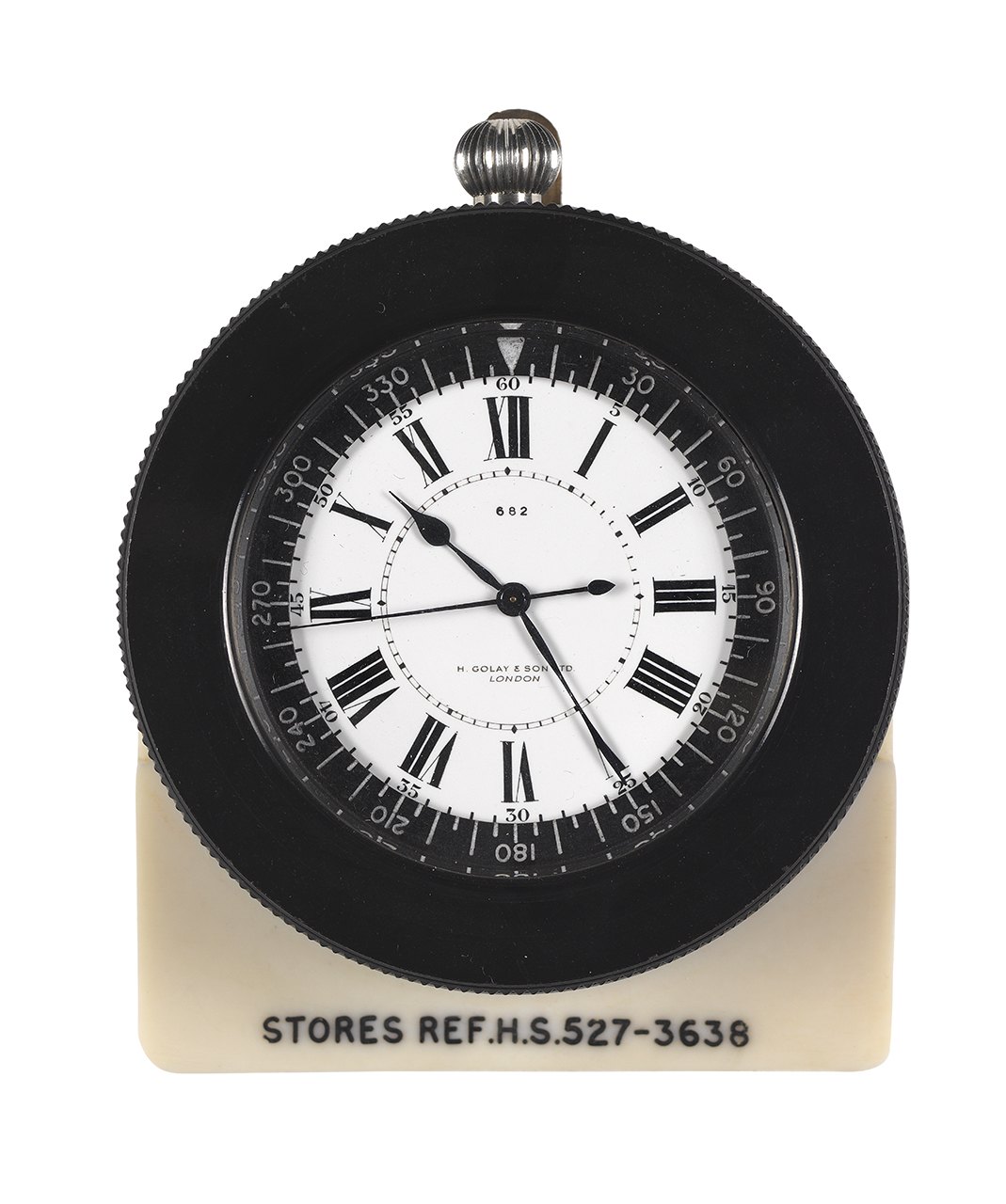
Dashboard watch no. 682 by H. Golay & Son Ltd
- Maker / attribution
- H. Golay & Son Ltd (maker)
- Date
- c. 1940
- Historical period
- Golden Age of Mechanical Watchmaking (1900 – 1945)
- Country of origin
- Unrecorded in source
- Object type
- Dashboard watch
- Materials / technique
- metal: brass; metal: steel
- Dimensions
- Overall: 32 x 82 x 101 mm
- Holding institution
- Royal Museums Greenwich
- Accession / object no.
- ZAA0261
- Credit line
- National Maritime Museum, Greenwich, London
- Catalogue title (original)
- 682 (English)
View the source record ↗ (opens another website in a new tab)Suggest a correction
Record summary
Held and catalogued by Royal Museums Greenwich (object number ZAA0261), this is a dashboard watch by H. Golay & Son Ltd, dated c. 1940. The Atlas places it in the Golden Age of Mechanical Watchmaking period (1900 – 1945) of its Pocket Watches collection. Materials and techniques recorded by the source: metal: brass; metal: steel. Recorded dimensions: Overall: 32 x 82 x 101 mm. The record is illustrated with 2 photographs.
Assembled from the source record's structured fields. Dates and attributions are given as the source states them; where a field is missing the Atlas leaves it blank rather than estimating.
Catalogue description
Catalogue description — Royal Museums Greenwich
This type of watch was used by the Fleet Air Arm in Fairey Swordfish aircraft during WWII. We learn from the 1941/1942 Admiralty Manual of Navigation that these watches were known as beacon watches and that they were only to be used in aircraft fitted with an R1147 radio receiver. The carriers were equipped with a revolving beacon that continuously transmitted second pulses, making a full rotation once per minute. The crucial feature of this system was that the beacon emitted a different sounding signal when it was pointing due north. Prior to launch (these planes were catapulted into the air) the observer would tune the radio receiver to the beacon and set the bezel of the watch so that zero on the outer scale and the tip of the second hand align precisely at the time of the northern signal. When returning to the carrier, the observer on board the aircraft would turn on the radio and listen to the beacon’s signal. The strongest reception would be experienced when the beacon was pointing directly at the aircraft and using the watch, the aircraft’s position relative to its carrier could be found and the pilot given the course to take. The primary benefit was that these slow aircraft could home in on their carrier from up to 100 miles away without sending out radio signals that may betray their position to the enemy.
Historical context
Golden Age of Mechanical Watchmaking (1900 – 1945)
The wristwatch displaces the pocket watch; waterproof cases, self-winding and grand complications.
The pocket watch reached technical maturity and then began to give way to the wristwatch after the First World War. Complicated watches for collectors such as Henry Graves Jr. and James Ward Packard, railroad watches, and slim Art Deco dress watches are characteristic.
Read the period in the timelineMore pocket watches from this periodEarlier: Industrial Revolution
Atlas type guide
Pocket chronometers and precision watches
A pocket chronometer is a watch built to observatory standards, traditionally with a detent escapement like a marine chronometer. English makers such as John Arnold and Thomas Earnshaw made the first pocket chronometers in the 1780s. In the nineteenth century the term increasingly referred to any watch that had passed official rating trials at observatories in Kew, Neuchâtel, Geneva or Besançon, and the Swiss lever chronometer became dominant.
Tourbillon and karrusel watches belong to the same world of precision. Breguet patented the tourbillon in 1801 to average out positional errors; Bahne Bonniksen's karrusel (1892) was a cheaper English alternative. Rating certificates (bulletins de marche) that accompany such watches are historical documents in their own right.
What to look for
- Detent escapement (no pallets; a fine spring detent locks the escape wheel).
- Observatory certificates, competition results or 'Chronometer' marking on the dial.
- Tourbillon carriage visible through an aperture or on the movement.
- Fine finishing: jewelled holes in gold chatons, diamond endstones.
Dating clues
- English pocket chronometers: c. 1780–1900.
- Observatory trials at Neuchâtel from 1866, Geneva from 1873, Kew from 1884.
- Karrusels: 1892–c. 1915.
General guidance written by the Atlas editors about this kind of object. It is not a statement about this particular piece; for that, rely on the source record above and on physical examination.
Read next:Spring detent (chronometer) escapementTourbillonDetached lever escapement
Related records
Pocket Watches · c. 1935
Dashboard watch no. 802 by H. Golay & Son Ltd
Royal Museums Greenwich
Pocket Watches · 1900–1999
Lapel watch by Erik Holmén, 1900–1999
Nordic Museum Foundation
Pocket Watches · 1873–1930
Pocket watch, Lilla Malma socken, 1873–1930
Sörmland Museum
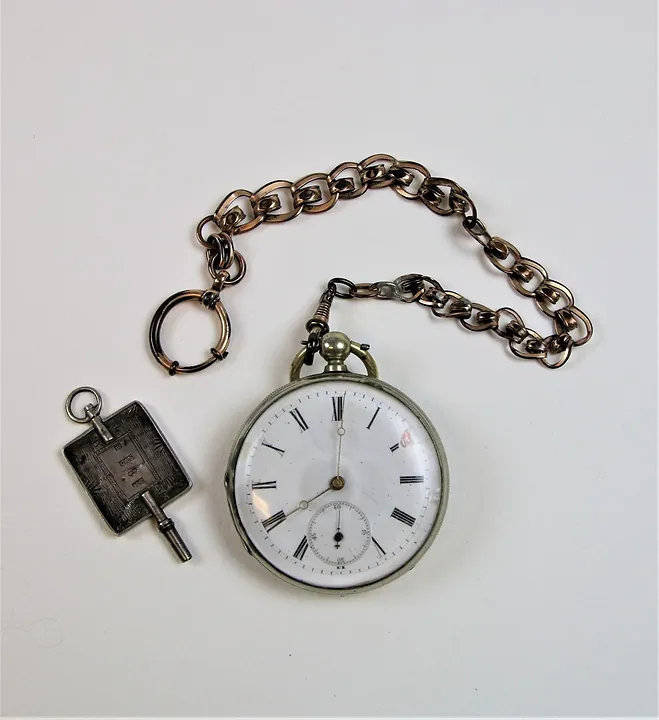
Pocket Watches · 1880–1920
Pocket watch, Sweden, 1880–1920
Sörmland Museum
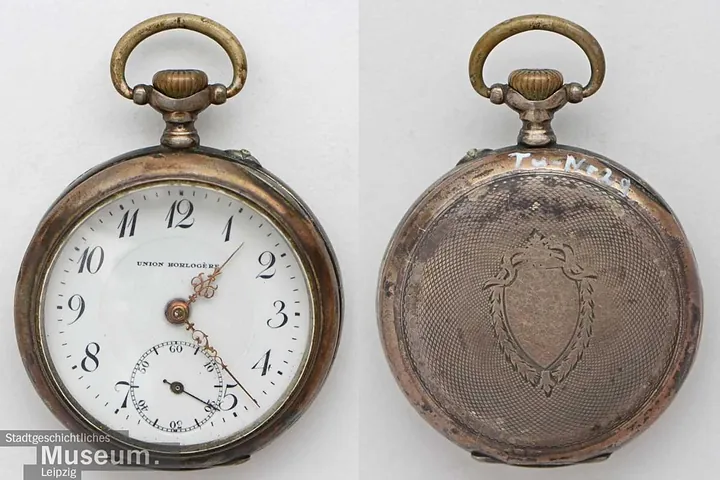
Pocket Watches · 1890–1910
Pocket watch by Union Horlogère, France, 1890–1910
Museum of City History Leipzig
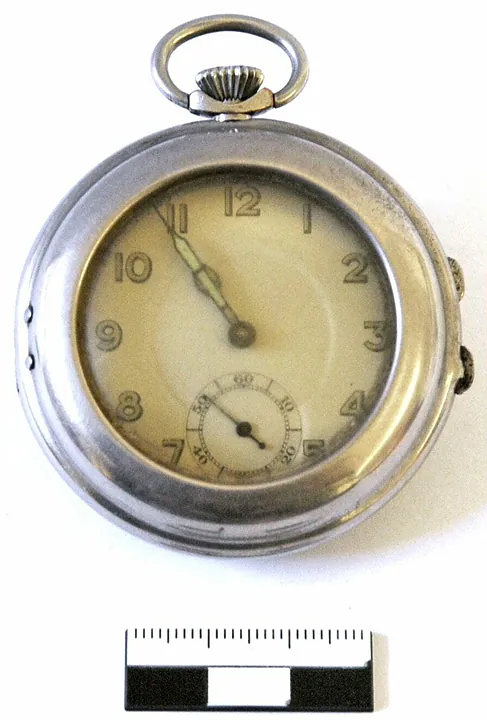
Pocket Watches · 1891–1945
Pocket watch, Germany, 1891–1945
Montanhistorisches Dokumentationszentrum
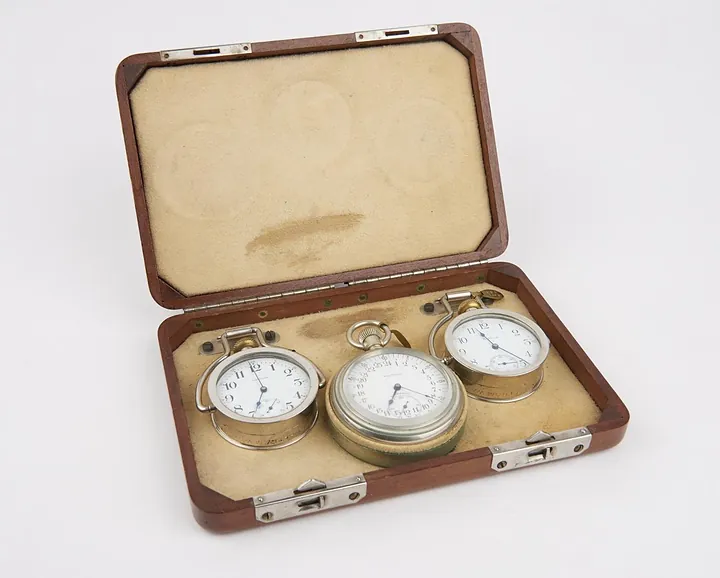
Pocket Watches · c. 1900
Pocket watch by American Waltham Watch Company, United States, c. 1900
Science Museum Group, London
Pocket Watches · c. 1900
Pocket watch by Firm of Breguet et Fils, France, c. 1900
The Metropolitan Museum of Art, New York