
Wristwatches · Wristwatch
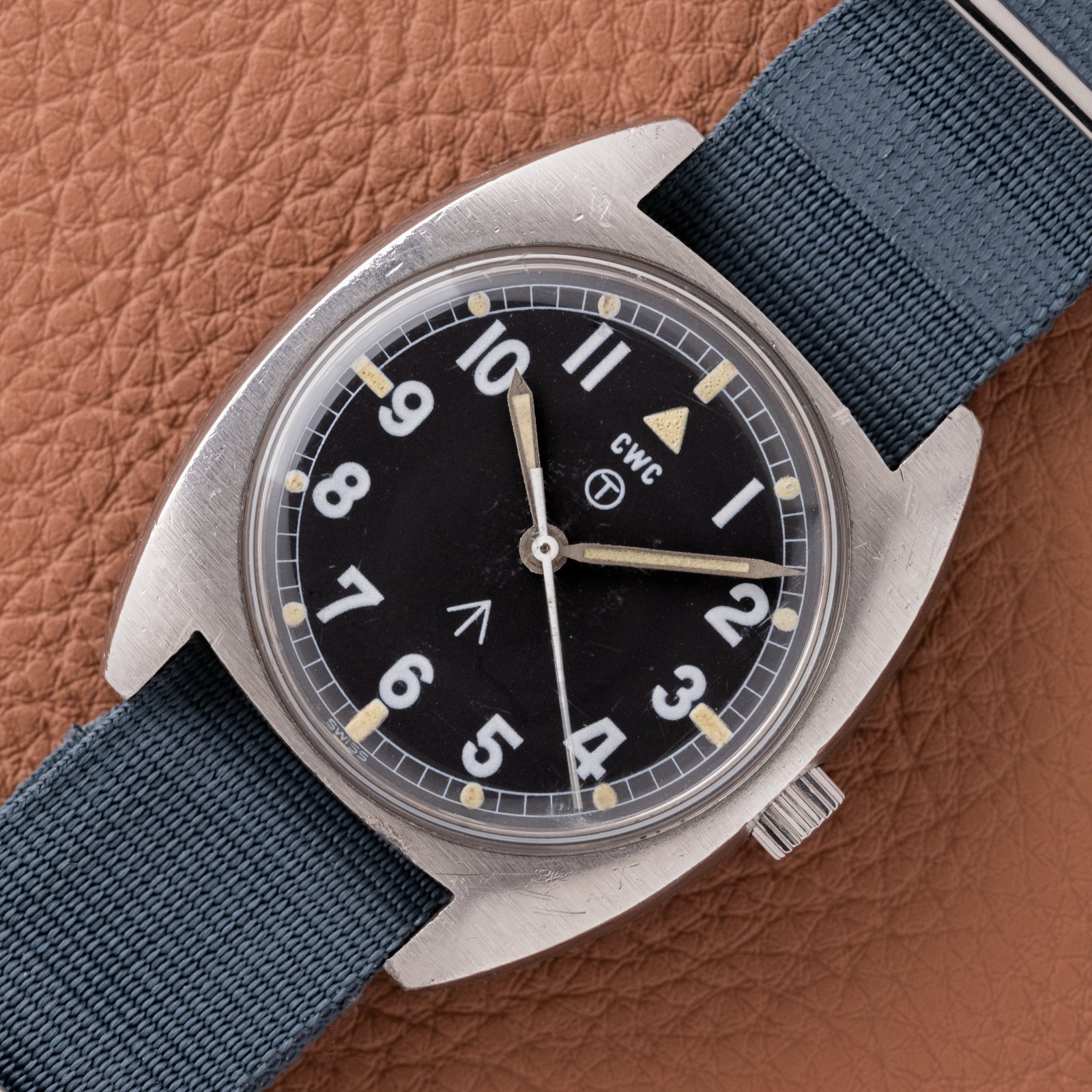
CWC British Military W10 (Ref. W10-6645-99), 1970s
- Maker / attribution
- CWC (maker)
- Date
- 1970s
- Historical period
- Quartz Revolution (1969 – 1990)
- Country of origin
- England
- Object type
- Wristwatch
- Dimensions
- Case 35 mm
- Stock no.
- Product 15887214837943
- Credit line
- Dealer listing, Huntington Company (product 15887214837943)
- Catalogue title (original)
- 1970s CWC British Military W10 (Ref. W10-6645-99) (English)
View the source record (dealer listing) ↗ (opens another website in a new tab)Suggest a correction
Record summary
Catalogued by Huntington Company (dealer) (stock number Product 15887214837943), this is a wristwatch by CWC, made in England, dated 1970s. The Atlas places it in the Quartz Revolution period (1969 – 1990) of its Wristwatches collection. Recorded dimensions: Case 35 mm. The record is illustrated with 6 photographs.
Assembled from the source record's structured fields. Dates and attributions are given as the source states them; where a field is missing the Atlas leaves it blank rather than estimating.
Catalogue description
Dealer description — Huntington Company
History and Significance The history of British military wristwatches is filled with fascinating examples of practical watchmaking, from the celebrated Dirty Dozen of the Second World War to the purpose-built field watches issued throughout the following decades. By the 1970s, the British Ministry of Defence had established clear requirements for the watches supplied to military personnel, emphasizing legibility, durability, and dependable mechanical movements. Cabot Watch Company, better known as CWC, entered this history in 1972, eventually becoming one of the most recognizable suppliers of British military watches. The company's early production reflected a straightforward philosophy: watches designed to perform a job, with little consideration for decorative details or unnecessary complications. The W10 designation is particularly important within British military watch collecting. Rather than referring to a conventional commercial model name, W10 was associated with watches supplied for British Army use, with the designation appearing as part of the military identification system. The reference W10-6645-99 belongs to this tradition of issued military timepieces, where the watch's identity was determined by its intended function rather than its place within a commercial collection. The design followed the practical requirements of military service, with a highly legible black dial, luminous hour markers, and a manually wound movement. These watches were intended to be reliable instruments, and their appearance reflects that purpose in almost every detail. One of the most recognizable characteristics of the CWC W10 is its distinctive cushion-shaped case. Unlike the traditional round cases found on many earlier military watches, the W10 incorporates a broad, softly angular stainless steel case with a relatively compact profile. The design gives the watch a strong utilitarian appearance while maintaining comfortable proportions on the wrist. Fixed strap bars were another important feature, eliminating the possibility of a conventional spring bar becoming detached during use. This construction required the use of a pass-through strap, an arrangement that remains closely associated with British military watches. The dial is an excellent example of functional design. Large Arabic numerals provide immediate legibility, while the white minute track and luminous hands allow the time to be read quickly. The broad arrow symbol identifies the watch's connection to British government property, an important marking that appears on numerous pieces of military equipment. The circled T indicates the use of tritium luminous material, a common feature of military watches produced during this period. Together, these markings provide a direct visual connection to the watch's original purpose, distinguishing an issued military timepiece from a civilian watch merely inspired by military design. Writer’s Thoughts Military watches are at their most interesting when the design has been shaped almost entirely by practical requirements. The CWC W10 is a wonderful example of that approach, with a case, dial, and strap arrangement that exist for reasons beyond appearance. The cushion-shaped case gives the watch a distinctive 1970s character, while the black dial and broad arrow marking immediately establish its military identity. There is very little decoration, yet the combination of the different elements creates a watch with an enormous amount of personality. The reference W10-6645-99 has the kind of authenticity that is difficult to reproduce in a modern military-inspired watch. The fixed strap bars are a particularly appealing detail. They reinforce the watch's original purpose and give the case a different character from conventional civilian wristwatches. Paired with a Phoenix fabric strap, the CWC retains the straightforward appearance that makes British military watches so enjoyable to collect. The manually wound movement adds another connection to the period, offering a simple mechanical experience that feels entirely appropriate for a watch developed around reliability and function. There is also something refreshing about the relatively modest dimensions of these military watches. At 35mm, the CWC W10 wears comfortably while retaining a surprisingly substantial presence because of its cushion case. The combination of military markings, practical construction, and unmistakable 1970s design makes the reference W10-6645-99 a compelling piece of British watchmaking history. It is a watch whose appeal comes from the story behind its design rather than from luxury materials or elaborate finishing. Our Promise Every watch is thoroughly vetted, carefully described with complete transparency, and guaranteed authentic. Each piece is offered in honest condition, ensuring collectors receive a timepiece that reflects both originality and integrity. Specifications Brand: CWC (Cabot Watch Company) Model: British Military W10 Reference: W10-6645-99 Year: 1970s Case Material: Stainless Steel Case Size: 35mm Dial: Black Military Dial with Arabic Numerals, Broad Arrow Marking, and Circled T Tritium Designation Movement: Manual-Winding Mechanical Movement Strap/Buckle: New Phoenix Fabric Strap Buckle/Clasp: Stainless Steel Pin Buckle Contents: Watch only Condition Case: Stainless steel case shows visible surface scratches and wear consistent with military use and age. The case retains its distinctive cushion shape. Dial: Black dial remains in good vintage condition with clear printing, well-preserved military markings, and attractive aging to the luminous hour markers. Hands: Hands remain in good vintage condition with aged luminous material consistent with the dial. Crystal: Crystal shows light surface wear consistent with age and use. Strap/Buckle: Newly fitted Phoenix fabric strap remains in excellent condition. Buckle/Clasp: Stainless steel pin buckle remains in excellent condition.
Historical context
Quartz Revolution (1969 – 1990)
Seiko's Astron begins mass quartz timekeeping; traditional industries contract sharply.
Quartz and digital watches transformed the market after 1969. Swiss employment collapsed, Japanese and Hong Kong production soared, and the Swatch (1983) helped the Swiss industry recover; mechanical watches survived as luxury goods.
Read the period in the timelineMore wristwatches from this periodEarlier: Modern Mechanical Horology
Atlas type guide
Military, pilot and travel watches
The wristwatch owes much of its adoption by men to warfare and aviation. Wristlets — small pocket watches soldered with lugs and worn on a strap — were used in colonial campaigns and became standard equipment in the First World War, with protective grilles over the crystal ('shrapnel guards'). Louis Cartier's Santos (1904), designed for the aviator Alberto Santos-Dumont, is often cited as an early purpose-made pilot's watch.
In the Second World War governments specified watches in detail: the German B-Uhr observation watches, the American A-11, and the British 'W.W.W.' (the 'Dirty Dozen' set of 1945). After the war, jet travel brought GMT and world-time watches, which show two or more time zones at once — Louis Cottier's world-time mechanism and the Rolex GMT-Master (1955) are examples.
What to look for
- Military markings on the case back: broad arrow, issue numbers, 'W.W.W.', 'A.T.P.'
- High-legibility black dials with luminous Arabic numerals; oversized crowns for gloved hands.
- 24-hour hands and rotating 24-hour bezels or city rings on GMT/world-time watches.
- Wire lugs on early wristlets converted from pocket watches.
Dating clues
- Wire-lug wristlets: c. 1900–1925.
- Military specifications of the Second World War: 1939–1945.
- GMT and world-time wristwatches: mainly after 1950.
General guidance written by the Atlas editors about this kind of object. It is not a statement about this particular piece; for that, rely on the source record above and on physical examination.
Related records
Wristwatches · c. 1985
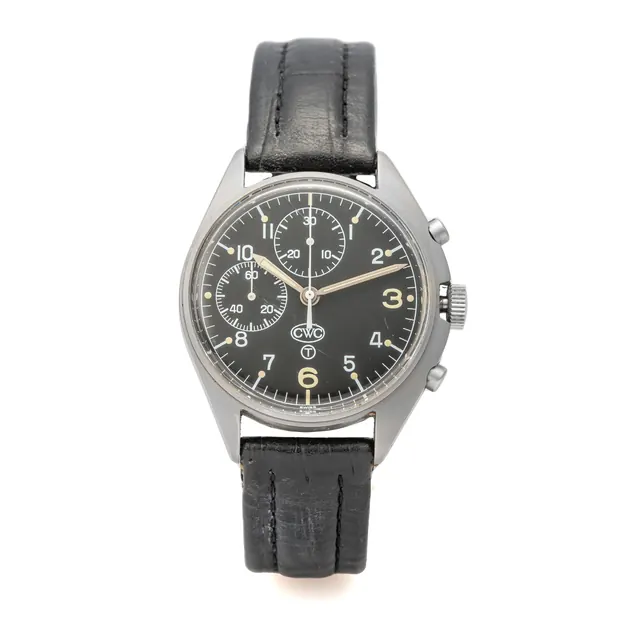
Cwc wristwatch, Military Chronograph, circa 1985
Antiquorum auction archive, Geneva
Wristwatches · 1986
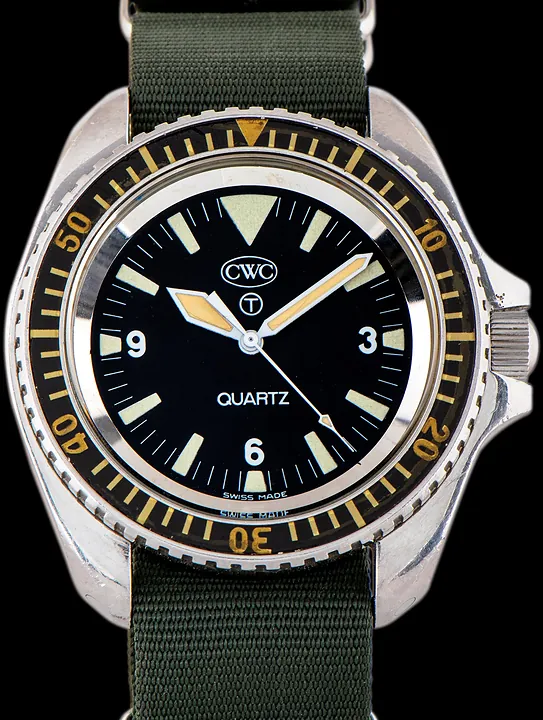
CWC Royal Navy Diver 0552/6645-99-7573314, 1986
Craft & Tailored (dealer), Los Angeles
Wristwatches · 2005
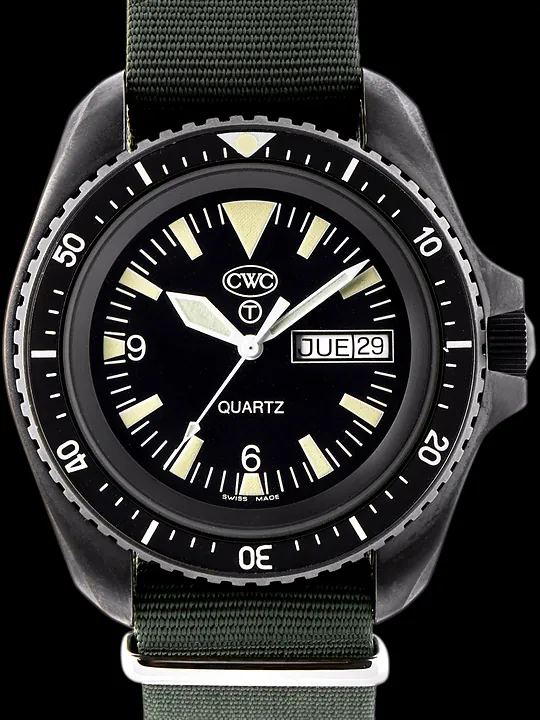
CWC Royal Navy SBS Diver W10/6645-99-7995443, 2005
Craft & Tailored (dealer), Los Angeles
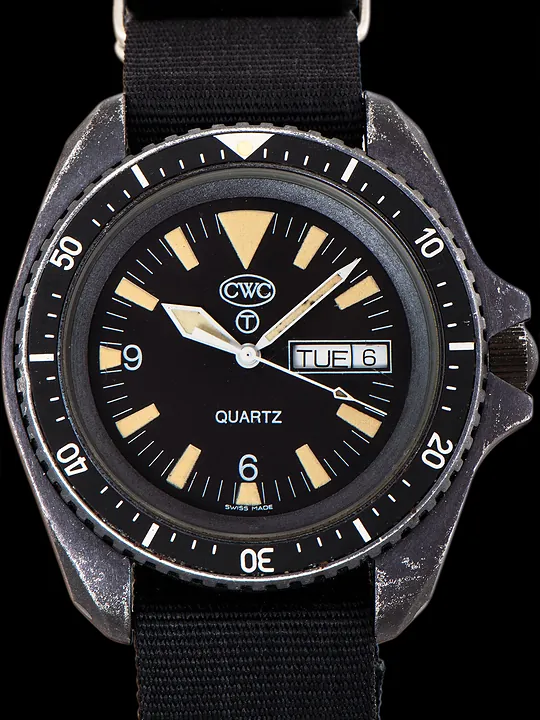
Wristwatches · 1993
CWC Royal Navy SBS Diver 0555/6645-99-7995443, 1993
Craft & Tailored (dealer), Los Angeles
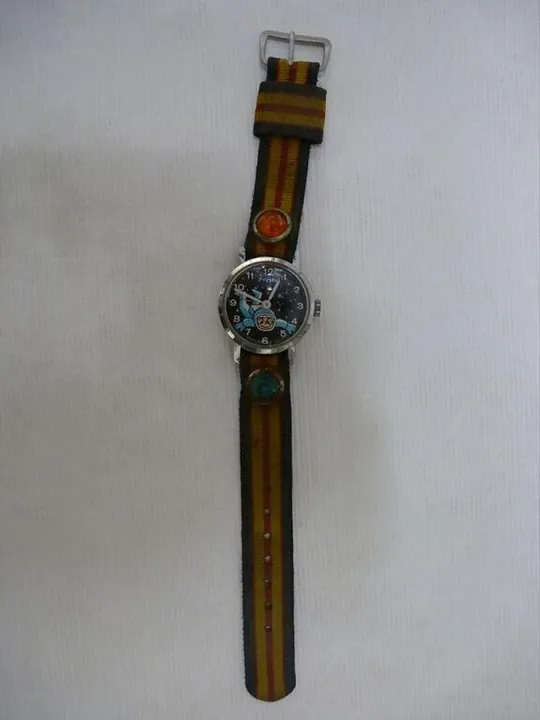
Wristwatches · c.1970
Wristwatch and strap with an astronaut motif, Israel & Britain, c.1970
Victoria and Albert Museum, London
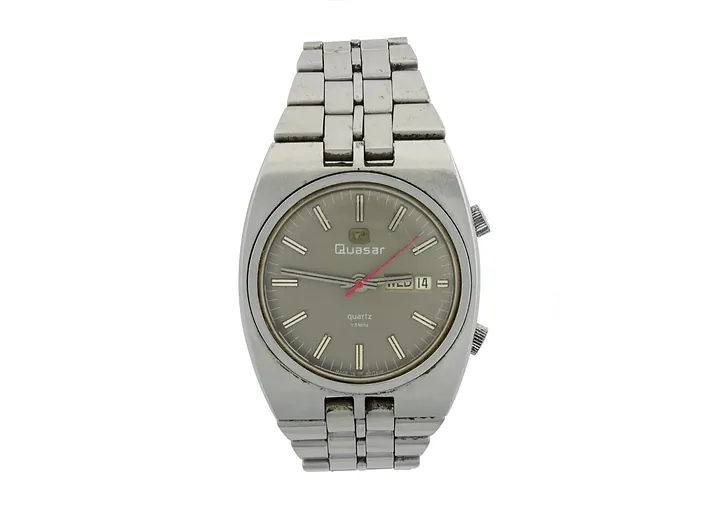
Wristwatches · 1970–1973
Wristwatch by Smiths Industries Limited, England, 1970–1973
Science Museum Group, London
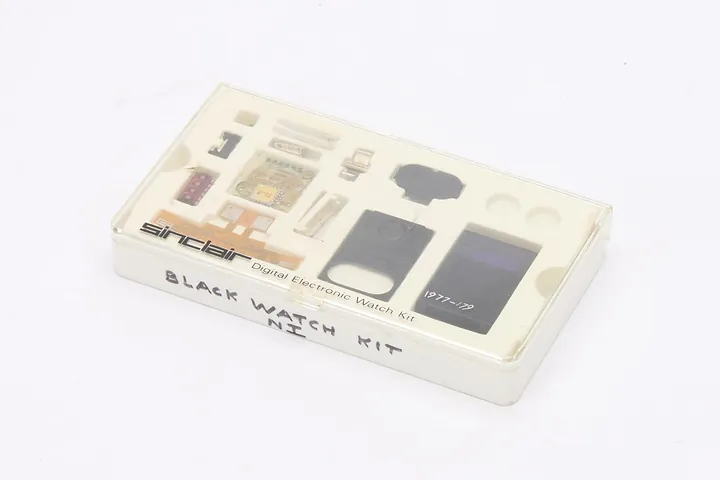
Wristwatches · 1975–1976
Sinclair "Black Watch" watch kit
Science Museum Group, London
Wristwatches · 1976
Wristwatch by Sinclair Radionics Ltd., England, 1976
Science Museum Group, London