
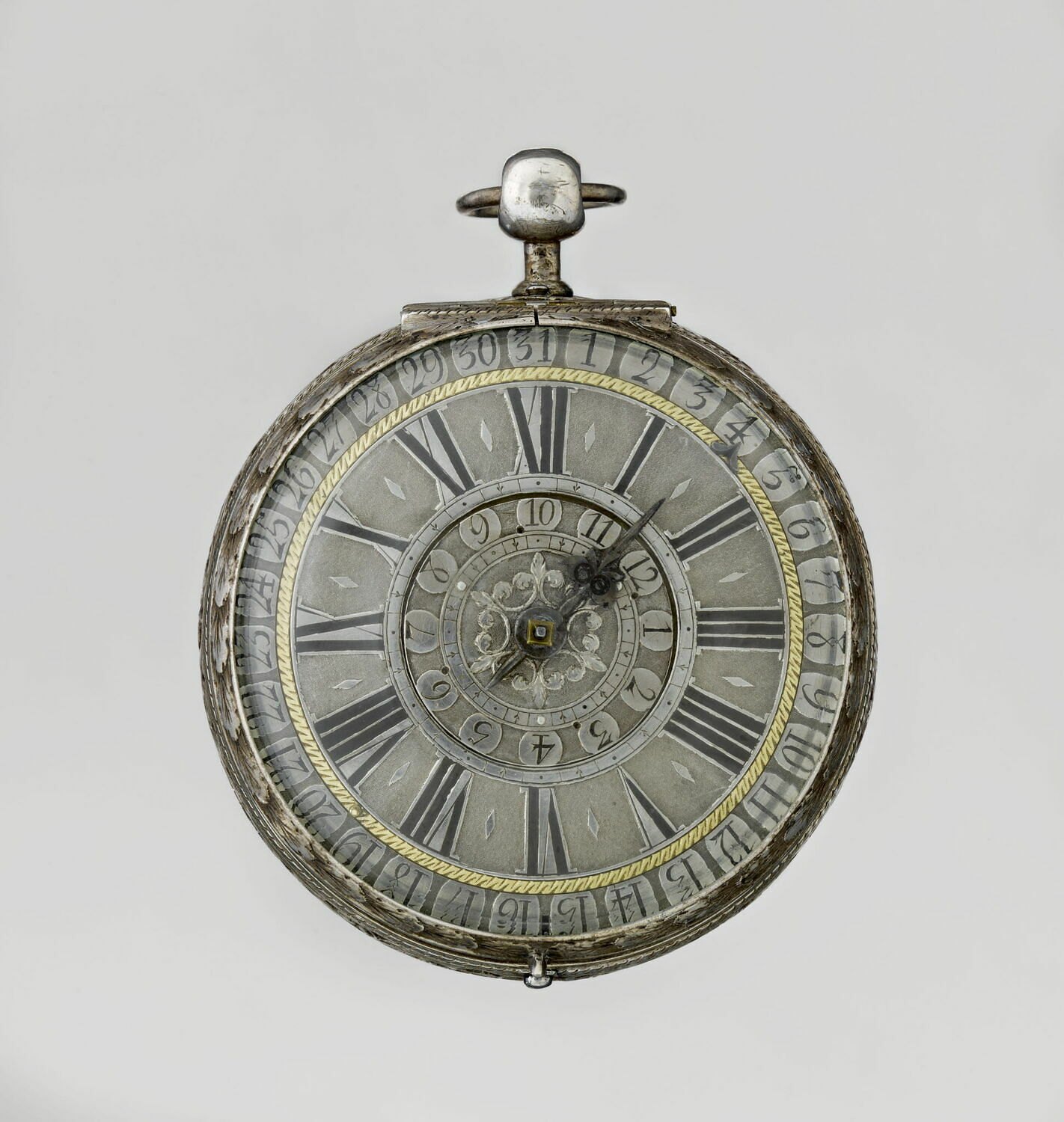
Pocket Watches · Coach watch
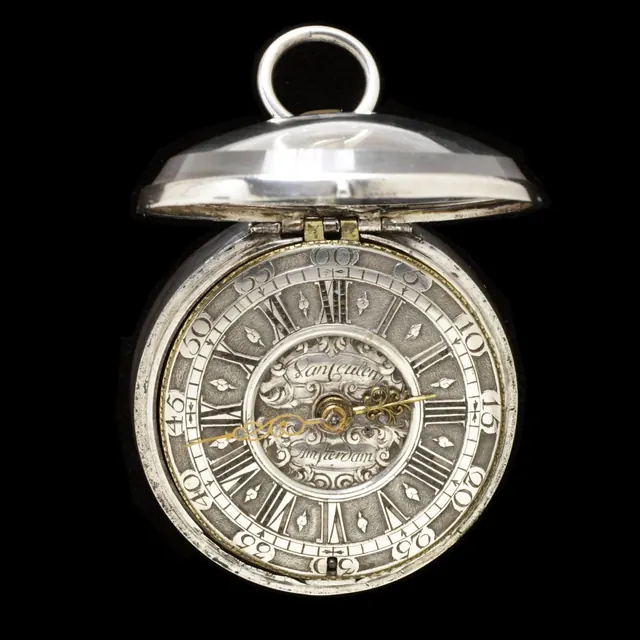
Coach watch by Johannes van Ceulen, Netherlands, 1675–1700
- Maker / attribution
- Johannes van Ceulen (Horloger)
- Date
- 1675–1700
- Historical period
- Early Modern Horology (1600 – 1750)
- Country of origin
- Netherlands
- Place
- La Haye, Netherlands
- Object type
- Coach watch
- Materials / technique
- silver
- Dimensions
- height 10,2 cm; diameter 7,5 cm; thickness 4 cm
- Holding institution
- Musée du Louvre, Paris
- Accession / object no.
- OA 8298
- Credit line
- Musée du Louvre, Département des Objets d'art du Moyen Age, de la Renaissance et des temps modernes
- Catalogue title (original)
- Montre de carrosse (French)
View the source record ↗ (opens another website in a new tab)Suggest a correction
Record summary
Held and catalogued by Musée du Louvre, Paris (object number OA 8298), this is a coach watch by Johannes van Ceulen, made in La Haye, Netherlands, dated 1675–1700. The Atlas places it in the Early Modern Horology period (1600 – 1750) of its Pocket Watches collection. Materials and techniques recorded by the source: silver. Recorded dimensions: height 10,2 cm; diameter 7,5 cm; thickness 4 cm. The record is illustrated with 6 photographs.
Assembled from the source record's structured fields. Dates and attributions are given as the source states them; where a field is missing the Atlas leaves it blank rather than estimating.
Catalogue description
Catalogue description — Musée du Louvre (French)
Fond du boîtier gravé au centre d'une rosace ; deux disques mobiles recouvrant les carrés de remontage du mouvement et du réveil. Carrure découpée à jour d'une frise de rinceaux fleuris ; lunette du verre gravée de feuilles. Tête du pendant en forme de boule laissant librement passer l'anneau de suspension. Sur le pourtour du cadran, un cercle indiquant les quantièmes ; chiffres romains sur des plaquettes rapportées. A l'intérieur, cadran du réveil à chiffres arabes, aiguille en acier fleuronnée. Mouvement doté d'un échappement à roue de rencontre, balancier doté d'un ressort-spiral-réglant. Mouvement muni d'un réveil ; le barillet du train de sonnerie repercé de rinceaux. Coq circulaire à deux pieds et les quatre piliers gravés et ajourés de rinceaux.
Shown in the original language of the source catalogue. An editor-reviewed English translation has not yet been published; we do not publish machine translations as authoritative text.
Dating and period as catalogued (French)
Epoque / période : Louis XIV (1643-1715) (Occident->époque moderne = Ancien Régime->dynastie des Bourbons) · · Date de création/fabrication : 1675 - 1700
Shown in the original language of the source catalogue. An editor-reviewed English translation has not yet been published; we do not publish machine translations as authoritative text.
Materials and techniques as catalogued (French)
Matériau : argent · Technique : techniques métal (orfèvrerie)
Shown in the original language of the source catalogue. An editor-reviewed English translation has not yet been published; we do not publish machine translations as authoritative text.
Inscriptions & marks
Signature : ; mouvement signé : Johannes van Ceulen Haghe
Provenance
collection Jules-René Olivier (1855-1933), horloger-collectionneur ; legs de sa sœur Marie-Julie Olivier, n° 748 ; comité du 24 janvier 1935 ; conseil du 5 février 1935 ; décret du 4 août 1935
Historical context
Early Modern Horology (1600 – 1750)
Huygens' pendulum and balance spring transform accuracy; English makers develop the anchor and deadbeat escapements.
The balance spring (c. 1675) improved watches dramatically and introduced the minute hand. English pair-cased verge watches with pierced balance cocks and French oignons were typical; enamel painting at Blois and Geneva, and the repeating watch (1680s), made watches objects of great refinement.
Read the period in the timelineMore pocket watches from this periodEarlier: Renaissance Horology
Atlas type guide
Verge and pair-cased watches
After Christiaan Huygens and Robert Hooke applied the balance spring around 1675, the verge watch became a reasonably reliable timekeeper and the minute hand became standard. Through the eighteenth century the typical English watch was a pair-cased verge: a fusee movement with a pierced, engraved balance cock, housed in an inner case and a separate protective outer case, often of repoussé gold, shagreen, tortoiseshell or enamel.
French watches of the same period were thicker 'oignons', later replaced by elegant thinner watches following Jean-Antoine Lépine's bar-bridge calibre of c. 1770. Dutch, Swiss and German makers supplied international markets, and verge watches were made until the mid-nineteenth century as cheaper alternatives to the cylinder and lever.
What to look for
- The pierced balance cock on the backplate: winged (continental) or with a foot (English); its style dates the watch.
- Fusee and chain visible through the movement; key winding through the dial (early) or case back.
- Hallmarks inside English silver or gold cases, which give a date letter.
- Maker's name and serial number engraved on the backplate; watch papers inside outer cases.
- Enamel dials (after c. 1720) versus earlier champlevé metal dials.
Dating clues
- Champlevé dials: c. 1680–1730; white enamel dials thereafter.
- English case hallmarks give the year of assay to within a year.
- Verge watches persisted in cheap production until c. 1850.
General guidance written by the Atlas editors about this kind of object. It is not a statement about this particular piece; for that, rely on the source record above and on physical examination.
Read next:Verge escapementFuseeBalance spring (hairspring)Verge escapement
Related records
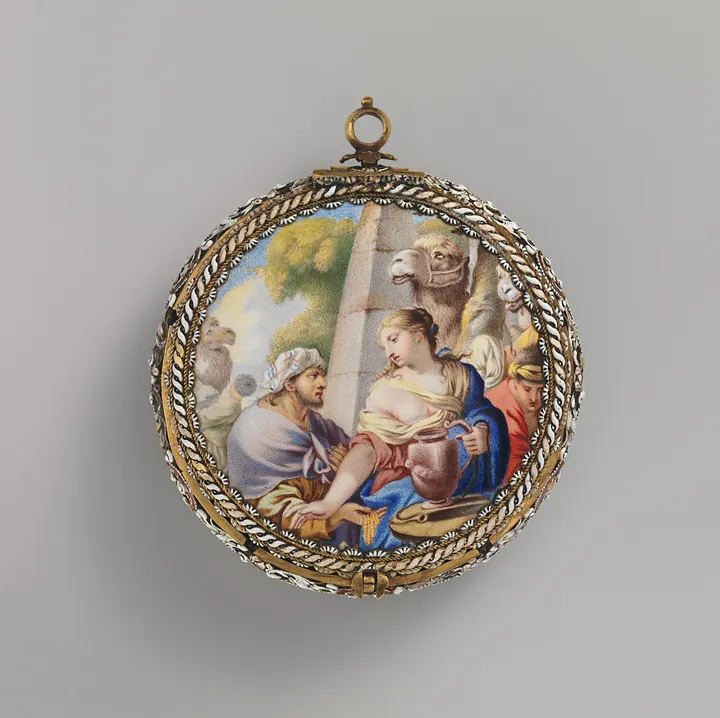
Pocket Watches · c. 1676–80
Watch with scenes from the story of Rebekah at the well
The Metropolitan Museum of Art, New York
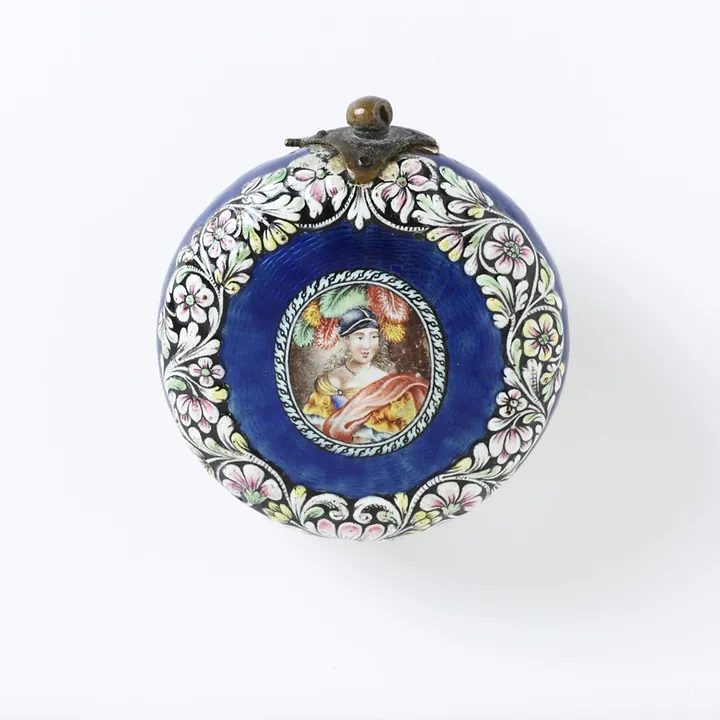
Pocket Watches · 1660–1670
Watch of enamelled and gilt brass, signed 'Pieter Visbach Haghe', made in The Hague, Holland, 1660–1670
Victoria and Albert Museum, London
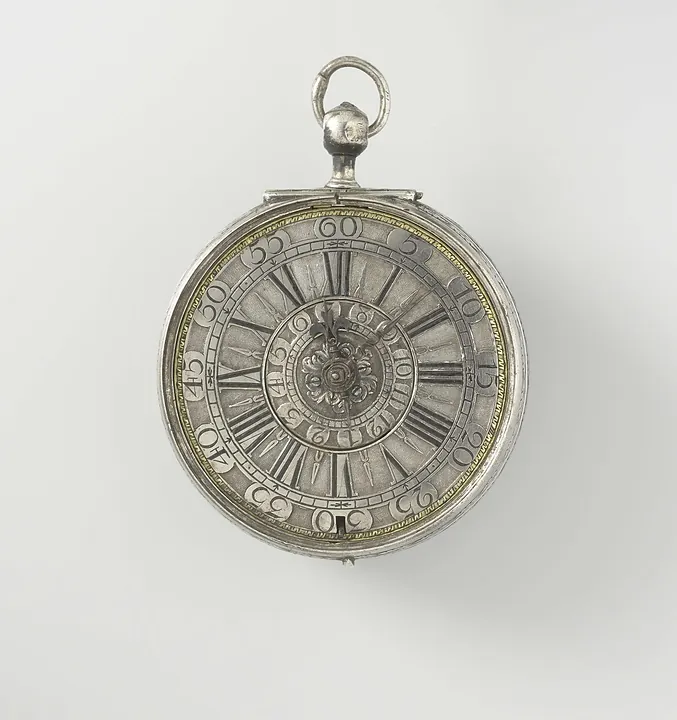
Pocket Watches · 1680
Pocket watch, Netherlands, 1680
Rijksmuseum
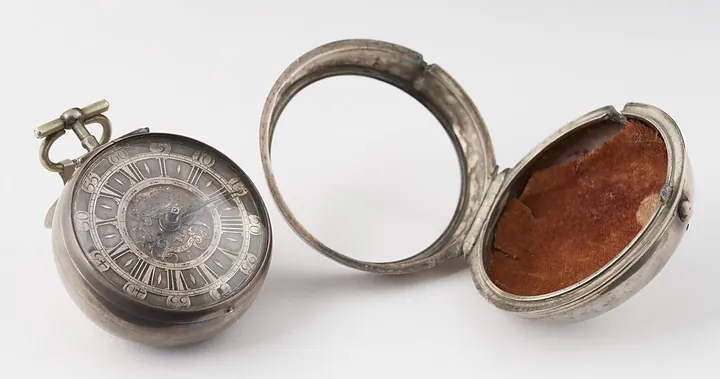
Pocket Watches · 1690-1700.
Verge watch in silver pair case by Johannes van Ceulen of the Hague, 1690-1700.
Science Museum Group, London
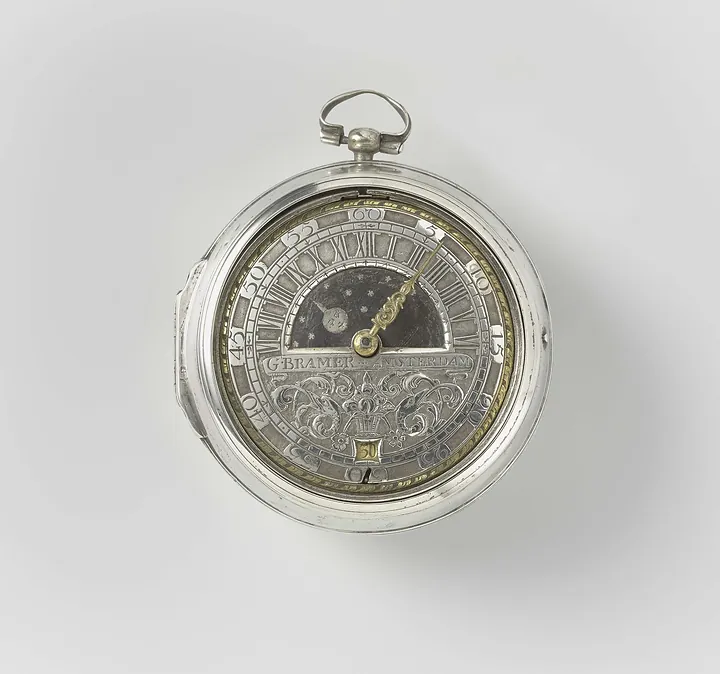
Pocket Watches · 1725
Pocket watch, Netherlands, 1725
Rijksmuseum
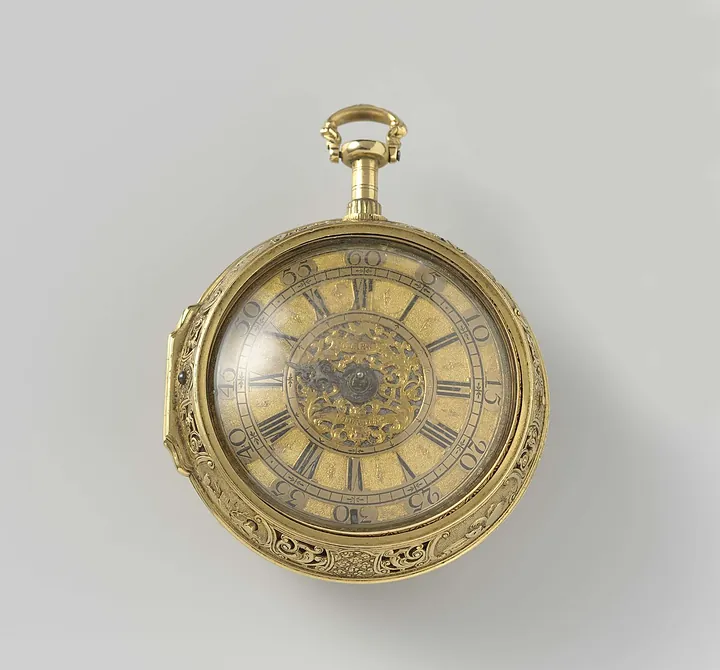
Pocket Watches · 1725
Repeating watch, Netherlands, 1725
Rijksmuseum
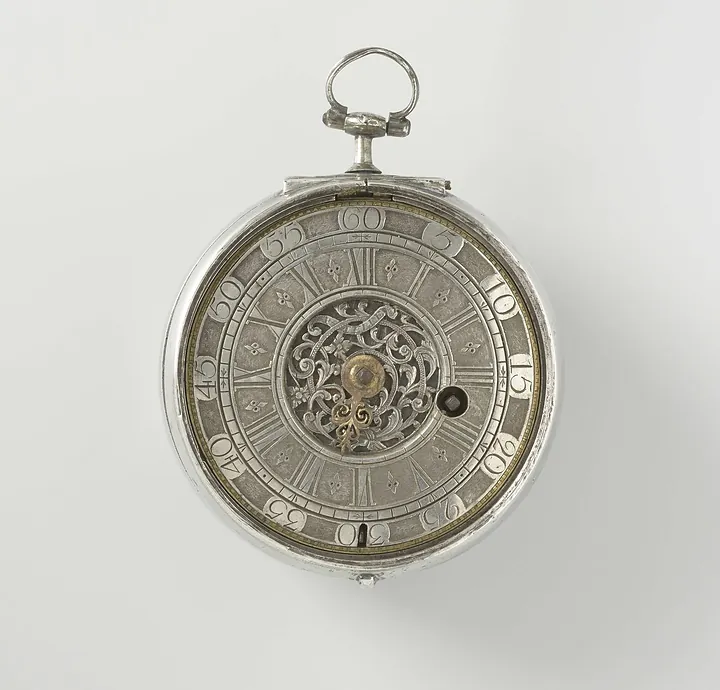
Pocket Watches · 1742
Pocket watch, Netherlands, 1742
Rijksmuseum
Pocket Watches · early 18th century
Watch by Oosterwyk Van Ceulen, Netherlands, early 18th century
Victoria and Albert Museum, London