Clocks · Clock
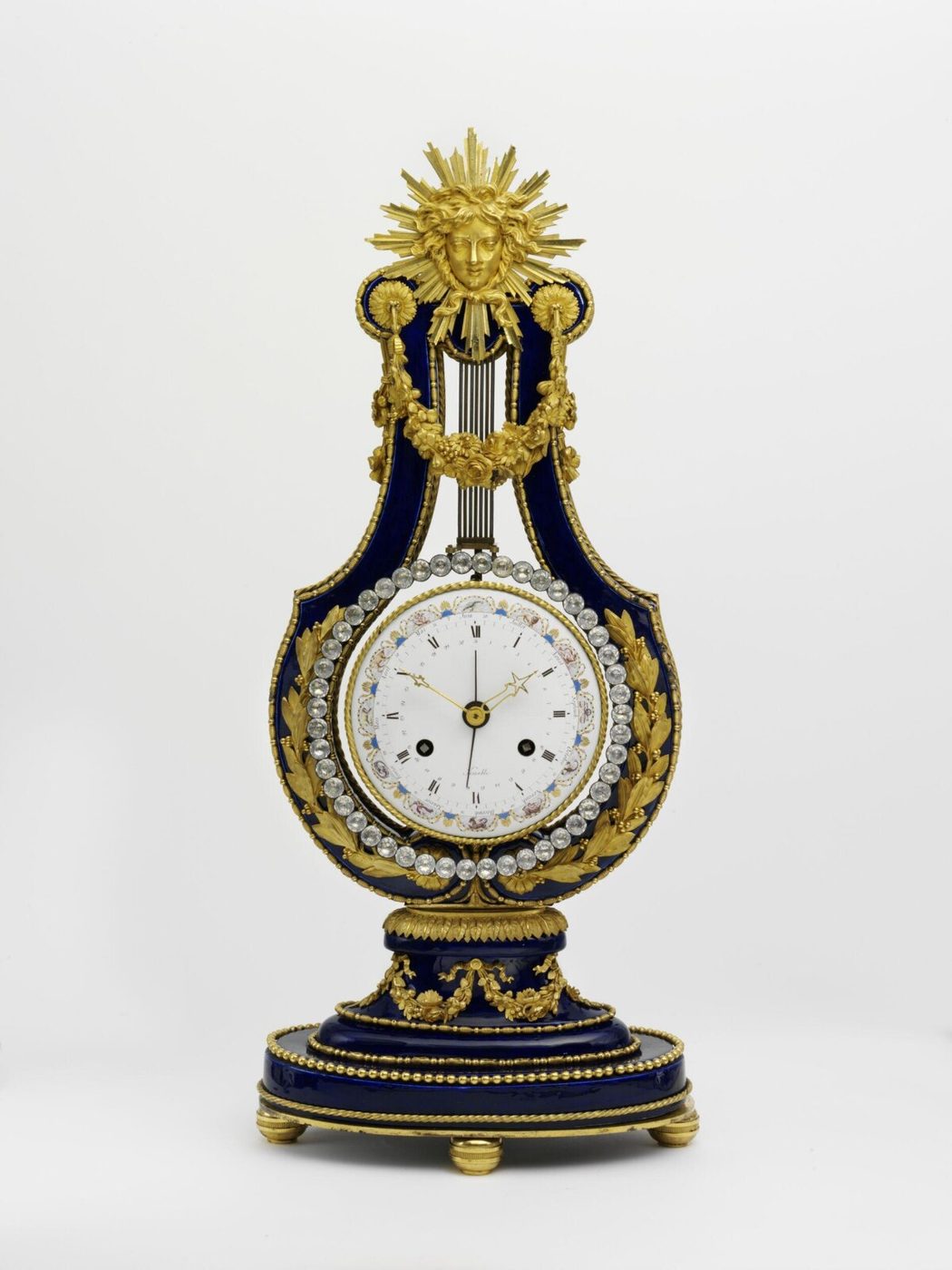
Clock with a porcelain frame case, lyre-shaped, Sèvres porcelain factory, Sèvres, ca. 1795-1797
- Maker / attribution
- Sèvres porcelain factory (maker)
- Date
- ca. 1795-1797
- Historical period
- Precision & Scientific Horology (1750 – 1850)
- Country of origin
- Unrecorded in source
- Place
- Sèvres
- Object type
- Clock
- Materials / technique
- Porcelain, decorated with a blue ground colour and gilded, the dial painted in enamels, ormolu mounted and chased
- Dimensions
- Height: 616 mm; Width: 275 mm; Depth: 169 mm
- Holding institution
- Victoria and Albert Museum, London
- Accession / object no.
- 1004-1882
- Credit line
- Bequeathed by John Jones
Record summary
Held and catalogued by Victoria and Albert Museum, London (object number 1004-1882), this is a clock by Sèvres porcelain factory, made in Sèvres, dated ca. 1795-1797. The Atlas places it in the Precision & Scientific Horology period (1750 – 1850) of its Clocks collection. Materials and techniques recorded by the source: Porcelain, decorated with a blue ground colour and gilded, the dial painted in enamels, ormolu mounted and chased. Recorded dimensions: Height: 616 mm; Width: 275 mm; Depth: 169 mm. The record is illustrated with 4 photographs.
Assembled from the source record's structured fields. Dates and attributions are given as the source states them; where a field is missing the Atlas leaves it blank rather than estimating.
Catalogue description
V&A — Summary
The lyre, with its association in mythology with Apollo, the sun god, was deemed a particularly appropriate shape for clock cases. They were produced in France in the eighteenth and nineteenth centuries in a wide range of materials: carved and gilded wood, marquetry, gilt bronze, marble and porcelain. In addition to this example in Sèvres porcelain, there are two similar Sèvres lyre clocks in the Royal Collection in London. One of these also has a dial painted with the signs of the zodiac by the enameller Coteau, while the other is signed by the same French clock maker, Kinable. A further example is in the Musée National de Céramique at Sèvres. The model was introduced at Sèvres in 1785 and went on being produced in small numbers right up to the end of the 18th century. We know from the factory's kiln records, that some thirty lyres went through the kilns from 1788-1797. Most of those that survive have the deep blue ( beau bleu ) ground colour, but a few are known in green, pink or turquoise blue. King Louis XVI, is recorded as buying a pair of blue-ground lyre clocks on 4th January 1786 at a cost of 384 livres . However, the factory records reveal that they were mostly bought by clock makers or marchands merciers (dealers in luxury goods) who then fitted them with clock dials and movements which are fortunately often dated and signed. The clock maker Dieudonné Kinable was active from the late 18th century until after 1816. His first recorded purchase of a lyre clock was on 26 pluviôse an III (14 February, 1795). Between that date and 25 March, 1797 (5 germinal, an V), he bought twelve lyres. On 12 June 1806 he purchased a further seven. While the date 1806 scratched on the springs of the museum's clock might suggest that its lyre case was one of the seven bought by Kinable in 1806, the fact that they were priced at a mere 48 francs each could indicate that they were part of unsold old stock which the manufactory was selling at a considerable discount. Reproduction Louis XVI lyre-shaped clocks were made in the second half of the nineteenth century, often copying the names and dates on known original versions. Information taken from Geoffrey de Bellaigue. French Porcelain in the Collection of Her Majesty the Queen , Royal Collection Publications, 2009, 3 vols. Vol. III, pp. 993-997.
V&A — Physical description
Case: Clock with a porcelain frame case, lyre-shaped and blue ( beau bleu , developed at Sèvres in 1763) ground with chased ormolu mounts and dial painted with the signs of the Zodiac, and the pendulum formed by a ring of paste diamonds. Dial: The innermost ring of figures 1 to 31 are for the day of the month. The next ring is marked with Roman hours. Surrounding this is the minute circle, with every fifth minute marked by a paste diamond. Around these are the names of the months in French, surrounded by painted figures of the zodiac by Cotteau, in various colours. The winding holes are inside IIII VIII, and the dial is signed 'Kinable' above VI. The hour and minute hands are pierced brass, the hands for the day of the month and annual calender steel; the latter hand has partly broken off. Movement: The circular movement plates are 12.7cm diameter. Both trains have going barrels, with an Amant-type pin-wheel escapement. The pendulum has a double bob, and at the front the ring of 47 paste diamonds each set in a thin copper cup, which surround the dial. These two lower parts of the pendulum are fixed below a horizontal A-shaped piece attached to the bottom of a mock compensation pendulum of 4 steel and 3 brass rods, each 15.2cm long and all fixed at the top and bottom, suspended from a stirrup with screw vertical adjustment and resting on a pair of knife-edges. An upward crutch attached to the pallet arbor has two pins which engage with the slots between the rods of the mock compensation, with a screw for sideways adjustment. The locking-plate striking train, with an outside count-wheel, allows for a single stroke at each half-hour, coaxial with the second wheel of the strike train.
V&A — Object history
This clock was among a large collection of furniture, porcelain, metalwork, paintings and books owned by the tailor and businessman John Jones, and kept in cramped conditions at his house at 95, Piccadilly. In his will of 4 December 1879 and in a codicil of 22 January 1880, Jones bequeathed the objects to the South Kensington Museum, and they were transferred there after his death in 1882. The Handbook to the Jones bequest, published in 1883, marvels at the value of the gift, which seems still not to have been displayed to best advantage: 'Probably a large majority of those who visit the Jones collection will be indisposed to believe ... that so limited a space as three not large galleries in the Museum can contain furniture and decorative arts worth no less than a quarter of a million of money'. Jones' principal collecting interests lay in French eighteenth-century furniture and decorative arts, of which this clock is a splendid and rare example, as well as reflecting the late-Victorian love of rich, gilded surfaces and historical artistic styles. One of sixteen clocks bequeathed to the South Kensington Museum by John Jones.
V&A — Production note
Metal mounting by Duplessis. The dial is signed by Cotteau (born Geneva after 1739, died after 1812), who painted the signs of the Zodiac, as well as by the clockmaker Kinable (active 1780-1825), who is known to have bought 13 porcelain clocks of this type from the Sèvres manufactory between 1795 and 1797.
V&A gallery label
Clock About 1795–97 This expensive model of clock was introduced as early as 1785 and made by the Sèvres factory for the rest of the century, even after the Revolution. In the shape of Apollo’s lyre and surmounted by the head of a Greek god, the clock has exceptionally fine gilded metal ornaments. France (Paris) Made at the Sèvres factory Movement by the clockmaker Kinable Porcelain; gilded copper alloy mounts; glass-paste diamonds; dial of painted enamels on copper Bequeathed by John Jones
V&A gallery label
Clock. Sèvres porcelain frame, lyre-shape, gros-bleu, with chased ormoulu mounts, the dial painted with the signs of the zodiac by Cotteau, and the pendulum formed by a ring of paste diamonds. The works by "Kinable". The metal mounting by Duplessis. French . Second half of 18 th cent y . L. 2 ft ¼ in; W. 10½ in. Jones Bequest 1004-1882
V&A gallery label
LYRE CLOCK French; late 18th century. Sèvres porcelain ( bleu nouveau ) mounted in cast and chased ormolu, the painted enamel dial surrounded by pastes. Dial signed by the clockmaker Kinable (active c. 1780-1825), and by the enameller Coteau, (born Geneva after 1739 - died after 1812) who painted the signs of the zodiac corresponding to the months. Kinable is known to have bought thirteen such porcelain lyres from the Sèvres manufactory between 1795 and 1797. Other versions are in the Royal Collection and at the Louvre. Jones Collection. 1004-1882
Inscriptions & marks
'Kinable'
Historical context
Precision & Scientific Horology (1750 – 1850)
Harrison solves longitude; Mudge invents the lever; Breguet's Paris workshop defines the modern watch.
The age of the deadbeat escapement, compensated pendulums and observatory regulators. Domestic clocks spread through the middle classes: English longcase and bracket clocks, French gilt-bronze mantel clocks, Viennese Biedermeier wall clocks, Black Forest painted-shield clocks, and the first American shelf clocks.
Read the period in the timelineMore clocks from this periodEarlier: Early Modern Horology
Atlas type guide
Domestic clocks
A clock combines four systems: a source of power (falling weight, coiled spring, or later electricity), a gear train that divides time, an escapement and oscillator that regulate it (foliot, pendulum or balance), and an indicating system of dial and hands or a bell. Its history runs from the large iron weight-driven clocks of the late thirteenth century to Renaissance spring-driven table clocks, the pendulum revolution of 1656, the factory clocks of the nineteenth century and electric and quartz clocks of the twentieth.
Domestic clocks also reflect regional furniture and decorative traditions — English longcase and bracket clocks, French pendules, Viennese regulators, Black Forest and American shelf clocks — and therefore record changing tastes as much as technical progress.
What to look for
- How the clock is powered: weights, spring barrel, fusee, electric coil.
- The oscillator: foliot, short pendulum, long seconds pendulum or balance.
- Whether it strikes: hour only (count wheel) or hours and quarters (rack striking).
- The maker or retailer's name on dial and movement, and any factory trademarks.
- Signs of alteration — replaced dials, converted escapements, 'married' cases.
Dating clues
- Before 1656 clocks used foliots or balances; after, most domestic clocks have pendulums.
- Anchor escapements spread after c. 1670; minute hands became common at the same time.
- Factory production in America and Germany transformed prices after c. 1840.
General guidance written by the Atlas editors about this kind of object. It is not a statement about this particular piece; for that, rely on the source record above and on physical examination.
Related records
Clocks · 1701-1799
Alarm clock, Austria, 1701-1799
Science Museum Group, London
Clocks · 1711–1827
Longcase clock by David Roentgen ( - ), England, 1711–1827
Badisches Landesmuseum Karlsruhe
Clocks · 1723–1811
Table clock by Louis Montjoye, France, 1723–1811
Badisches Landesmuseum Karlsruhe
Clocks · 1738–1814
Table clock by Jean Simon Bourdier, France, 1738–1814
Badisches Landesmuseum Karlsruhe
Clocks · 1740-1760
Longcase clock, English, 1740-1760, japanned wood, John Ellicott
Victoria and Albert Museum, London
Clocks · 1740–60
Tall clock by Samuel Bagnall, United States, 1740–60
The Metropolitan Museum of Art, New York
Clocks · 1750-1800
Bracket clock in metal case with scroll handles and flamed-shaped top signed by Pierre Seignoret, Clockmaket to the the Comte d'Artois
Victoria and Albert Museum, London
Clocks · 1750
Clock by Georg Gfell, Germany, 1750
German Clock Museum