
Pocket Watches · Alarm watch
Clock-watch with alarm
- Maker / attribution
- Hans Schniep (Made by)
- Date
- 1590–1610
- Historical period
- Early Modern Horology (1600 – 1750)
- Country of origin
- Germany
- Place
- Speyer
- Object type
- Alarm watch
- Materials / technique
- brass, gold
- Dimensions
- Diameter: 73.50 millimetres (case) Thickness: 36.50 millimetres
- Holding institution
- British Museum
- Accession / object no.
- 1958,1201.2213
- Credit line
- British Museum, London
- Catalogue title (original)
- Clock-watch with alarm (English)
View the source record ↗ (opens another website in a new tab)Suggest a correction
Record summary
Held and catalogued by British Museum (object number 1958,1201.2213), this is an alarm watch by Hans Schniep, made in Speyer, Germany, dated 1590–1610. The Atlas places it in the Early Modern Horology period (1600 – 1750) of its Pocket Watches collection. Materials and techniques recorded by the source: brass, gold. Recorded dimensions: Diameter: 73.50 millimetres (case) Thickness: 36.50 millimetres. The record is illustrated with 6 photographs.
Assembled from the source record's structured fields. Dates and attributions are given as the source states them; where a field is missing the Atlas leaves it blank rather than estimating.
Catalogue description
Description — British Museum
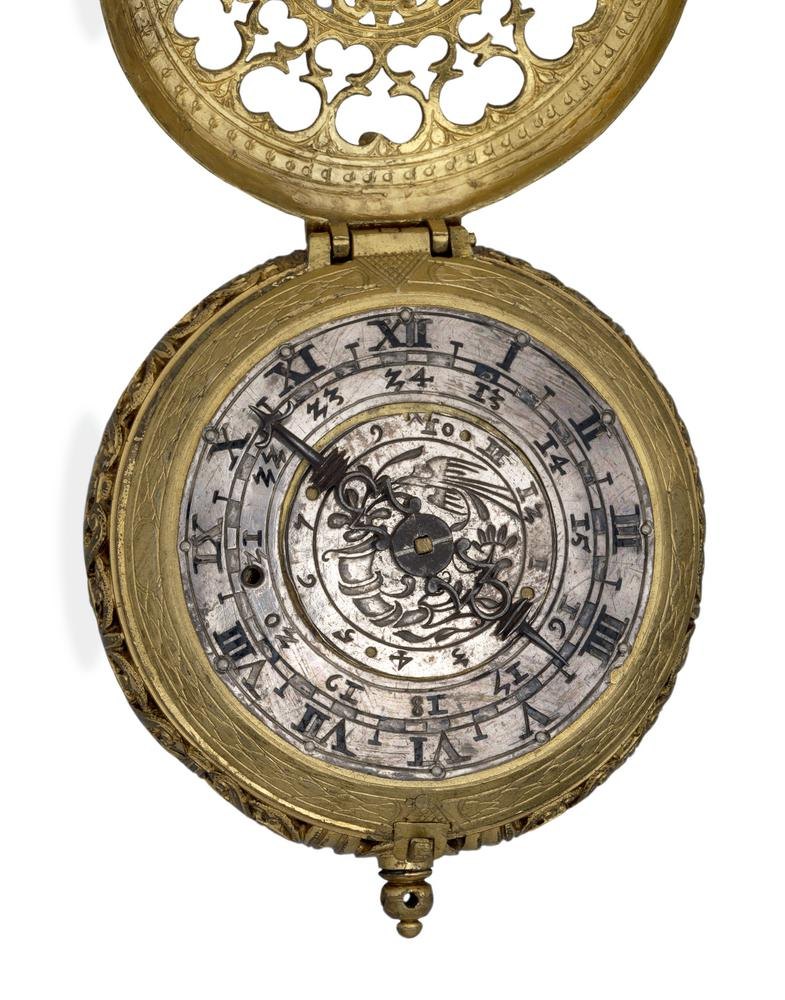
CLOCK-WATCH WITH ALARM Germany, ca.1580 : Movement with circular gilt-brass plates and square pillars rivetted to the back-plate. Open mainsprings with guard-posts to prevent fouling of the other components. Most of the train wheels are of steel, those of brass are replacements. Verge escapement; verge, balance, balance-cock and all the stackfreed components are replacements. : Striking train with nag's head release. Annular count-wheel for hours only. The bell is not original. : Gilt-brass dial-plate with an applied silver chapter-ring, the touch pieces filed flush. Central silver alarm-setting disc originally with coloured enamel decoration. Chapter-ring with hours I-XII and 13-24 and T-shaped half-hour marks with a quarters circle between. A hole near IX is for strike release should it get out of phase with the time indicated by the hand. : Gilt-brass case pierced and engraved with symmetrical designs; a typical 'urn and flower' decoration on the back. : Movement with punched signature:- 'HANS SCHNIEP IN SPIER' (Hans Schniep of Speyer purchased his freedom of that town in 1572. He died in about 1624. : Ilbert Collection, 1958. (M&LA CAI-2213).
Curator's comments — British Museum
Text from 'Watches', by David Thompson, London, 2008, p. 16-17. Hans Schniep GILT-BRASS CASED STACKFREED CLOCK-WATCH WITH ALARM SPEYER, GERMANY, c. 1580 SIGNED: 'HANS SCHNIEP IN SPEIR' By the third quarter of the sixteenth century, the number of watch- and clockmakers in South Germany had grown enormously and guilds were being established to oversee apprenticeships and organize the work. Cities such as Augsburg, where a clockmakers' guild was established in 1564, and Munich, where a guild was established a year later, had a prolific output, which increased during the second half of the century. While the cities of Bayern were the heartland of watchmaking in the sixteenth century, nevertheless there were makers in other locations who excelled. One was Hans Schniep, who lived and worked in Speyer, or Spier, on the Rhine near Mannheim. The city had been the site of important events in the Reformation, especially in 1529, when six princes and fourteen cities sent a petition to the Reichstag, whose seat was in the city, protesting against the imperial ban on Martin Luther's teachings. Schniep gained the Freedom of Speyer in 1572 and his name appears in the lists of the Guilds of Smiths until 1599. He is best known for a watch in the form of a book, now in the Musée du Louvre, Paris, which is signed 'HANS SCHNIEP IN SPEIR 1583' and punched with a triple-spired church, the town-mark of Speyer. While the book-watch can be seen as a less common form of Germanic work, the watch shown here is typical of the last quarter of the sixteenth century. The general design of watches changed from the tambour (drum) shape to this more rounded form. The cover is domed and the case band has a noticeable bombé shape. The back of the case is also domed and is pierced and engraved with a typical urn-and-flower pattern. The front cover is pierced with apertures to reveal the numerals on the silver and enamel dial beneath. This dial is decorated using a technique known as basse-taille in which the design, usually an exotic bird and flowers, is first engraved and then filled with coloured enamels, although here, sadly, much of the enamel is now missing. The chapter ring is numbered for the hours with Roman numerals, I-XII, and a second circle of Arabic numerals, 13-24, with the '2' written in the 'z' form characteristic of Germanic clocks and watches of this period. The quarter-hours are shown by a circle of alternate hatched and plain rectangles. To set the alarm, the central disc is turned until the desired time appears beneath the tail of the hand, which in this instance is a later replacement. Finally there is a hole in the dial near the '21' hour numeral. This hole, often filled in by ill-informed restorers, is provided so that the owner may insert a small peg such as a toothpick to release the striking tram when the watch has stopped through lack of winding, but the going train continued after the striking spring has run down. The plates and pillars of the movement are brass, but the wheels are iron, as in earlier Germanic practice. The going train is controlled by a verge escapement with a dumb-bell balance (here a modern replacement). The mainspring of the going train has a stackfreed mechanism to even out its changing torque. The striking mechanism, which sounds the hours 1-12 on a bell in the back of the case, is controlled by a count wheel and also has iron wheels. View more about curator's comments Comment from Hugh Tait, Catalogue of Watches in the British Museum. Vol. I (1987) Made by Hans Schniep (signed); Speyer, Germany, late 16th or early 17th century Watch with Hour-Striking Mechanism and Alarum Case: Back: simple version of the 'urn and flowers' pattern (pierced) but with the addition of two swags of drapery attached to the lower terminals of the two handles of the urn; in the centre is an attachment for the bell, but neither the screw nor the bell seems to be original. Band: standard; turned pendant with ring, and pendentive finial pierced with two holes intersecting at right angles in the centre. Lid: standard; the latch has been removed. Dial: applied silver chapter-ring with silver touch-pins and traces of black enamel in the numerals and divisions; in the centre, a silver alarum-setting dial with arabic numerals (1-12) running in a clockwise direction, and engraved with a cornucopia, foliage and a bird in flight (originally filled with coloured translucent enamels); the brass rim is engraved with a highly stylised laurel wreath; the steel hand is a later replacement; strike-release hole at IX. Movement: (a) Brass plates and pillars engraved with straight lines (but no conical sinks); brass crown-wheel clip and striking mainspring block with engraved floral decoration. (b) All the furniture on the pillar-plate has been renewed, with the possible exception of the cock for the pin-wheel; the short balance-cock is a later replacement. (c) Punch-mark: HANS SCHNIEP IN SPEIR (near the edge of the plate outside the free end of the stackfreed spring). Each letter of the inscription is individually punched. (d) All the wheels are of steel, except the contrate- and crown-wheel in the going-train and third-wheel in the striking-train, the arbor of which also carries a brass-slotted cam to engage the end of the modified locking-arm. The upper end of the pin-wheel arbor runs in a cock. The contrate-wheel in the alarum-train is a later replacement in brass and the slide has been removed. The alarum is now locked by the end of a brass spring, mounted on the plate, engaging a pin on the arm of the alarum hammer. The latch for the movement is missing. Diameter (of case): 73.5 mm. Provenance: Ilbert Collection, 1958. Notes: 1. For a similarly cased watch, engraved on the movement with the initials CM, see 'La Collection Olivier' 1984, no. 42. 2. There is no published account of this maker's career. Dr Karl Schultz, Director of the Historisches Museum der Pfalz, Speyer am Rhein, has very kindly communicated t.
Inscriptions & marks
signature; HANS SCHNIEP IN SPIER [movement]
Provenance
Previous owner/ex-collection:, Courtenay Adrian Ilbert, Previous owner/ex-collection:, Percy Webster; Acquired 1958
Historical context
Early Modern Horology (1600 – 1750)
Huygens' pendulum and balance spring transform accuracy; English makers develop the anchor and deadbeat escapements.
The balance spring (c. 1675) improved watches dramatically and introduced the minute hand. English pair-cased verge watches with pierced balance cocks and French oignons were typical; enamel painting at Blois and Geneva, and the repeating watch (1680s), made watches objects of great refinement.
Read the period in the timelineMore pocket watches from this periodEarlier: Renaissance Horology
Atlas type guide
Early spring-driven watches
Portable spring-driven timepieces appeared in southern Germany, France and Italy in the early sixteenth century; Peter Henlein of Nuremberg is traditionally credited, although the historical record is complex. These early watches were worn as pendants or carried, had iron or brass movements with a verge escapement and a foliot or small balance, and used a stackfreed or fusee to equalise spring force. They indicated hours only and were notoriously inaccurate.
From the later sixteenth century watches were made in Blois, Paris, Geneva, London and Augsburg in oval, octagonal, cruciform, skull and other 'form' cases of rock crystal, gilt brass, silver and enamel. They were jewellery and status objects as much as timekeepers.
What to look for
- A single hour hand and often a touch-pin hour ring for feeling the time.
- Stackfreed (a cam and spring) instead of a fusee on German watches.
- Pierced and engraved cocks over the balance, fine gut fusee lines.
- Rock-crystal, enamelled or engraved form cases.
Dating clues
- Drum-shaped German watches: c. 1530–1580.
- Oval and form watches: c. 1580–1650.
- Before c. 1675 there is no balance spring; watches can vary by many minutes a day.
General guidance written by the Atlas editors about this kind of object. It is not a statement about this particular piece; for that, rely on the source record above and on physical examination.
Read next:FuseeFoliotThe Melanchthon watch
Related records
Pocket Watches · 1600–1699
Pocket watch by Georg Ernst, Germany, 1600–1699
Fine Arts Museum Vienna
Pocket Watches · 1600–1699
Pocket watch by Johan Etmiller, Germany, 1600–1699
Nordic Museum Foundation
Pocket Watches · early 17th century
Watch with gilt brass case, crystal and blue glass panels signed 'Conradt Kreizer', Germany, early 17th century
Victoria and Albert Museum, London
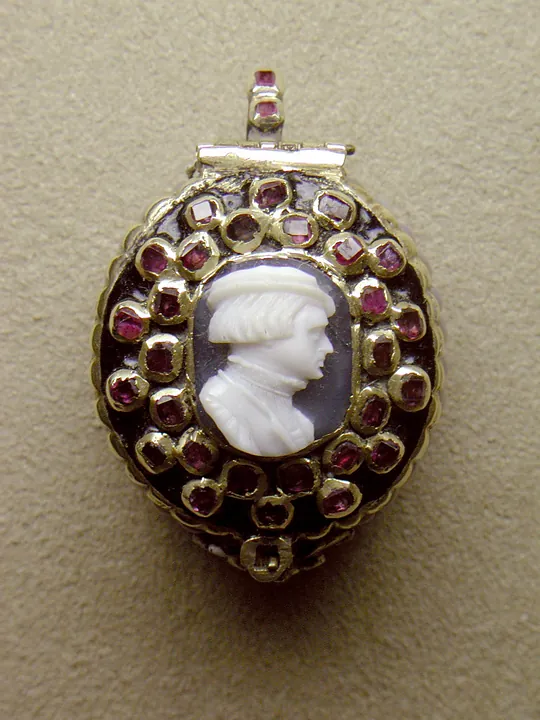
Pocket Watches · watch c. 1650, cameo 16th–17th century
Watch by Wilhelm Peffenhauser, Germany, watch c. 1650, cameo 16th–17th century
The Metropolitan Museum of Art, New York
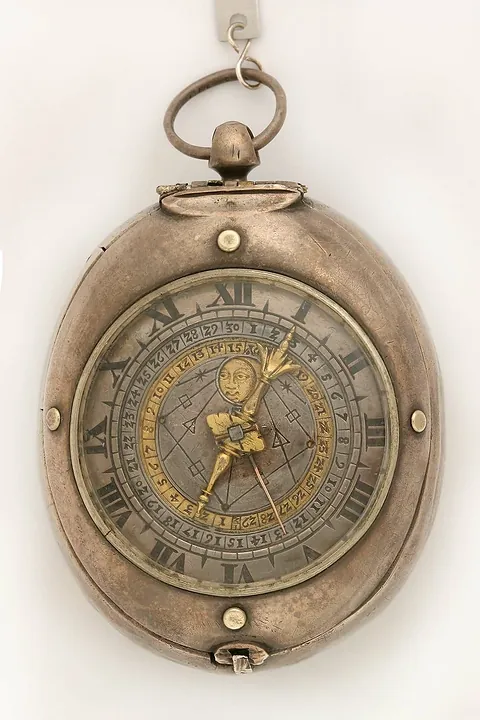
Pocket Watches · c. 1650
Pocket watch by Johann Sayller, Germany, c. 1650
German Clock Museum
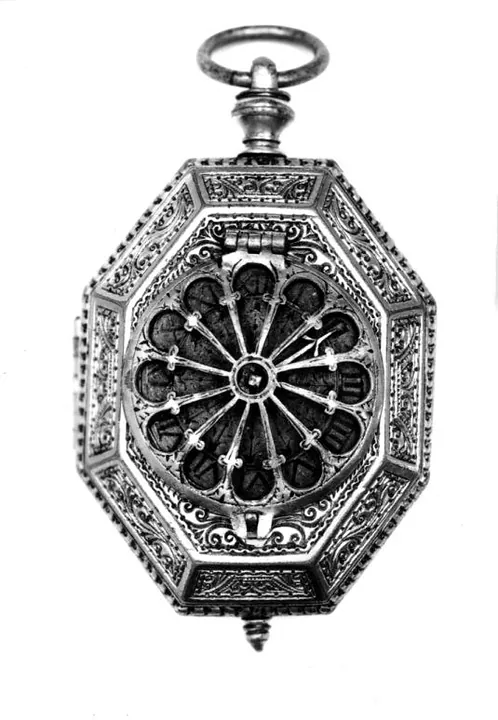
Pocket Watches · 1650–1699
Pocket watch, Germany, 1650–1699
Badisches Landesmuseum Karlsruhe
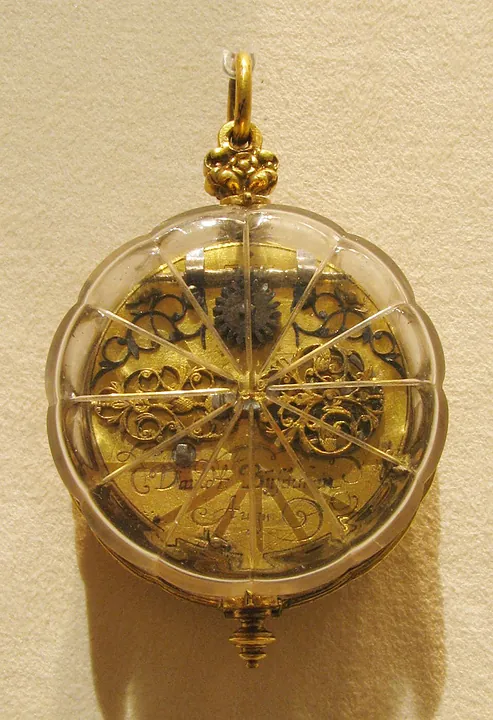
Pocket Watches · probably after 1657
Watch by David Buschman, Germany, probably after 1657
The Metropolitan Museum of Art, New York
Pocket Watches · c. 1670
Watch by Nicolaus Rugendas the Younger, Germany, c. 1670
The Metropolitan Museum of Art, New York