
Clocks · Clock
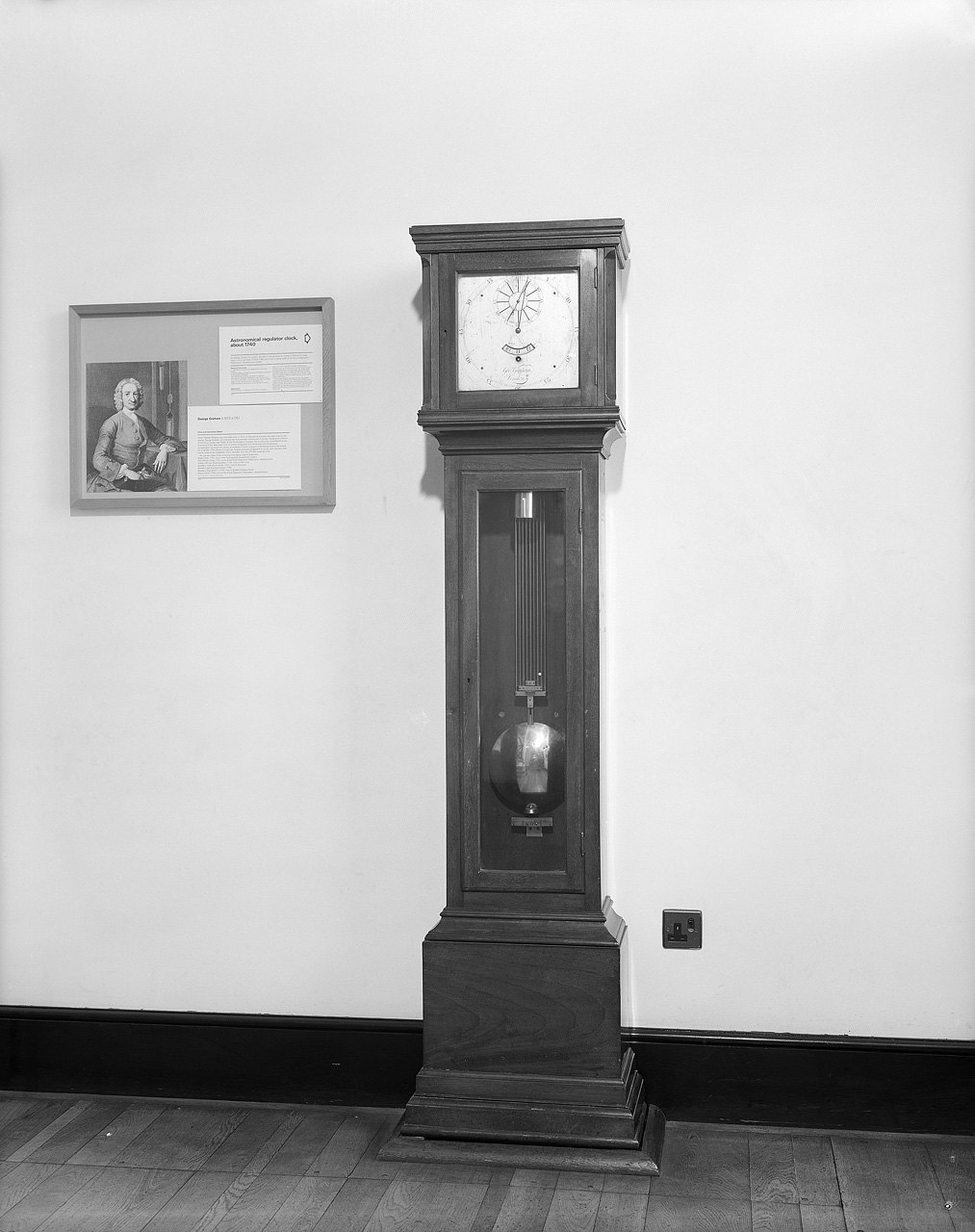
Clock no. 680 by George Graham
- Maker / attribution
- George Graham (maker)
- Date
- c. 1730
- Historical period
- Early Modern Horology (1600 – 1750)
- Country of origin
- England
- Object type
- Clock
- Materials / technique
- wood; brass
- Dimensions
- Overall: 1840 x 450 x 260 mm
- Holding institution
- Royal Museums Greenwich
- Accession / object no.
- ZAA0590
- Credit line
- National Maritime Museum, Greenwich, London
- Catalogue title (original)
- No. 680 (English)
View the source record ↗ (opens another website in a new tab)Suggest a correction
Record summary
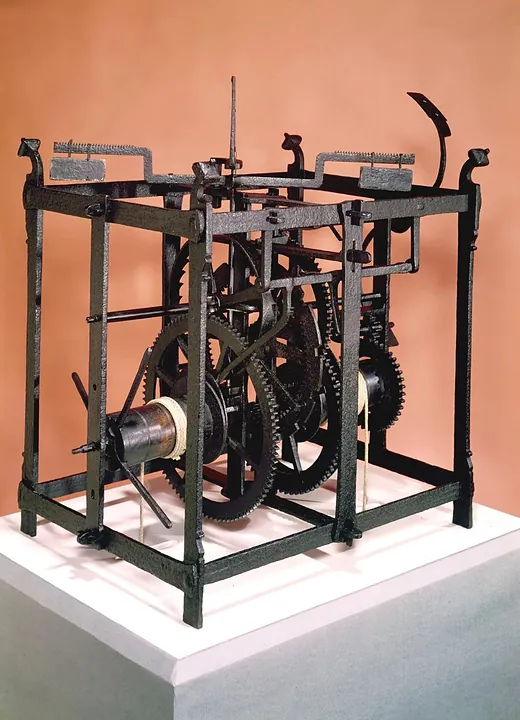
Held and catalogued by Royal Museums Greenwich (object number ZAA0590), this is a clock by George Graham, made in England, dated c. 1730. The Atlas places it in the Early Modern Horology period (1600 – 1750) of its Clocks collection. Materials and techniques recorded by the source: wood; brass. Recorded dimensions: Overall: 1840 x 450 x 260 mm. The record is illustrated with 1 photograph.
Assembled from the source record's structured fields. Dates and attributions are given as the source states them; where a field is missing the Atlas leaves it blank rather than estimating.
Catalogue description
Catalogue description — Royal Museums Greenwich
Astronomical regulator No. 680. This clock was re-assembled in 2004 with the exception of the electrical contacts. Month going, bolt and shutter working power replaced by Harrison's. New escape wheel and pallets, electrical contacts added for minute and hour impulses. It has also been recased. The square silver dial displays hours in an aperture.
Historical context
Early Modern Horology (1600 – 1750)
Huygens' pendulum and balance spring transform accuracy; English makers develop the anchor and deadbeat escapements.
Huygens's pendulum (1656–57) improved clock accuracy from about a quarter of an hour to under a minute a day. The anchor escapement (c. 1670) and the long seconds pendulum created the longcase clock; London makers such as Fromanteel, Knibb, Tompion and Quare led European clockmaking, and French makers created the Boulle pendule.
Read the period in the timelineMore clocks from this periodEarlier: Renaissance Horology
Atlas type guide
Domestic clocks
A clock combines four systems: a source of power (falling weight, coiled spring, or later electricity), a gear train that divides time, an escapement and oscillator that regulate it (foliot, pendulum or balance), and an indicating system of dial and hands or a bell. Its history runs from the large iron weight-driven clocks of the late thirteenth century to Renaissance spring-driven table clocks, the pendulum revolution of 1656, the factory clocks of the nineteenth century and electric and quartz clocks of the twentieth.
Domestic clocks also reflect regional furniture and decorative traditions — English longcase and bracket clocks, French pendules, Viennese regulators, Black Forest and American shelf clocks — and therefore record changing tastes as much as technical progress.
What to look for
- How the clock is powered: weights, spring barrel, fusee, electric coil.
- The oscillator: foliot, short pendulum, long seconds pendulum or balance.
- Whether it strikes: hour only (count wheel) or hours and quarters (rack striking).
- The maker or retailer's name on dial and movement, and any factory trademarks.
- Signs of alteration — replaced dials, converted escapements, 'married' cases.
Dating clues
- Before 1656 clocks used foliots or balances; after, most domestic clocks have pendulums.
- Anchor escapements spread after c. 1670; minute hands became common at the same time.
- Factory production in America and Germany transformed prices after c. 1840.
General guidance written by the Atlas editors about this kind of object. It is not a statement about this particular piece; for that, rely on the source record above and on physical examination.
Related records
Clocks · c. 1720
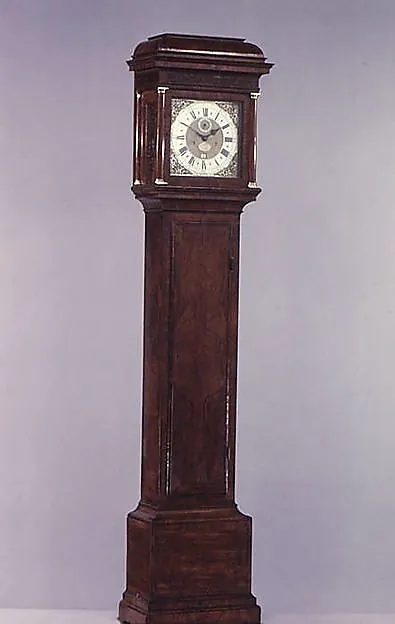
Longcase clock by George Graham, England, c. 1720
The Metropolitan Museum of Art, New York
Clocks · c. 1720
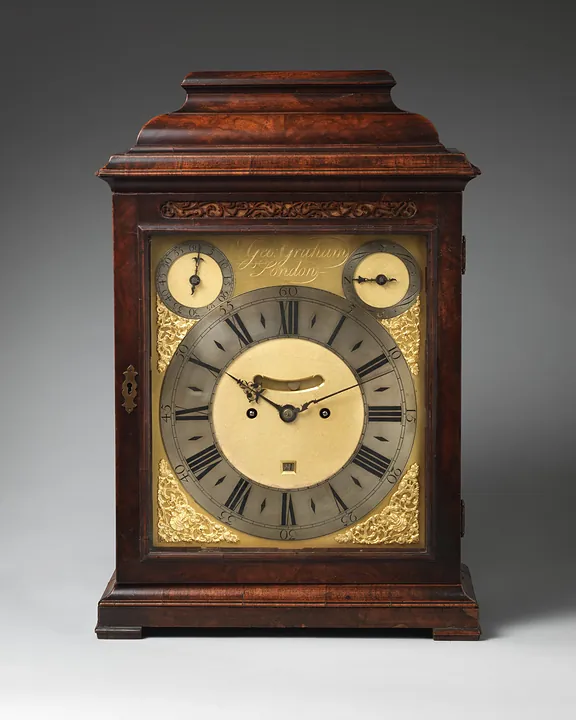
Table or bracket clock by George Graham, England, c. 1720
The Metropolitan Museum of Art, New York
Movements & Components · 1711
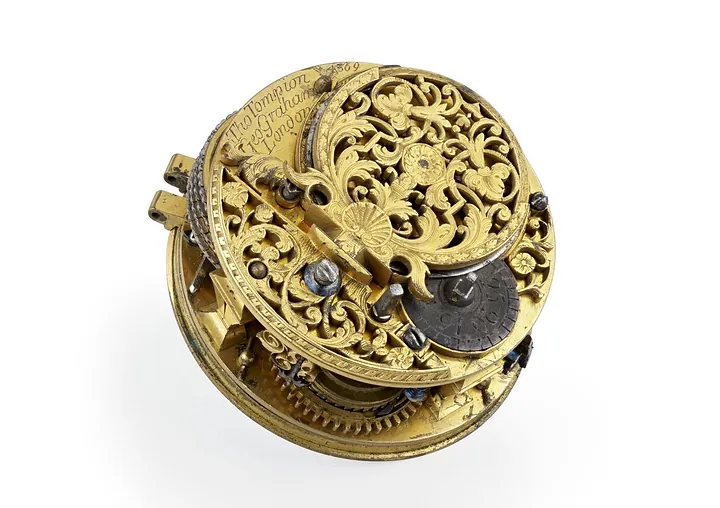
Watch movement by Thomas Tompion and George Graham, England, 1711
Science Museum Group, London
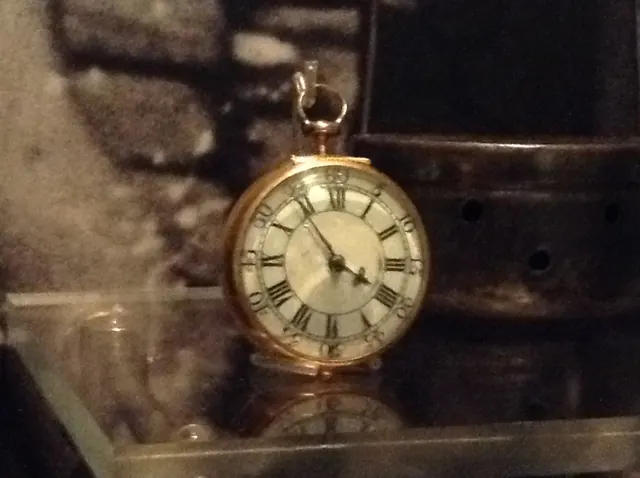
Pocket Watches · c. 1747
Pocket Watch - George Graham, No. 6363, c. 1747
Museums Victoria, Melbourne
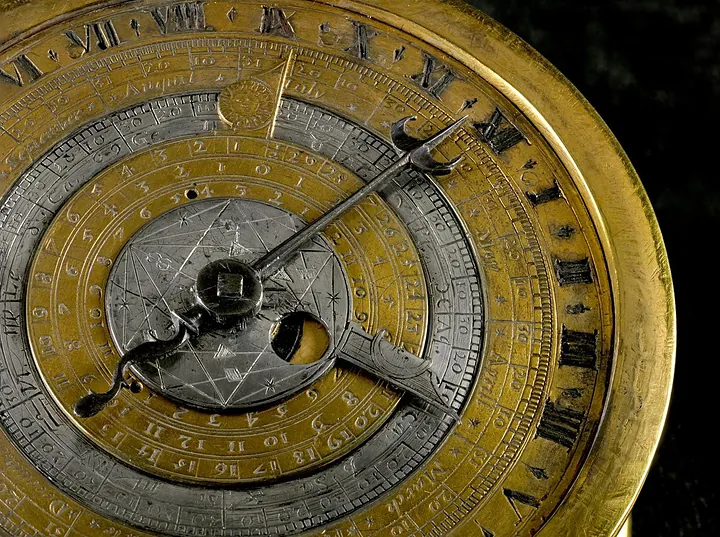
Clocks · 1598–1603
Circular table-clock with calendrical and lunar indications made by Nicholas Vallin in London between 1598 and 1603.
Science Museum Group, London
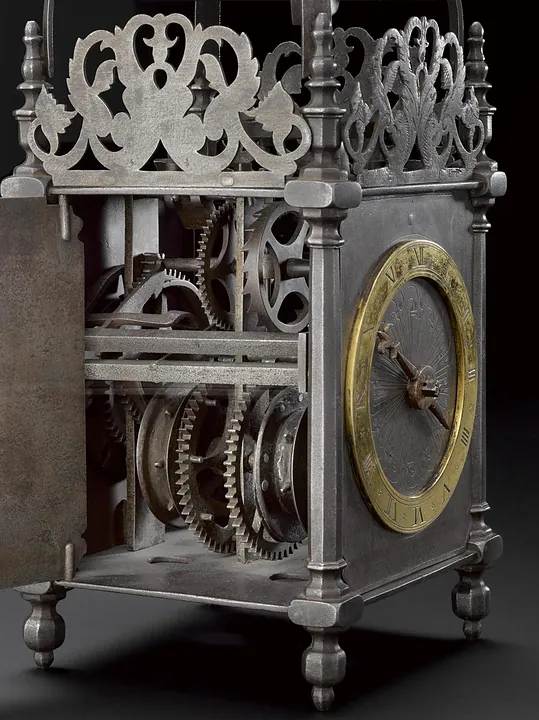
Clocks · 1611
English iron lantern clock, with wheel balance, by John Holloway, Market Lavington, Wiltshire, England, 1611.
Science Museum Group, London
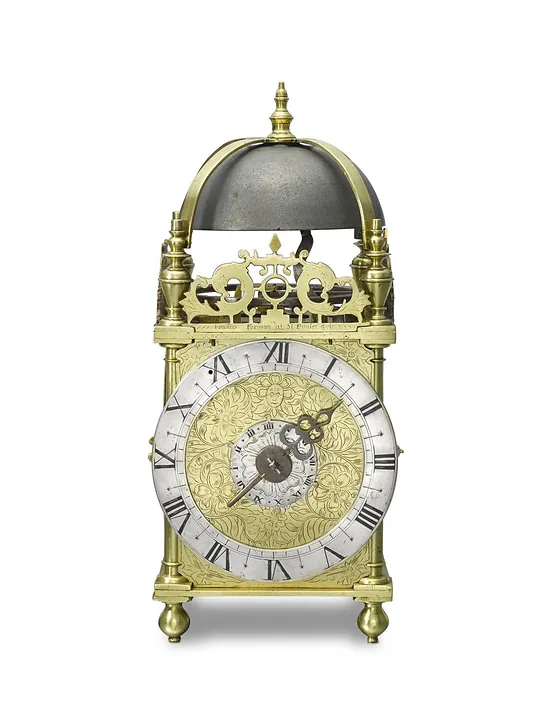
Clocks · 1630
Lantern clock by Francis Forman, England, 1630
Science Museum Group, London
Clocks · 1632–1640
Turret clock, England, 1632–1640
Science Museum Group, London