Clocks · Clock
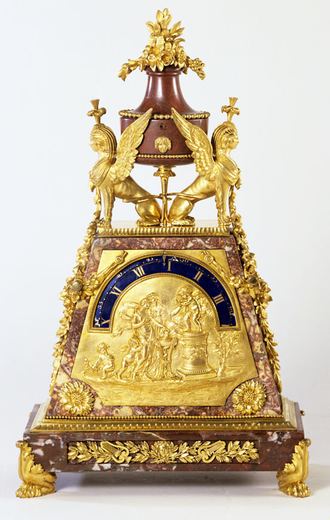
Clock, Japan, 1800–1899
- Maker / attribution
- Unrecorded in source
- Date
- 1800–1899
- Historical period
- Precision & Scientific Horology (1750 – 1850)
- Country of origin
- Japan
- Place
- Japan
- Object type
- Clock
- Holding institution
- German Clock Museum
- Accession / object no.
- Museu_ProvidedCHO_museum_digital_57145__technical_number_
- Catalogue title (original)
- Konsolenuhr (Dai-Tokei), Japan, 19. Jahrhundert (German)
Record summary
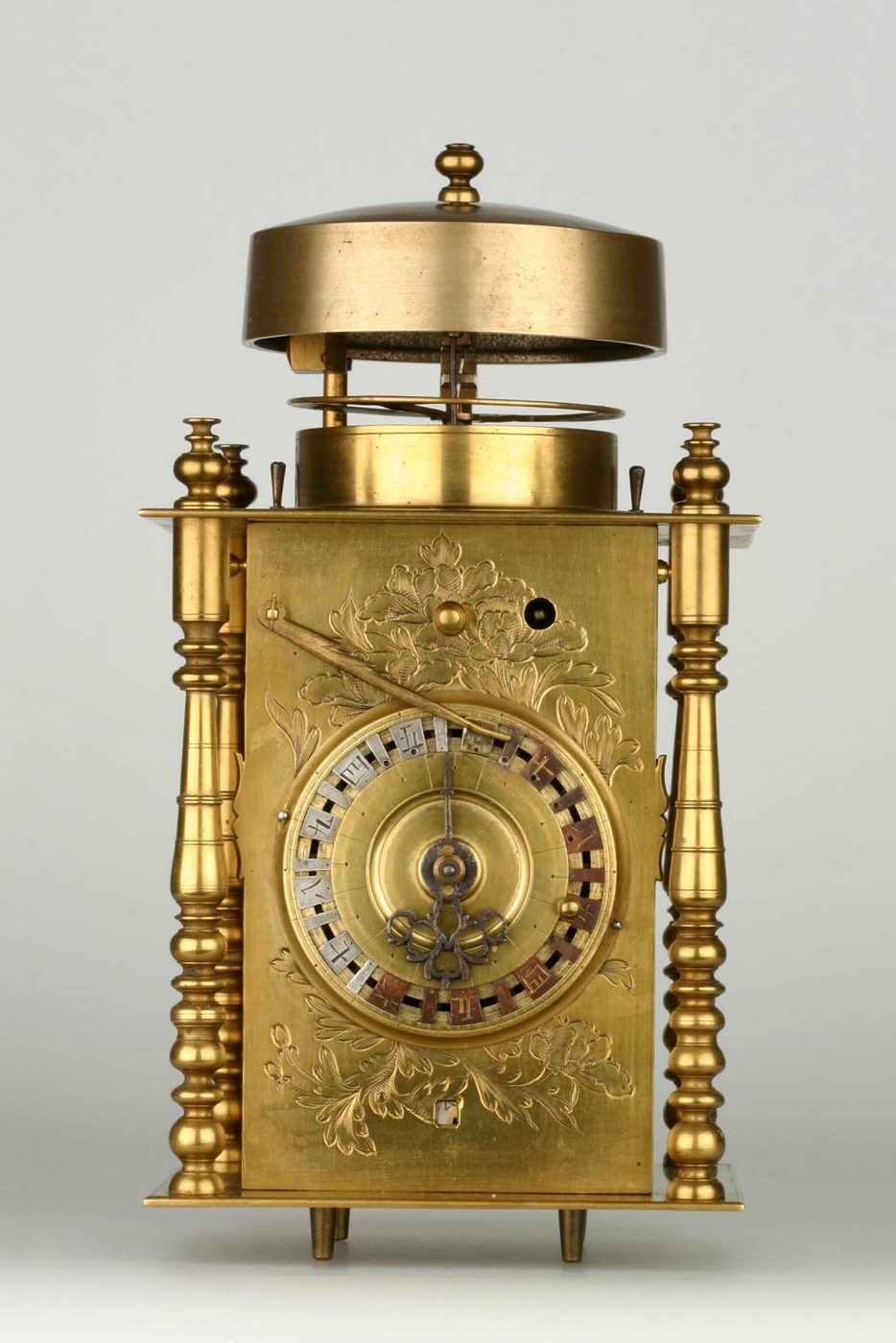
Held and catalogued by German Clock Museum (object number Museu_ProvidedCHO_museum_digital_57145__technical_number_), this is a clock, made in Japan, dated 1800–1899. The Atlas places it in the Precision & Scientific Horology period (1750 – 1850) of its Clocks collection. The record is illustrated with 1 photograph.
Assembled from the source record's structured fields. Dates and attributions are given as the source states them; where a field is missing the Atlas leaves it blank rather than estimating.
Catalogue description
Catalogue description from German Clock Museum (German)
Bis gegen Ende des 19. Jahrhunderts wurden in Japan die Tage nicht in 24 gleich lange Stunden eingeteilt, sondern der Tag und die Nacht in je sechs Toki. Wie die Tage auf der Nordhalbkugel im Sommer länger sind als die Nächte, so waren die Tages-Toki im Sommer länger als die Nacht-Toki. Im Winter war es umgekehrt. Um das japanische Zeitsystem darstellen zu können, wurden beispielsweise gleichmäßig laufende Uhren wie diese Tischuhr (Dai-Tokei) gefertigt, die über verstellbare Halbtoki- und Toki-Marken verfügt. (Deutsches Uhrenmuseum Furtwangen)
Shown in the original language of the source catalogue. An editor-reviewed English translation has not yet been published; we do not publish machine translations as authoritative text.
Historical context
Precision & Scientific Horology (1750 – 1850)
Harrison solves longitude; Mudge invents the lever; Breguet's Paris workshop defines the modern watch.
The age of the deadbeat escapement, compensated pendulums and observatory regulators. Domestic clocks spread through the middle classes: English longcase and bracket clocks, French gilt-bronze mantel clocks, Viennese Biedermeier wall clocks, Black Forest painted-shield clocks, and the first American shelf clocks.
Read the period in the timelineMore clocks from this periodEarlier: Early Modern Horology
Atlas type guide
Domestic clocks
A clock combines four systems: a source of power (falling weight, coiled spring, or later electricity), a gear train that divides time, an escapement and oscillator that regulate it (foliot, pendulum or balance), and an indicating system of dial and hands or a bell. Its history runs from the large iron weight-driven clocks of the late thirteenth century to Renaissance spring-driven table clocks, the pendulum revolution of 1656, the factory clocks of the nineteenth century and electric and quartz clocks of the twentieth.
Domestic clocks also reflect regional furniture and decorative traditions — English longcase and bracket clocks, French pendules, Viennese regulators, Black Forest and American shelf clocks — and therefore record changing tastes as much as technical progress.
What to look for
- How the clock is powered: weights, spring barrel, fusee, electric coil.
- The oscillator: foliot, short pendulum, long seconds pendulum or balance.
- Whether it strikes: hour only (count wheel) or hours and quarters (rack striking).
- The maker or retailer's name on dial and movement, and any factory trademarks.
- Signs of alteration — replaced dials, converted escapements, 'married' cases.
Dating clues
- Before 1656 clocks used foliots or balances; after, most domestic clocks have pendulums.
- Anchor escapements spread after c. 1670; minute hands became common at the same time.
- Factory production in America and Germany transformed prices after c. 1840.
General guidance written by the Atlas editors about this kind of object. It is not a statement about this particular piece; for that, rely on the source record above and on physical examination.
Related records
Clocks · 1800–1899
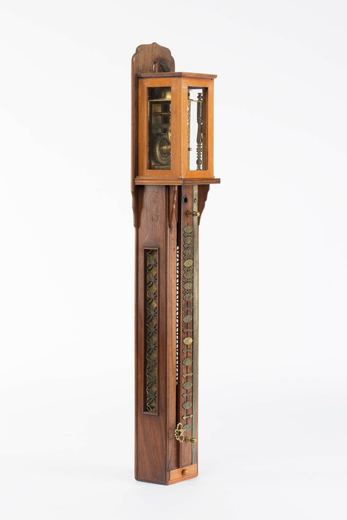
Japanese clock, 1800–1899 (German Clock Museum Museu_ProvidedCHO_museum_digital_57184__technical_number_)
German Clock Museum
Clocks · 1800–1899
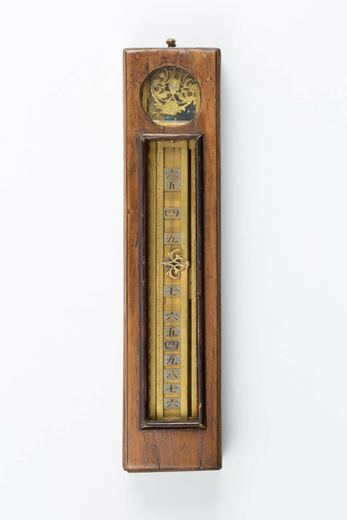
Japanese clock, 1800–1899 (German Clock Museum Museu_ProvidedCHO_museum_digital_57261__technical_number_)
German Clock Museum
Clocks · 1800-1890
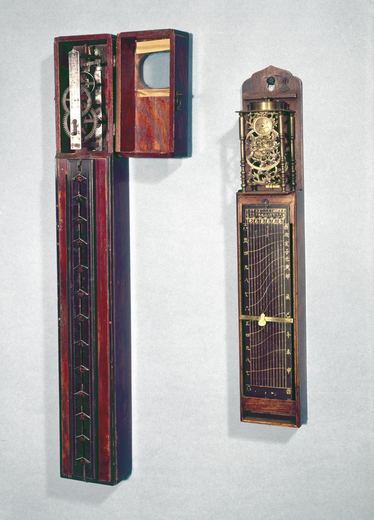
Japanese pillar clock with single foliot balance and iron movement (weight missing), Unsigned, 1800-1890
Science Museum Group, London
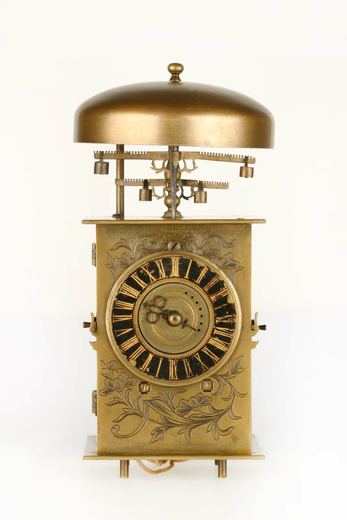
Clocks · 1800–1899
Wall clock, Japan, 1800–1899
German Clock Museum
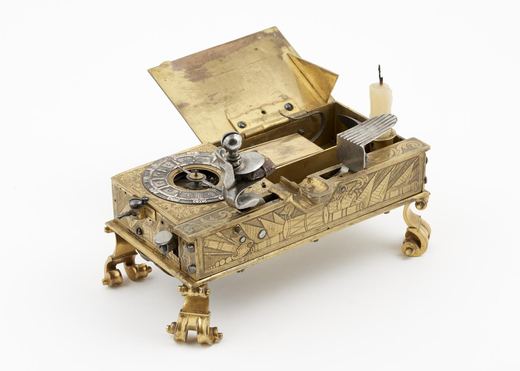
Clocks · 1701-1799
Alarm clock, Austria, 1701-1799
Science Museum Group, London
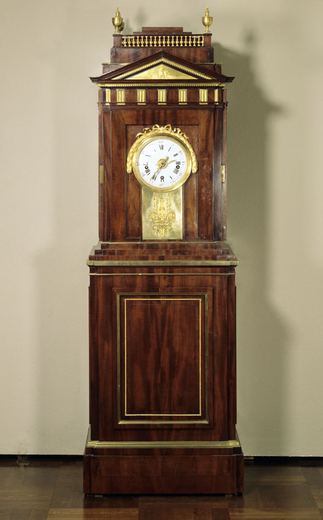
Clocks · 1711–1827
Longcase clock by David Roentgen ( - ), England, 1711–1827
Badisches Landesmuseum Karlsruhe
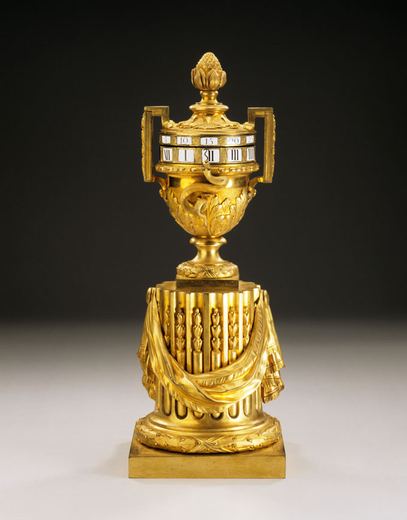
Clocks · 1723–1811
Table clock by Louis Montjoye, France, 1723–1811
Badisches Landesmuseum Karlsruhe
Clocks · 1738–1814
Table clock by Jean Simon Bourdier, France, 1738–1814
Badisches Landesmuseum Karlsruhe