
Clocks · Clock
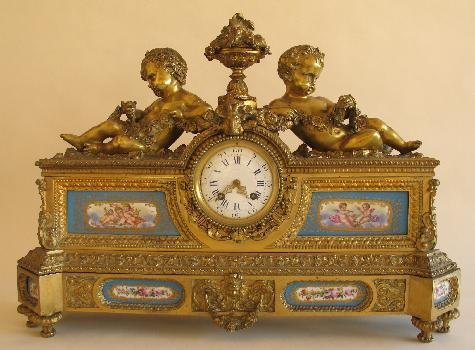
Clock by Placas de porcelana: Real Fábrica de Porcelana de Sèvres Relojeros: Miroy Frères Broncista: Atribuido a, 1860–1880
- Maker / attribution
- Placas de porcelana: Real Fábrica de Porcelana de Sèvres Relojeros: Miroy Frères Broncista: Atribuido a (Maker); Henri Picard (Maker)
- Date
- 1860–1880
- Historical period
- Industrial Revolution (1850 – 1900)
- Country of origin
- Unrecorded in source
- Place
- París
- Object type
- Clock
- Materials / technique
- Bronce Porcelana Esmalte Vidrio Latón Acero
- Dimensions
- Altura = 46,50 cm Anchura = 65,50 cm Profundidad = 15,50 cm
- Holding institution
- National Museum of Decorative Arts
- Accession / object no.
- pages_Main_idt_15634_inventary_CE19106_table_FMUS_museum_MNAD
- Credit line
- National Museum of Decorative Arts
- Catalogue title (original)
- Reloj de sobremesa (Spanish)
View the source record ↗ (opens another website in a new tab)Suggest a correction
Record summary
Held and catalogued by National Museum of Decorative Arts (object number pages_Main_idt_15634_inventary_CE19106_table_FMUS_museum_MNAD), this is a clock by Placas de porcelana: Real Fábrica de Porcelana de Sèvres Relojeros: Miroy Frères Broncista: Atribuido a, made in París, dated 1860–1880. The Atlas places it in the Industrial Revolution period (1850 – 1900) of its Clocks collection. Materials and techniques recorded by the source: Bronce Porcelana Esmalte Vidrio Latón Acero. Recorded dimensions: Altura = 46,50 cm Anchura = 65,50 cm Profundidad = 15,50 cm. The record is illustrated with 1 photograph.
Assembled from the source record's structured fields. Dates and attributions are given as the source states them; where a field is missing the Atlas leaves it blank rather than estimating.
Catalogue description
Catalogue description from National Museum of Decorative Arts
Reloj con caja de bronce alargada, peraltada por seis patas bulbosas. La base presenta un friso con las esquinas cortadas en un módulo adelantado. Sobre una zona moldurada, se organiza el frente principal en cuyo centro se incorpora un reloj con maquinaria de sonería y esfera de porcelana con cifras romanas para las horas y arábigas para los minutos. Los vanos practicados en la armadura frontal del reloj incorporan placas de porcelana decoradas con grupos florales en la parte inferior de la peana y dos escenas con angelillos interactuando con instrumentos musicales en la zona superior. La rica decoración que aparece en la parte superior del reloj tiene como principal motivo dos niños afrontados por la espalda y recostados con gesto despreocupado a ambos lados de la esfera y flanqueados por un frutero con abundantes flores, hojas y frutos dispuestos en pirámide y coronados por un nido donde un ave, seguramente una paloma esta cubriendo y protegiendo a sus polluelos. Los niños, coronados de flores y hojas, recuestan sus cuerpos sobre el manto vegetal cincelado en el cerramiento superior de la pieza y sujetan en sus manos una larga guirnalda de flores dividida en el centro por una cabeza de cabra situada en la parte superior de la esfera, justo delante del citado frutero. El reloj actualmente en uso, tiene péndulo y sonería con rueda contadora sobre campana. Ofrece cifras romanas esmaltadas en azul, para las horas y arábigas para los minutos, en color negro. Las agujas de lámina metalica dorada, caladas, son de un tipo característico del Segundo Imperio, una de ellas con representación de la flor de lis.
Shown in the original language of the source catalogue. An editor-reviewed English translation has not yet been published; we do not publish machine translations as authoritative text.
Historical context
Industrial Revolution (1850 – 1900)
American interchangeable-parts manufacture; railroad time standards; Swiss and German factory systems.
Factory production transformed the clock into an everyday object. American makers (Seth Thomas, Ansonia, Waterbury) and German factories (Junghans, Gustav Becker, Lenzkirch) sold millions of shelf, wall and alarm clocks worldwide; France produced standardised Paris movements and carriage clocks; electric time distribution began.
Read the period in the timelineMore clocks from this periodEarlier: Precision & Scientific Horology
Atlas type guide
Domestic clocks
A clock combines four systems: a source of power (falling weight, coiled spring, or later electricity), a gear train that divides time, an escapement and oscillator that regulate it (foliot, pendulum or balance), and an indicating system of dial and hands or a bell. Its history runs from the large iron weight-driven clocks of the late thirteenth century to Renaissance spring-driven table clocks, the pendulum revolution of 1656, the factory clocks of the nineteenth century and electric and quartz clocks of the twentieth.
Domestic clocks also reflect regional furniture and decorative traditions — English longcase and bracket clocks, French pendules, Viennese regulators, Black Forest and American shelf clocks — and therefore record changing tastes as much as technical progress.
What to look for
- How the clock is powered: weights, spring barrel, fusee, electric coil.
- The oscillator: foliot, short pendulum, long seconds pendulum or balance.
- Whether it strikes: hour only (count wheel) or hours and quarters (rack striking).
- The maker or retailer's name on dial and movement, and any factory trademarks.
- Signs of alteration — replaced dials, converted escapements, 'married' cases.
Dating clues
- Before 1656 clocks used foliots or balances; after, most domestic clocks have pendulums.
- Anchor escapements spread after c. 1670; minute hands became common at the same time.
- Factory production in America and Germany transformed prices after c. 1840.
General guidance written by the Atlas editors about this kind of object. It is not a statement about this particular piece; for that, rely on the source record above and on physical examination.
Related records
Clocks · 1830–1870
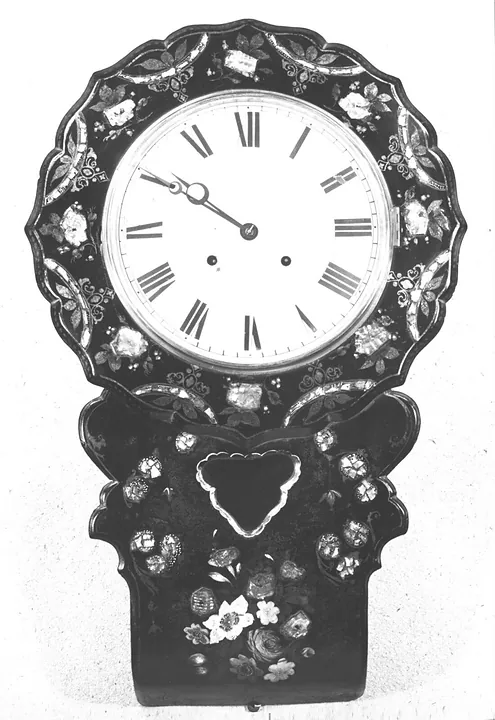
Wall clock in a papier mâché case with painted decoration. English, mid 19th century.
Victoria and Albert Museum, London
Clocks · 1840–1900
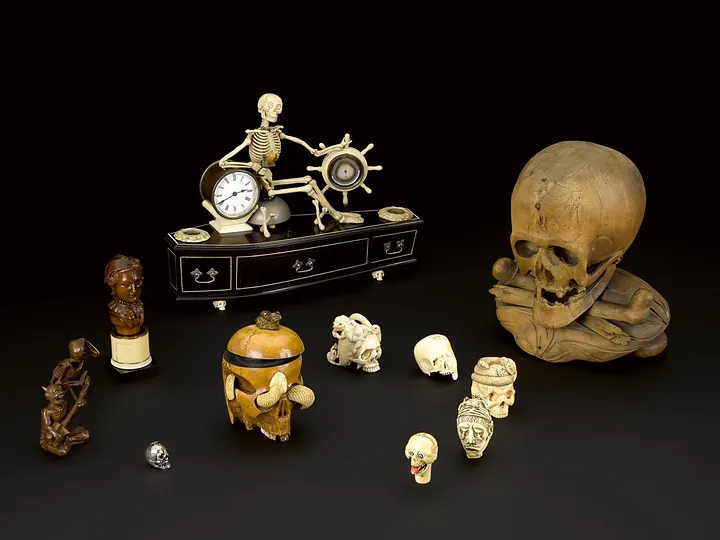
Alarm clock, mounted on model of coffin with skeleton, probably English, 1840–1900
Science Museum Group, London
Clocks · 1840–1880
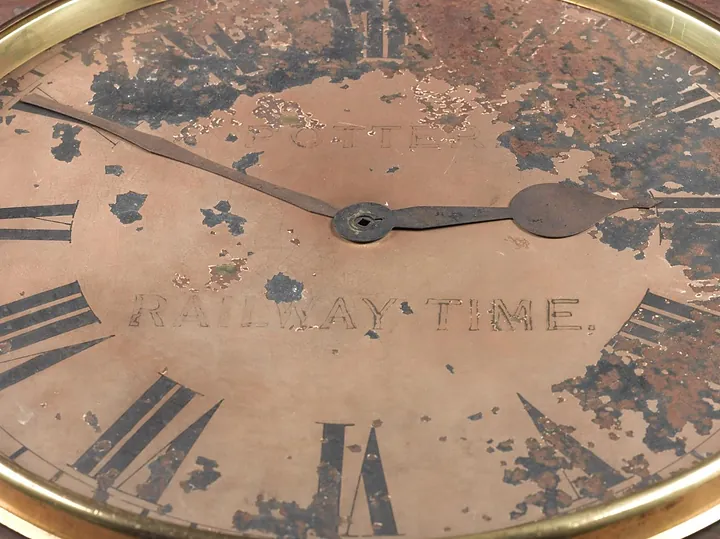
Clock dial marked "Potter, Railway Time" with two hands, unknown maker, British, 1840–1880
Science Museum Group, London
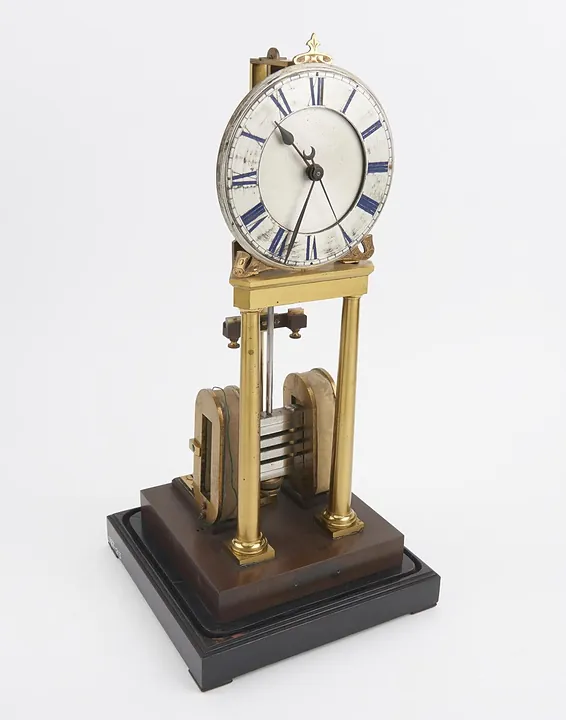
Clocks · 1840–1877
Electric clock of the Bain type
Science Museum Group, London
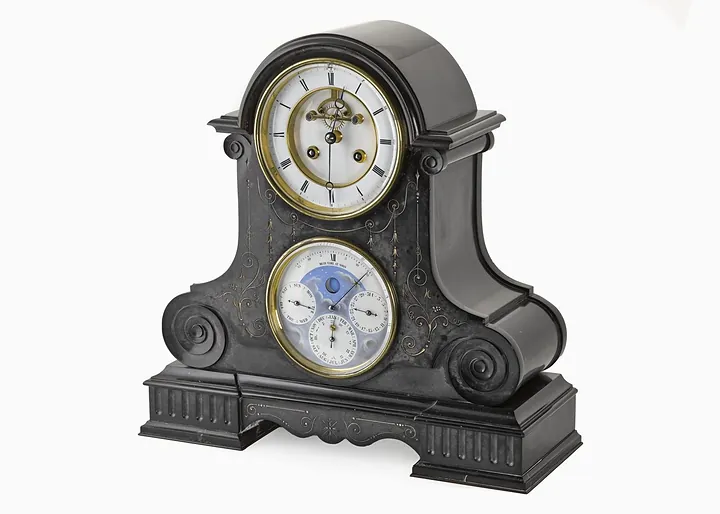
Clocks · 1840–1878
Mantel clock by A. Brocot, France, 1840–1878
Science Museum Group, London
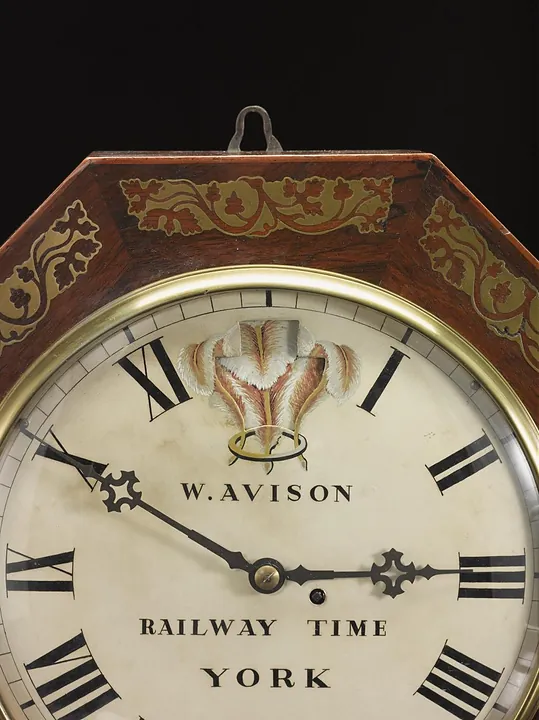
Clocks · 1840–1880
Wall Clock in octagonal case with Prince of Wales Feathers above makers name "W. Avison, Railway Time, York", made by William Avison, England, 1840–1880.
Science Museum Group, London
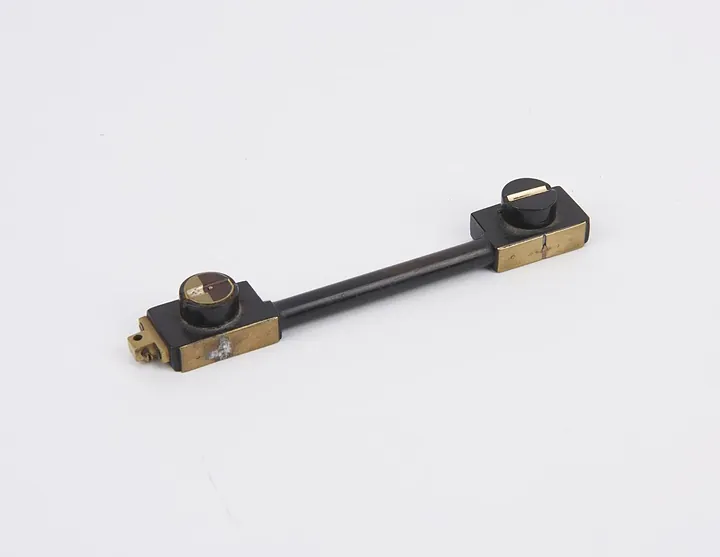
Clocks · 1841–1870
Contact bar from electric clock, unsigned, London, England, 1841–1870
Science Museum Group, London
Clocks · 1841–1870
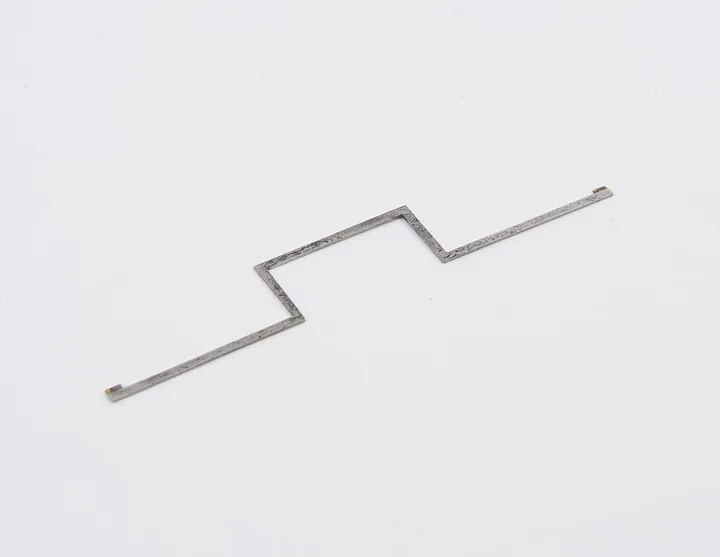
Contactor from electric clock, unsigned, London, England, 1841–1870
Science Museum Group, London