
Clocks · Clock
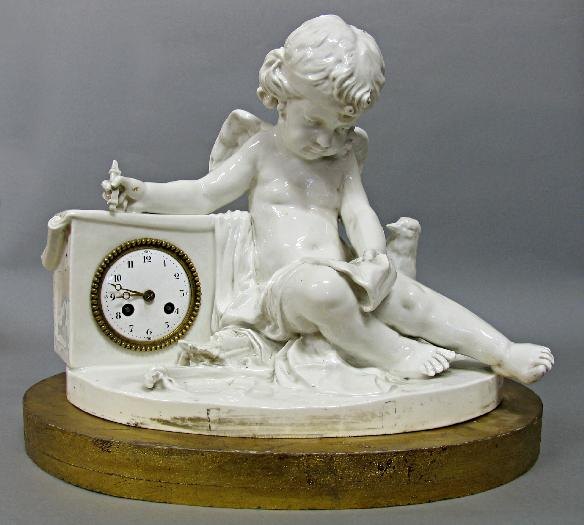
Clock by Vincenti & Cie, 1856–1875
- Maker / attribution
- Vincenti & Cie (movement)
- Date
- 1856–1875
- Historical period
- Industrial Revolution (1850 – 1900)
- Country of origin
- Unrecorded in source
- Place
- Francia
- Object type
- Clock
- Materials / technique
- Porcelana Bronce Esmalte Latón Acero Madera Pintura Esmalte
- Dimensions
- Esfera de reloj: Diámetro máximo = 9,50 cmPeana: Anchura máxima = 41,50 cm Altura = 4 cm Profundidad máxima = 29 cmReloj de sobremesa: Profundidad máxima = 25,50 cm Altura = 30 cm Anchura máxima = 36 cm
- Holding institution
- National Museum of Decorative Arts
- Accession / object no.
- pages_Main_idt_4764_inventary_CE04744_table_FMUS_museum_MNAD
- Credit line
- National Museum of Decorative Arts
- Catalogue title (original)
- El Amor - Reloj de sobremesa (Spanish)
View the source record ↗ (opens another website in a new tab)Suggest a correction
Record summary
Held and catalogued by National Museum of Decorative Arts (object number pages_Main_idt_4764_inventary_CE04744_table_FMUS_museum_MNAD), this is a clock by Vincenti & Cie, made in Francia, dated 1856–1875. The Atlas places it in the Industrial Revolution period (1850 – 1900) of its Clocks collection. Materials and techniques recorded by the source: Porcelana Bronce Esmalte Latón Acero Madera Pintura Esmalte. Recorded dimensions: Esfera de reloj: Diámetro máximo = 9,50 cmPeana: Anchura máxima = 41,50 cm Altura = 4 cm Profundidad máxima = 29 cmReloj de sobremesa: Profundidad máxima = 25,50 cm Altura = 30 cm Anchura máxima = 36 cm. The record is illustrated with 1 photograph.
Assembled from the source record's structured fields. Dates and attributions are given as the source states them; where a field is missing the Atlas leaves it blank rather than estimating.
Catalogue description
Catalogue description from National Museum of Decorative Arts
Reloj de porcelana blanca con reborde en forma de cordoncillo perlado realizado en bronce dorado, enmarcando la esfera. Sobre una pequeña base ovalada de bronce dorado se ha colocado el reloj propiamente dicho de porcelana, sobre el cual se ha colocado a su vez un elemento en forma de mesa rectangular en cuyo interior va la maquinaria del reloj y en la parte anterior presenta la esfera igualmente en porcelana blanca. Junto a este elemento cuadrado y colocado sobre sus vestiduras, se sienta un pequeño Eros-niño desnudo con el carcaj y las flechas a su lado en el suelo y un ave a su costado izquierdo. El dios aparece en actitud de estar leyendo en un pergamino que sujeta con la mano izquierda sobre sus piés, mientras con la derecha está escribiendo con un estilete sobre la mesita anteriormente citada donde se cobija el reloj. Los bucles rizados que cubren su cabeza van sujetos alrededor de la misma con una cinta. La esfera presenta las cifras horarias con numeración árabe y ofrece e igualmente señalización de minutos y segundos, sonerie, marcando los cuatro cuartos. Las agujas son de metal dorado.
Shown in the original language of the source catalogue. An editor-reviewed English translation has not yet been published; we do not publish machine translations as authoritative text.
Historical context
Industrial Revolution (1850 – 1900)
American interchangeable-parts manufacture; railroad time standards; Swiss and German factory systems.
Factory production transformed the clock into an everyday object. American makers (Seth Thomas, Ansonia, Waterbury) and German factories (Junghans, Gustav Becker, Lenzkirch) sold millions of shelf, wall and alarm clocks worldwide; France produced standardised Paris movements and carriage clocks; electric time distribution began.
Read the period in the timelineMore clocks from this periodEarlier: Precision & Scientific Horology
Atlas type guide
Domestic clocks
A clock combines four systems: a source of power (falling weight, coiled spring, or later electricity), a gear train that divides time, an escapement and oscillator that regulate it (foliot, pendulum or balance), and an indicating system of dial and hands or a bell. Its history runs from the large iron weight-driven clocks of the late thirteenth century to Renaissance spring-driven table clocks, the pendulum revolution of 1656, the factory clocks of the nineteenth century and electric and quartz clocks of the twentieth.
Domestic clocks also reflect regional furniture and decorative traditions — English longcase and bracket clocks, French pendules, Viennese regulators, Black Forest and American shelf clocks — and therefore record changing tastes as much as technical progress.
What to look for
- How the clock is powered: weights, spring barrel, fusee, electric coil.
- The oscillator: foliot, short pendulum, long seconds pendulum or balance.
- Whether it strikes: hour only (count wheel) or hours and quarters (rack striking).
- The maker or retailer's name on dial and movement, and any factory trademarks.
- Signs of alteration — replaced dials, converted escapements, 'married' cases.
Dating clues
- Before 1656 clocks used foliots or balances; after, most domestic clocks have pendulums.
- Anchor escapements spread after c. 1670; minute hands became common at the same time.
- Factory production in America and Germany transformed prices after c. 1840.
General guidance written by the Atlas editors about this kind of object. It is not a statement about this particular piece; for that, rely on the source record above and on physical examination.
Related records
Clocks · 1856–1875
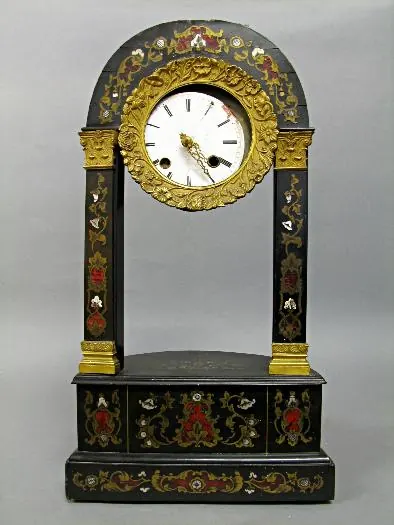
Clock by Vincenti & Cie, 1856–1875
National Museum of Decorative Arts
Clocks · c. 1855
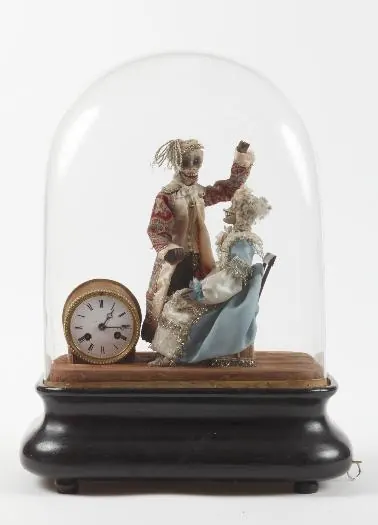
Clock by Vincenti & Cie, c. 1855
National Museum of Romanticism
Clocks · 1830–1870
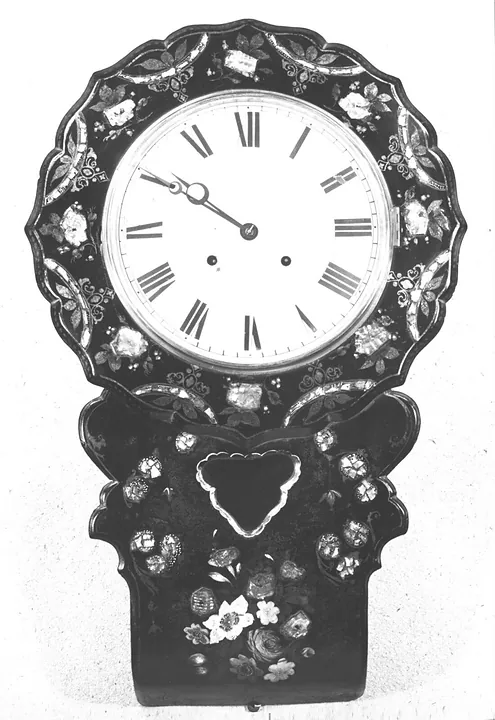
Wall clock in a papier mâché case with painted decoration. English, mid 19th century.
Victoria and Albert Museum, London
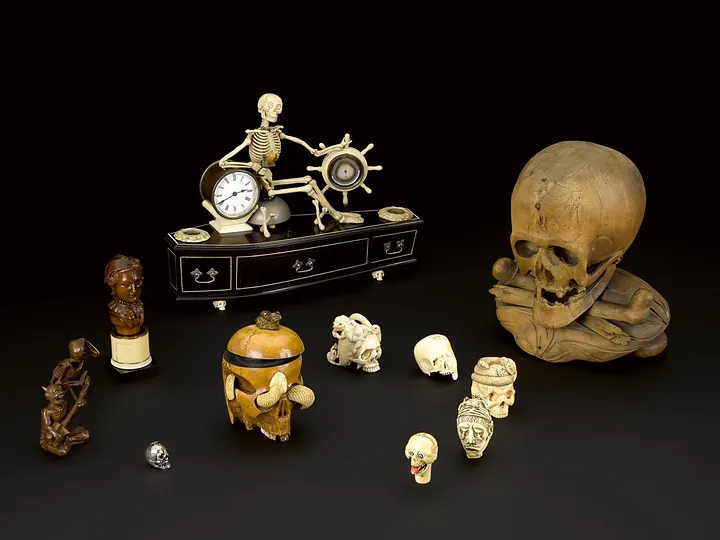
Clocks · 1840–1900
Alarm clock, mounted on model of coffin with skeleton, probably English, 1840–1900
Science Museum Group, London
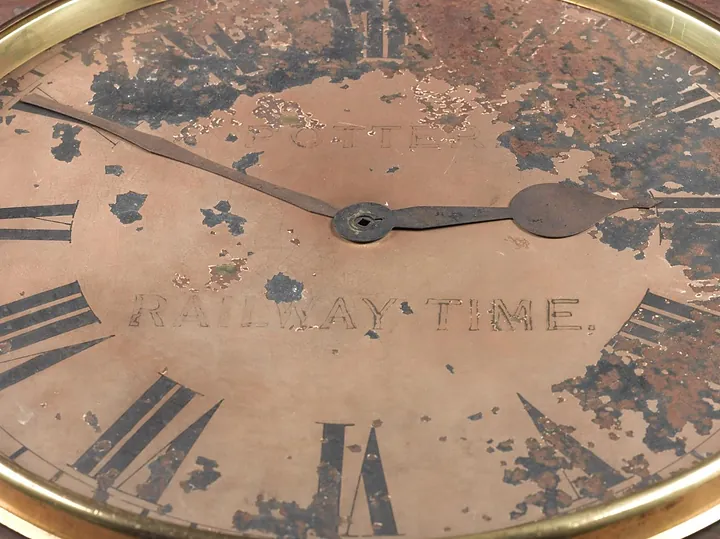
Clocks · 1840–1880
Clock dial marked "Potter, Railway Time" with two hands, unknown maker, British, 1840–1880
Science Museum Group, London
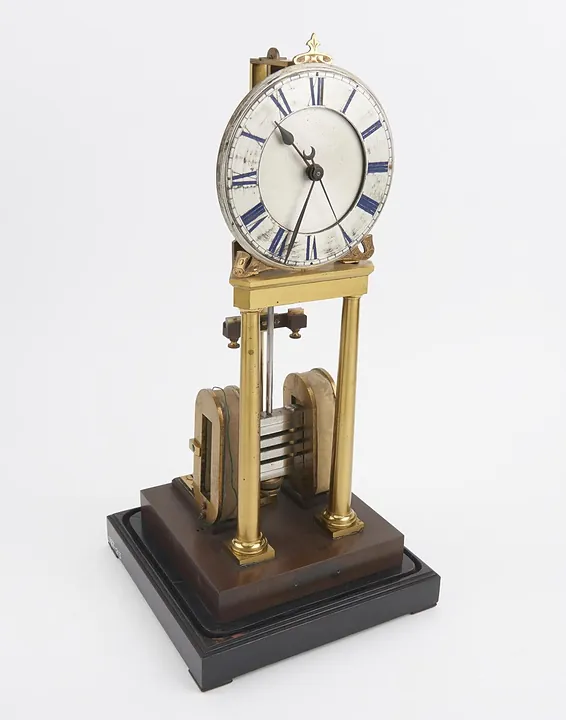
Clocks · 1840–1877
Electric clock of the Bain type
Science Museum Group, London
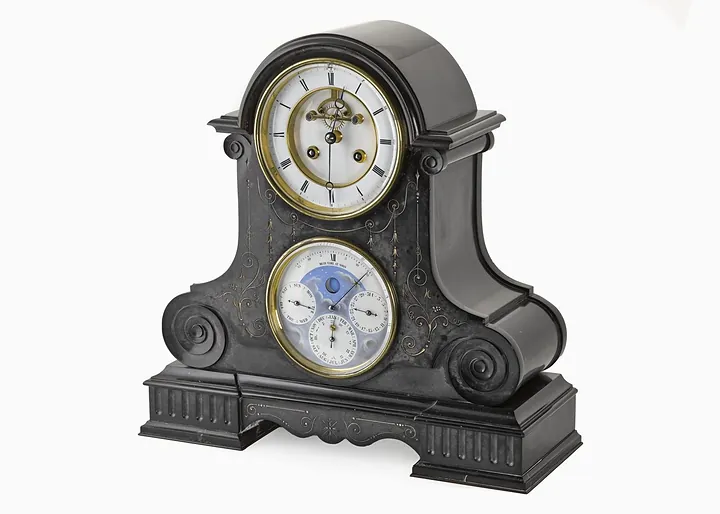
Clocks · 1840–1878
Mantel clock by A. Brocot, France, 1840–1878
Science Museum Group, London
Clocks · 1840–1880
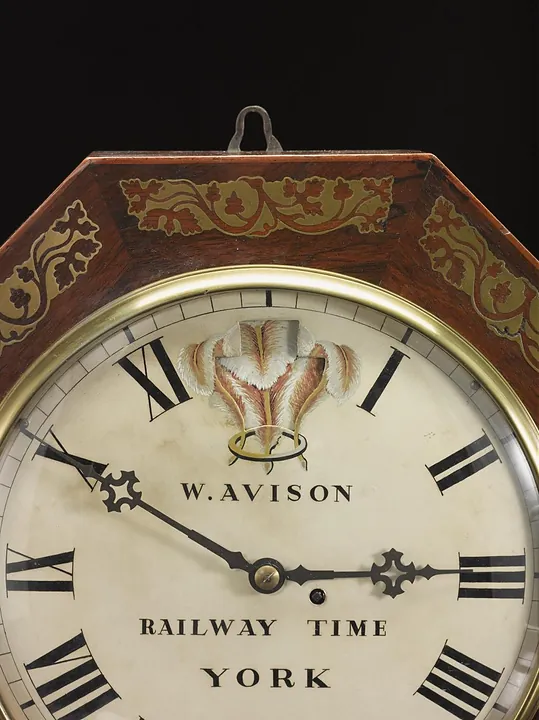
Wall Clock in octagonal case with Prince of Wales Feathers above makers name "W. Avison, Railway Time, York", made by William Avison, England, 1840–1880.
Science Museum Group, London