Clocks · Clock
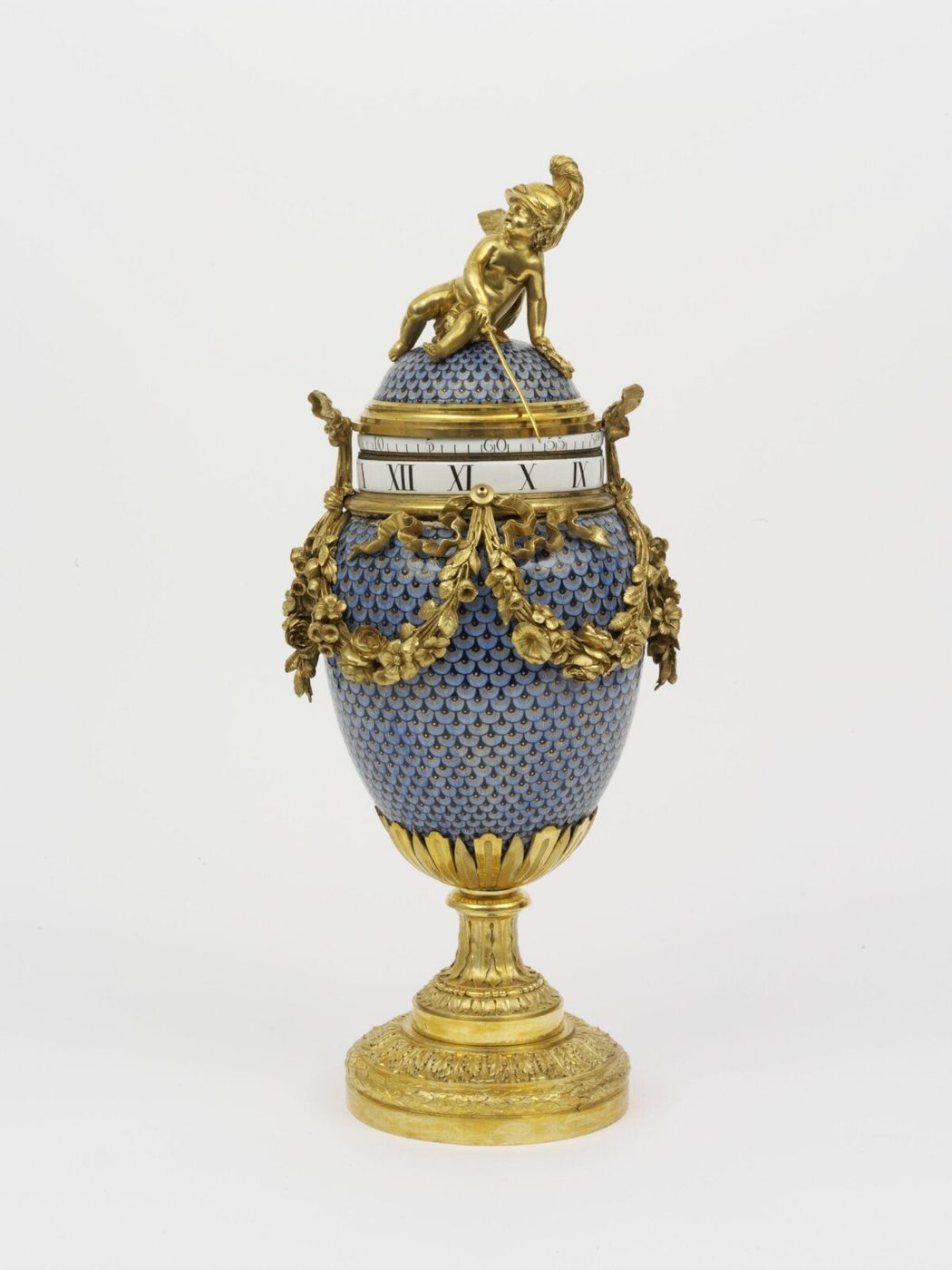
Clock by Jean-Claude-Thomas Chambellan (fils) Duplessis, Sèvres, ca. 1770-1780
- Maker / attribution
- Jean-Claude-Thomas Chambellan (fils) Duplessis (designer); Sèvres (maker)
- Date
- ca. 1770-1780
- Historical period
- Precision & Scientific Horology (1750 – 1850)
- Country of origin
- Unrecorded in source
- Place
- Sèvres
- Object type
- Clock
- Materials / technique
- Porcelain mounted in ormolu
- Dimensions
- Height: 44 cm; Width: 17.5 cm; Depth: cm (17)
- Holding institution
- Victoria and Albert Museum, London
- Accession / object no.
- 171-1879
Record summary
Held and catalogued by Victoria and Albert Museum, London (object number 171-1879), this is a clock by Jean-Claude-Thomas Chambellan (fils) Duplessis, made in Sèvres, dated ca. 1770-1780. The Atlas places it in the Precision & Scientific Horology period (1750 – 1850) of its Clocks collection. Materials and techniques recorded by the source: Porcelain mounted in ormolu. Recorded dimensions: Height: 44 cm; Width: 17.5 cm; Depth: cm (17). The record is illustrated with 4 photographs.
Assembled from the source record's structured fields. Dates and attributions are given as the source states them; where a field is missing the Atlas leaves it blank rather than estimating.
Catalogue description
V&A — Summary
The most important French porcelain factory was founded in about 1740 in the royal château of Vincennes, with workmen lured from the nearby factory at Chantilly. Commercial production began in earnest around 1745 when Louis XV granted it a privilege to make porcelain 'in the manner of Saxony, painted and gilded, with human figures'. Such was the prestige of porcelain production that the privilege was signed by the king at a military encampment in Flanders (modern Belgium), where he was engaged in battle. As the wording of the privilege suggests, the factory's earliest style was indebted to the prestigious hard-paste porcelain of the factory at Meissen in Saxony. However, the support and protection of Louis XV and his mistress, Madame de Pompadour, enabled Vincennes to secure the best technicians, artists, sculptors and designers. Jean-Claude Duplessis (director of models, 1748-74), Jean-Jacques Bachelier (director of decoration, 1751-93), Etienne-Maurice Falconet (director of sculpture, 1757-66) and the painter François Boucher played a central role in the development of this entirely new French art form. The factory's repertoire quickly evolved from the emulation of East Asian or Meissen examples to incorporate the latest styles used in French gilt-bronze, woodcarving and decorative painting. Vincennes became renowned for its luxurious ground colours and richly-tooled gilded decoration. By 1756 the factory had outgrown its workshops in the old château and it transferred to specially constructed premises at Sèvres (south-west of Paris). In 1759 the king purchased the factory outright. The Royal Manufactory specialised in exceptionally luxurious objects, many destined for the French court. Capable of startling innovation, the factory produced a constantly evolving repertoire to suit the changing tastes of its clients. Each year it displayed the latest models in the king's apartments at Versailles, where courtiers were expected to support the royal enterprise through purchases and commissions. Sèvres porcelain was admired and collected by the royal, noble and wealthy elite throughout Europe, but it also became widely imitated. Although the factory's royal privileges were intended to eliminate competition, these frequently proved ineffective. Sèvres also produced the most expensive porcelain in France. Prices ranged from a few livres for a plain cup and saucer or pomade pot, to several thousand livres for a single vase and tens of thousands for a dinner service. In 1773 Louis XV sent a dinner service valued at 12,424 livres to Maria Carolina, Queen of Naples and Sicily, to commemorate the baptism of her second daughter. However, this seems quite modest in comparison to the 331,317 livres spent by Catherine II of Russia on an exceptionally lavish banqueting service. Comprising 800 items for 60 settings, it took three years to complete and was finally delivered in 1779. The cost of an item depended on the level of decoration. At Sèvres, a plain white covered cup and socketed saucer with a simple gilded rim cost about 18 livres. The same item but with a coloured ground, decorated with painted figures and gold cost about 72 livres. Marie Antoinette spent as much as 144 livres on a particularly finely decorated example. The extent of gold decoration, in particular, was a major determinant of the cost. An undecorated white plate with a simple gilded band could be bought for less than 5 livres. Catherine II's plates, on the other hand, had three layers of gold to achieve sufficient depth for the richly tooled decoration. Each cost a staggering 242 livres. The introduction of hard-paste porcelain in the 1770s considerably reduced the cost of gold decoration. Chemically precipitated gold powder was less expensive to produce and could be applied to hard-paste porcelain in much thinner layers than the costly ground gold leaf applied to soft-paste. The exorbitant cost of this kind of porcelain can be judged by incomes. For much of the eighteenth century, an unskilled labourer earned between about 100 and 300 livres per year. A skilled manual worker, such as a senior artist at Sèvres, earned around 1000 livres, and a wealthy doctor could make about 10,000 livres. The nobility enjoyed incomes ranging from about 40,000 to 100,000 livres. Princely or royal incomes were higher still: the Duc de Villeroy, sponsor of the Villeroy (later Mennecy porcelain factory) had 377,175 livres a year. Ornamental vases were sold individually, in pairs, or in groups called ‘garnitures’. They were most commonly displayed in formal arrangements on chimney pieces, on tables in front of mirrors and on commodes (chests of drawers). The colours, patterns and shapes could be matched with other furnishings, such as textiles and decorative painting. Different models could be combined within the same arrangement and the marchands-merciers played an important role in assembling these sets. Sèvres produced over 250 models during the eighteenth century, which were introduced to its clients at the yearly sales held in the king’s apartments at Versailles. Some vases were intended to hold fresh flowers or pot-pourri (dried and perfumed petals and leaves). Perfume was an integral part of the fashionable interior. Pot pourri vases provided an elegant means by which to combat the unpleasant odours of eighteenth-century life and, from the start, they were an important part of the porcelain factories’ repertoire. Vases were often among the most expensive of Sevres' productions, particularly if they were embellished with gilt-bronze mounts. In 1782 Louis XVI presented Sèvres vases, valued at a staggering 12,000 livres each, to the Comtesse du Nord (daughter-in-law of Catherine II of Russia). Jean-Claude-Thomas Chambellan Duplessis (c.1730-83) was a bronze founder, designer and supplier of gilt-bronze mounts to Sèvres. His father, Jean-Claude Chambellan Duplessis, was Artistic Director (in charge of models) at the factory from the late 1740s…
V&A — Physical description
Clock with moveable dial bands set in an oviform vase decorated with an imbricated pattern in blue, black and gold. On the cover a gilt-bronze figure of cupid armed, and on the shoulders are handles and floral festoons also of gilt bronze.
V&A — Object history
Bought from the collection of John Charles Robinson
V&A gallery label
Garniture with clock and two pot-pourri vases 1770–80 Parisian merchants created luxurious novelties by adding elaborate metal fittings to ceramics and other artefacts. Responding to this trend, the Sèvres porcelain factory in Paris began producing vases specifically for mounting with gilded metal ordered from specialist metalworkers. The mounts on these pot-pourri vases have an openwork structure to allow the scent of aromatic leaves and petals to permeate the room. France (Paris) Made at the Sèvres factory Mounts probably designed by Jean-Claude Duplessis Porcelain painted in enamels and gilded; gilded copper alloy mounts Museum nos. 171, 172&A-1879
Inscriptions & marks
Clock movement signed 'Martin AParis'
Historical context
Precision & Scientific Horology (1750 – 1850)
Harrison solves longitude; Mudge invents the lever; Breguet's Paris workshop defines the modern watch.
The age of the deadbeat escapement, compensated pendulums and observatory regulators. Domestic clocks spread through the middle classes: English longcase and bracket clocks, French gilt-bronze mantel clocks, Viennese Biedermeier wall clocks, Black Forest painted-shield clocks, and the first American shelf clocks.
Read the period in the timelineMore clocks from this periodEarlier: Early Modern Horology
Atlas type guide
Domestic clocks
A clock combines four systems: a source of power (falling weight, coiled spring, or later electricity), a gear train that divides time, an escapement and oscillator that regulate it (foliot, pendulum or balance), and an indicating system of dial and hands or a bell. Its history runs from the large iron weight-driven clocks of the late thirteenth century to Renaissance spring-driven table clocks, the pendulum revolution of 1656, the factory clocks of the nineteenth century and electric and quartz clocks of the twentieth.
Domestic clocks also reflect regional furniture and decorative traditions — English longcase and bracket clocks, French pendules, Viennese regulators, Black Forest and American shelf clocks — and therefore record changing tastes as much as technical progress.
What to look for
- How the clock is powered: weights, spring barrel, fusee, electric coil.
- The oscillator: foliot, short pendulum, long seconds pendulum or balance.
- Whether it strikes: hour only (count wheel) or hours and quarters (rack striking).
- The maker or retailer's name on dial and movement, and any factory trademarks.
- Signs of alteration — replaced dials, converted escapements, 'married' cases.
Dating clues
- Before 1656 clocks used foliots or balances; after, most domestic clocks have pendulums.
- Anchor escapements spread after c. 1670; minute hands became common at the same time.
- Factory production in America and Germany transformed prices after c. 1840.
General guidance written by the Atlas editors about this kind of object. It is not a statement about this particular piece; for that, rely on the source record above and on physical examination.
Related records
Clocks · 1701-1799
Alarm clock, Austria, 1701-1799
Science Museum Group, London
Clocks · 1711–1827
Longcase clock by David Roentgen ( - ), England, 1711–1827
Badisches Landesmuseum Karlsruhe
Clocks · 1723–1811
Table clock by Louis Montjoye, France, 1723–1811
Badisches Landesmuseum Karlsruhe
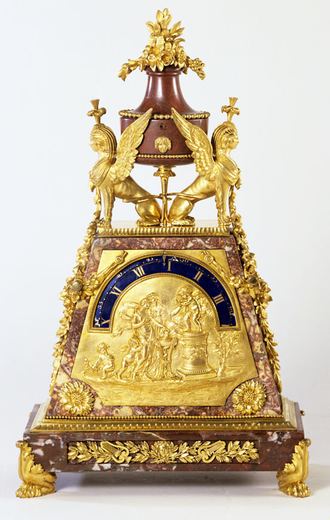
Clocks · 1738–1814
Table clock by Jean Simon Bourdier, France, 1738–1814
Badisches Landesmuseum Karlsruhe
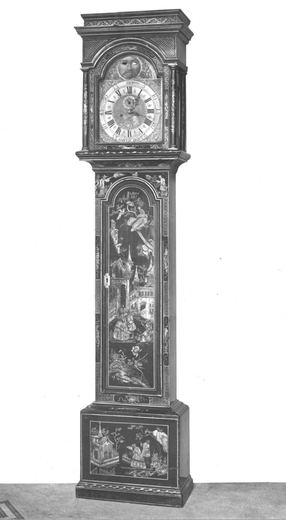
Clocks · 1740-1760
Longcase clock, English, 1740-1760, japanned wood, John Ellicott
Victoria and Albert Museum, London
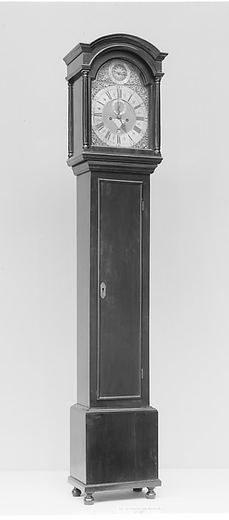
Clocks · 1740–60
Tall clock by Samuel Bagnall, United States, 1740–60
The Metropolitan Museum of Art, New York
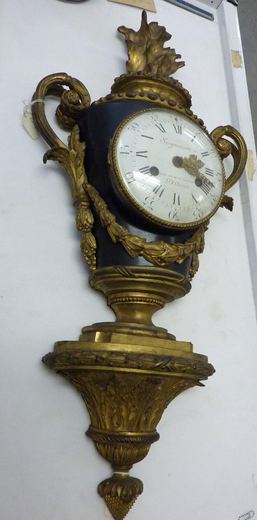
Clocks · 1750-1800
Bracket clock in metal case with scroll handles and flamed-shaped top signed by Pierre Seignoret, Clockmaket to the the Comte d'Artois
Victoria and Albert Museum, London
Clocks · 1750
Clock by Georg Gfell, Germany, 1750
German Clock Museum