
Wristwatches · Wristwatch
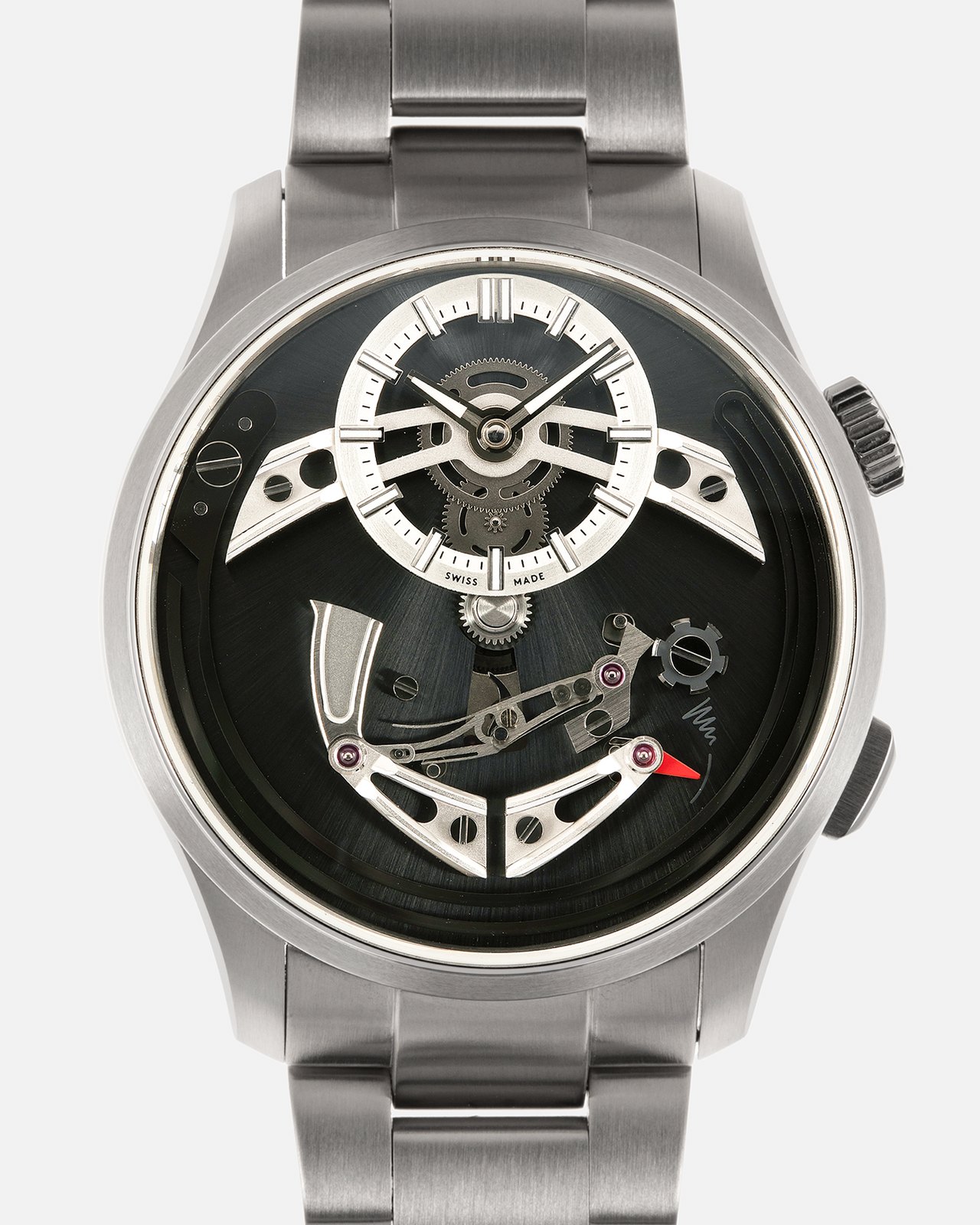
Christopher Ward Bel Canto C1 Nero, 2024
- Maker / attribution
- Christopher Ward (maker)
- Date
- 2024
- Historical period
- Contemporary Horology (2010 – Present)
- Country of origin
- Unrecorded in source
- Object type
- Wristwatch
- Dimensions
- Case 41 mm
- Stock no.
- Product 7309393559639
- Credit line
- Dealer listing, S.Song Watches (product 7309393559639)
- Catalogue title (original)
- Christopher Ward Bel Canto C1 Nero (English)
View the source record (dealer listing) ↗ (opens another website in a new tab)Suggest a correction
Record summary
Catalogued by S.Song Watches (dealer), Seattle (stock number Product 7309393559639), this is a wristwatch by Christopher Ward, dated 2024. The Atlas places it in the Contemporary Horology period (2010 – Present) of its Wristwatches collection. Recorded dimensions: Case 41 mm. The record is illustrated with 6 photographs.
Assembled from the source record's structured fields. Dates and attributions are given as the source states them; where a field is missing the Atlas leaves it blank rather than estimating.
Catalogue description
Dealer description — S.Song Watches
As someone who has spent years hunting for some pretty insane watches, I remain a simple watch enthusiast at heart. Although I haven’t extensively explored microbrands as a whole, it would be misleading for me to say that I have never been intrigued by their value propositions and creativity. The way I see it, the microbrand sector is an underrated and exciting area for watch lovers, filled with hidden gems. Among the sea of microbrands today, there was one brand that has particularly caught my attention in recent years due to the buzz surrounding its groundbreaking release: the C1 Bel Canto. I’m referring to Christopher Ward, a UK-based brand founded in 2004, known for offering budget-friendly, high-quality watches with simple and modern designs. It is worth noting, however, that over the years, Christopher Ward has evolved into a formidable independent brand that transcends the typical "microbrand" label. Frankly speaking, for the longest time, Christopher Ward was never on my radar of watch brands to look out for. While they have created some solid designs over the years and occasionally wowed enthusiasts with their promising designs and in-house movements (e.g. the C9 Harrison Jumping Hour, the Chronometer-certified Cal. SH21, etc), they never truly emerged from their shells. However, everything changed with the release of the C1 Bel Canto in 2022. The C1 Bel Canto is arguably the most affordable chiming watch money can buy today. It features a chiming complication known as the Sonnerie Au Passage (which translates to "ring as it passes" in French), sounding once at the top of each hour to signal the passage of time. The genesis of this ingenious design originated with Christopher Ward’s technical director, Frank Stelzer, who drew inspiration from a design he helped Meistersinger produce—the Bell Hora (yes, Christopher Ward actually makes watches for the German brand). He had a realization that they could adapt their jump hour module into a similar chiming design. Conceptually, it all made perfect sense, as the jump hour mechanism already included a rapid change system for each passing hour that could theoretically accommodate the chiming mechanism. After extensive research and development, the result was the Cal. FS01 movement, named after Frank himself. This movement is essentially based on the Sellita Cal. SW200-1, with more than 60 new additional components being created for the chiming complication and added onto the existing jump hour (Cal. JJ01) module. Moving on to the C1 Bel Canto’s impeccably executed dial, Christopher Ward enlisted the help of world-renowned independent watchmaker Armin Strom for the platine —a thin plate that provides structural support to the movement and helps hold the components in place—as well as specialist movement manufacturer Chronode SA, known for their work with brands like MB&F, specifically for the hammer, spring, and bridges. The result? An exceptionally well-finished and stunning dial featuring an intriguing network of components showcasing the architecture of the chiming complication in its full glory. At the 12:00 position, you’ll find a floating time display suspended by two symmetrical bridges on either side. This display connects to the chiming gong at 7:00 through a network of screws and works in tandem with the isolated turret wheel on the opposing side, which locks and unlocks the gong via manipulation of a dedicated pusher at 4:00. When the chiming mechanism is activated, the red indicator points toward the squiggle-script section. Overall, the dial is visually balanced and a true delight to behold. During my time with it, I often found myself just staring at the dial and losing track of time as it passed. To round everything off, the C1 is housed in a beautifully finished 41mm x 13mm case made from grade 5 titanium, paired with a Bader bracelet crafted from grade 2 titanium. This combination gives the C1 a feathery-light feel, despite its seemingly large case size, and it wears very comfortably on the wrist.
Historical context
Contemporary Horology (2010 – Present)
Silicon components, connected watches, optical-lattice research clocks and a thriving independent scene.
Smartwatches became the world's best-selling watches, while mechanical watchmaking focuses on craft, innovation (silicon components, new escapements) and independent makers.
Read the period in the timelineMore wristwatches from this periodEarlier: Mechanical Renaissance
Atlas type guide
Wristwatches
Bracelet watches were worn by women from the early nineteenth century — Breguet made one for Caroline Murat, Queen of Naples, in 1810–12 — but the wristwatch only became a man's instrument with military use and aviation in the early twentieth century. Between the World Wars it overtook the pocket watch; the 1920s and 1930s brought rectangular Art Deco cases, water-resistant cases and the first automatic winding systems.
After 1945 the wristwatch became a carrier of identity — dress watches, sports and dive watches, chronographs, calendars — produced by Swiss, American, Japanese, German, Soviet and Chinese industries. The quartz revolution after 1969 and the mechanical renaissance since the 1990s, including the rise of independent watchmakers, complete the story.
What to look for
- The reference number (between the lugs or inside the case back) and serial number, the starting point for dating.
- The calibre: its maker and number are often stamped under the dial or on the bridge.
- Originality of dial, hands and crown — refinished ('redial') dials are common.
- Case material marks: 18K/750, 14K/585, stainless steel, gold-filled, plated.
Dating clues
- Wire-lug cases: before c. 1925.
- Water-resistant screw-down cases: from 1926.
- Quartz movements: from 1969; sapphire crystals widespread after c. 1980.
General guidance written by the Atlas editors about this kind of object. It is not a statement about this particular piece; for that, rely on the source record above and on physical examination.
Related records

Wristwatches · 2010
Wristwatch, 2010
Modemuseum Hasselt
Wristwatches · 2018 (Series 4 released in September 2018; '1977' in the source is the model number A1977)
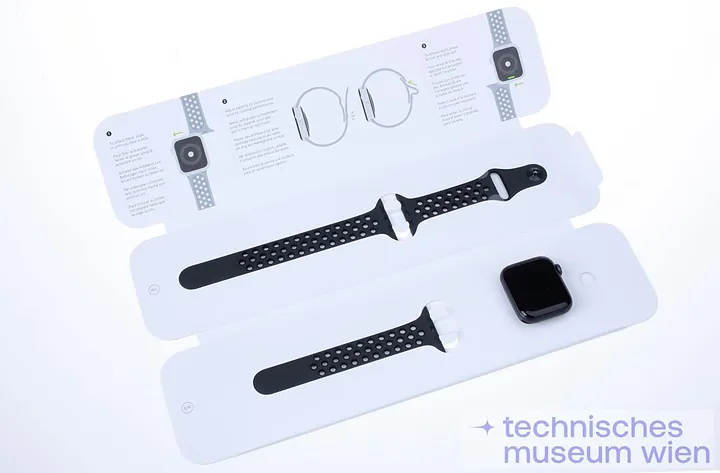
Apple Watch Series 4 (GPS, 40 mm, model A1977), 2018
Vienna Museum of Science and Technology
Wristwatches · c. 2010s
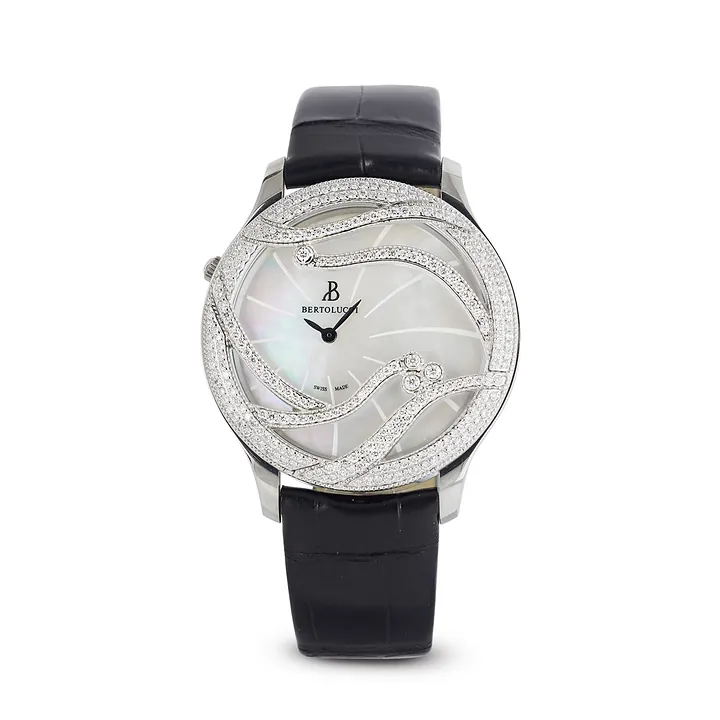
Bertolucci Stria III, ref. 11513.50.45.B88.6C1.501, c. 2010s
Antiquorum auction archive, Geneva
Wristwatches · c. 2010s
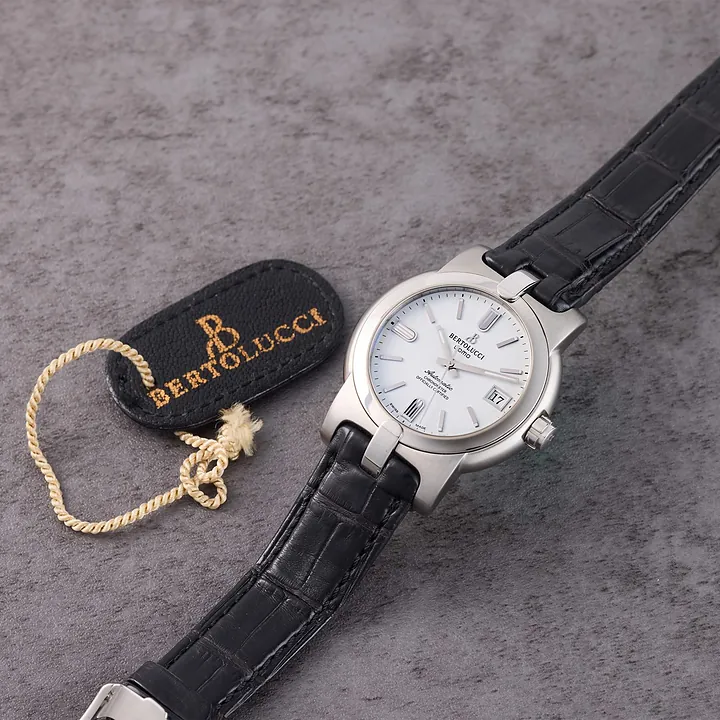
Bertolucci Uoma, ref. 824.51.41.10B, c. 2010s
Antiquorum auction archive, Geneva

Wristwatches · c. 2010s
Breguet Type XXI, ref. 3810, c. 2010s (Antiquorum Lot 381-24)
Antiquorum auction archive, Geneva

Wristwatches · c. 2010s
Breguet Type XXI, ref. 3810, c. 2010s (Antiquorum Lot 386-229)
Antiquorum auction archive, Geneva

Wristwatches · Sold in September 2010
Breitling Cosmonaute, ref. A 22322, Sold in September 2010
Antiquorum auction archive, Geneva
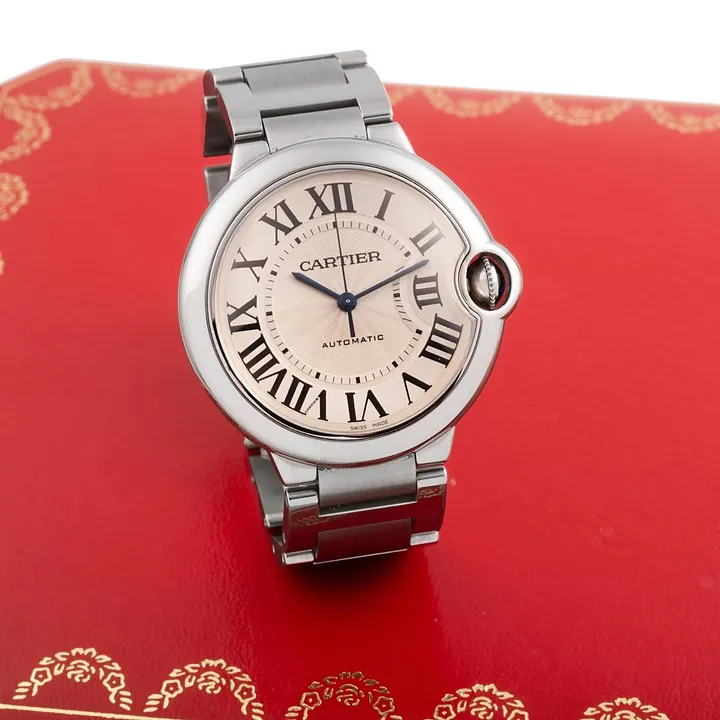
Wristwatches · c. 2010s
Cartier Ballon Bleu, ref. 3284, c. 2010s
Antiquorum auction archive, Geneva