
Wristwatches · Wristwatch
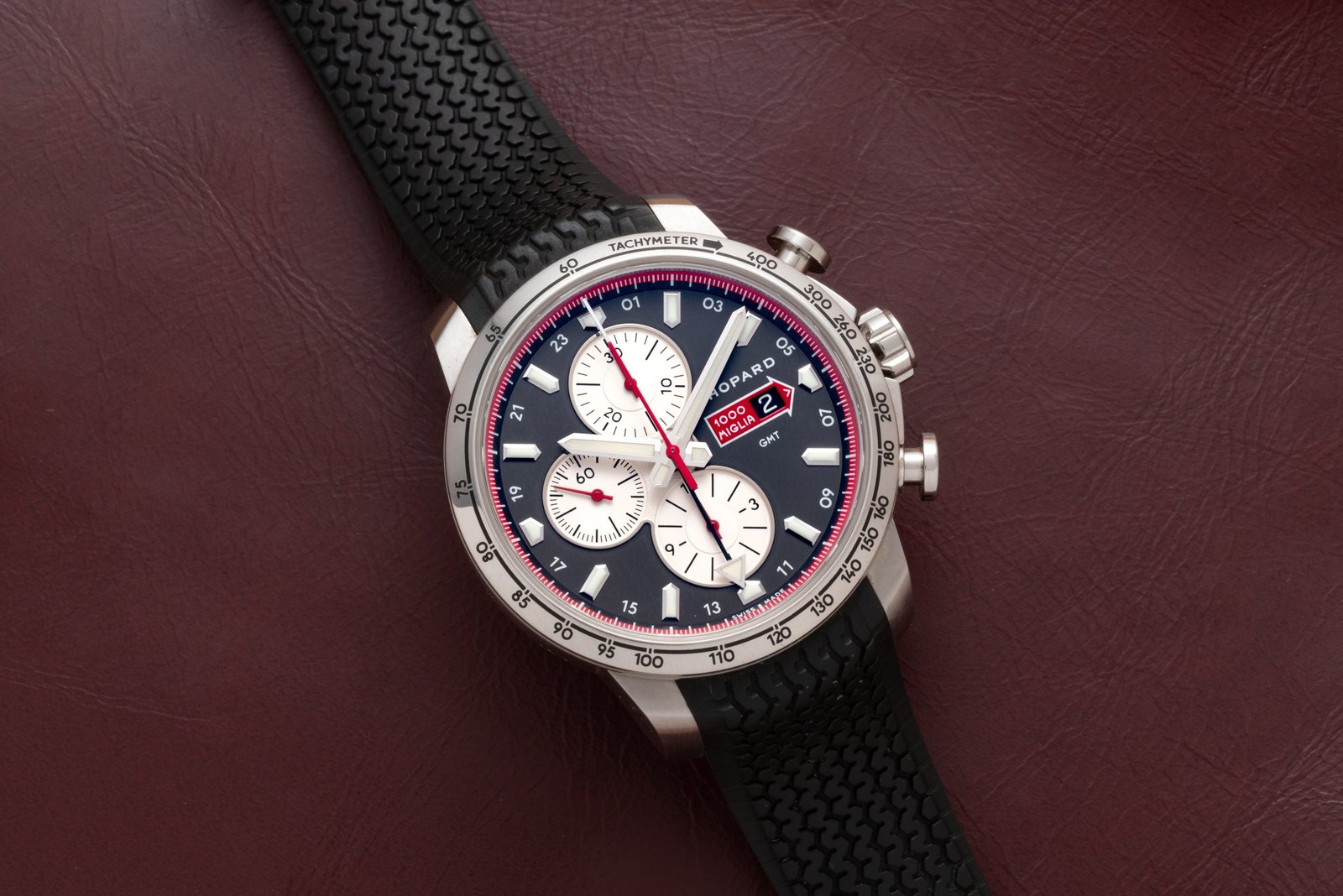
Chopard Mille Miglia 2013 Competitor Watch
- Maker / attribution
- Chopard (maker)
- Date
- 2013
- Historical period
- Contemporary Horology (2010 – Present)
- Country of origin
- Switzerland
- Object type
- Wristwatch
- Dimensions
- Case 45 mm
- Stock no.
- 40991855
- Credit line
- Dealer listing, Analog/Shift (40991855)
- Catalogue title (original)
- Chopard Mille Miglia 2013 Competitor Watch (English)
View the source record (dealer listing) ↗ (opens another website in a new tab)Suggest a correction
Record summary
Catalogued by Analog/Shift (dealer), New York (stock number 40991855), this is a wristwatch by Chopard, made in Switzerland, dated 2013. The Atlas places it in the Contemporary Horology period (2010 – Present) of its Wristwatches collection. Recorded dimensions: Case 45 mm. The record is illustrated with 6 photographs.
Assembled from the source record's structured fields. Dates and attributions are given as the source states them; where a field is missing the Atlas leaves it blank rather than estimating.
Catalogue description
Dealer description — Analog/Shift
The historic Mille Miglia 1,000-km endurance race from Brescia to Rome has captured the hearts and imagination of motorsport enthusiasts since its inception in 1927. Echoing the bygone era of motorsports' golden age, modern runnings of the Mille Miglia captivate enthusiasts and draw competitors from around the world, flogging vintage machines on grueling road stages through densely populated towns and the scenic Italian countryside. This legendary event is a symbol of endurance, elegance and precision. Among the many luxury brands that have embraced the spirit of the Mille Miglia and stepped up for sponsorship, Chopard stands out as a special partner, having become nearly synonymous with the event itself since becoming its official timekeeper in 1988. Since that year, it has been traditional to present each competitor with a commemorative timepiece — just like the one we have here. This particular example is from the 2013 running of the Mille Miglia and was presented to Thomas Miller, pilot of entry #396 — an exceptional Aston Martin DB 2/4 in BRG — to mark the occasion. A Chopard GMT Chronograph, it features a 45mm stainless steel case with a steel tachymeter bezel, a signed, screw-down crown, and steel mushroom-style chronograph pushers. Its black dial houses a luminous applied indices and a white triple-register display comprised of a 12 hour totalizer at 6 o’clock, a running seconds display at 9 o’clock, and a 30-minute totalizer at 12 o’clock. A date indicator at 3 o’clock, a matching luminous handset, and the iconic red 1000 MIGLIA pennant puts the finishing touches on the informative dial The caseback is engraved ‘Mille Miglia 2013’ and '396', confirming the car's racing number. This watch comes accompanied by its presentation box, instruction manual, chronometer certification and a COO dated May 2013. In great overall condition and coming directly from the collection of its original owner, this piece offers a slice of history that ties motorsports and perhaps its greatest modern horological sponsor. It's the perfect addition to any automotive or timepiece collection!
Historical context
Contemporary Horology (2010 – Present)
Silicon components, connected watches, optical-lattice research clocks and a thriving independent scene.
Smartwatches became the world's best-selling watches, while mechanical watchmaking focuses on craft, innovation (silicon components, new escapements) and independent makers.
Read the period in the timelineMore wristwatches from this periodEarlier: Mechanical Renaissance
Atlas type guide
Wristwatches
Bracelet watches were worn by women from the early nineteenth century — Breguet made one for Caroline Murat, Queen of Naples, in 1810–12 — but the wristwatch only became a man's instrument with military use and aviation in the early twentieth century. Between the World Wars it overtook the pocket watch; the 1920s and 1930s brought rectangular Art Deco cases, water-resistant cases and the first automatic winding systems.
After 1945 the wristwatch became a carrier of identity — dress watches, sports and dive watches, chronographs, calendars — produced by Swiss, American, Japanese, German, Soviet and Chinese industries. The quartz revolution after 1969 and the mechanical renaissance since the 1990s, including the rise of independent watchmakers, complete the story.
What to look for
- The reference number (between the lugs or inside the case back) and serial number, the starting point for dating.
- The calibre: its maker and number are often stamped under the dial or on the bridge.
- Originality of dial, hands and crown — refinished ('redial') dials are common.
- Case material marks: 18K/750, 14K/585, stainless steel, gold-filled, plated.
Dating clues
- Wire-lug cases: before c. 1925.
- Water-resistant screw-down cases: from 1926.
- Quartz movements: from 1969; sapphire crystals widespread after c. 1980.
General guidance written by the Atlas editors about this kind of object. It is not a statement about this particular piece; for that, rely on the source record above and on physical examination.
Related records
Wristwatches · Sold on 23 Jun 1998
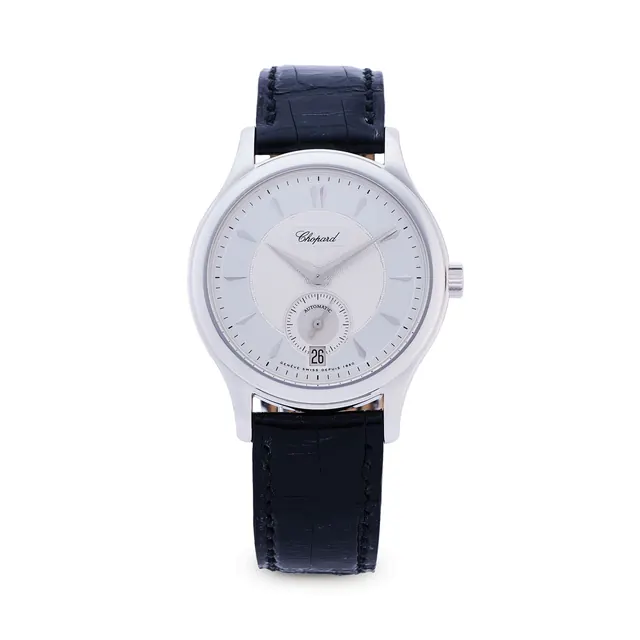
Chopard wristwatch, ref. 16/91860/2, L.U.c. 1860 Guilloche Dial, Sold on 23 Jun 1998
Antiquorum auction archive, Geneva
Wristwatches · c. 2000s
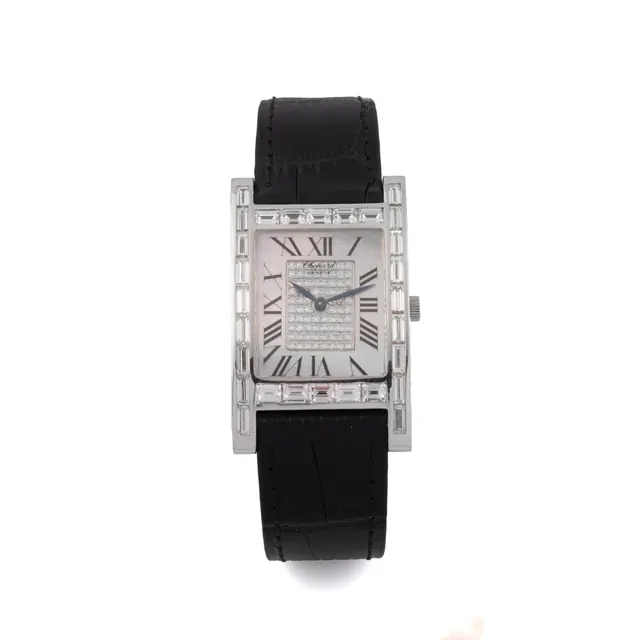
Chopard wristwatch, ref. 471, Your Hour Mop Dial, circa 2000's
Antiquorum auction archive, Geneva
Wristwatches · 2017
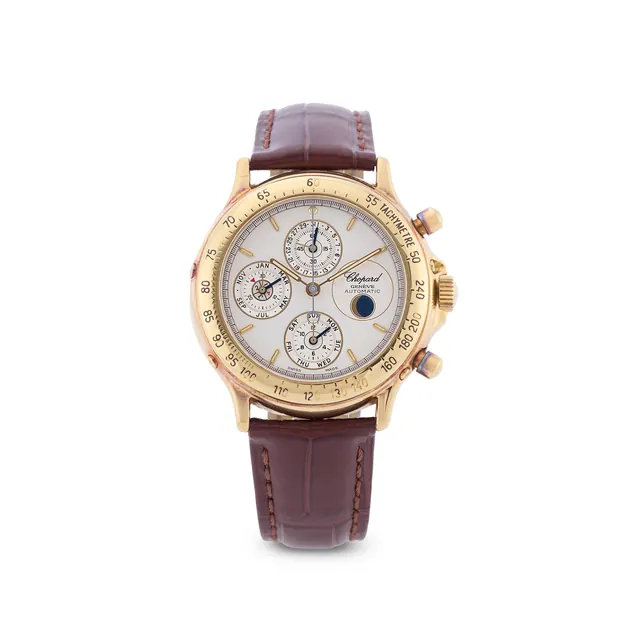
Chopard wristwatch, ref. 36/1208, Classic Perpetual Calendar Limited 12/50, Sold in June, 2017
Antiquorum auction archive, Geneva
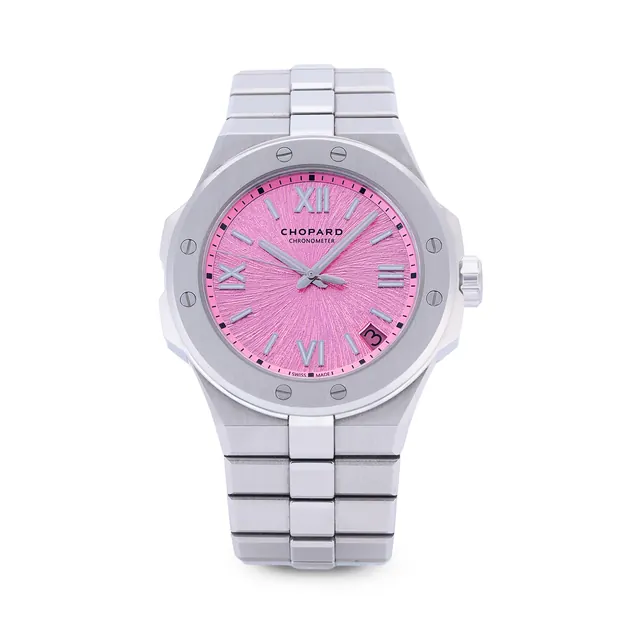
Wristwatches · c. 2024
Chopard wristwatch, ref. 298600-3022, Alpine Eagle, circa 2024
Antiquorum auction archive, Geneva

Wristwatches · c. 2010s
Breguet Type XXI, ref. 3810, c. 2010s (Antiquorum Lot 381-24)
Antiquorum auction archive, Geneva

Wristwatches · c. 2010s
Breguet Type XXI, ref. 3810, c. 2010s (Antiquorum Lot 386-229)
Antiquorum auction archive, Geneva

Wristwatches · Sold in September 2010
Breitling Cosmonaute, ref. A 22322, Sold in September 2010
Antiquorum auction archive, Geneva

Wristwatches · c. 2010
Corum Bubble Chrono, ref. 396.150.20, c. 2010
Antiquorum auction archive, Geneva