
Clocks · Chiming clock
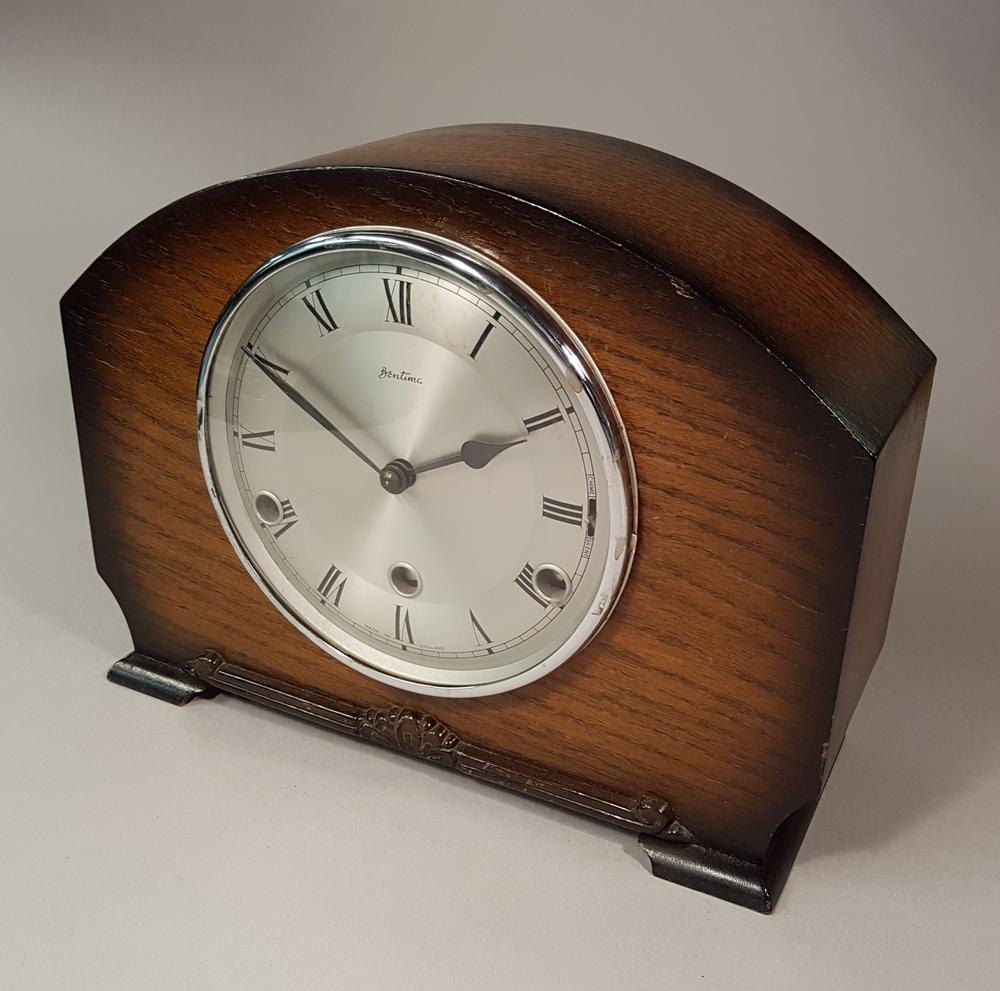
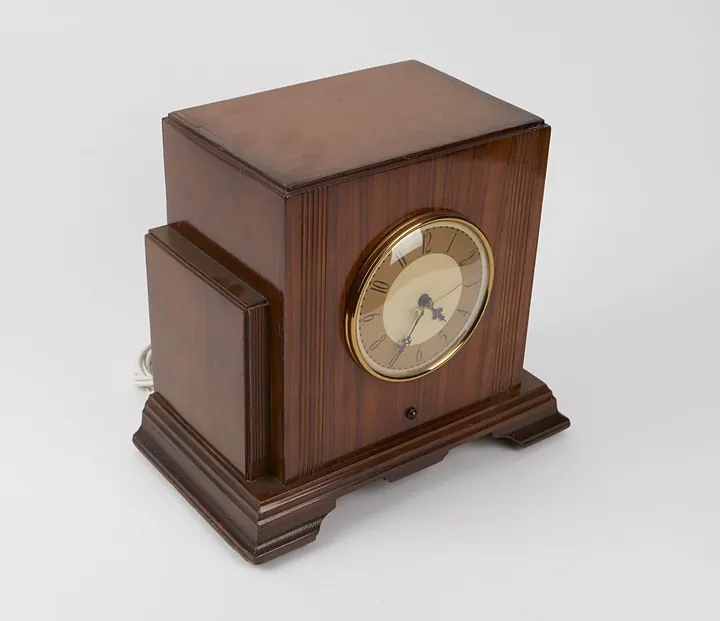
Chiming mantel clock with round silvered dial, chrome plated bezel in an oak curve-top case
- Maker / attribution
- Perivale Clock Manufacturing Company Ltd (Factory of)
- Date
- 1958–1959
- Historical period
- Modern Mechanical Horology (1945 – 1969)
- Country of origin
- British Isles
- Place
- Perivale
- Object type
- Chiming clock
- Dimensions
- Height: 214 millimetres Width: 287 millimetres Depth: 118 millimetres
- Holding institution
- British Museum
- Accession / object no.
- 2012,8028.72
- Credit line
- British Museum, London
- Catalogue title (original)
- Chiming mantel clock with round silvered dial, chrome plated bezel in an oak curve-top case (English)
View the source record ↗ (opens another website in a new tab)Suggest a correction
Record summary
Held and catalogued by British Museum (object number 2012,8028.72), this is a chiming clock by Perivale Clock Manufacturing Company Ltd, made in Perivale, British Isles, dated 1958–1959. The Atlas places it in the Modern Mechanical Horology period (1945 – 1969) of its Clocks collection. Recorded dimensions: Height: 214 millimetres Width: 287 millimetres Depth: 118 millimetres. The record is illustrated with 1 photograph.
Assembled from the source record's structured fields. Dates and attributions are given as the source states them; where a field is missing the Atlas leaves it blank rather than estimating.
Catalogue description
Description — British Museum
Chiming mantel clock with round silvered dial, chrome plated bezel in an oak curve-top case. Four hammers acting on four underslung gongs.
Curator's comments — British Museum
See 'Clockmaking in England and Wales in the Twentieth Century : the industrialized manufacture of domestic mechanical clocks' by John Glanville and William M. Wolmuth, Crowood Press , 2015 p 314, 328-9.
Inscriptions & marks
inscription; movement back plate, below hammer assembly bracket; 495353; inscription; dial; Bentima; CHIME SILENT; MADE IN ENGLAND; inscription; Movement back plate; PERIVALE; ALL BRITISH CLOCKS; with Britannia image
Provenance
Donated by:, John Glanville, Donated by:, Bill Wolmuth
Historical context
Modern Mechanical Horology (1945 – 1969)
Tool watches for divers, pilots and astronauts; electric watches anticipate the electronic age.
Post-war clocks combined new materials and industrial design: plastic and metal cases, battery-powered transistor movements from the late 1950s, and design classics by George Nelson, Max Bill and others. The first caesium atomic clock (1955) moved the definition of time from astronomy to physics.
Read the period in the timelineMore clocks from this periodEarlier: Golden Age of Mechanical Watchmaking
Atlas type guide
Mantel and French pendule clocks
The mantel clock — the French pendule de cheminée — is as much decorative art as timekeeper. From the late seventeenth century Parisian clockmakers worked with cabinet-makers, bronze founders and gilders (ciseleurs-doreurs) to create cases in Boulle marquetry, gilt bronze and marble, while the movements were often supplied by specialist makers. Clocks of the Louis XIV, Louis XV and Louis XVI periods, and Empire clocks with allegorical figures, set fashions copied across Europe.
The nineteenth century industrialised the type. The 'Paris movement', a standardised round movement with silk-thread or Brocot suspension and count-wheel striking, was made in huge numbers by firms such as Japy and Vincenti, and fitted into cases of every style and material.
What to look for
- Round 'Paris' movements with makers' stamps (e.g. Japy Frères, Vincenti, S. Marti) and medal marks from exhibitions.
- Suspension type: silk thread (earlier) or Brocot adjustable suspension (after c. 1840).
- Visible Brocot escapement on the dial in later clocks.
- Fire-gilt (mercury) gilding on bronzes versus later electro-gilding.
- Signed dials naming a retailer rather than the movement maker.
Dating clues
- Silk-suspension Paris movements: c. 1800–1850.
- Brocot suspension and visible escapements: after c. 1840.
- Exhibition medal stamps on movements give dates after the medal year.
General guidance written by the Atlas editors about this kind of object. It is not a statement about this particular piece; for that, rely on the source record above and on physical examination.
Read next:Anchor (recoil) escapement
Related records
Clocks · c1947
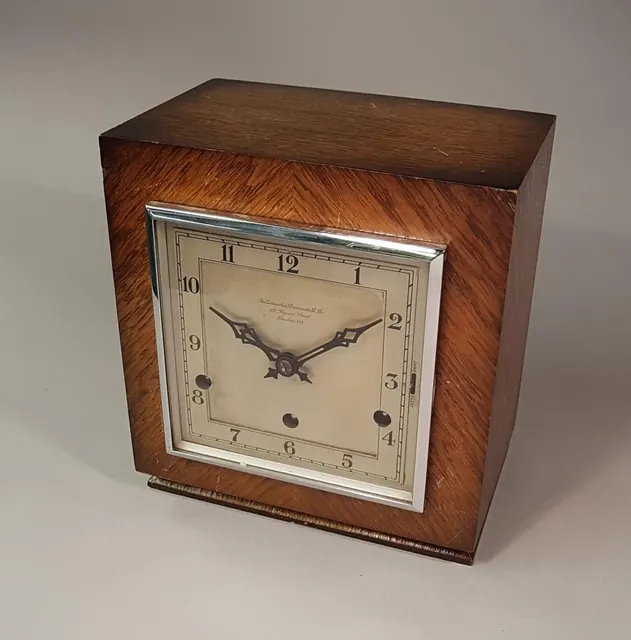
Chiming mantel clock with a square silvered dial, and chapter ring, chrome plated bezel in a square oak case
British Museum
Clocks · 1954–1955
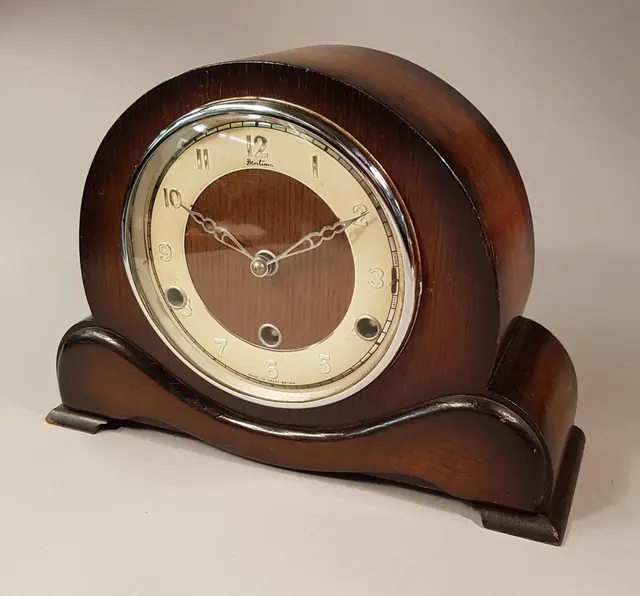
Chiming mantel clock with round wooden dial, cream painted chapter ring and chrome plated bezel in an oak round top case
British Museum
Clocks · 1935
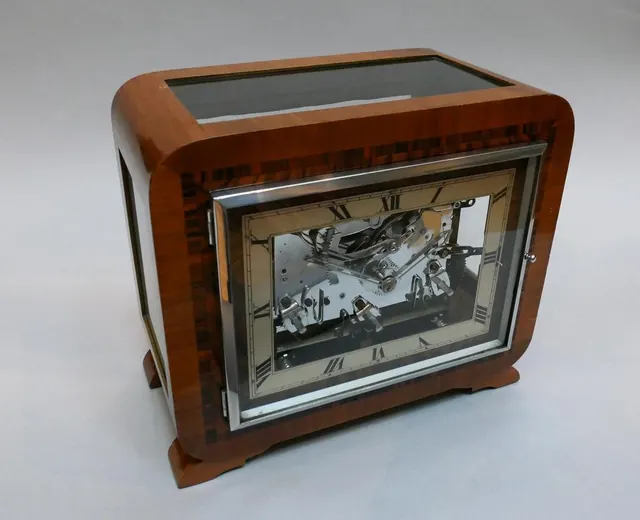
Three-train clock in a five glass, walnut framed case. Chromium plated. Westminster chime
British Museum
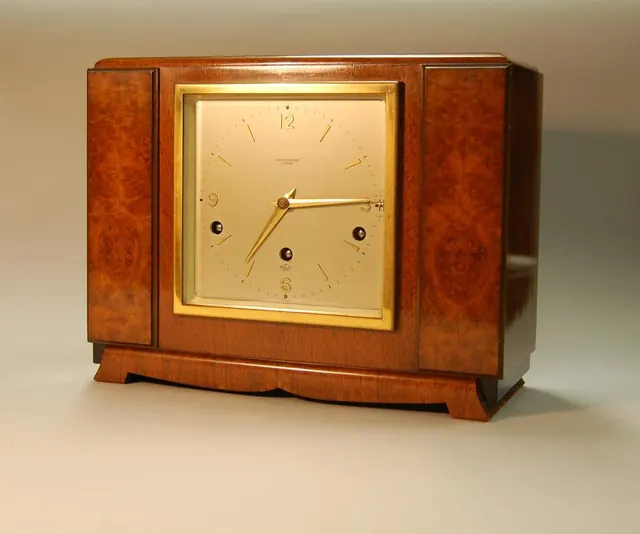
Clocks · 1955–1965
Walnut Cased Quarter-Chiming Mantel Clock
British Museum
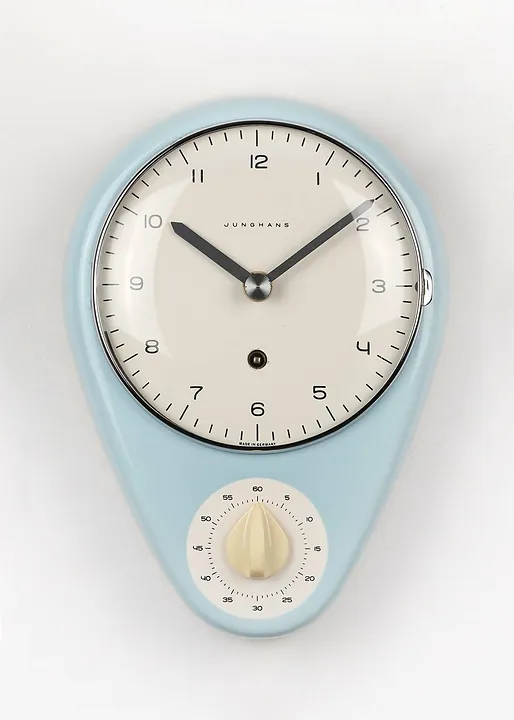
Clocks · c. 1960
Clock, Germany, c. 1960 (no. 58196)
German Clock Museum
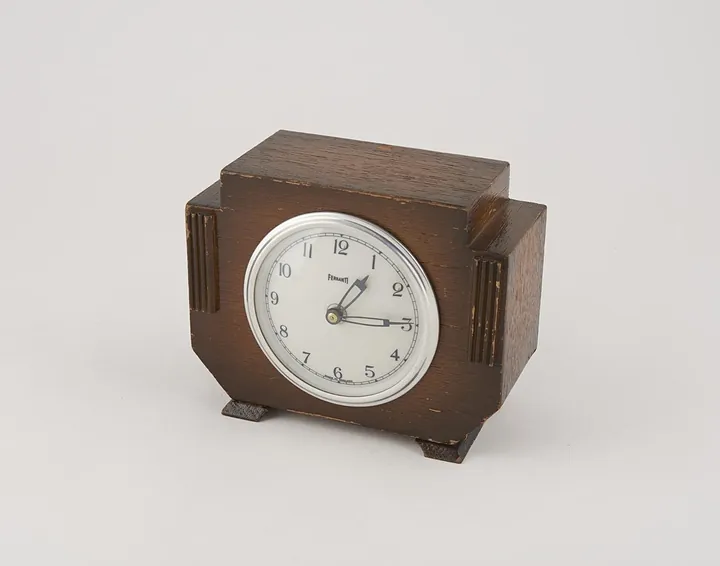
Clocks · 1930–1960
Ferranti electric mantel clock. (no. Y1996.10.820)
Science Museum Group, London
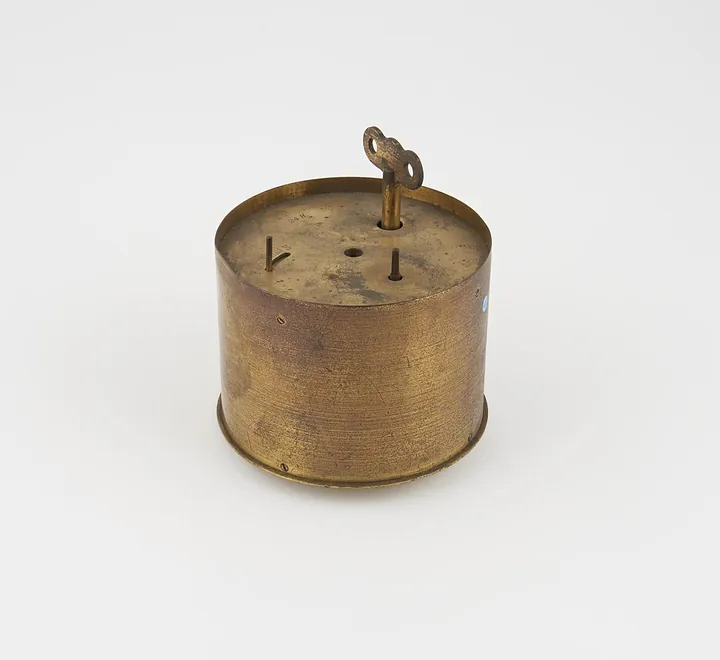
Clocks · 1931–1970
Clock and drum for recorder, 24 hours, English, 1931–1970.
Science Museum Group, London
Clocks · 1937; 1980
Clock by Bestone and Hammond, United States, 1937; 1980
Science Museum Group, London