
Wristwatches · Wristwatch
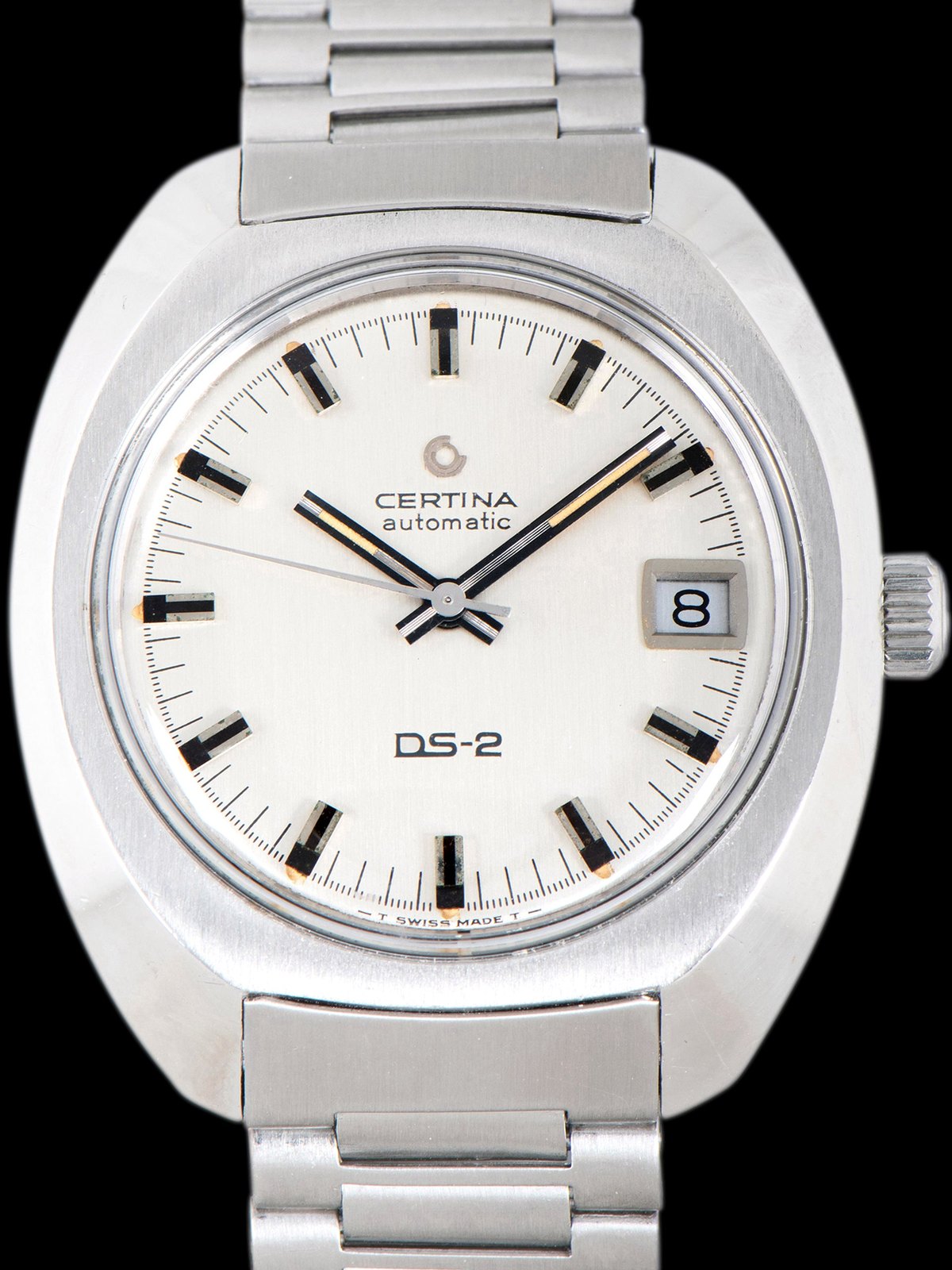
Certina DS-2 Automatic (Ref. 5801 300) Silver Dial, 1970s
- Maker / attribution
- Certina (maker)
- Date
- 1970s
- Historical period
- Quartz Revolution (1969 – 1990)
- Country of origin
- Switzerland
- Object type
- Wristwatch
- Materials / technique
- silver
- Stock no.
- CRTDS5801300
- Credit line
- Dealer listing, Craft & Tailored (CRTDS5801300)
- Catalogue title (original)
- 1970s Certina DS-2 Automatic (Ref. 5801 300) Silver Dial (English)
View the source record (dealer listing) ↗ (opens another website in a new tab)Suggest a correction
Record summary
Catalogued by Craft & Tailored (dealer), Los Angeles (stock number CRTDS5801300), this is a wristwatch by Certina, made in Switzerland, dated 1970s. The Atlas places it in the Quartz Revolution period (1969 – 1990) of its Wristwatches collection. Materials and techniques recorded by the source: silver. The record is illustrated with 6 photographs.
Assembled from the source record's structured fields. Dates and attributions are given as the source states them; where a field is missing the Atlas leaves it blank rather than estimating.
Catalogue description
Dealer description — Craft & Tailored
In 1888 two brothers, Adolf and Alfred Kurth opened a watch movement and watchmaking supplies factory in Grenchen, Switzerland. By 1906, the company started creating complete watches under the moniker, Grana, before renaming to the name that stuck—Certina—in 1924. From producing automatic movements for Hamilton to supplying the US Navy with superior dive watches for their Sealab-II experiments in 1965 and even adorning the wrist of Muhammad Ali, Certina has been a heavyweight player with an underdog presence for decades. This ref. 5801 300 is a quintessentially-70s piece with a chunky cushion-style case and radial dial. It also features the in-house Certina cal. 25-651 automatic movement. All in all, it's a perfect example of the brand's ability to create a tough, functional, and attractive timepiece that can stand the test of time without breaking the bank. SPECS Stock # CRTDS5801300 Brand Certina Style DS-2 Model 5801 300 Serial 81XXXXX Size Men's Material Stainless Steel Dial Silver Millimeters 38 Bracelet Certina "NSA" Rolled-Link Bracelet CASE & BRACELET The lightly polished case is in excellent condition with strong dimensions and very little signs of use. The case retains its original "Certina" signed crown. The case back is adorned with a fan-blade motif that surrounds a turtle medallion that reads Certina-DS and remains fully intact and is in wonderful overall condition. The watch comes supplied on its original stainless steel "NSA" rolled link bracelet featuring the stretch adjust clasp. The bracelet will fit up to a 7 1/2-inch wrist. DIAL & HANDS The brushed silver dial has incredible depth and is in near-perfect vintage condition, with no damage or obscene elements of age. The tritium lume plots all remain fully intact when inspected under U.V. light and have aged to a handsome golden patina. The black and steel original tritium hands match the dial perfectly, under UV light inspection the minute hand exhibits some minor cracking and the hour hand exhibits no degradation. ACCESSORIES None. The watch is keeping time, the previous service history is unknown. A movement service can be provided upon request.
Historical context
Quartz Revolution (1969 – 1990)
Seiko's Astron begins mass quartz timekeeping; traditional industries contract sharply.
Quartz and digital watches transformed the market after 1969. Swiss employment collapsed, Japanese and Hong Kong production soared, and the Swatch (1983) helped the Swiss industry recover; mechanical watches survived as luxury goods.
Read the period in the timelineMore wristwatches from this periodEarlier: Modern Mechanical Horology
Atlas type guide
Automatic (self-winding) watches
Self-winding watches use the wearer's motion to wind the mainspring. Abraham-Louis Perrelet and Breguet made 'perpétuelle' pocket watches with oscillating weights in the late eighteenth century, but the principle only became practical in the wristwatch. John Harwood patented a bumper automatic in 1923; Rolex's Perpetual rotor (1931) winding in one direction, and later bidirectional rotors (Eterna, Felsa Bidynator), established the modern form. Micro-rotors (Universal Genève, Buren) and peripheral rotors made automatic watches thinner.
What to look for
- A semicircular rotor turning 360° over the movement, or a 'bumper' weight that rebounds between springs.
- 'Automatic', 'Perpetual' or 'Self-winding' on the dial.
- A sealed screw-back case, since automatic watches are wound less often by the crown.
Dating clues
- Bumper automatics: 1923–c. 1955.
- Full rotors: from 1931 (Rolex); widespread after c. 1950.
- Micro-rotors: from 1954–1958.
General guidance written by the Atlas editors about this kind of object. It is not a statement about this particular piece; for that, rely on the source record above and on physical examination.
Related records

Wristwatches · 1900–1999
Wristwatch by Certina, Switzerland, 1900–1999
Nordic Museum Foundation
Wristwatches · originally sold in December 2025 (per the lot record)
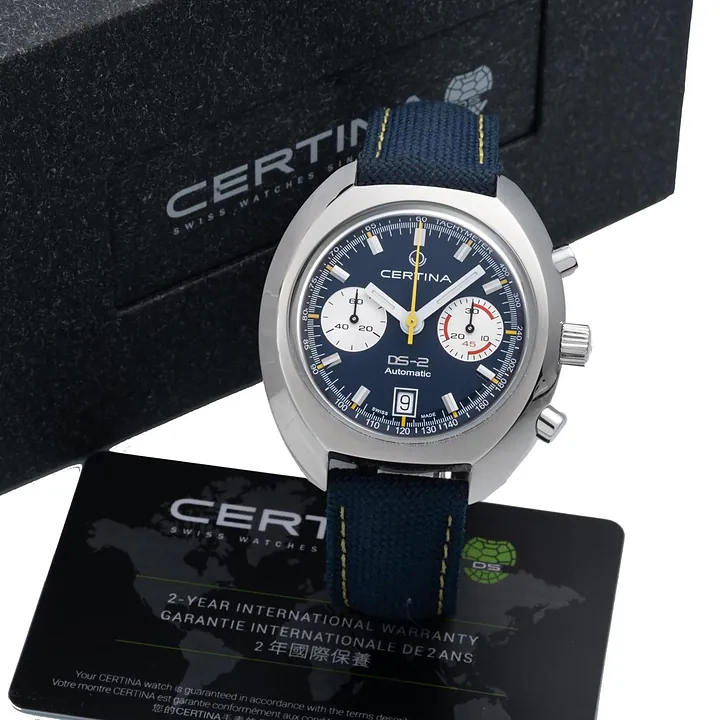
Certina DS-2 Chronograph Automatic, ref. C024.462.18.041.00, originally sold in December 2025
Antiquorum auction archive, Geneva
Wristwatches · originally sold in January 2026 (per the lot record)
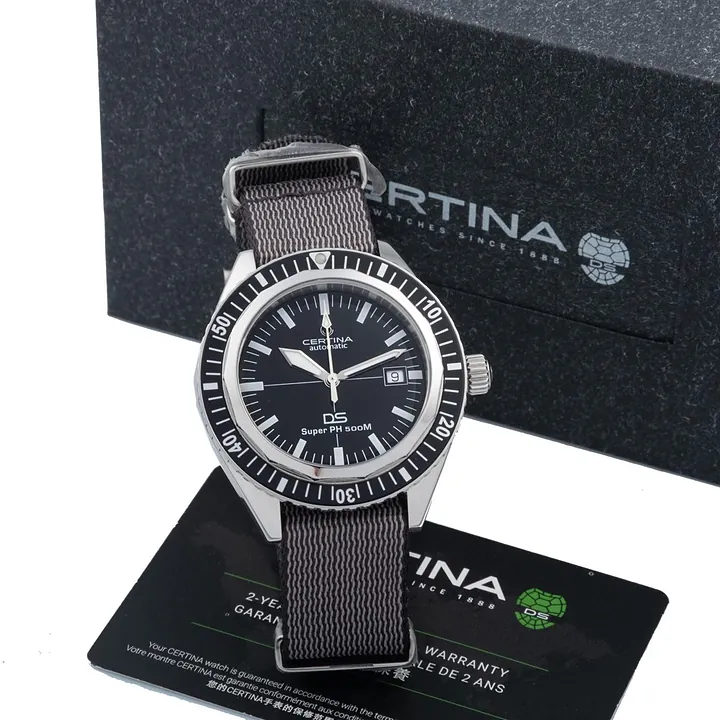
Certina DS Super PH 500m, ref. C037.407.18.050.00, originally sold in January 2026
Antiquorum auction archive, Geneva
Wristwatches · c. 1965-1970
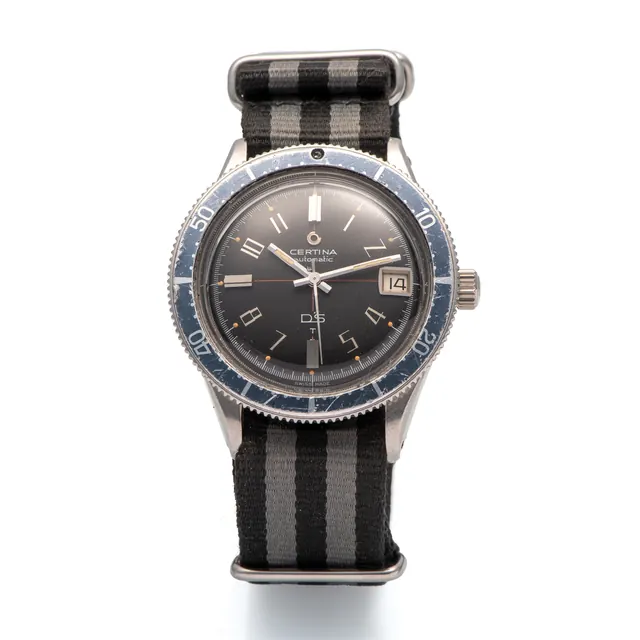
Certina wristwatch, ref. 5801, Ds, circa 1965-1970
Antiquorum auction archive, Geneva

Wristwatches · 1970
Wristwatch by Heno, Switzerland, 1970
Museum Rotterdam

Wristwatches · 1960–1986
'Tri-Compax' calendar chronograph wristwatch in gold case, by Universal, Geneva, Switzerland, 1960–1986.
Science Museum Group, London

Wristwatches · 1969–1970
Beta 21 Quartz wristwatch movement, made in Switzerland, 1970.
Science Museum Group, London

Wristwatches · c. 1969
Omega Speedmaster Moonwatch, ref. 145022-69st, c. 1969
Antiquorum auction archive, Geneva