
Wristwatches · Wristwatch
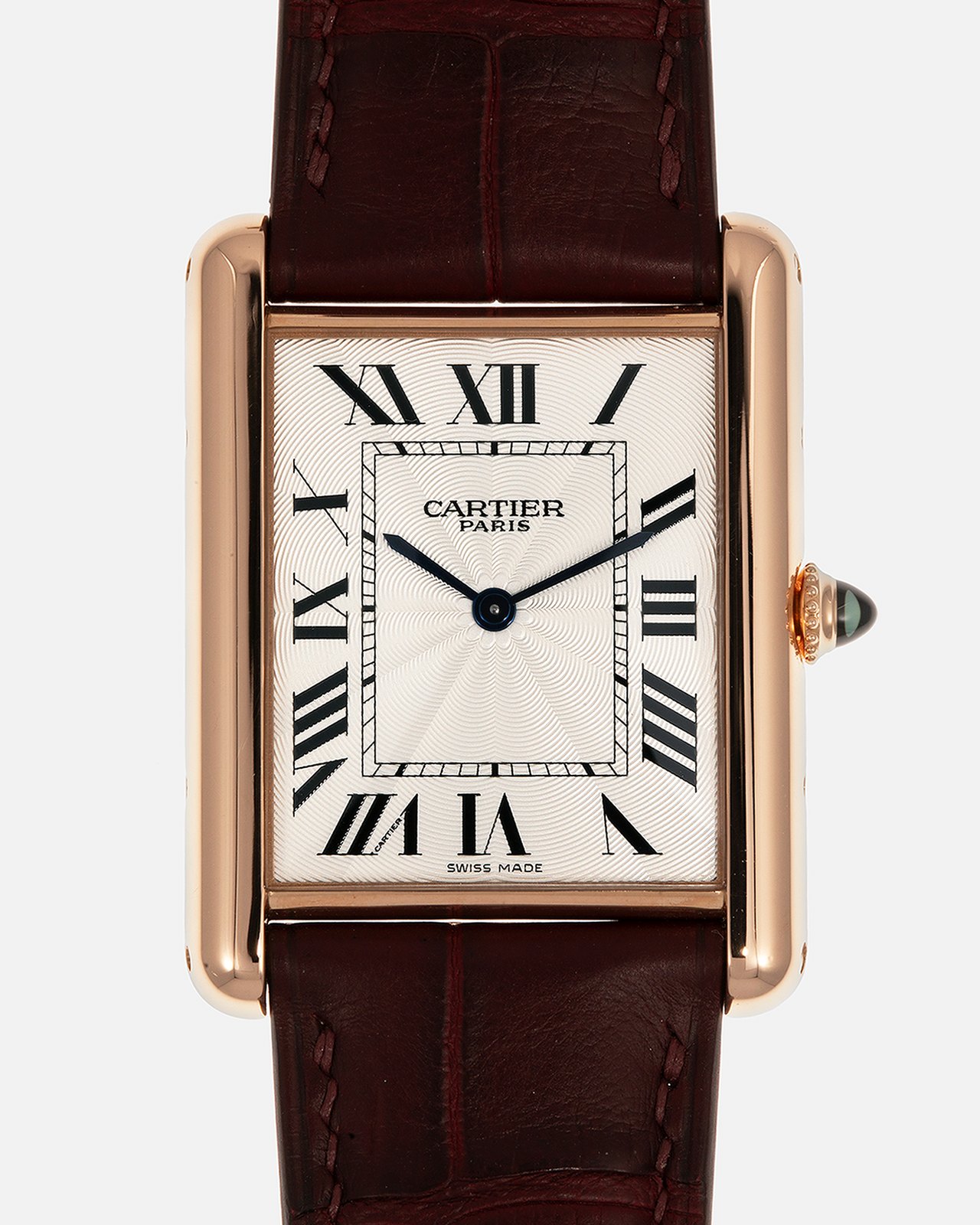
Cartier Tank Louis Cartier XL CPCP 2914 RG, 2009
- Maker / attribution
- Cartier (maker)
- Date
- 2009
- Historical period
- Mechanical Renaissance (1990 – 2010)
- Country of origin
- France
- Object type
- Wristwatch
- Dimensions
- Case 40 mm
- Stock no.
- Product 7652927144023
- Credit line
- Dealer listing, S.Song Watches (product 7652927144023)
- Catalogue title (original)
- Cartier Tank Louis Cartier XL CPCP 2914 RG (English)
View the source record (dealer listing) ↗ (opens another website in a new tab)Suggest a correction
Record summary
Catalogued by S.Song Watches (dealer), Seattle (stock number Product 7652927144023), this is a wristwatch by Cartier, made in France, dated 2009. The Atlas places it in the Mechanical Renaissance period (1990 – 2010) of its Wristwatches collection. Recorded dimensions: Case 40 mm. The record is illustrated with 6 photographs.
Assembled from the source record's structured fields. Dates and attributions are given as the source states them; where a field is missing the Atlas leaves it blank rather than estimating.
Catalogue description
Dealer description — S.Song Watches
The name Cartier needs little introduction. As one of the most influential jewellery and watch brands of the last century, it has long stood as a symbol of luxury and refinement. Without diminishing its historical significance, Cartier has often been regarded more as a design-driven brand than a purely horological one, with iconic models such as the Tank, Crash, and Santos celebrated as much for their aesthetics as for their heritage. Even today, it is Cartier’s elegant and unconventional forms that continue to attract collectors and give the brand a place within the watchmaking realm that few others can truly match. The 1990s proved to be a pivotal period for watchmaking as brands gradually recovered from the quartz crisis. As interest in mechanical horology began to return, Cartier decided it was time to demonstrate a different side of the brand. This ultimately led to the creation of the Collection Privée Cartier Paris (CPCP), a specialized division dedicated to reinterpreting some of Cartier’s most celebrated designs with high-quality mechanical movements sourced from renowned manufacturers, such as Piaget and Jaeger-LeCoultre. Looking back today, it remains one of the most important modern chapters in Cartier’s watchmaking history. Presented here is an exceptional example of the Cartier Tank Louis XL 2914 from that celebrated CPCP era (1998–2008), cased in 18-carat rose gold. Produced only between 2006 and 2008 and believed to have been limited to around 250 examples in this configuration, the 2914 remains one of the rarest and most sought-after modern Tank references among collectors today. It was also released alongside an even rarer platinum counterpart, the 2915, believed to have been produced in just 50 examples. As far as case design goes, the Tank Louis remains elegant, refined, and unmistakably Cartier in form. Offered in the uncommon XL sizing, the 2914 measures approximately 40mm x 30mm and carries a stronger presence on the wrist while still preserving the elongated silhouette and visual harmony that have long defined the Tank Louis. Crafted entirely from lustrous rose gold and finished with the collection’s signature sapphire cabochon-set crown, the watch retains all the hallmarks of the traditional Tank blueprint while subtly improving overall wearability. The dial is equally emblematic of the CPCP era, distinguished by the intricate rosette guilloché motif found specifically on higher-end CPCP Tank models. Executed with remarkable subtlety, the dial features Cartier’s elongated Roman numerals, chemin de fer minute track on the periphery, and the coveted stacked “Cartier Paris” inscription at 12:00. Hidden discreetly within the VII numeral is another distinctive element of Cartier—the secret signature embedded within the numeral itself. The dial is further complemented by a set of classic blued épée hands, whose deep metallic hue provides a sharp contrast against the silvered guilloché surface. Framed within a beautifully textured centre that shifts gently under changing light, the guilloché possesses a richness and depth that photographs rarely fully capture. Combined with the radiance of the rose gold case, the dial elevates the 2914 far beyond a conventional Tank Louis, reinforcing why CPCP pieces continue to be held in such high regard among collectors today. Powering the watch from within is the Piaget-based, ultra-thin, manual-winding Cartier Cal. 9701 MC. Offering a 36-hour power reserve, the calibre remains not only impressively slim but also meticulously executed, with beautifully decorated bridges engraved with Cartier’s double-C motif. More notably, the Tank Louis XL is among the very few rectangular Cartier models to house a rectangular calibre, allowing the movement architecture to mirror the shape of the case itself. It is an old-school approach to watchmaking rarely seen in modern production, where shaped cases often conceal standard round movements hidden beneath spacer rings. Altogether, the Cal. 9701 MC stands as a highly considered calibre and a fitting mechanical counterpart to the understated elegance of the 2914 itself. Cartier has never been a brand associated purely with technical watchmaking, yet that has never been the point. What Cartier achieved better than most was the ability to create designs that transcended generations, tastes, and trends, and few watches embody that idea more completely than the Tank Louis. Elegant, restrained, and endlessly timeless, the Tank Louis remains the quintessential Tank for many collectors, with CPCP variants such as this 2914 representing the design formula at its absolute peak. Blending the elevated execution of that era with the enduring proportions and understated character that have long distinguished the Tank Louis, the 2914 stands as a deeply compelling piece of modern horology for the enthusiast who appreciates refinement in its purest form.
Historical context
Mechanical Renaissance (1990 – 2010)
Mechanical watches return as cultural objects; independent watchmaking flourishes.
Mechanical watches returned as cultural and luxury objects. Complications, tourbillons and new materials proliferated; independent watchmakers such as George Daniels, F.P. Journe and Philippe Dufour revived artisanal watchmaking; collecting vintage watches became a major field.
Read the period in the timelineMore wristwatches from this periodEarlier: Quartz Revolution
Atlas type guide
Wristwatches
Bracelet watches were worn by women from the early nineteenth century — Breguet made one for Caroline Murat, Queen of Naples, in 1810–12 — but the wristwatch only became a man's instrument with military use and aviation in the early twentieth century. Between the World Wars it overtook the pocket watch; the 1920s and 1930s brought rectangular Art Deco cases, water-resistant cases and the first automatic winding systems.
After 1945 the wristwatch became a carrier of identity — dress watches, sports and dive watches, chronographs, calendars — produced by Swiss, American, Japanese, German, Soviet and Chinese industries. The quartz revolution after 1969 and the mechanical renaissance since the 1990s, including the rise of independent watchmakers, complete the story.
What to look for
- The reference number (between the lugs or inside the case back) and serial number, the starting point for dating.
- The calibre: its maker and number are often stamped under the dial or on the bridge.
- Originality of dial, hands and crown — refinished ('redial') dials are common.
- Case material marks: 18K/750, 14K/585, stainless steel, gold-filled, plated.
Dating clues
- Wire-lug cases: before c. 1925.
- Water-resistant screw-down cases: from 1926.
- Quartz movements: from 1969; sapphire crystals widespread after c. 1980.
General guidance written by the Atlas editors about this kind of object. It is not a statement about this particular piece; for that, rely on the source record above and on physical examination.
Related records

Clocks · 1863
Clock by Albert-Ernest Carrier-Belleuse, France, 1863
The Metropolitan Museum of Art, New York

Clocks · c. 1980s
Cartier "art Deco", c. 1980s
Antiquorum auction archive, Geneva

Clocks · c. 2000s
Cartier Desk Clock with Alarm, c. 2000s
Antiquorum auction archive, Geneva

Clocks · c. 2000s
Cartier Lacquer Arched Desk Clock with Alarm, ref. W0100037, c. 2000s
Antiquorum auction archive, Geneva
Wristwatches · c. 1990
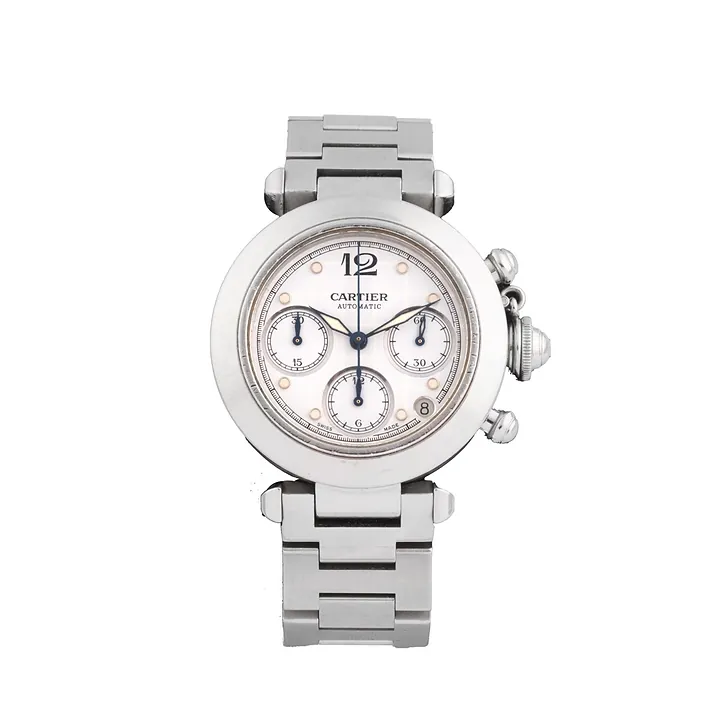
Cartier Pasha, ref. 2412, c. 1990
Antiquorum auction archive, Geneva
Wristwatches · c. 1990
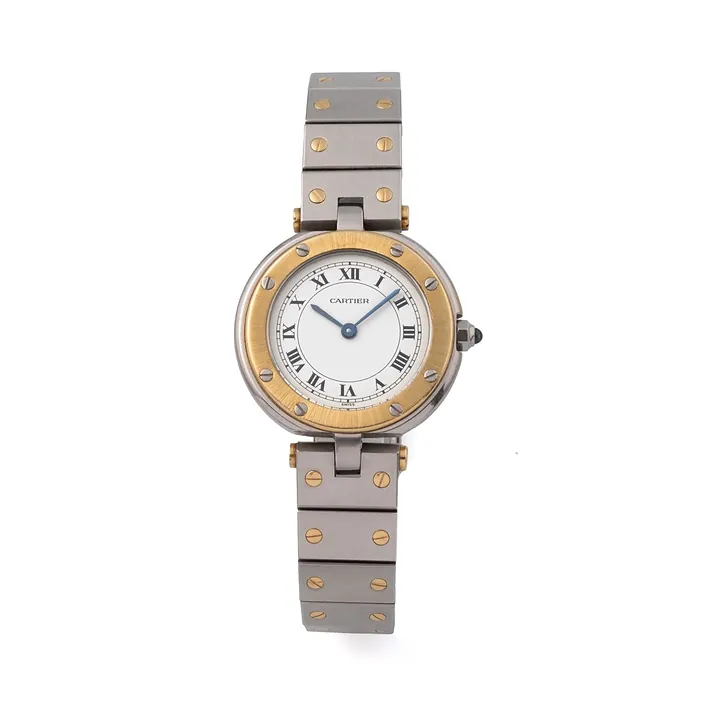
Cartier Santos Ronde Vendome, c. 1990
Antiquorum auction archive, Geneva
Wristwatches · c. 1990s
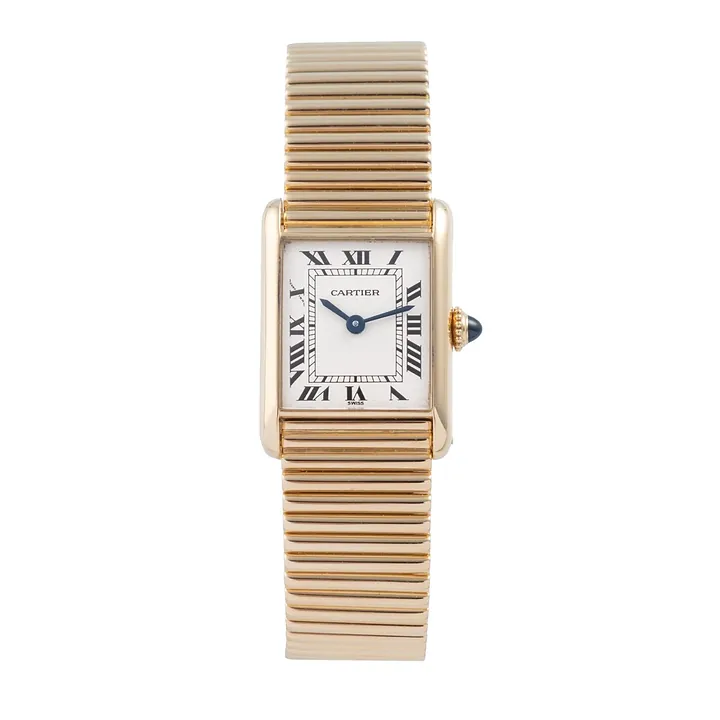
Cartier Tank Louis Cartier, ref. 6711, c. 1990s
Antiquorum auction archive, Geneva
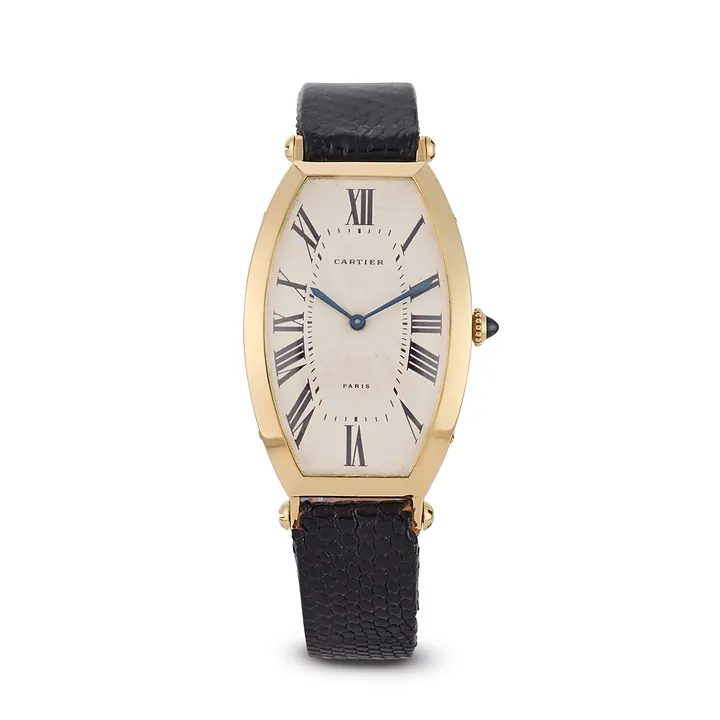
Wristwatches · c. 1991
Cartier Tonneau Paris 1991, c. 1991
Antiquorum auction archive, Geneva