
Wristwatches · Wristwatch
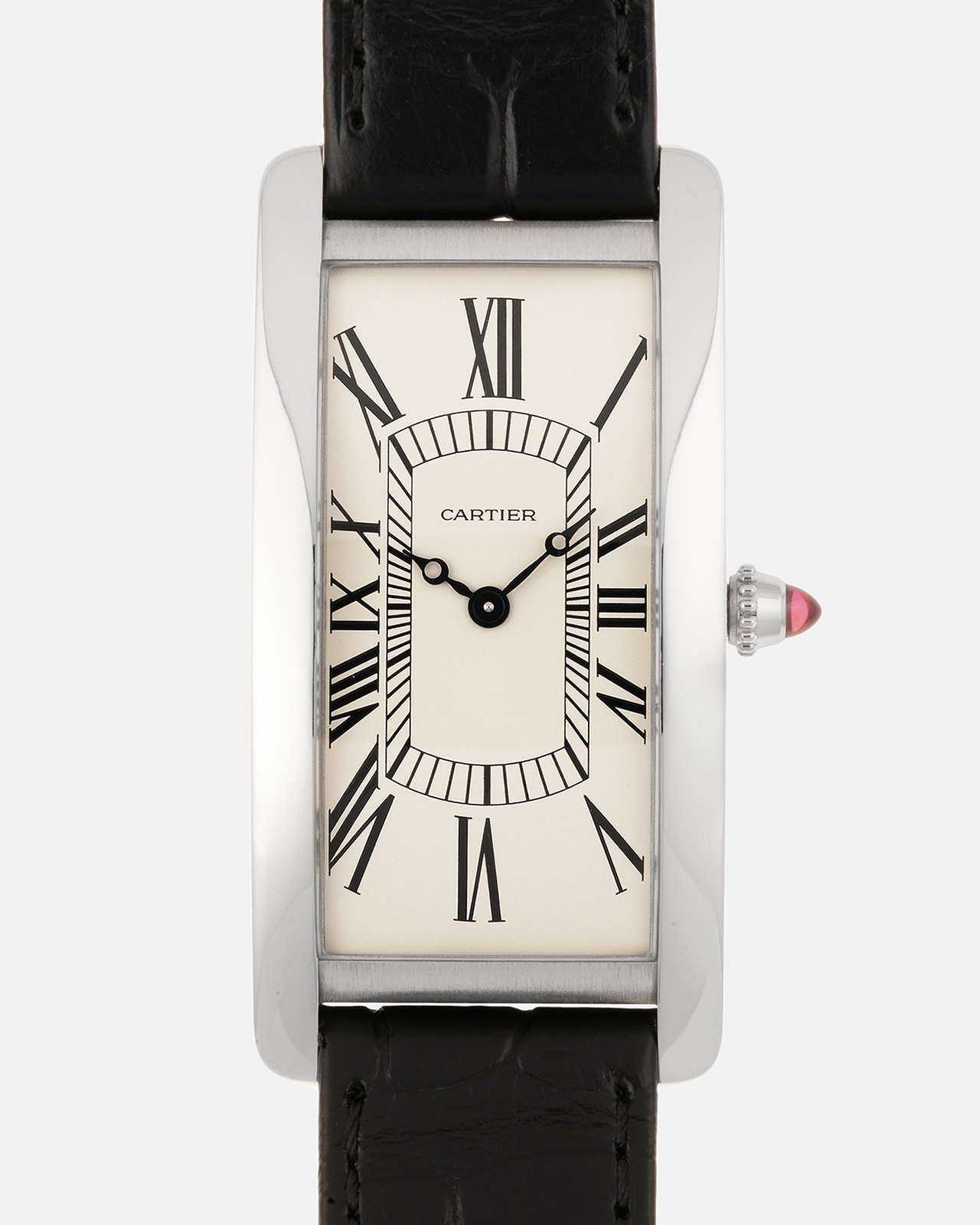
Cartier Tank Cintrée Les Rééditions Platinum, 2024
- Maker / attribution
- Cartier (maker)
- Date
- 2024
- Historical period
- Contemporary Horology (2010 – Present)
- Country of origin
- France
- Object type
- Wristwatch
- Materials / technique
- platinum
- Dimensions
- Case 46 mm
- Stock no.
- Product 7309392838743
- Credit line
- Dealer listing, S.Song Watches (product 7309392838743)
- Catalogue title (original)
- Cartier Tank Cintrée Les Rééditions Platinum (English)
View the source record (dealer listing) ↗ (opens another website in a new tab)Suggest a correction
Record summary
Catalogued by S.Song Watches (dealer), Seattle (stock number Product 7309392838743), this is a wristwatch by Cartier, made in France, dated 2024. The Atlas places it in the Contemporary Horology period (2010 – Present) of its Wristwatches collection. Materials and techniques recorded by the source: platinum. Recorded dimensions: Case 46 mm. The record is illustrated with 6 photographs.
Assembled from the source record's structured fields. Dates and attributions are given as the source states them; where a field is missing the Atlas leaves it blank rather than estimating.
Catalogue description
Dealer description — S.Song Watches
The name Cartier needs no introduction. As one of the most influential and celebrated jewellery and watch brands of the last century, it has always stood as a mark of luxury and desirability. Without taking away from its historical significance, I would say that when it comes to watches, Cartier has always been predominantly known as a ‘design’ brand rather than a pure watchmaking one, with stunningly iconic models such as the Tank, the Crash, and the Santos all seen as important due to how it looks. In fact, to this day, it is the beautiful and unconventional designs that attract collectors and allow it to hold a unique position in the watch brand hierarchy that no other possesses. While there are many iconic models from Cartier, it would be hard to dispute that the Tank Cintrée sits at the top as one of the flagships of the brand. For historical context, the Tank Cintrée made its debut in 1921, a mere two years following the introduction of the original Tank and has intermittently held its place in the brand's repertoire ever since. One special thing to note about the Tank Cintrée, in general, is that it has always been either made to order or in very small quantities, making the model itself, irrespective of variant, a very special one. Exceptionally elegant, majestic and revered by many for its timeless allure, we have for you today a special Cartier Tank Cintrée Les Rééditions in platinum. As the name suggests, this Tank Cintrée was released as a limited edition of just 150 pieces as part of the Les Rééditions de Cartier program in 2023, following the Tank Cintrée 100th Anniversary, the Pasha Perpetual Calendar in 2021, and the Pebble in 2022. For those who are unfamiliar, the Les Rééditions program seeks to revive some of the Maison 's historically significant designs that collectors love and admire in the most faithful form possible. Aesthetically, this Tank Cintrée Les Rééditions is as close to the original as it gets; from a distance, it’s almost impossible to distinguish it. Designed as a more refined and graceful version of the Tank, the Cintrée—which means "curved" in English—features a distinctive case profile characterized by a broad, elongated yet slender design (this example measures 46mm x 23mm) with a gentle arch, allowing it to comfortably embrace any wrist and fit seamlessly under a cuff. As with all Tank Cintrées, it is hard to describe in mere words just how elegant and thoughtful the case design actually is. It is only once after one wears a Tank Cintrée, that they truly understand what the hype is all about. I have never seen a watch sit so perfectly flush against my wrist, and that is a true testament to the masterful design of the Tank Cintrée. As expected of Cartier, the dial beneath the mineral glass of this Tank Cintrée Les Rééditions has also been executed exceptionally well. It embodies the quintessential Cartier aesthetic, featuring a tastefully restrained and serene design that pays homage to the original Tank models. Its off-white, eggshell hue is intentionally designed to evoke the appearance of the original Tank Cintrée that has gracefully aged over 100 years, which is a nice touch and a subtle nod to its heritage and design roots. Other notable details include a contrasting railway minute track in black, Cartier's signature Roman numerals with serifs placed along the periphery, a set of blued steel Breguet-style hands at the centre, and the iconic ruby cabochon set within the beaded crown at 3:00. This ruby cabochon not only serves as a distinctive Cartier hallmark for its platinum pieces but also adds a beautiful touch of embellishment, enhancing the overall neutral colour palette showcased in this example. Powering the Tank Cintrée Les Rééditions from within is Cartier's manual-winding Cal. 9780 MC, which is essentially Cartier’s version of Jaeger LeCoultre’s ultra-thin Cal. 849. This connection symbolizes a nice little tribute to its history, as vintage Tank Cintrées were also powered by Jaeger LeCoultre movements. In terms of power reserve, it can hold a charge for up to 36 hours when fully wound. Given everything I have discussed above, it's no mystery why the Tank Cintrée has prominently held the esteemed position of the flagship model within the renowned Maison — it simply looks and wears like a dream. As mentioned earlier, this particular Tank Cintrée Les Rééditions in platinum is exceptionally rare, with only 150 pieces produced at its debut in 2023. Undoubtedly, it stands out as one of the most iconic Cartier timepieces crafted in the Maison’s most coveted metal, making it an absolute must-have for any serious collector.
Historical context
Contemporary Horology (2010 – Present)
Silicon components, connected watches, optical-lattice research clocks and a thriving independent scene.
Smartwatches became the world's best-selling watches, while mechanical watchmaking focuses on craft, innovation (silicon components, new escapements) and independent makers.
Read the period in the timelineMore wristwatches from this periodEarlier: Mechanical Renaissance
Atlas type guide
Wristwatches
Bracelet watches were worn by women from the early nineteenth century — Breguet made one for Caroline Murat, Queen of Naples, in 1810–12 — but the wristwatch only became a man's instrument with military use and aviation in the early twentieth century. Between the World Wars it overtook the pocket watch; the 1920s and 1930s brought rectangular Art Deco cases, water-resistant cases and the first automatic winding systems.
After 1945 the wristwatch became a carrier of identity — dress watches, sports and dive watches, chronographs, calendars — produced by Swiss, American, Japanese, German, Soviet and Chinese industries. The quartz revolution after 1969 and the mechanical renaissance since the 1990s, including the rise of independent watchmakers, complete the story.
What to look for
- The reference number (between the lugs or inside the case back) and serial number, the starting point for dating.
- The calibre: its maker and number are often stamped under the dial or on the bridge.
- Originality of dial, hands and crown — refinished ('redial') dials are common.
- Case material marks: 18K/750, 14K/585, stainless steel, gold-filled, plated.
Dating clues
- Wire-lug cases: before c. 1925.
- Water-resistant screw-down cases: from 1926.
- Quartz movements: from 1969; sapphire crystals widespread after c. 1980.
General guidance written by the Atlas editors about this kind of object. It is not a statement about this particular piece; for that, rely on the source record above and on physical examination.
Related records

Clocks · 1863
Clock by Albert-Ernest Carrier-Belleuse, France, 1863
The Metropolitan Museum of Art, New York

Clocks · c. 1980s
Cartier "art Deco", c. 1980s
Antiquorum auction archive, Geneva

Clocks · c. 2000s
Cartier Desk Clock with Alarm, c. 2000s
Antiquorum auction archive, Geneva

Clocks · c. 2000s
Cartier Lacquer Arched Desk Clock with Alarm, ref. W0100037, c. 2000s
Antiquorum auction archive, Geneva
Wristwatches · c. 2010s
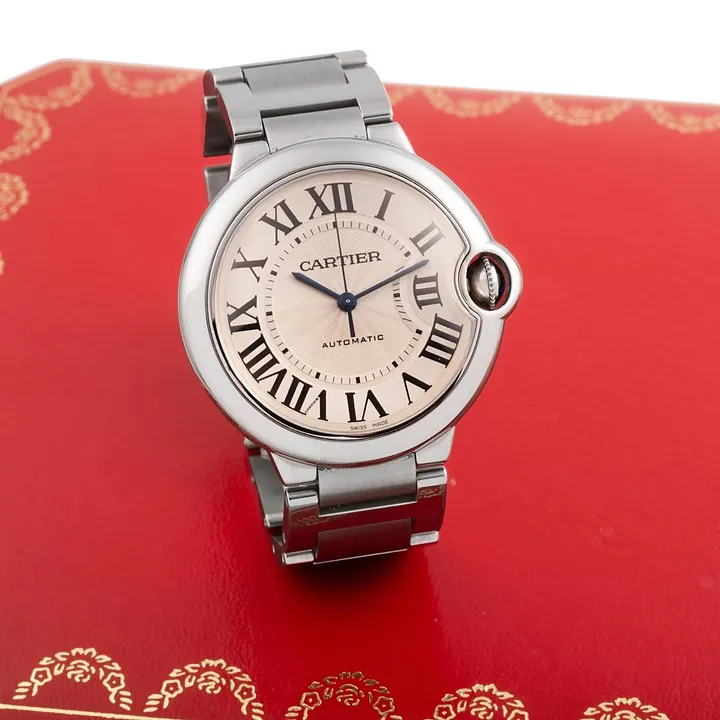
Cartier Ballon Bleu, ref. 3284, c. 2010s
Antiquorum auction archive, Geneva

Wristwatches · originally sold in December 2021 (per the lot record)
Cartier Tank Must, ref. CRWSTA0054, originally sold in December 2021
Antiquorum auction archive, Geneva
Wristwatches · originally sold in 2023 (per the lot record)
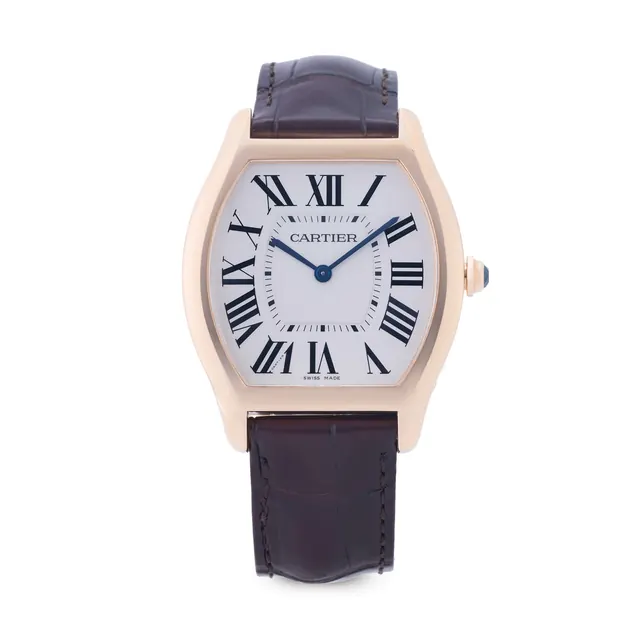
Cartier wristwatch, ref. WGTO0002, Tortue, originally sold in 2023
Antiquorum auction archive, Geneva
Wristwatches · c. 2020
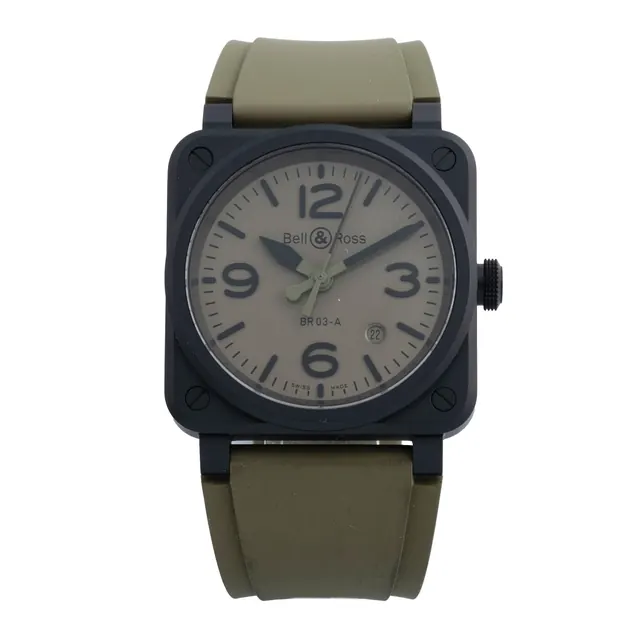
Bell & Ross wristwatch, ref. BR, Aviation Type, circa 2020
Antiquorum auction archive, Geneva