
Wristwatches · Wristwatch
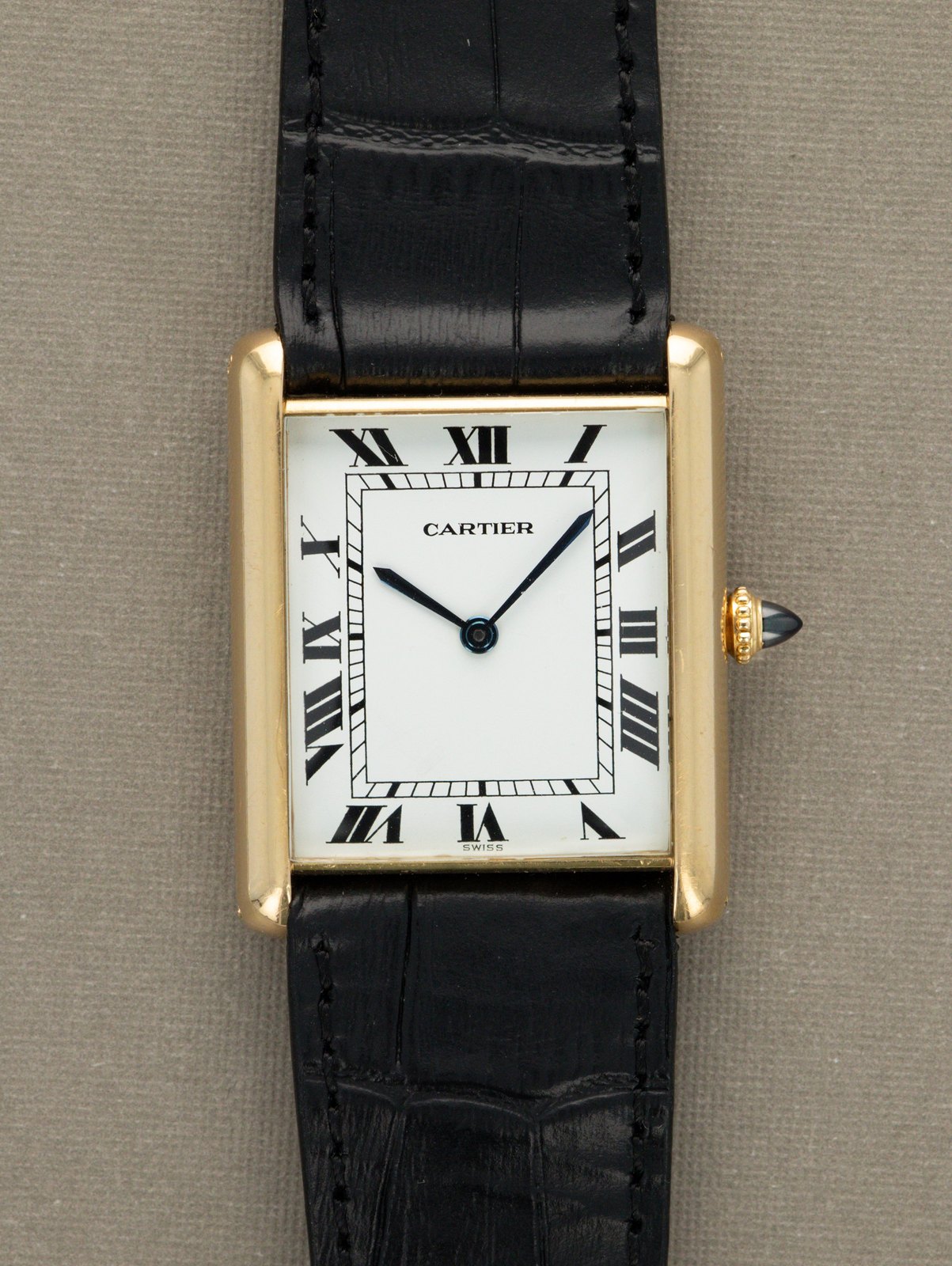
Cartier Tank Automatique 'Jumbo' XL, 'Swiss' Dial
- Maker / attribution
- Cartier (maker)
- Date
- c. 1970s
- Historical period
- Quartz Revolution (1969 – 1990)
- Country of origin
- Switzerland
- Object type
- Wristwatch
- Dimensions
- Case 23 mm
- Stock no.
- OC2581
- Credit line
- Dealer listing, Oliver & Clarke (OC2581)
- Catalogue title (original)
- Cartier Tank Automatique 'Jumbo' XL - 'Swiss' Dial Unpolished (English)
View the source record (dealer listing) ↗ (opens another website in a new tab)Suggest a correction
Record summary
Catalogued by Oliver & Clarke (dealer), United Kingdom (stock number OC2581), this is a wristwatch by Cartier, made in Switzerland, dated c. 1970s. The Atlas places it in the Quartz Revolution period (1969 – 1990) of its Wristwatches collection. Recorded dimensions: Case 23 mm. The record is illustrated with 6 photographs.
Assembled from the source record's structured fields. Dates and attributions are given as the source states them; where a field is missing the Atlas leaves it blank rather than estimating.
Catalogue description
Dealer description — Oliver & Clarke
The Cartier Tank was one of the first wristwatches. Full stop! Inspired by the Renault Tanks used on the battlefield in WWI — yes, true story. Revolutionary at the time, Louis Cartier took inspiration from the profile of the treads on a period Renault tank, and based the case on them by way of the of brancards doubling as the lugs themselves. Over the course of the 20 th Century, the Tank became the watch to wear. Silent movie stars like Rudolph Valentino, artists like Andy Warhol, and even Jackie Kennedy were all fans of the signature timepiece from the King of Jewelers and the Jeweler of Kings. An icon indeed in the truest sense of the word. The model was first introduced in a few different case shapes which bore different names that intertwine with the inspiration behind them. Perhaps the most significant, well-known, and debatably desirable of these first pieces, the Tank Louis Cartier, was introduced in 1922 and was named after Louis Cartier himself. When people think of a Cartier Tank, theres a good change that this is the model that comes to mind. The Tank that we have here is a variation of that original model — though with a few differences.... The piece we have here, is known as a 'Jumbo XL' for its increased dimensions over the usual 23mm x 31mm Tank Louis, and even the slightly smaller 'Jumbo.' It comes in at approximately 28mm x 35mm, but when viewed from the side, it's thickness, or lack thereof, is immediately apparent. These cases feature a small 'bubbleback' case design to accommodate the automatic-winding movement within. This example dates to circa the 1970s and comes to us in strong overall condition. The case remains thick and retains symmetrical proportions with crisp hallmarks and engravings throughout. Inside, the white enamel 'Swiss' signed dial inside is very well preserved, seemingly devoid of any fracturing and major wear, and the black text remains crisp and clear. It has an always beautiful blued-steel 'sword' handset — which is complimented that ubiquitous blue sapphire cabochon crown. Do you want a Tank but prefer to not manually-wind your watch? Here you go!
Historical context
Quartz Revolution (1969 – 1990)
Seiko's Astron begins mass quartz timekeeping; traditional industries contract sharply.
Quartz and digital watches transformed the market after 1969. Swiss employment collapsed, Japanese and Hong Kong production soared, and the Swatch (1983) helped the Swiss industry recover; mechanical watches survived as luxury goods.
Read the period in the timelineMore wristwatches from this periodEarlier: Modern Mechanical Horology
Atlas type guide
Automatic (self-winding) watches
Self-winding watches use the wearer's motion to wind the mainspring. Abraham-Louis Perrelet and Breguet made 'perpétuelle' pocket watches with oscillating weights in the late eighteenth century, but the principle only became practical in the wristwatch. John Harwood patented a bumper automatic in 1923; Rolex's Perpetual rotor (1931) winding in one direction, and later bidirectional rotors (Eterna, Felsa Bidynator), established the modern form. Micro-rotors (Universal Genève, Buren) and peripheral rotors made automatic watches thinner.
What to look for
- A semicircular rotor turning 360° over the movement, or a 'bumper' weight that rebounds between springs.
- 'Automatic', 'Perpetual' or 'Self-winding' on the dial.
- A sealed screw-back case, since automatic watches are wound less often by the crown.
Dating clues
- Bumper automatics: 1923–c. 1955.
- Full rotors: from 1931 (Rolex); widespread after c. 1950.
- Micro-rotors: from 1954–1958.
General guidance written by the Atlas editors about this kind of object. It is not a statement about this particular piece; for that, rely on the source record above and on physical examination.
Related records

Clocks · 1863
Clock by Albert-Ernest Carrier-Belleuse, France, 1863
The Metropolitan Museum of Art, New York

Clocks · c. 1980s
Cartier "art Deco", c. 1980s
Antiquorum auction archive, Geneva

Clocks · c. 2000s
Cartier Desk Clock with Alarm, c. 2000s
Antiquorum auction archive, Geneva

Clocks · c. 2000s
Cartier Lacquer Arched Desk Clock with Alarm, ref. W0100037, c. 2000s
Antiquorum auction archive, Geneva

Wristwatches · 1970
Wristwatch by Heno, Switzerland, 1970
Museum Rotterdam

Wristwatches · 1960–1986
'Tri-Compax' calendar chronograph wristwatch in gold case, by Universal, Geneva, Switzerland, 1960–1986.
Science Museum Group, London

Wristwatches · 1969–1970
Beta 21 Quartz wristwatch movement, made in Switzerland, 1970.
Science Museum Group, London

Wristwatches · c. 1969
Omega Speedmaster Moonwatch, ref. 145022-69st, c. 1969
Antiquorum auction archive, Geneva