
Wristwatches · Wristwatch
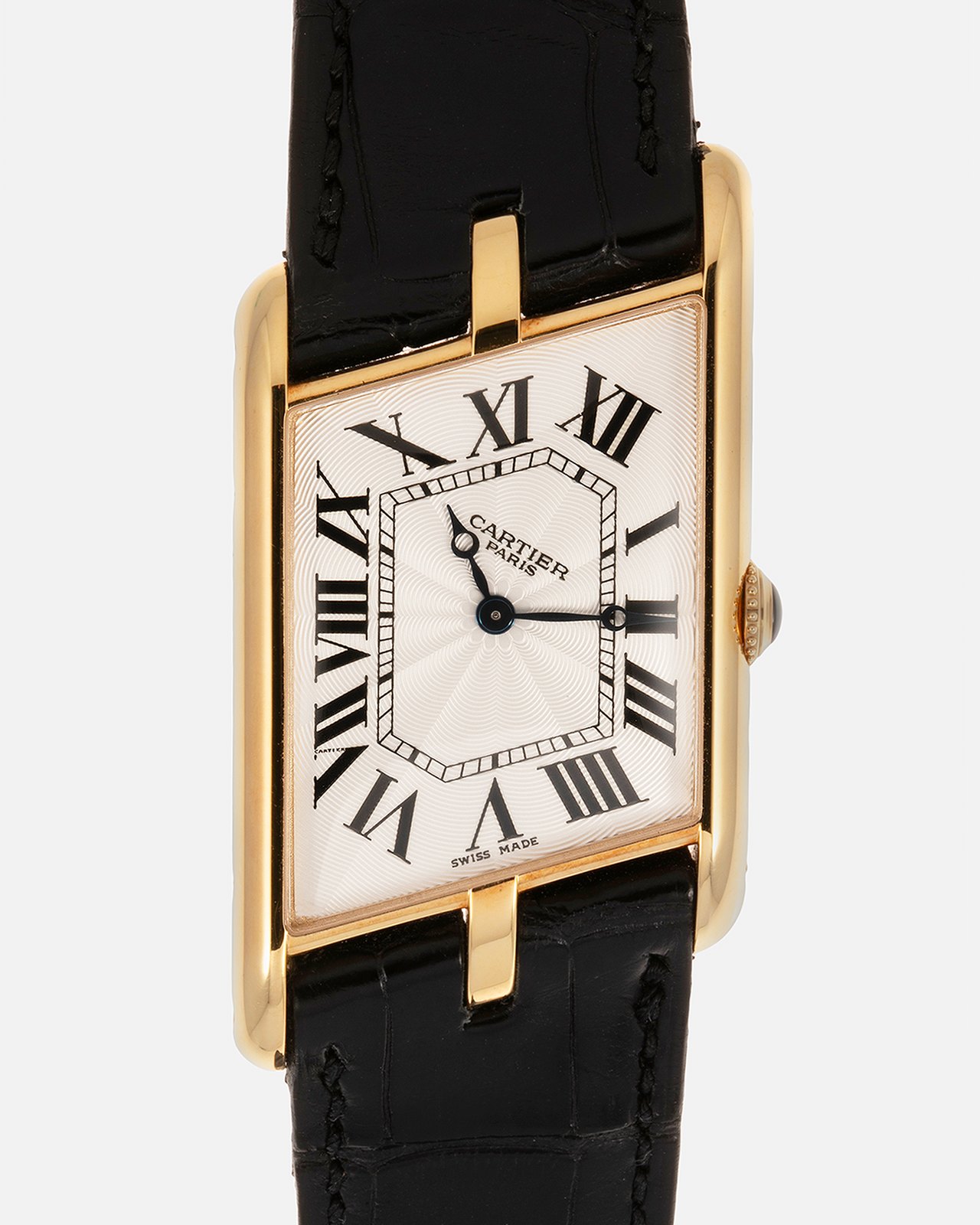
Cartier Tank Asymmetric/Asymetrique Collection Prive CPCP 2842, 2006
- Maker / attribution
- Cartier (maker)
- Date
- 2006
- Historical period
- Mechanical Renaissance (1990 – 2010)
- Country of origin
- France
- Object type
- Wristwatch
- Dimensions
- Case 26.5 mm
- Stock no.
- Product 6894284472407
- Credit line
- Dealer listing, S.Song Watches (product 6894284472407)
- Catalogue title (original)
- Cartier Tank Asymmetric/Asymetrique Collection Prive CPCP 2842 (English)
View the source record (dealer listing) ↗ (opens another website in a new tab)Suggest a correction
Record summary
Catalogued by S.Song Watches (dealer), Seattle (stock number Product 6894284472407), this is a wristwatch by Cartier, made in France, dated 2006. The Atlas places it in the Mechanical Renaissance period (1990 – 2010) of its Wristwatches collection. Recorded dimensions: Case 26.5 mm. The record is illustrated with 6 photographs.
Assembled from the source record's structured fields. Dates and attributions are given as the source states them; where a field is missing the Atlas leaves it blank rather than estimating.
Catalogue description
Dealer description — S.Song Watches
Amongst the most famous watches lies a handful of timepieces that have stood the test of time for over an entire century. Released in 1917 and inspired by the tanks Louis Cartier saw on the western front in WWI, the Cartier Tank is a classic timepiece that has become one of the famed French jewellery Maison's most important collections. Over its long and storied past, it has taken on many different shapes, styles, sizes, colours, and so much more. In keeping with Cartier's devotion to the creative, the Tank Asymétrique was first released in 1936 as a quirky yet fundamentally classically styled watch. To understand the design origins of the Tank Asymétrique, we need to go back to the 1930s — an interesting period for Cartier due to the Art Deco movement, which saw the iconic Tank design undergo a multitude of variations. Among these was the Tank Asymétrique, which was known as the “Parallélogramme” or “Losange” at the time as it fundamentally deviates from its conventional rectangular case shape. It was deemed as a radical yet innovative design that was unlike anything the traditional watch market had seen at the time. The Tank Asymétrique we have here today is no ordinary one, this is the 150-piece limited edition Ref. 2842 released under the CPCP (Collection Privée Cartier Paris) collection based on the original Parallélogramme from 1936. For context, the ’90s was an unconventional and murky time for watch brands, having just come out of the quartz crisis that decimated most of the industry. Brands were either experimenting like crazy or strictly conservative, wary of the fact they just survived the equivalent of a nuclear bomb. The industry was slowly coming back, with consumers beginning to take an interest in mechanical watches, and with this in mind, Cartier decided that it was time to improve its image as a true watchmaking brand. The result was the Collection Privé Cartier Paris division, referred to simply as the CPCP. The CPCP was intended to be the premier mechanical watchmaking division of Cartier and looking back on it today, it was one of the best decisions they ever made. The philosophy was simple, the CPCP took iconic models that were already loved by many, and reproduced them with high-grade movements, working with bonafide watch manufactures such as Piaget, Jaeger-LeCoultre, Frédéric Piguet, Girard-Perregaux, and more. The easiest way to differentiate a CPCP watch was by the dial, with all but one model (Tank Cintrée) featuring a ‘Cartier Paris’ inscription- an ode to its heritage. The dials were always crafted from solid gold and often featured a strong hand-turned guilloche pattern with Cartier’s signature ‘rosette’ in the middle of the dial beneath the handset. Coming back to the case design of this Cartier Tank Asymétrique CPCP Ref. 2842. Its 26.5mm x 41mm x 7.5mm 18-carat yellow gold case features a distinctive triple-lug construction, a characteristic Cartier cabochon-set winding crown and a 30-degree slanted dial and case which offsets every hour marker by one hour clockwise. As such, the vertical equator spans from 11 o'clock to 4 o'clock, and the horizontal spans from 8 o'clock to 2 o'clock - making for quite a unique time-reading experience on the wrist. Its off-white engine-turned guilloche dial houses applied black Roman numerals, a railway minute track, a set of blued steel hands and a secret Cartier signature at 7 o ‘clock. Powering it from within is the 18-jewelled, manual-winding Cal. 9770 MC with a power reserve of 38 hours. The original Tank Asymétrique was initially introduced to drivers as a way of easing the task of reading the time, the dial's offset design appears to take the conventional layout once viewed while the wearing arm is outstretched like it would be while holding a steering wheel. An eccentric niche within watchmaking, these elegant driver's watches hark back to a time when dash-mounted clocks in cars were rare, and taking one hand off the wheel to check the time may prove to be dangerous given the absence of power-steering. That being said, even after all these years when the use case for such a specific design has lost its significance and real-life applicability, the design of the Tank Asymétrique remains ever relevant. Why? Well, I think the magic of the Tank Asymétrique’s aesthetic and design lies in the way it tastefully leverages its unorthodox concept and austere geometry into a whole new identity that is beautiful, unique, and refreshing.
Historical context
Mechanical Renaissance (1990 – 2010)
Mechanical watches return as cultural objects; independent watchmaking flourishes.
Mechanical watches returned as cultural and luxury objects. Complications, tourbillons and new materials proliferated; independent watchmakers such as George Daniels, F.P. Journe and Philippe Dufour revived artisanal watchmaking; collecting vintage watches became a major field.
Read the period in the timelineMore wristwatches from this periodEarlier: Quartz Revolution
Atlas type guide
Wristwatches
Bracelet watches were worn by women from the early nineteenth century — Breguet made one for Caroline Murat, Queen of Naples, in 1810–12 — but the wristwatch only became a man's instrument with military use and aviation in the early twentieth century. Between the World Wars it overtook the pocket watch; the 1920s and 1930s brought rectangular Art Deco cases, water-resistant cases and the first automatic winding systems.
After 1945 the wristwatch became a carrier of identity — dress watches, sports and dive watches, chronographs, calendars — produced by Swiss, American, Japanese, German, Soviet and Chinese industries. The quartz revolution after 1969 and the mechanical renaissance since the 1990s, including the rise of independent watchmakers, complete the story.
What to look for
- The reference number (between the lugs or inside the case back) and serial number, the starting point for dating.
- The calibre: its maker and number are often stamped under the dial or on the bridge.
- Originality of dial, hands and crown — refinished ('redial') dials are common.
- Case material marks: 18K/750, 14K/585, stainless steel, gold-filled, plated.
Dating clues
- Wire-lug cases: before c. 1925.
- Water-resistant screw-down cases: from 1926.
- Quartz movements: from 1969; sapphire crystals widespread after c. 1980.
General guidance written by the Atlas editors about this kind of object. It is not a statement about this particular piece; for that, rely on the source record above and on physical examination.
Related records
Clocks · 1863
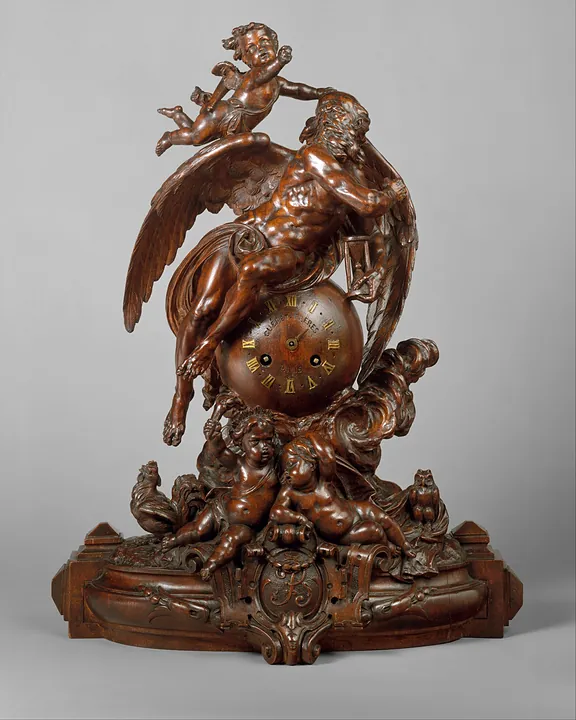
Clock by Albert-Ernest Carrier-Belleuse, France, 1863
The Metropolitan Museum of Art, New York
Clocks · c. 1980s
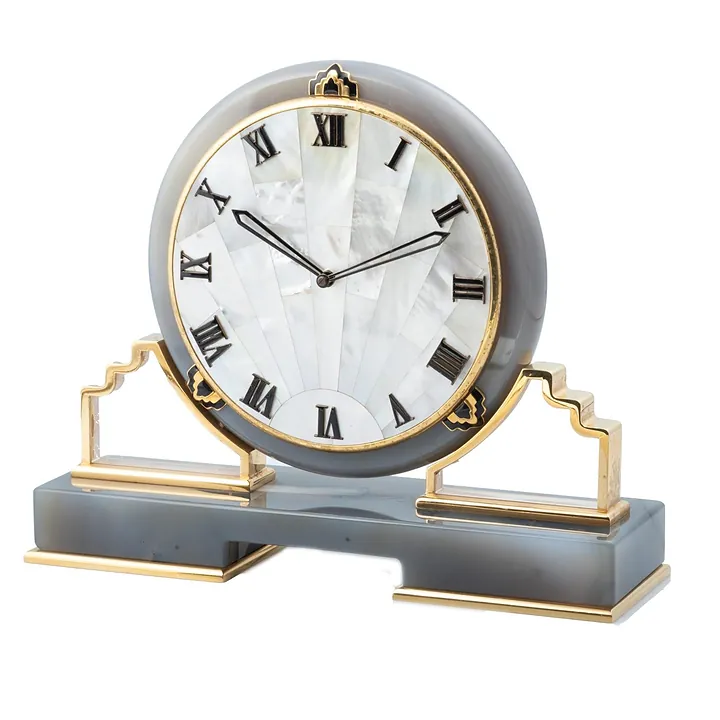
Cartier "art Deco", c. 1980s
Antiquorum auction archive, Geneva
Clocks · c. 2000s
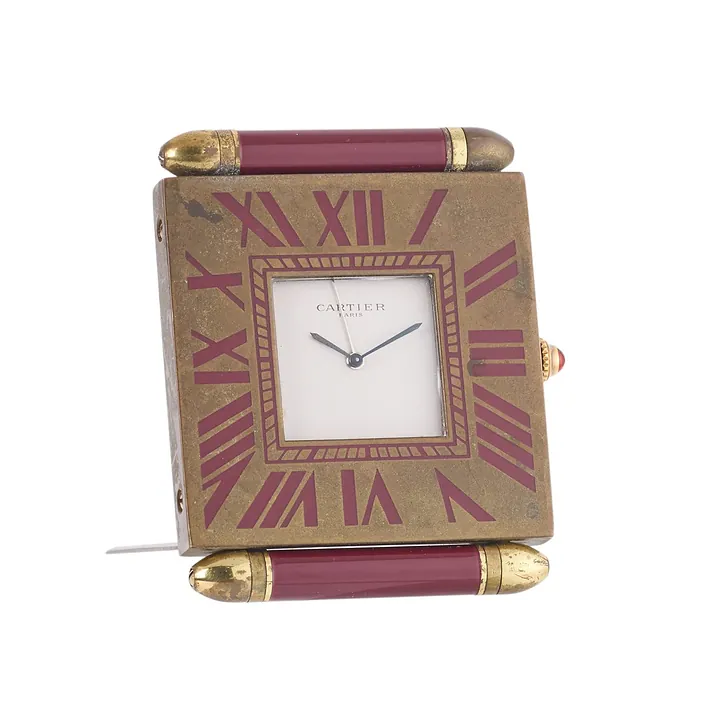
Cartier Desk Clock with Alarm, c. 2000s
Antiquorum auction archive, Geneva
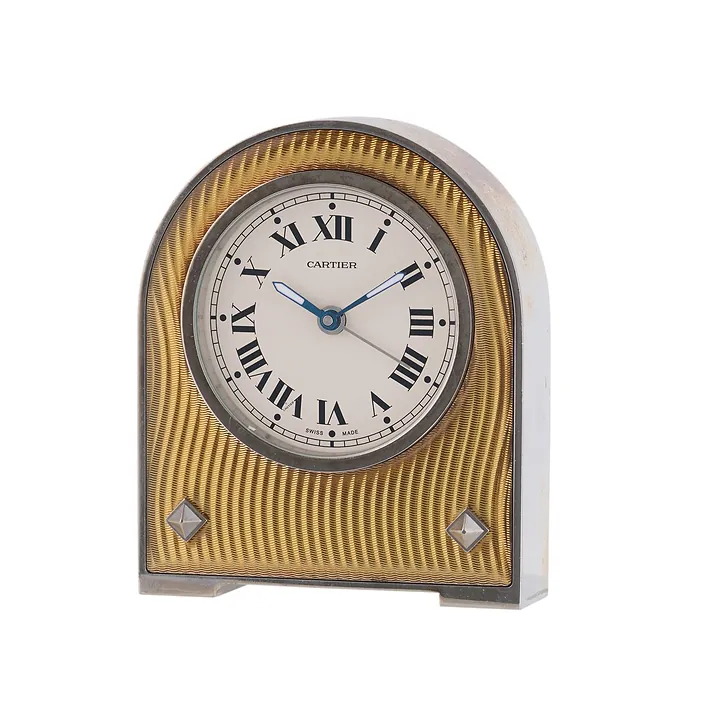
Clocks · c. 2000s
Cartier Lacquer Arched Desk Clock with Alarm, ref. W0100037, c. 2000s
Antiquorum auction archive, Geneva
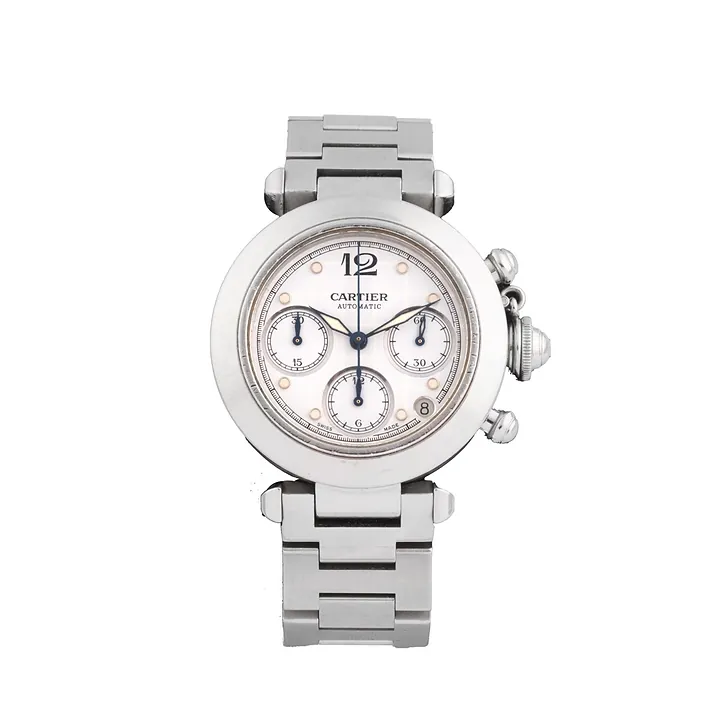
Wristwatches · c. 1990
Cartier Pasha, ref. 2412, c. 1990
Antiquorum auction archive, Geneva
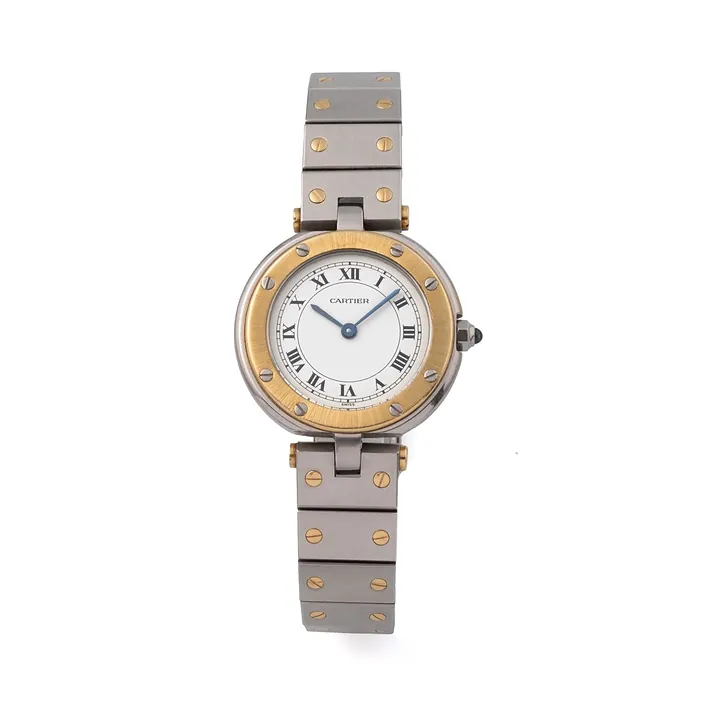
Wristwatches · c. 1990
Cartier Santos Ronde Vendome, c. 1990
Antiquorum auction archive, Geneva
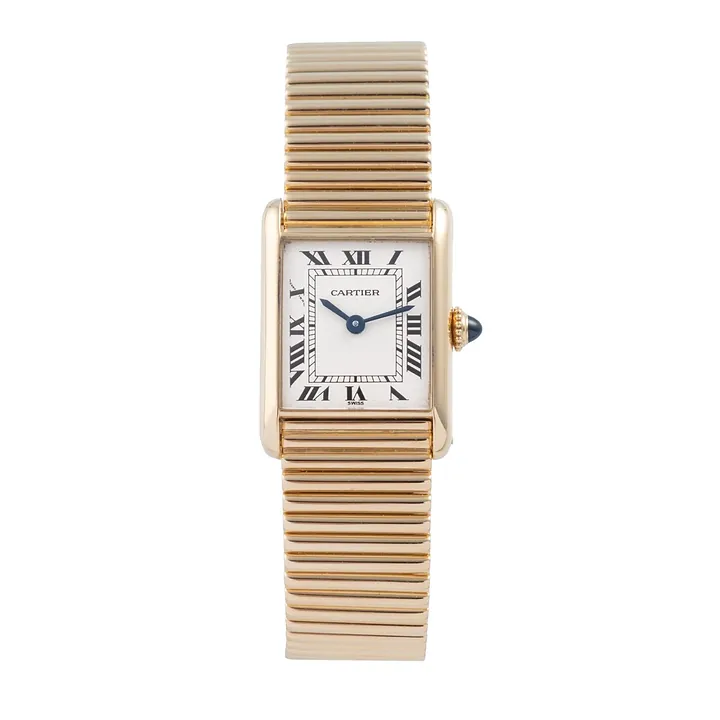
Wristwatches · c. 1990s
Cartier Tank Louis Cartier, ref. 6711, c. 1990s
Antiquorum auction archive, Geneva
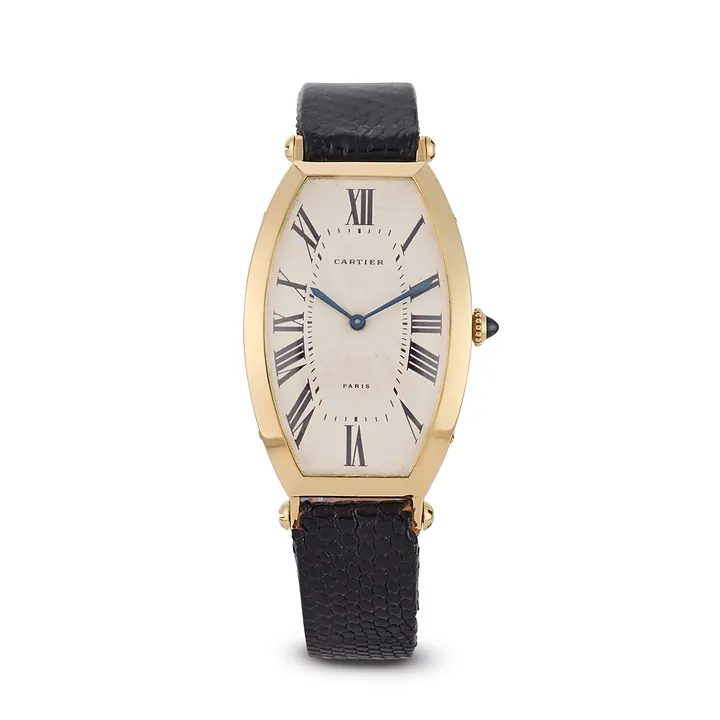
Wristwatches · c. 1991
Cartier Tonneau Paris 1991, c. 1991
Antiquorum auction archive, Geneva