
Wristwatches · Wristwatch
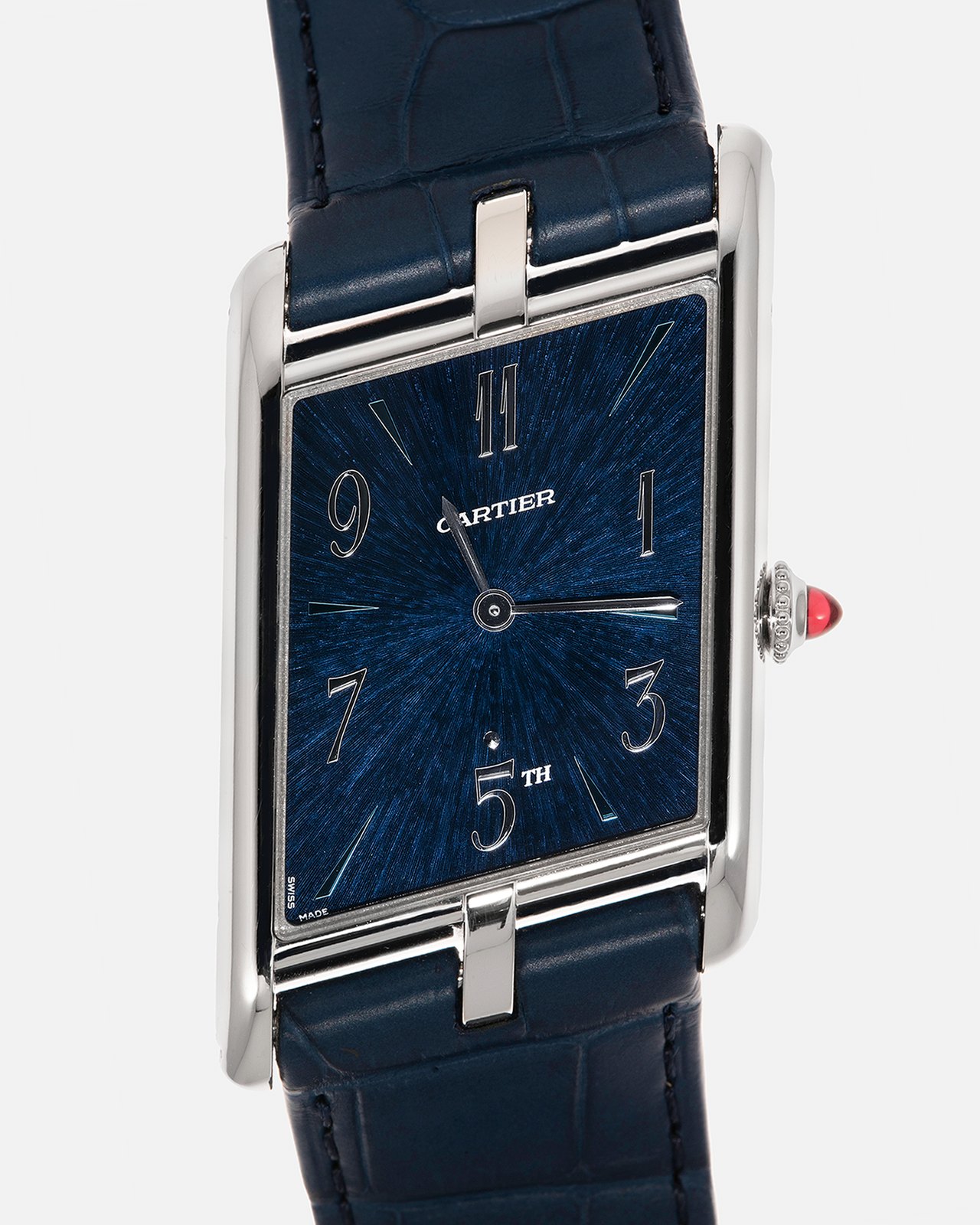
Cartier Tank Asymmetric/Asymetrique 5th Avenue New York Edition Platinum, 2024
- Maker / attribution
- Cartier (maker)
- Date
- 2024
- Historical period
- Contemporary Horology (2010 – Present)
- Country of origin
- United States
- Object type
- Wristwatch
- Materials / technique
- platinum
- Dimensions
- Case 47 mm
- Stock no.
- Product 7665821843543
- Credit line
- Dealer listing, S.Song Watches (product 7665821843543)
- Catalogue title (original)
- Cartier Tank Asymmetric/Asymetrique 5th Avenue New York Edition Platinum (English)
View the source record (dealer listing) ↗ (opens another website in a new tab)Suggest a correction
Record summary
Catalogued by S.Song Watches (dealer), Seattle (stock number Product 7665821843543), this is a wristwatch by Cartier, made in United States, dated 2024. The Atlas places it in the Contemporary Horology period (2010 – Present) of its Wristwatches collection. Materials and techniques recorded by the source: platinum. Recorded dimensions: Case 47 mm. The record is illustrated with 6 photographs.
Assembled from the source record's structured fields. Dates and attributions are given as the source states them; where a field is missing the Atlas leaves it blank rather than estimating.
Catalogue description
Dealer description — S.Song Watches
Among the most recognisable watch designs ever created, the Cartier Tank occupies a rare position. Introduced in 1917 and inspired by the silhouette of the Renault FT tanks that Louis Cartier observed on the Western Front during the First World War, the Tank became one of Cartier’s defining creations. Over the decades, the collection has evolved through numerous interpretations in size, shape, proportion, and style, yet its core identity has remained intact. Few variations, however, depart from convention as dramatically as the Tank Asymétrique. First introduced in 1936 during the height of the Art Deco period, the Tank Asymétrique represented Cartier at its most experimental. Originally known as the “Parallélogramme” or “Losange,” it abandoned the strict rectangular form of the traditional Tank in favour of a sharply angled case and a dial layout that felt genuinely radical for its time. While unmistakably elegant, it was also deliberately unconventional, challenging the visual symmetry that defined most watchmaking of the era. The example offered here closely follows the spirit of those early designs. Its defining feature is a 30-degree slanted case and dial architecture, paired with an unusual triple-lug construction that immediately distinguishes it from the rest of the Tank family. Every hour marker is rotated one position clockwise, shifting the visual axis of the dial. The vertical axis now runs from 11:00 to 4:00, while the horizontal spans from 8:00 to 2:00, resulting in a display that initially feels disorienting yet becomes surprisingly intuitive on the wrist. This particular Tank Asymétrique is distinguished further by its exclusivity. This was not a standard production model, but a special edition created for Cartier’s Fifth Avenue boutique in New York City. While Cartier never officially disclosed production numbers, examples remain exceptionally scarce, with availability reportedly reserved for a very small circle of longstanding clients and collectors. The Asymétrique's unconventional form gives it a distinctive presence on the wrist. The 47mm x 26mm platinum 950 case carries substantial weight while retaining the refined elegance expected of a Tank. The ruby cabochon crown contrasts subtly against the ice-cool tone of the platinum case, though the dial naturally draws most of the attention. Finished with a blue sunburst texture and alternating hour markers, the dial shifts noticeably under changing light, moving between deep navy and vibrant electric blue tones. A discreet "TH" signature and dot beside the 5 o’clock marker pay tribute to Cartier's Fifth Avenue boutique, with the same commemorative theme continued through the engraved caseback. Powering the watch is the ultra-thin manual-wind Cal. 1917 MC, selected in part to accommodate the limited internal space afforded by the asymmetrical case. The movement itself is relatively straightforward, featuring 19 jewels and approximately 38 hours of power reserve, though its compact architecture was essential in preserving the case's slim profile. Historically, the Tank Asymétrique was conceived as a driver's watch. Its angled dial was designed so that when the wearer extended their arm toward a steering wheel, the display would align naturally within the driver's line of sight. Today, that original purpose feels largely obsolete, particularly in an era where automotive instrumentation is ubiquitous. Yet the appeal of the Tank Asymétrique has never rested solely on practicality. What continues to make the watch compelling is the confidence of its execution. Cartier took an idea that could easily have become novelty-driven and transformed it into something remarkably coherent. The asymmetrical display, severe lines, and distorted proportions resolve into something unexpectedly elegant rather than theatrical. Even decades later, it remains one of the few watches that genuinely feels unlike anything else on the market. Among modern executions of the Tank Asymétrique, this New York edition stands out as one of the strongest. The combination of the hefty platinum case, vivid blue dial, unusual dial layout, and boutique-exclusive status gives the watch enormous character without relying on excess. It is eccentric without becoming loud, and distinctive without sacrificing refinement. More than anything, it reflects Cartier’s longstanding ability to challenge convention without compromising elegance.
Historical context
Contemporary Horology (2010 – Present)
Silicon components, connected watches, optical-lattice research clocks and a thriving independent scene.
Smartwatches became the world's best-selling watches, while mechanical watchmaking focuses on craft, innovation (silicon components, new escapements) and independent makers.
Read the period in the timelineMore wristwatches from this periodEarlier: Mechanical Renaissance
Atlas type guide
Wristwatches
Bracelet watches were worn by women from the early nineteenth century — Breguet made one for Caroline Murat, Queen of Naples, in 1810–12 — but the wristwatch only became a man's instrument with military use and aviation in the early twentieth century. Between the World Wars it overtook the pocket watch; the 1920s and 1930s brought rectangular Art Deco cases, water-resistant cases and the first automatic winding systems.
After 1945 the wristwatch became a carrier of identity — dress watches, sports and dive watches, chronographs, calendars — produced by Swiss, American, Japanese, German, Soviet and Chinese industries. The quartz revolution after 1969 and the mechanical renaissance since the 1990s, including the rise of independent watchmakers, complete the story.
What to look for
- The reference number (between the lugs or inside the case back) and serial number, the starting point for dating.
- The calibre: its maker and number are often stamped under the dial or on the bridge.
- Originality of dial, hands and crown — refinished ('redial') dials are common.
- Case material marks: 18K/750, 14K/585, stainless steel, gold-filled, plated.
Dating clues
- Wire-lug cases: before c. 1925.
- Water-resistant screw-down cases: from 1926.
- Quartz movements: from 1969; sapphire crystals widespread after c. 1980.
General guidance written by the Atlas editors about this kind of object. It is not a statement about this particular piece; for that, rely on the source record above and on physical examination.
Related records
Clocks · 1863
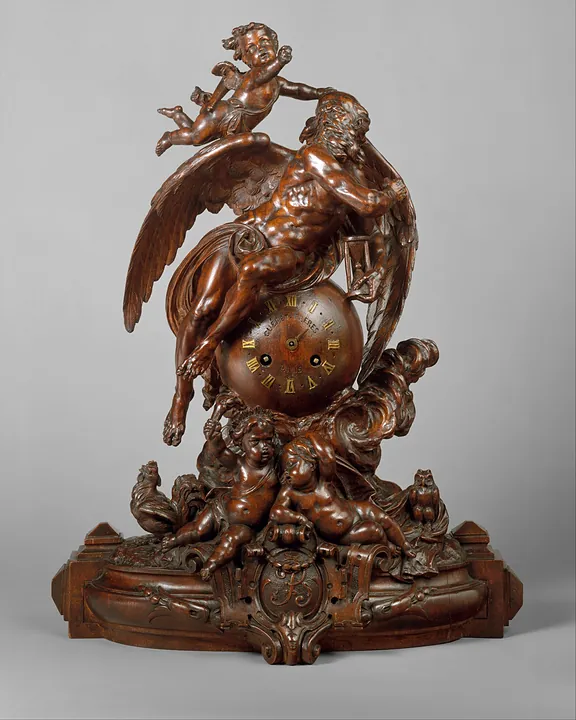
Clock by Albert-Ernest Carrier-Belleuse, France, 1863
The Metropolitan Museum of Art, New York
Clocks · c. 1980s
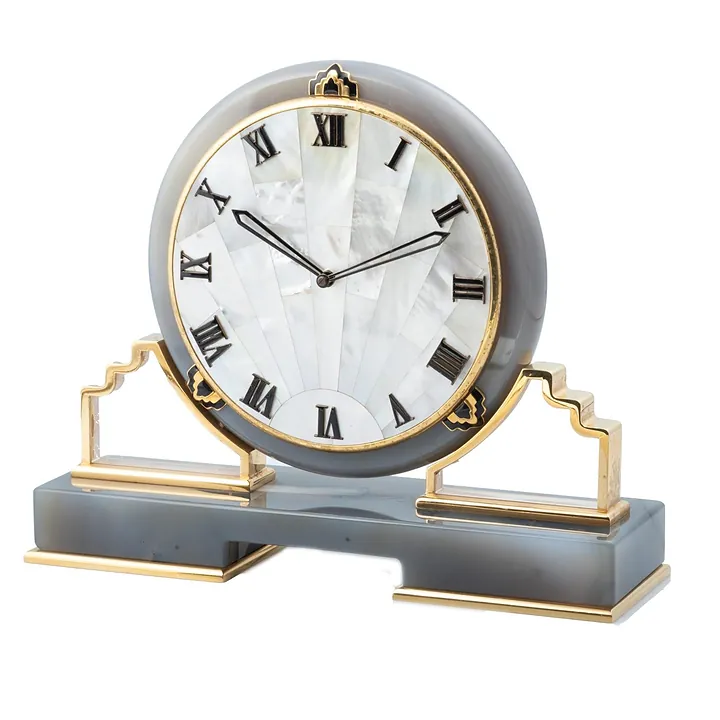
Cartier "art Deco", c. 1980s
Antiquorum auction archive, Geneva
Clocks · c. 2000s
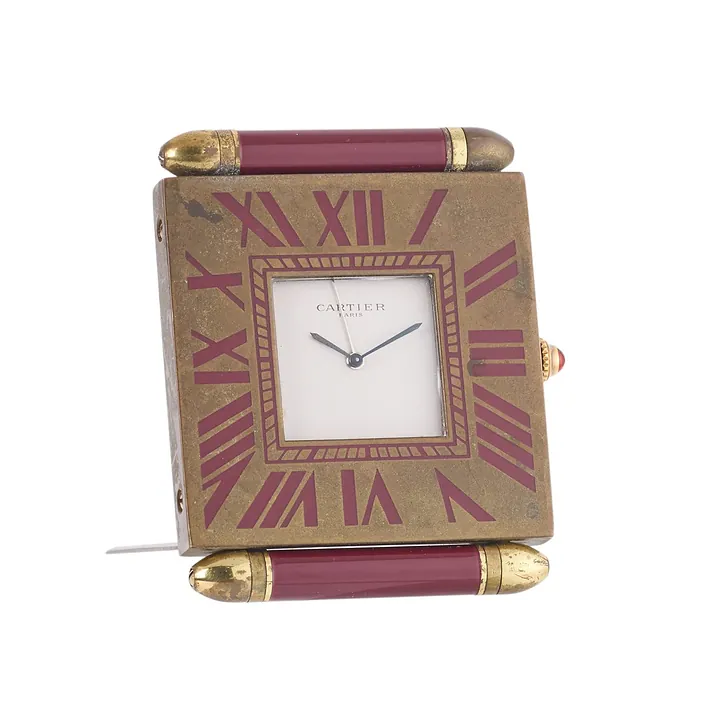
Cartier Desk Clock with Alarm, c. 2000s
Antiquorum auction archive, Geneva
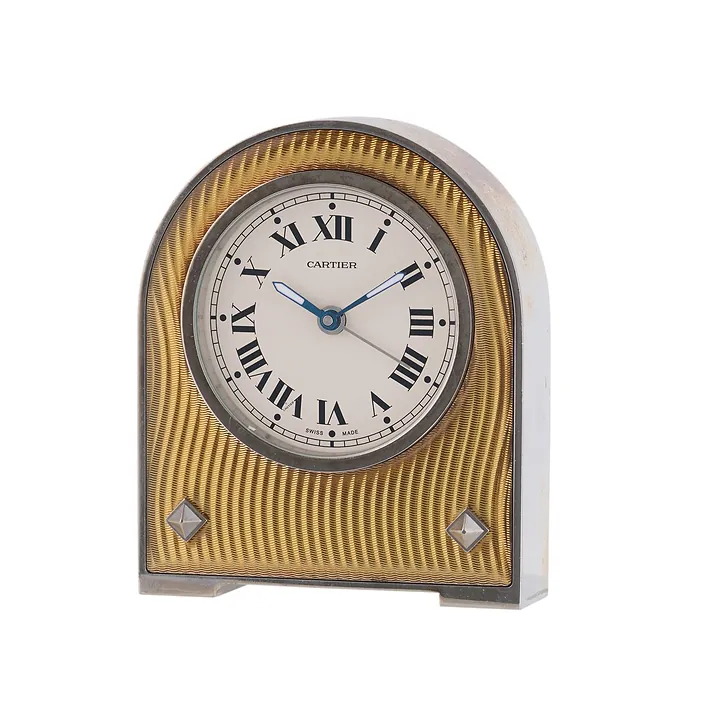
Clocks · c. 2000s
Cartier Lacquer Arched Desk Clock with Alarm, ref. W0100037, c. 2000s
Antiquorum auction archive, Geneva
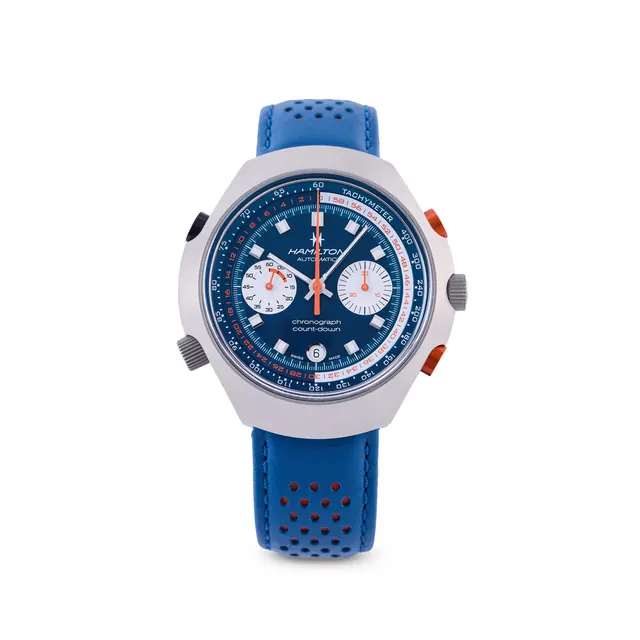
Wristwatches · originally sold in February 2025 (per the lot record)
Hamilton wristwatch, ref. H51606640, American Classic Chrono-Matic 50 Limited Edition, originally sold in February 2025 (per the lot record)
Antiquorum auction archive, Geneva
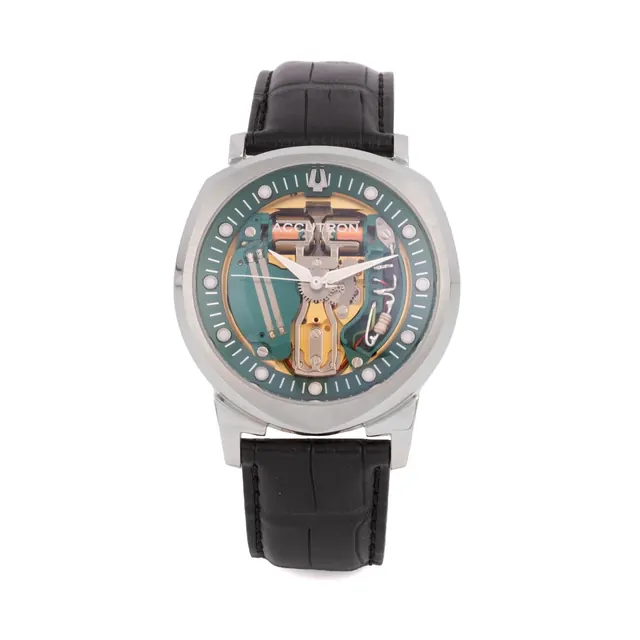
Wristwatches · 2010s
Bulova wristwatch, ACCUTRON 50th Anniversary Limited Edition, 2010s
Antiquorum auction archive, Geneva
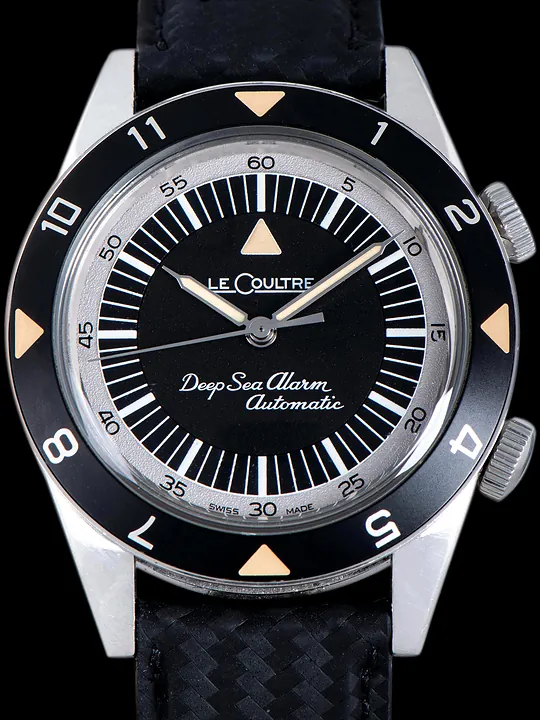
Wristwatches · 2014
Jaeger-LeCoultre Memovox 'Tribute to Deep Sea' (Ref. Q2028440) "USA Edition", 2014
Craft & Tailored (dealer), Los Angeles

Wristwatches · 2010
Wristwatch, 2010
Modemuseum Hasselt