
Wristwatches · Wristwatch
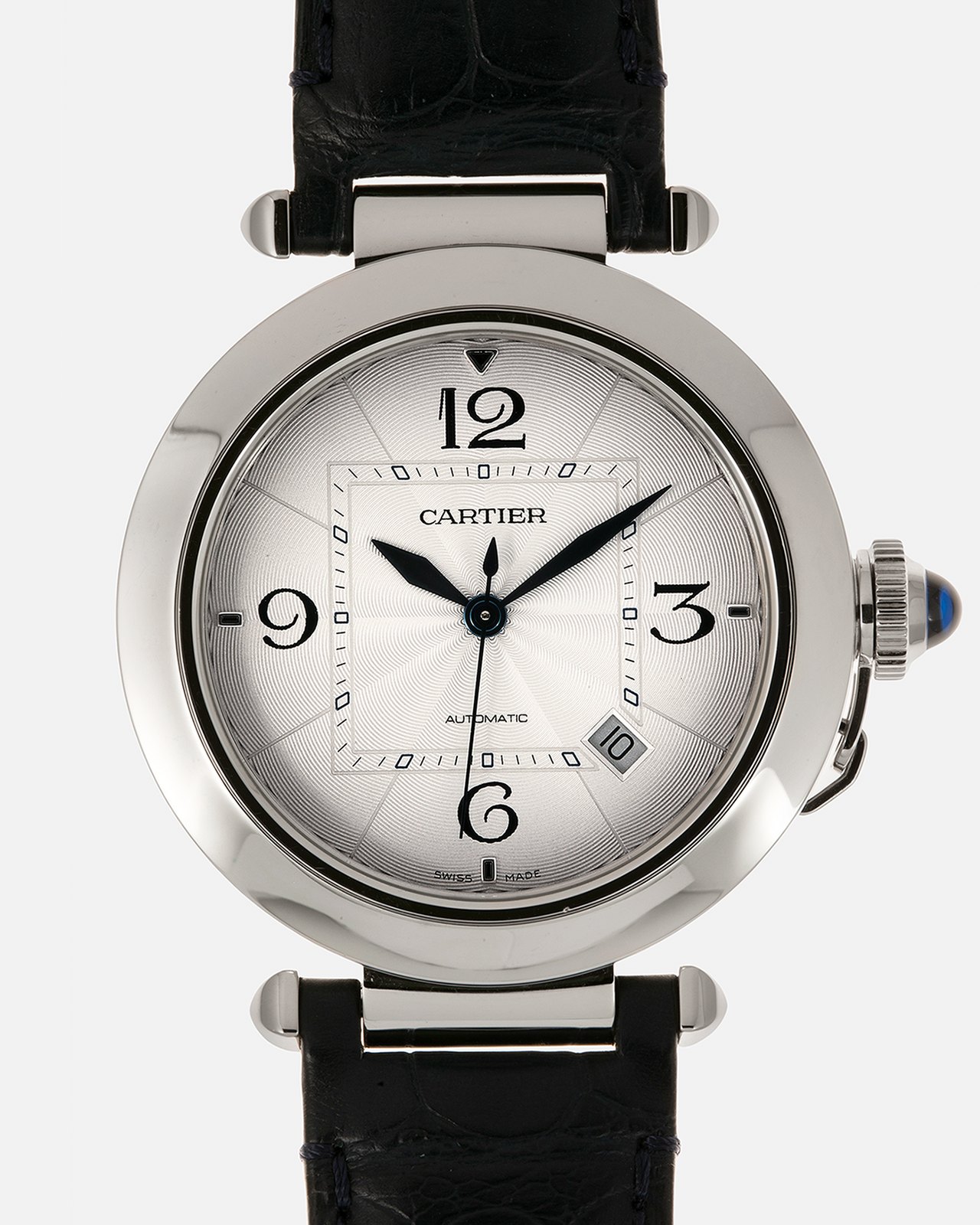
Cartier Pasha 4266 Steel, 2021
- Maker / attribution
- Cartier (maker)
- Date
- 2021
- Historical period
- Contemporary Horology (2010 – Present)
- Country of origin
- France
- Object type
- Wristwatch
- Materials / technique
- steel
- Dimensions
- Case 41 mm
- Stock no.
- Product 7450296877143
- Credit line
- Dealer listing, S.Song Watches (product 7450296877143)
- Catalogue title (original)
- Cartier Pasha 4266 Steel (English)
View the source record (dealer listing) ↗ (opens another website in a new tab)Suggest a correction
Record summary
Catalogued by S.Song Watches (dealer), Seattle (stock number Product 7450296877143), this is a wristwatch by Cartier, made in France, dated 2021. The Atlas places it in the Contemporary Horology period (2010 – Present) of its Wristwatches collection. Materials and techniques recorded by the source: steel. Recorded dimensions: Case 41 mm. The record is illustrated with 6 photographs.
Assembled from the source record's structured fields. Dates and attributions are given as the source states them; where a field is missing the Atlas leaves it blank rather than estimating.
Catalogue description
Dealer description — S.Song Watches
Bold, unconventional and steeped in lore, the Cartier Pasha is a watch born from legend and reimagined for modern wrists. Its origins traces all the way back to 1932 when Thami El Glaoui, the Pasha of Marrakesh, reportedly commissioned Louis Cartier to create a waterproof timepiece befitting his active lifestyle, which included swimming. It was a rare and one-of-a-kind request at the time, blending elegance with real world functionality. Although no official archival record can confirm that such a specific watch was delivered at the time, the story endures in Cartier lore as the spiritual origin of the Pasha, a watch imagined to embody elegance, durability, and utility in a single package. Some scholarly sources have suggested that rather than the round-cased Pasha we know of today, the watch in question may have been a one-off rectangular Tank Étanche, featuring an innovative waterproofing system made possible by a newly developed screw-down crown cover. This forward-thinking detail positioned it as a precursor to the modern sports watch archetype. Inspired by this, the contemporary Pasha was introduced in 1985, brought to life by Gérald Genta, the prolific designer behind iconic watches such as the Audemars Piguet Royal Oak, Patek Philippe Nautilus, Universal Genève Polerouter, among many others. With its large, round case, the Pasha represented a striking departure from a Maison long celebrated for its ornate yet unconventional rectangular and square forms. A prominent screw-down crown cap, secured by a small chain, evokes the aesthetic of a vintage canteen bottle, which adds to its utilitarian charm. Most examples feature highly legible Arabic numerals at 12, 3, 6, and 9, with some models distinguished by a removable grid overlay known as the grille. In every respect, the Pasha stood in bold contrast to the classically proportioned Tank and Santos. Its confident proportions and unconventional details signaled a bold new direction for the esteemed Maison, one that embraced presence and practicality without sacrificing the elegance and purity of form that define Cartier. Offered here today is a modern Pasha from the Maison’s refreshed lineup unveiled at Watches and Wonders 2020. The collection spanned a variety of case sizes and precious metal configurations, alongside standout pieces such as a bold skeletonised model and an exceptional skeleton tourbillon. While this particular example we have here may appear to be the simplest and, perhaps, most straightforward of the collection, I feel that that very simplicity is its greatest strength. In many ways, it represents the purest expression of the Pasha’s design ethos. Much like the iconic Tank, it requires no further embellishment—the core design fundamentals are so strong, so self-assured, that they speak entirely for themselves even in its most simple form. It is a watch that seemingly knows exactly what it is and feels no need to shout. Just look at it: a round, stainless steel case measuring contemporary proportions of 41mm x 9.55mm, with a beautifully brushed mid-case band contrasting elegantly against the mirror-polished bezel. Classic Arabic numerals at 12, 3, 6, and 9 lend a sober, balanced feel, complemented by a pair of thermally blued hands at the centre that complete the composition with quiet flair. It is also worth mentioning that this iteration of the Pasha also integrates a touch of modern practicality within its signature Vendôme-style lugs. Like the latest Santos models, it features Cartier’s QuickSwitch mechanism, which allows its wearer to effortlessly change straps by pressing a discreet tab between the lugs. It’s an intuitive and thoughtful innovation that bridges timeless design with contemporary convenience. Powered by Cartier’s self-winding Cal. 1847 MC, this solid and reliable workhorse movement is known for its enhanced resistance to magnetism. This technical resilience is achieved through the use of nickel-phosphorus alloys in the construction of the escapement, making it significantly less susceptible to external magnetic fields. As far as power reserve goes, the Cal. 1847 MC can hold a charge of up to 42 hours on a full wind, ensuring dependable performance throughout the duration of daily wear. A product of royal utility and 1980s bravado, the Pasha de Cartier remains a design-forward icon that effortlessly balances heritage with quiet sophistication. It stands as one of the most distinctive and daring designs in Cartier’s portfolio, an outlier that, paradoxically, feels entirely and unmistakably Cartier. Clean, confident, and refined, this particular example of the Pasha proves that sometimes, less truly is more.
Historical context
Contemporary Horology (2010 – Present)
Silicon components, connected watches, optical-lattice research clocks and a thriving independent scene.
Smartwatches became the world's best-selling watches, while mechanical watchmaking focuses on craft, innovation (silicon components, new escapements) and independent makers.
Read the period in the timelineMore wristwatches from this periodEarlier: Mechanical Renaissance
Atlas type guide
Wristwatches
Bracelet watches were worn by women from the early nineteenth century — Breguet made one for Caroline Murat, Queen of Naples, in 1810–12 — but the wristwatch only became a man's instrument with military use and aviation in the early twentieth century. Between the World Wars it overtook the pocket watch; the 1920s and 1930s brought rectangular Art Deco cases, water-resistant cases and the first automatic winding systems.
After 1945 the wristwatch became a carrier of identity — dress watches, sports and dive watches, chronographs, calendars — produced by Swiss, American, Japanese, German, Soviet and Chinese industries. The quartz revolution after 1969 and the mechanical renaissance since the 1990s, including the rise of independent watchmakers, complete the story.
What to look for
- The reference number (between the lugs or inside the case back) and serial number, the starting point for dating.
- The calibre: its maker and number are often stamped under the dial or on the bridge.
- Originality of dial, hands and crown — refinished ('redial') dials are common.
- Case material marks: 18K/750, 14K/585, stainless steel, gold-filled, plated.
Dating clues
- Wire-lug cases: before c. 1925.
- Water-resistant screw-down cases: from 1926.
- Quartz movements: from 1969; sapphire crystals widespread after c. 1980.
General guidance written by the Atlas editors about this kind of object. It is not a statement about this particular piece; for that, rely on the source record above and on physical examination.
Related records

Clocks · 1863
Clock by Albert-Ernest Carrier-Belleuse, France, 1863
The Metropolitan Museum of Art, New York

Clocks · c. 1980s
Cartier "art Deco", c. 1980s
Antiquorum auction archive, Geneva

Clocks · c. 2000s
Cartier Desk Clock with Alarm, c. 2000s
Antiquorum auction archive, Geneva

Clocks · c. 2000s
Cartier Lacquer Arched Desk Clock with Alarm, ref. W0100037, c. 2000s
Antiquorum auction archive, Geneva
Wristwatches · c. 2010s
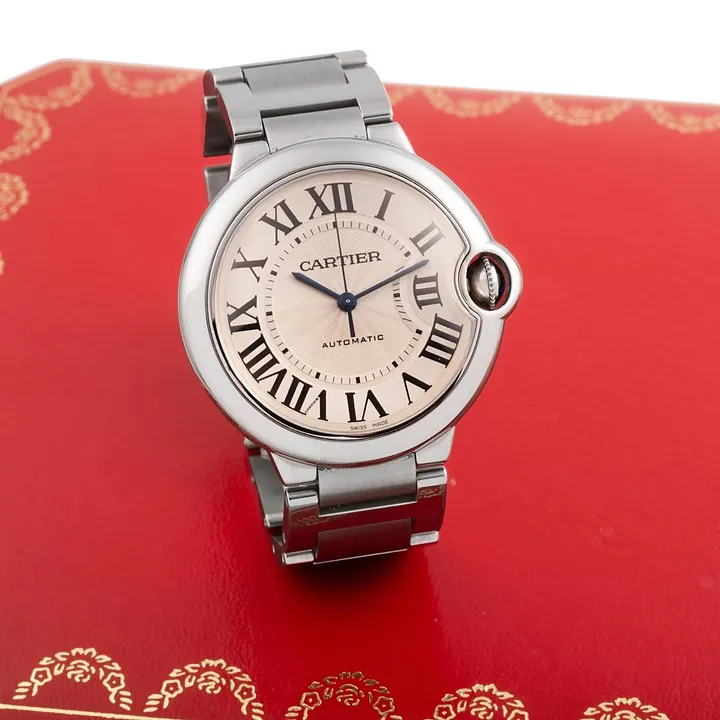
Cartier Ballon Bleu, ref. 3284, c. 2010s
Antiquorum auction archive, Geneva
Wristwatches · originally sold in December 2021 (per the lot record)
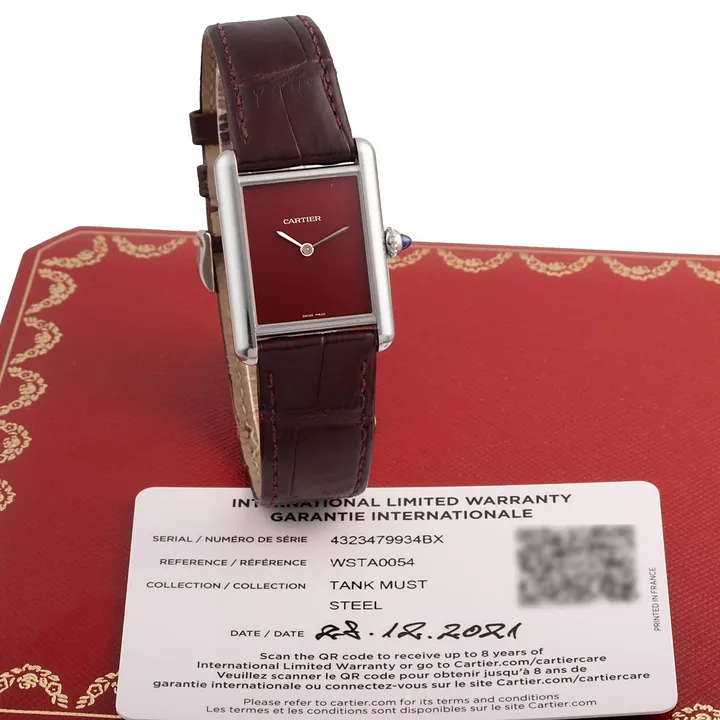
Cartier Tank Must, ref. CRWSTA0054, originally sold in December 2021
Antiquorum auction archive, Geneva
Wristwatches · originally sold in 2023 (per the lot record)
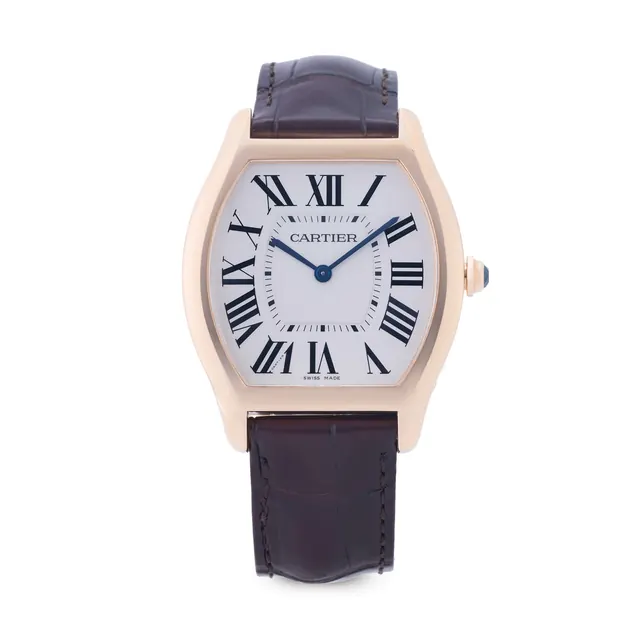
Cartier wristwatch, ref. WGTO0002, Tortue, originally sold in 2023
Antiquorum auction archive, Geneva
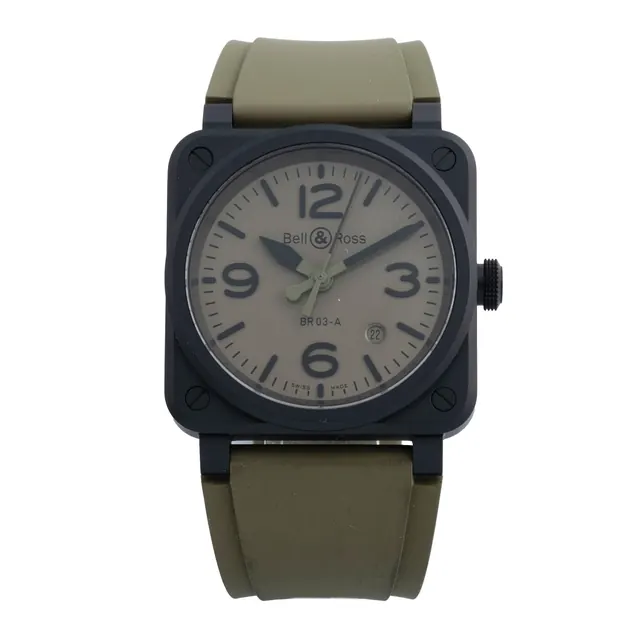
Wristwatches · c. 2020
Bell & Ross wristwatch, ref. BR, Aviation Type, circa 2020
Antiquorum auction archive, Geneva