
Wristwatches · Wristwatch
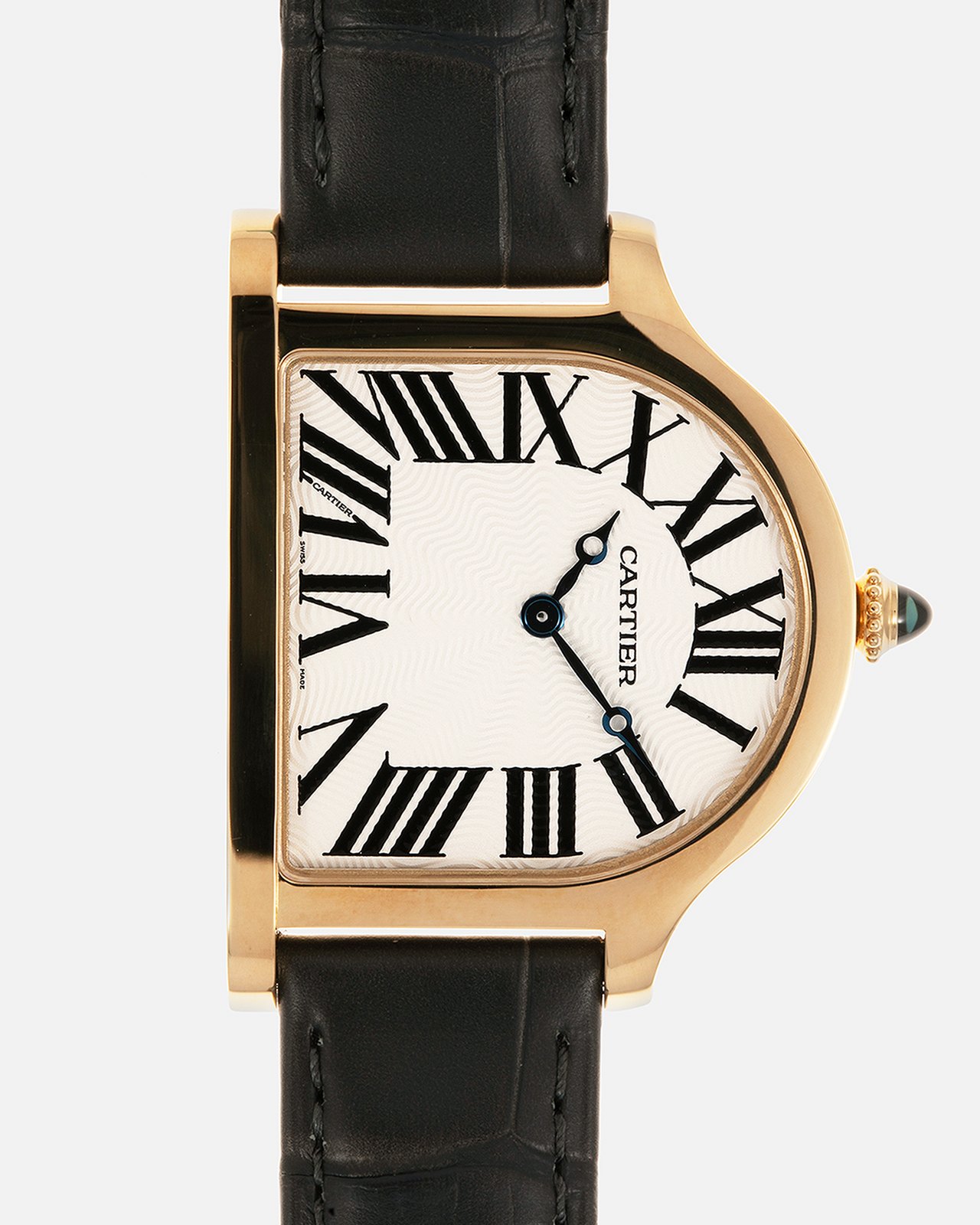
Cartier Cloche NSO Custom Order, 2024
- Maker / attribution
- Cartier (maker)
- Date
- 2024
- Historical period
- Contemporary Horology (2010 – Present)
- Country of origin
- France
- Object type
- Wristwatch
- Dimensions
- Case 15 mm
- Stock no.
- Product 7387520434263
- Credit line
- Dealer listing, S.Song Watches (product 7387520434263)
- Catalogue title (original)
- Cartier Cloche NSO Custom Order (English)
View the source record (dealer listing) ↗ (opens another website in a new tab)Suggest a correction
Record summary
Catalogued by S.Song Watches (dealer), Seattle (stock number Product 7387520434263), this is a wristwatch by Cartier, made in France, dated 2024. The Atlas places it in the Contemporary Horology period (2010 – Present) of its Wristwatches collection. Recorded dimensions: Case 15 mm. The record is illustrated with 6 photographs.
Assembled from the source record's structured fields. Dates and attributions are given as the source states them; where a field is missing the Atlas leaves it blank rather than estimating.
Catalogue description
Dealer description — S.Song Watches
The name Cartier needs no introduction. As one of the most influential and celebrated jewellery and watch brands of the last 100 years, it has always stood as a mark of luxury and desirability. Without taking away from its historical significance, I would say that when it comes to watches, Cartier has always been predominantly known as a ‘design’ brand rather than a pure watchmaking one, with stunningly iconic models such as the Tank, the Crash and the Santos all seen as important due to how it looks. In fact, to this day, it is the beautiful and unconventional designs that attract collectors and allow it to hold a unique position in the watch brand hierarchy that no other possesses. When discussing iconic Cartier designs, names like the Crash, Tank Cintrée, and Santos Dumont often come to mind. However, today, we are excited to present a timepiece that offers a subtle departure from the classic Cartier case design: the Cloche de Cartier. Crafted in 18-carat yellow gold, it features a beautifully executed, vintage-inspired guilloché dial with bold Roman Numerals. Furthermore, this particular example was conceived as a part of Cartier’s NSO program (New Special Order), which is an exclusive offering only made available to Cartier's most exclusive clients, allowing them to craft semi-custom Cartier timepieces using design options available in Cartier's catalogue. To truly understand the history and significance of the Cloche, I think we must revisit the early 20th century. Picture this: It's 1920, and the world is slowly recovering from the aftermath of World War I. In the vibrant atmosphere of Paris, there's a palpable desire for something new, liberating, and thrilling. When the first Cloche was introduced, initially as a brooch, it sparked immense interest and excitement among the stylish and daring individuals of the slightly eccentric café society scene. This era, known as Les Années Folles , or the Roaring Twenties, embraced social, artistic, and cultural dynamism like never before. The Cloche, with its innovative design, was unlike anything seen before, resembling a bell, hence its name, which literally translates to "bell" in French. Over time, the Cloche evolved into a wristwatch, boasting more luxurious materials such as platinum and diamonds, along with a yellow gold version featuring a leather strap, which was introduced in 1922. While the Cloche made a critically acclaimed return in 2021 as part of Cartier’s prestigious Privé Collection, we're beginning to see a growing number of collectors choosing the Cloche as the platform design for their respective NSOs, and it’s not hard to see why—measuring a modest 37.15mm x 28.75mm with a mere thickness of 6.7mm, the Cloche is slightly larger than its vintage predecessors but remains relatively svelte compared to many contemporary counterparts. This makes it a perfect fit for most modern wrists. The bell-shaped case of the Cloche is undoubtedly its most distinctive characteristic. Thanks to this unique and unconventional design, the original owner chose to omit the chemin de fer railroad minute track, allowing the iconic Roman numeral hour markers to fully take center stage, slightly enlarged. Accompanying this intriguing combination is a vintage-inspired dial with a unique and elaborate guilloché motif, which stands out among other examples I’ve seen so far. Positioned next to the sapphire cabochon crown, the 12:00 marker seamlessly follows the curvature of the case. This intentional design choice serves a practical purpose: when the strap is secured, the watch can also function as a desk clock, making it perfect for display on a nightstand or desk. To complete this striking ensemble, this Cloche NSO is also fitted with a set of elegant blued apple-shaped hands at its center, beautifully complementing the iconic sapphire blue cabochon set on its beaded crown, and offers a nice contrast to its 18-carat yellow gold case. Encased within the Cloche is Cartier’s in-house Cal. 1917 MC, a rather compact manual-winding movement that Cartier developed to accommodate the demanding requirements of certain unique Cartier case shapes, such as the Privé Tank Asymétrique and the Privé Tonneau. Because of this, it uses a much smaller mainspring, resulting in a significantly conservative power reserve of 38 hours. While this may seem modest, I think it is ample for a formal or dress watch, serving its purpose rather effectively. Undoubtedly, the Cloche stands out as an exceptional dress watch from Cartier in nearly every aspect, and its relative rarity only adds to its allure. To think that a watch designed and conceived a little over a century ago was able to withstand the tides of time is an impressive feat. While it may not enjoy the same level of recognition as Cartier's more iconic models, the Cloche holds a special place among collectors thanks to its overall rarity, enduring visual appeal, and unconventional design. There’s a certain romanticism and timelessness embedded in the Cloche’s design language, and I’m confident it will continue to captivate for many more decades to come.
Historical context
Contemporary Horology (2010 – Present)
Silicon components, connected watches, optical-lattice research clocks and a thriving independent scene.
Smartwatches became the world's best-selling watches, while mechanical watchmaking focuses on craft, innovation (silicon components, new escapements) and independent makers.
Read the period in the timelineMore wristwatches from this periodEarlier: Mechanical Renaissance
Atlas type guide
Wristwatches
Bracelet watches were worn by women from the early nineteenth century — Breguet made one for Caroline Murat, Queen of Naples, in 1810–12 — but the wristwatch only became a man's instrument with military use and aviation in the early twentieth century. Between the World Wars it overtook the pocket watch; the 1920s and 1930s brought rectangular Art Deco cases, water-resistant cases and the first automatic winding systems.
After 1945 the wristwatch became a carrier of identity — dress watches, sports and dive watches, chronographs, calendars — produced by Swiss, American, Japanese, German, Soviet and Chinese industries. The quartz revolution after 1969 and the mechanical renaissance since the 1990s, including the rise of independent watchmakers, complete the story.
What to look for
- The reference number (between the lugs or inside the case back) and serial number, the starting point for dating.
- The calibre: its maker and number are often stamped under the dial or on the bridge.
- Originality of dial, hands and crown — refinished ('redial') dials are common.
- Case material marks: 18K/750, 14K/585, stainless steel, gold-filled, plated.
Dating clues
- Wire-lug cases: before c. 1925.
- Water-resistant screw-down cases: from 1926.
- Quartz movements: from 1969; sapphire crystals widespread after c. 1980.
General guidance written by the Atlas editors about this kind of object. It is not a statement about this particular piece; for that, rely on the source record above and on physical examination.
Related records

Clocks · 1863
Clock by Albert-Ernest Carrier-Belleuse, France, 1863
The Metropolitan Museum of Art, New York

Clocks · c. 1980s
Cartier "art Deco", c. 1980s
Antiquorum auction archive, Geneva

Clocks · c. 2000s
Cartier Desk Clock with Alarm, c. 2000s
Antiquorum auction archive, Geneva

Clocks · c. 2000s
Cartier Lacquer Arched Desk Clock with Alarm, ref. W0100037, c. 2000s
Antiquorum auction archive, Geneva
Wristwatches · c. 2010s
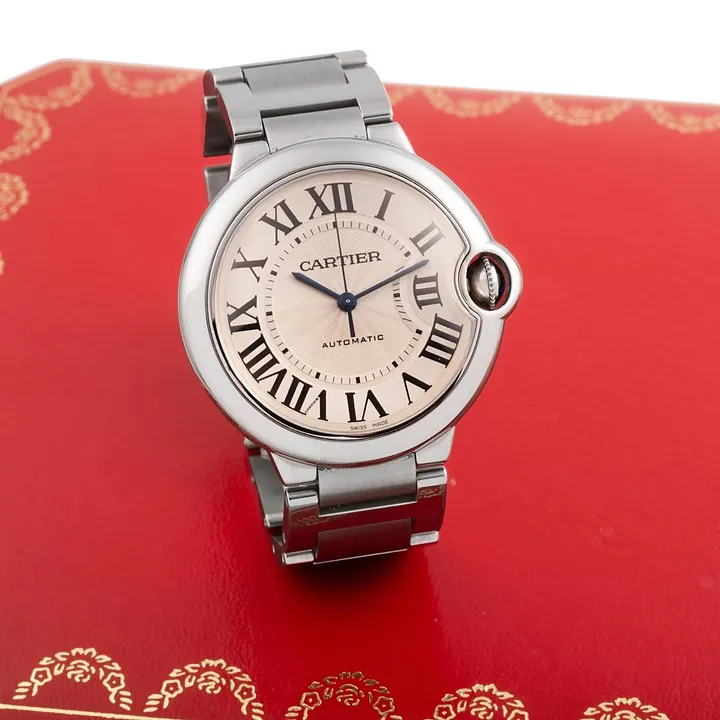
Cartier Ballon Bleu, ref. 3284, c. 2010s
Antiquorum auction archive, Geneva

Wristwatches · originally sold in December 2021 (per the lot record)
Cartier Tank Must, ref. CRWSTA0054, originally sold in December 2021
Antiquorum auction archive, Geneva
Wristwatches · originally sold in 2023 (per the lot record)
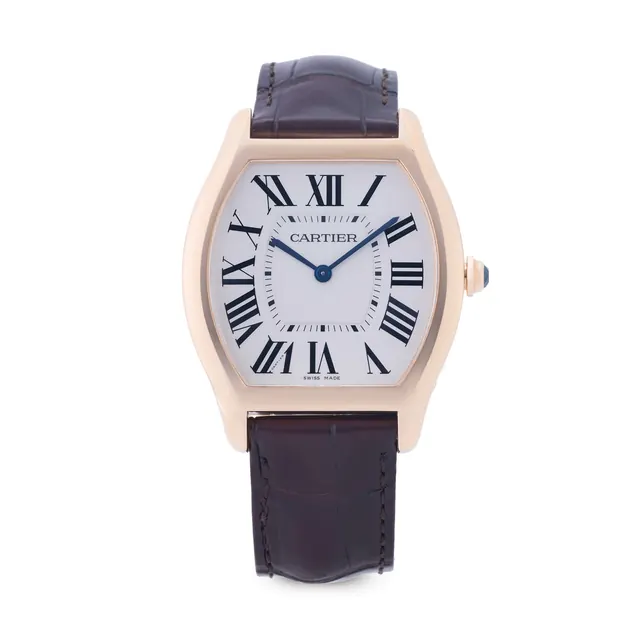
Cartier wristwatch, ref. WGTO0002, Tortue, originally sold in 2023
Antiquorum auction archive, Geneva
Wristwatches · c. 2020
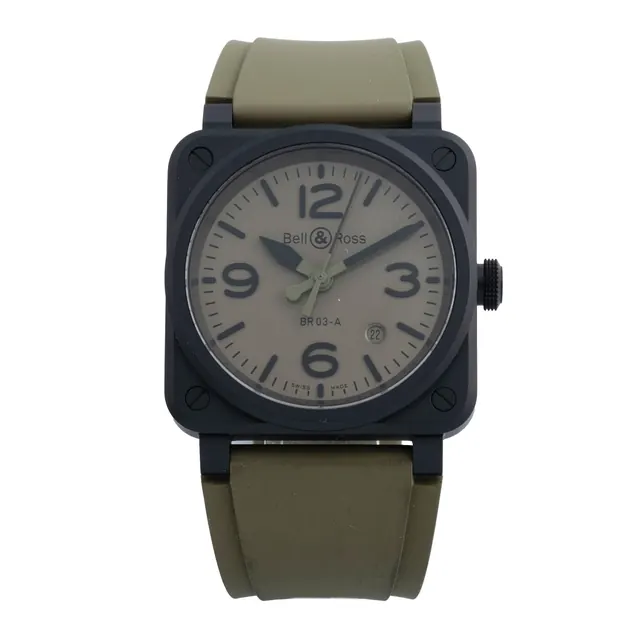
Bell & Ross wristwatch, ref. BR, Aviation Type, circa 2020
Antiquorum auction archive, Geneva