
Wristwatches · Wristwatch
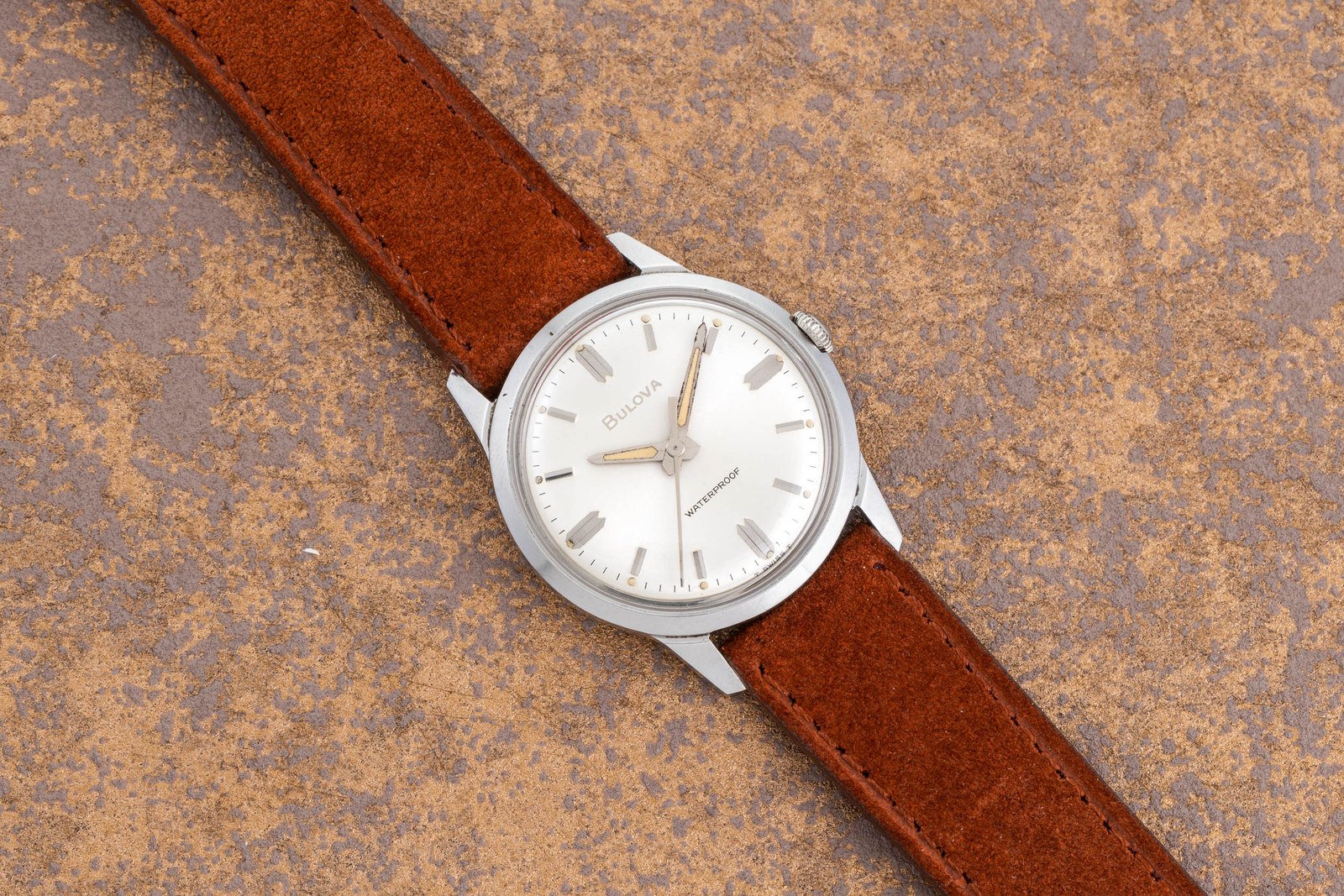
Bulova Waterproof Dress Watch, c. 1966
- Maker / attribution
- Bulova (maker)
- Date
- c. 1966
- Historical period
- Modern Mechanical Horology (1945 – 1969)
- Country of origin
- United States
- Object type
- Wristwatch
- Dimensions
- Case 32 mm
- Stock no.
- 40990053
- Credit line
- Dealer listing, Analog/Shift (40990053)
- Catalogue title (original)
- Bulova Waterproof Dress Watch (English)
View the source record (dealer listing) ↗ (opens another website in a new tab)Suggest a correction
Record summary
Catalogued by Analog/Shift (dealer), New York (stock number 40990053), this is a wristwatch by Bulova, made in United States, dated c. 1966. The Atlas places it in the Modern Mechanical Horology period (1945 – 1969) of its Wristwatches collection. Recorded dimensions: Case 32 mm. The record is illustrated with 6 photographs.
Assembled from the source record's structured fields. Dates and attributions are given as the source states them; where a field is missing the Atlas leaves it blank rather than estimating.
Catalogue description
Dealer description — Analog/Shift
The story of Bulova is deeply entwined with American manufacturing. Its founder, a Czech immigrant named Joseph Bulova, was inspired by the advances that Ford made in his factory in Highland Park, Michigan. Starting in 1912, Bulova built a factory in Biel, Switzerland, using Ford’s principles of mass production. The brand was among the first to offer a wide range of wristwatches for men, with a distinctive visual style that—thanks to its innovative adoption of advertising and a relocation to Astoria, Queens—became fixed in the American imagination. Bulova took over offices in the Empire State Building and installed an observatory on the roof, in order to measure universal time. In the workshop down below, watchmakers timed the watches they were working on to readings taken in the observatory. The watches that Bulova produced were varied, from handsome three-handers to divers and even chronographs. Bulova produced its first chronographs in the 1940s—single-button affairs with screw-on bezels. Throughout the 1950s, 60s, and 70's, Bulova honed its mastery of chronographs. This particular piece dates to circa 1966 and is in superb overall condition. Appropriate for any wrist, this svelte piece features a 32mm case with a luminous silver sunburst dial with a matching 'obelisk' handset, a hand-cranking movement, and a signed crown. Whether you're a seasoned collector or just getting started, it's hard to go wrong with a timelessly designed manually-wound watch that suits for any occasion.
Historical context
Modern Mechanical Horology (1945 – 1969)
Tool watches for divers, pilots and astronauts; electric watches anticipate the electronic age.
The classic era of the mechanical wristwatch: dive watches, chronographs for motor racing and space flight, GMT watches for jet travel, slim dress watches, automatic calendars, and the rise of Japanese manufacturers alongside Swiss, American, German and Soviet industries.
Read the period in the timelineMore wristwatches from this periodEarlier: Golden Age of Mechanical Watchmaking
Atlas type guide
Dive and water-resistant watches
Keeping water and dust out of a wristwatch was a long-standing challenge. Rolex's screw-down Oyster case (1926) and Omega's Marine (1932) were landmarks; in the early 1950s Blancpain's Fifty Fathoms and Rolex's Submariner defined the professional dive watch with rotating bezels for timing dives, luminous dials and high water resistance. The ISO 6425 standard (1982) later codified what a 'diver's watch' must do.
Dive watches became icons of post-war design and exploration, and their evolution — helium escape valves, ceramic bezels, saturation-diving depth ratings — records the history of underwater work.
What to look for
- Unidirectional or bidirectional rotating bezel with minute markings.
- Screw-down crown and case back; depth rating printed on the dial.
- Luminous hands and markers (radium before c. 1960, tritium c. 1960–1998, then Super-LumiNova).
- Reference numbers on the case between the lugs or inside the back.
Dating clues
- Screw-down Oyster cases: from 1926.
- Professional dive watches: from 1953.
- Tritium 'T' marks on dials: c. 1960–1998.
General guidance written by the Atlas editors about this kind of object. It is not a statement about this particular piece; for that, rely on the source record above and on physical examination.
Related records
Wristwatches · c. 1969
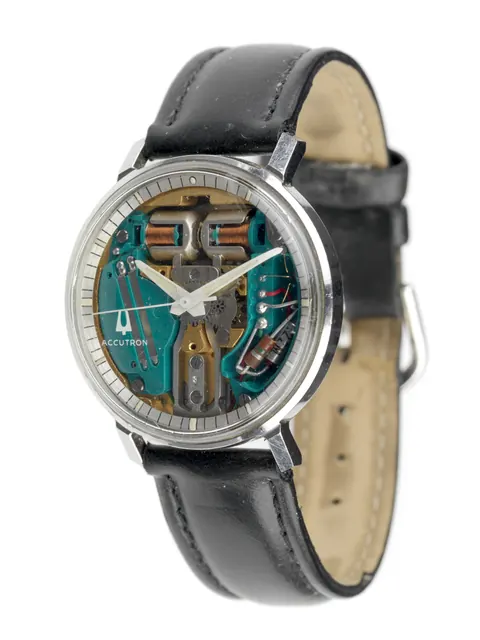
Bulova 'Accutron' tuning-fork wristwatch by Bulova
Royal Museums Greenwich
Wristwatches · c. 1965
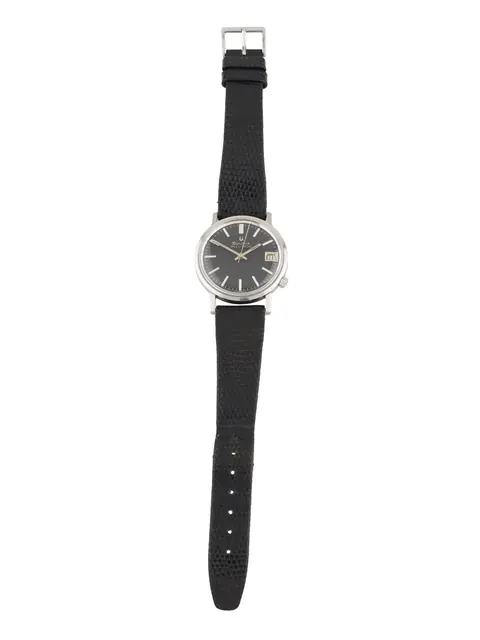
Wristwatch Accutron by Knud Geelmuyden Bull
Royal Museums Greenwich
Clocks · c. 1960s
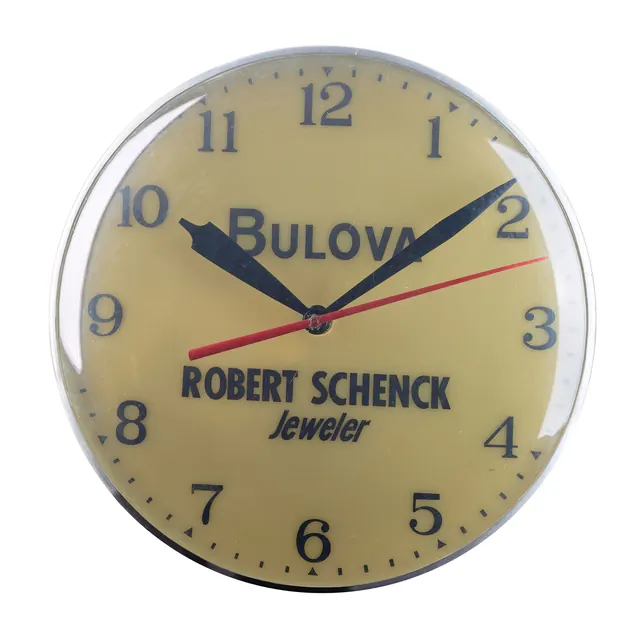
Bulova wall clock, Lighted Advertising Wall Clock for Robert Schenck Jeweler, circa 1960s
Antiquorum auction archive, Geneva
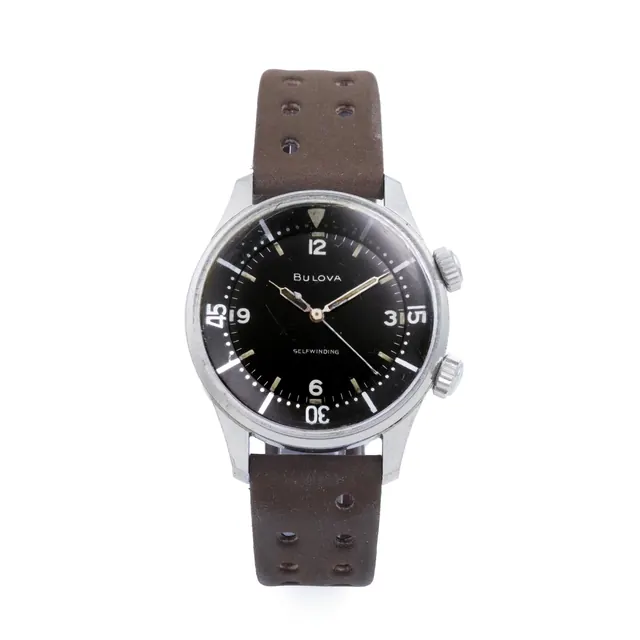
Wristwatches · 1963
Bulova wristwatch, ref. 314, Diver Super Compressor, 1963
Antiquorum auction archive, Geneva
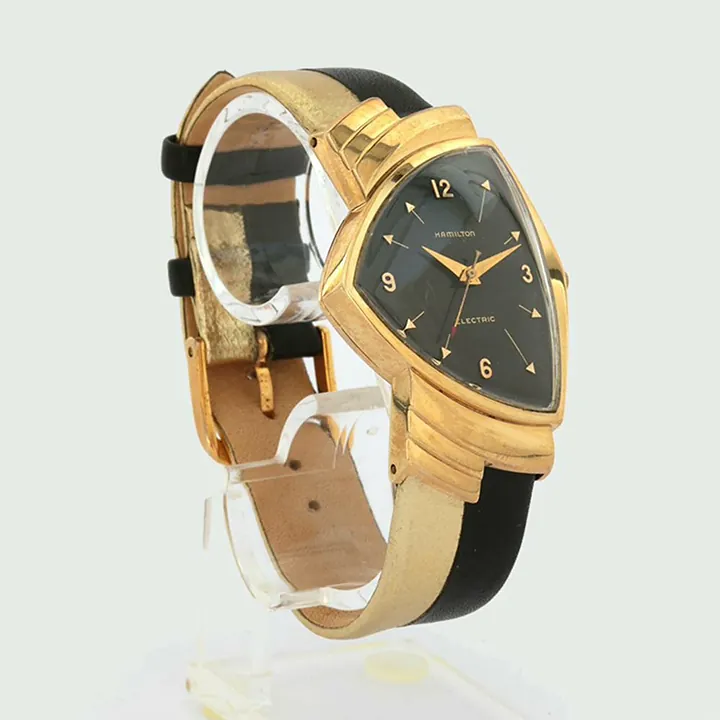
Wristwatches · c. 1957
Wristwatch by Richard H. Arbib, United States, c. 1957
German Clock Museum
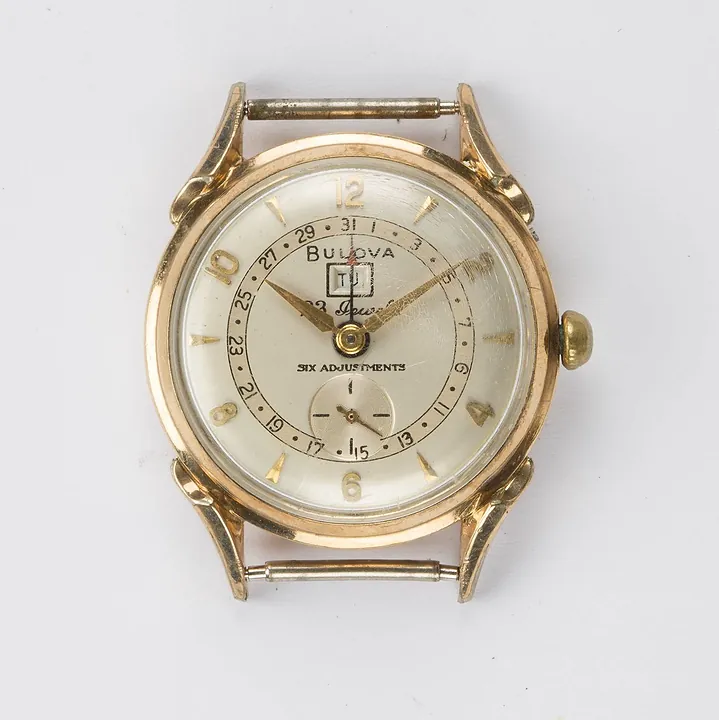
Wristwatches · 1959
Wristwatch by Josef Bulova, United States, 1959
German Clock Museum
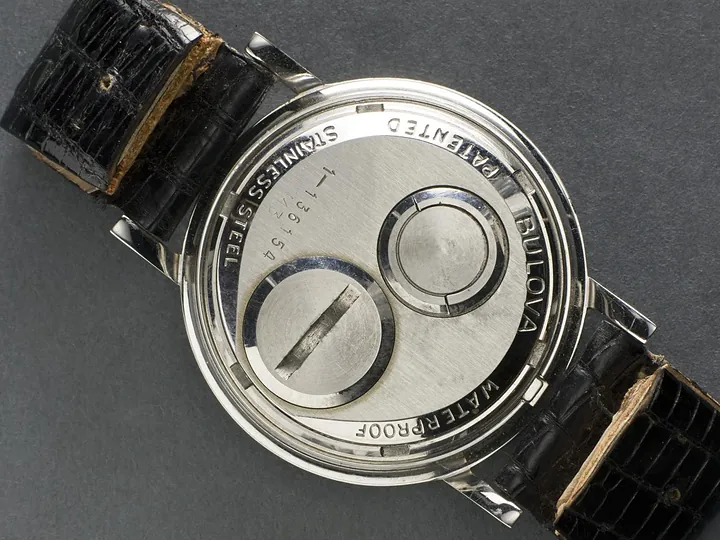
Wristwatches · 1960–1963
Bulova Accutron tuning-fork wristwatch on a demonstration stand, designed by Max Hetzel, United States, 1960–1963
Science Museum Group, London
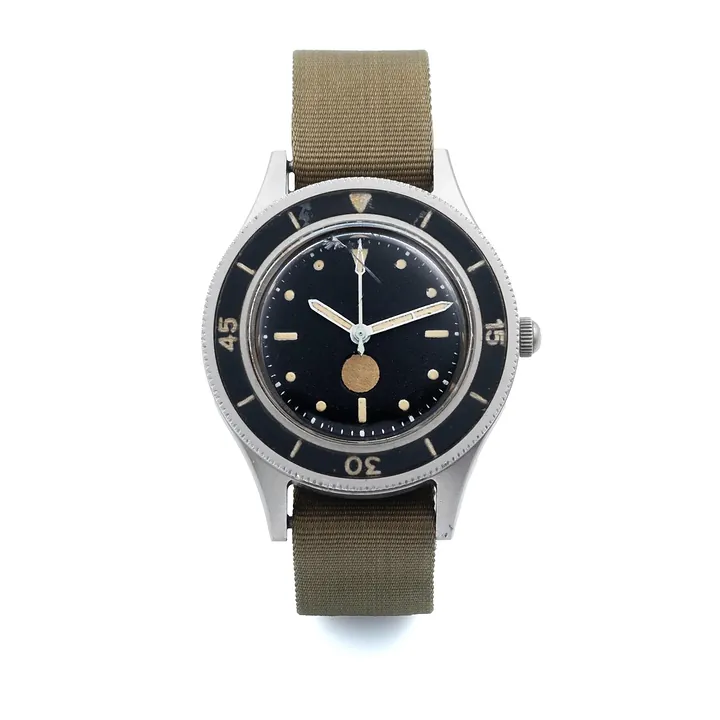
Wristwatches · 1964
Tornek-Rayville wristwatch, ref. TR 900, 1964
Antiquorum auction archive, Geneva