
Wristwatches · Wristwatch
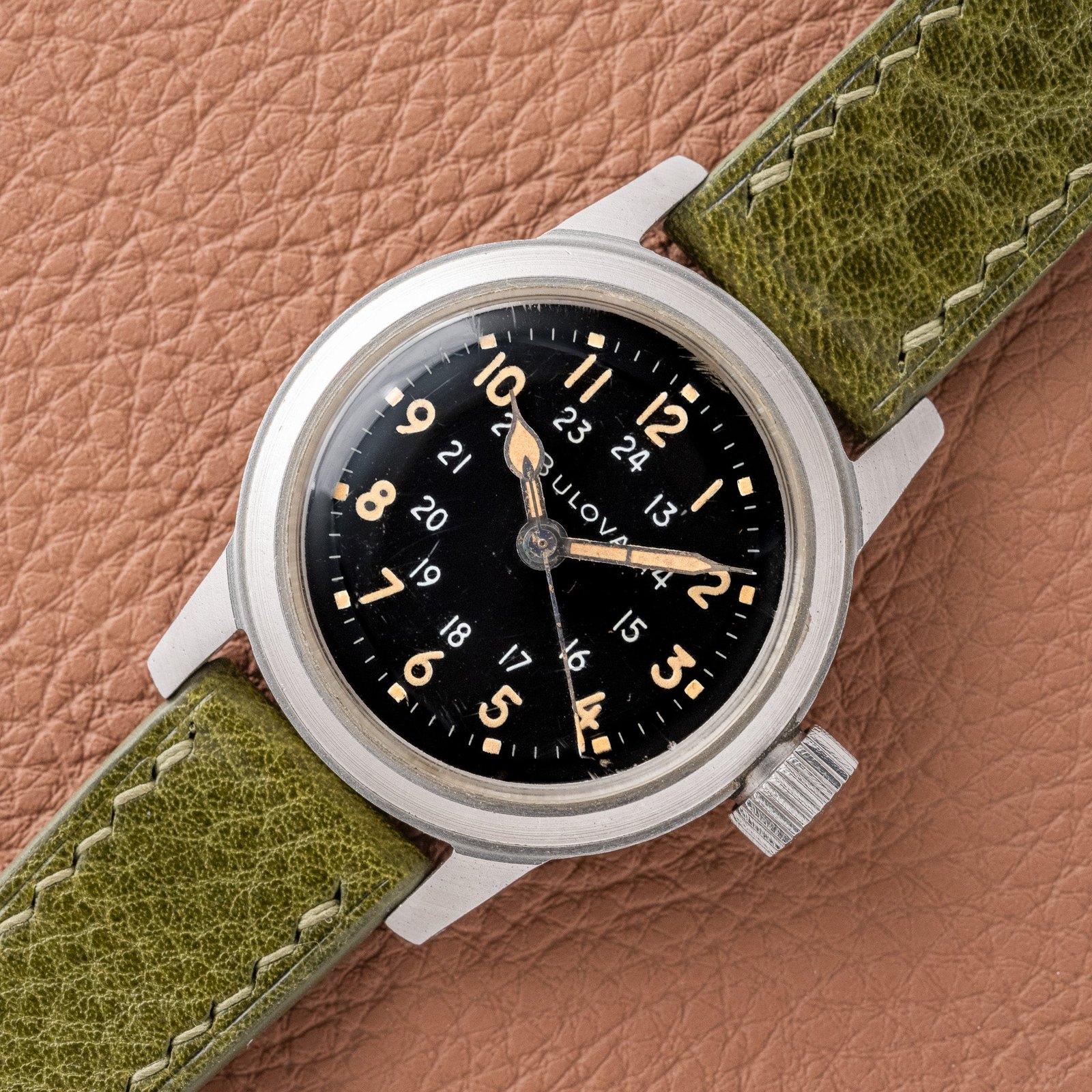
Bulova U.S. Military Issued Watch (Ref. MIL-W-3818A), 1960s
- Maker / attribution
- Bulova (maker)
- Date
- 1960s
- Historical period
- Modern Mechanical Horology (1945 – 1969)
- Country of origin
- United States
- Object type
- Wristwatch
- Dimensions
- Case 34 mm
- Stock no.
- Product 8398669906103
- Credit line
- Dealer listing, Huntington Company (product 8398669906103)
- Catalogue title (original)
- 1960s Bulova U.S. Military Issued Watch (Ref. MIL-W-3818A) (English)
View the source record (dealer listing) ↗ (opens another website in a new tab)Suggest a correction
Record summary
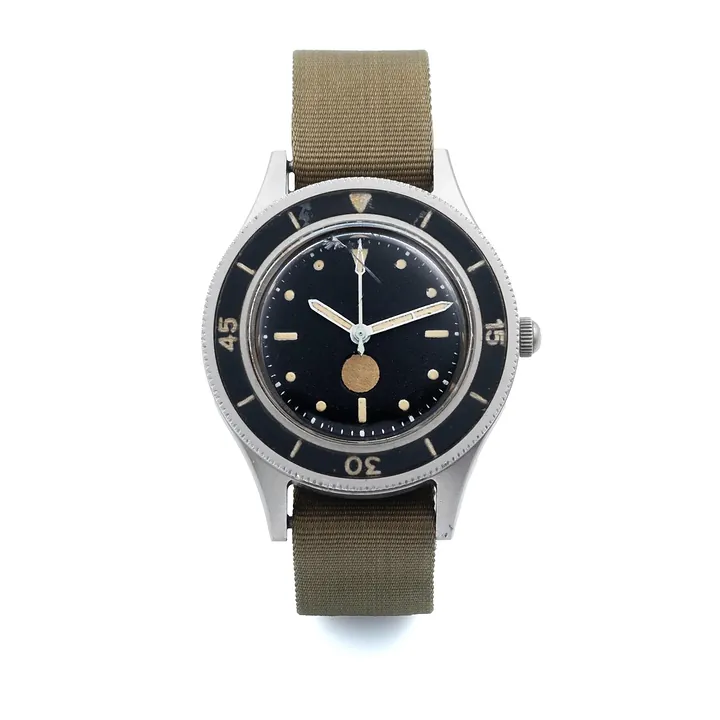
Catalogued by Huntington Company (dealer) (stock number Product 8398669906103), this is a wristwatch by Bulova, made in United States, dated 1960s. The Atlas places it in the Modern Mechanical Horology period (1945 – 1969) of its Wristwatches collection. Recorded dimensions: Case 34 mm. The record is illustrated with 6 photographs.
Assembled from the source record's structured fields. Dates and attributions are given as the source states them; where a field is missing the Atlas leaves it blank rather than estimating.
Catalogue description
Dealer description — Huntington Company
History & Significance The Bulova MIL-W-3818A occupies a pivotal place in American military watch history. Introduced in the early 1960s, this reference was produced under a U.S. military specification intended to standardize wristwatches issued to service members. Bulova was one of several approved suppliers, and these watches were built to meet strict functional requirements rather than commercial aesthetics. The specification emphasized durability, legibility, and serviceability. A compact stainless steel case housed a hand-wound movement, while the matte black dial featured bold luminous Arabic numerals and a fully indexed inner 24-hour scale. This layout allowed for quick time reading in low-light conditions and easy conversion between standard and military time, a critical feature for issued equipment. Unlike civilian Bulova models of the era, the MIL-W-3818A was never intended as a consumer product. Production quantities were limited to government contracts, and many examples were heavily worn, modified, or discarded during service. Surviving watches in honest condition provide a direct link to Cold War-era military issue and reflect a period when American manufacturers played a central role in supplying dependable mechanical tools to the armed forces. Writer’s Thoughts This is a purpose-built watch in the purest sense. The proportions are compact but confident, the dial is exceptionally readable, and the overall feel is utilitarian without being crude. On the wrist, it wears light and balanced, with just enough character to remind you it was designed for use rather than display. Our Promise Every watch is thoroughly vetted, carefully described with complete transparency, and guaranteed authentic. This watch is offered in honest condition. Specifications Brand: Bulova Model: MIL-W-3818A Year: 1960s Case Material: Stainless steel Case Size: Approximately 34mm Bezel: Smooth stainless steel Dial: Matte black military dial with luminous Arabic numerals and inner 24-hour scale Crystal: Acrylic Movement: Manual wind Bulova movement Strap/Bracelet: Aftermarket leather strap Buckle/Clasp: Tang buckle Contents: Watch only Condition Case: The case shows uniform surface wear consistent with age and service use. Brushed surfaces display light scratches, with no deep gouges or structural damage visible. Case geometry remains intact. Crystal: Acrylic crystal shows surface scratches consistent with age. Dial: In excellent condition, with strong contrast and intact printing. Luminous material appears even and consistent, with no signs of moisture damage or degradation. Hands: Hands show age-appropriate wear with intact lume. Strap/Bracelet: Aftermarket leather strap is new. Buckle/Clasp: Tang buckle is new.
Historical context
Modern Mechanical Horology (1945 – 1969)
Tool watches for divers, pilots and astronauts; electric watches anticipate the electronic age.
The classic era of the mechanical wristwatch: dive watches, chronographs for motor racing and space flight, GMT watches for jet travel, slim dress watches, automatic calendars, and the rise of Japanese manufacturers alongside Swiss, American, German and Soviet industries.
Read the period in the timelineMore wristwatches from this periodEarlier: Golden Age of Mechanical Watchmaking
Atlas type guide
Military, pilot and travel watches
The wristwatch owes much of its adoption by men to warfare and aviation. Wristlets — small pocket watches soldered with lugs and worn on a strap — were used in colonial campaigns and became standard equipment in the First World War, with protective grilles over the crystal ('shrapnel guards'). Louis Cartier's Santos (1904), designed for the aviator Alberto Santos-Dumont, is often cited as an early purpose-made pilot's watch.
In the Second World War governments specified watches in detail: the German B-Uhr observation watches, the American A-11, and the British 'W.W.W.' (the 'Dirty Dozen' set of 1945). After the war, jet travel brought GMT and world-time watches, which show two or more time zones at once — Louis Cottier's world-time mechanism and the Rolex GMT-Master (1955) are examples.
What to look for
- Military markings on the case back: broad arrow, issue numbers, 'W.W.W.', 'A.T.P.'
- High-legibility black dials with luminous Arabic numerals; oversized crowns for gloved hands.
- 24-hour hands and rotating 24-hour bezels or city rings on GMT/world-time watches.
- Wire lugs on early wristlets converted from pocket watches.
Dating clues
- Wire-lug wristlets: c. 1900–1925.
- Military specifications of the Second World War: 1939–1945.
- GMT and world-time wristwatches: mainly after 1950.
General guidance written by the Atlas editors about this kind of object. It is not a statement about this particular piece; for that, rely on the source record above and on physical examination.
Related records
Wristwatches · c. 1969
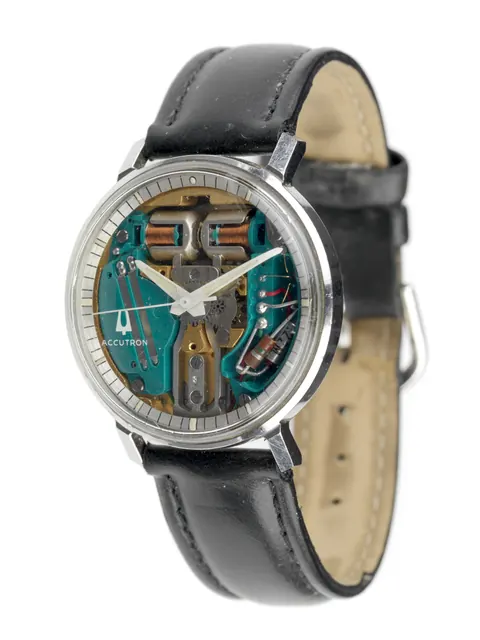
Bulova 'Accutron' tuning-fork wristwatch by Bulova
Royal Museums Greenwich
Wristwatches · c. 1965
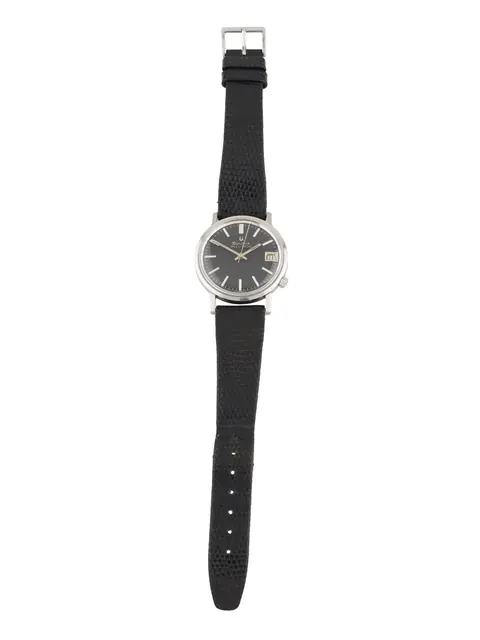
Wristwatch Accutron by Knud Geelmuyden Bull
Royal Museums Greenwich
Clocks · c. 1960s
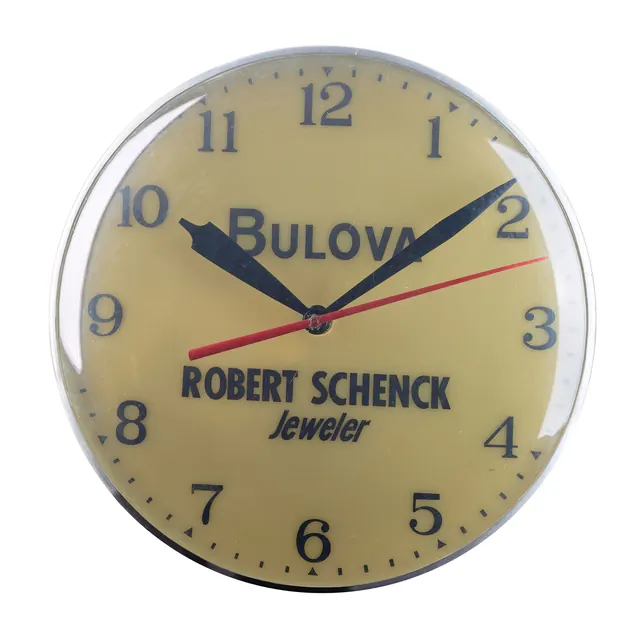
Bulova wall clock, Lighted Advertising Wall Clock for Robert Schenck Jeweler, circa 1960s
Antiquorum auction archive, Geneva
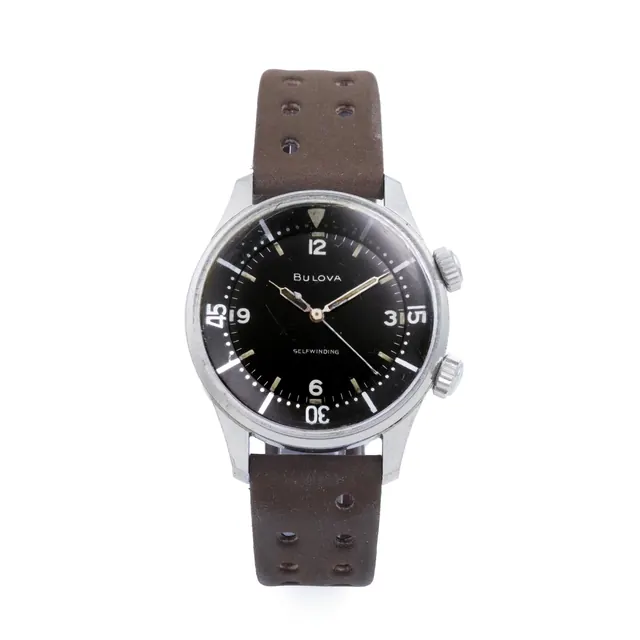
Wristwatches · 1963
Bulova wristwatch, ref. 314, Diver Super Compressor, 1963
Antiquorum auction archive, Geneva
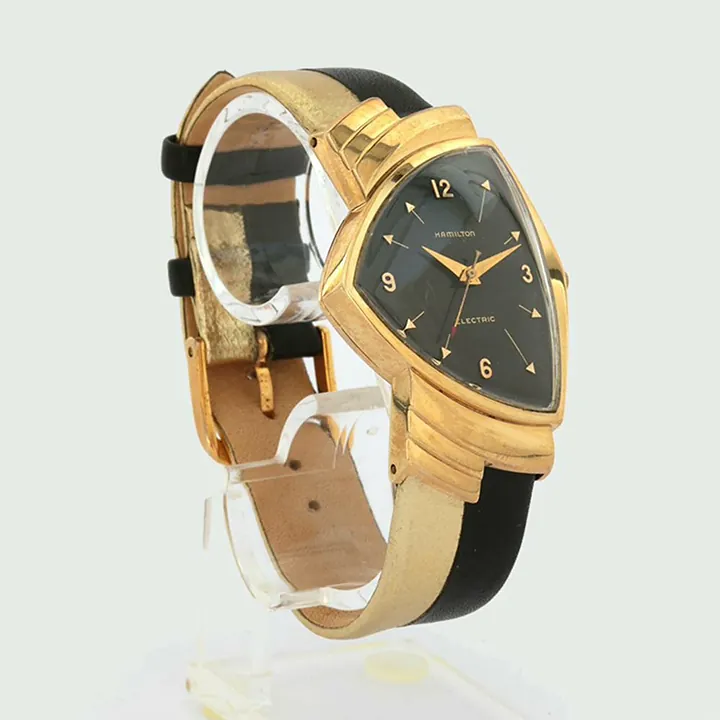
Wristwatches · c. 1957
Wristwatch by Richard H. Arbib, United States, c. 1957
German Clock Museum
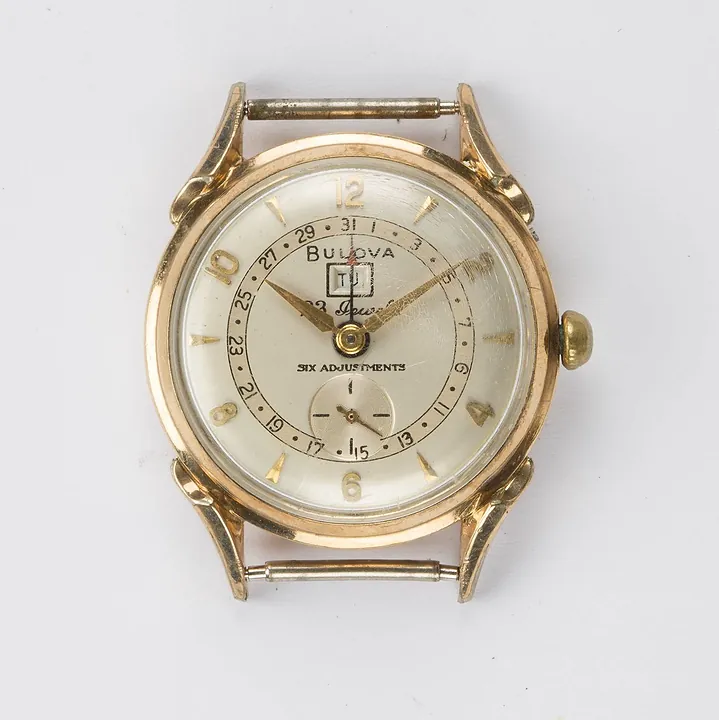
Wristwatches · 1959
Wristwatch by Josef Bulova, United States, 1959
German Clock Museum
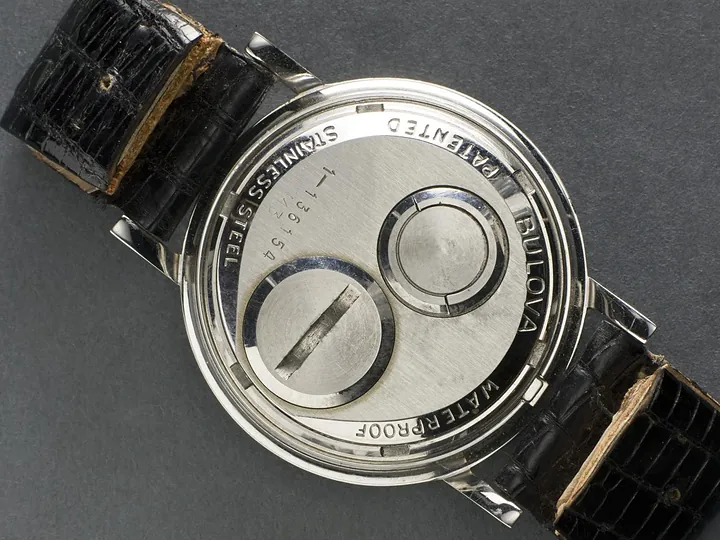
Wristwatches · 1960–1963
Bulova Accutron tuning-fork wristwatch on a demonstration stand, designed by Max Hetzel, United States, 1960–1963
Science Museum Group, London
Wristwatches · 1964
Tornek-Rayville wristwatch, ref. TR 900, 1964
Antiquorum auction archive, Geneva