
Wristwatches · Wristwatch
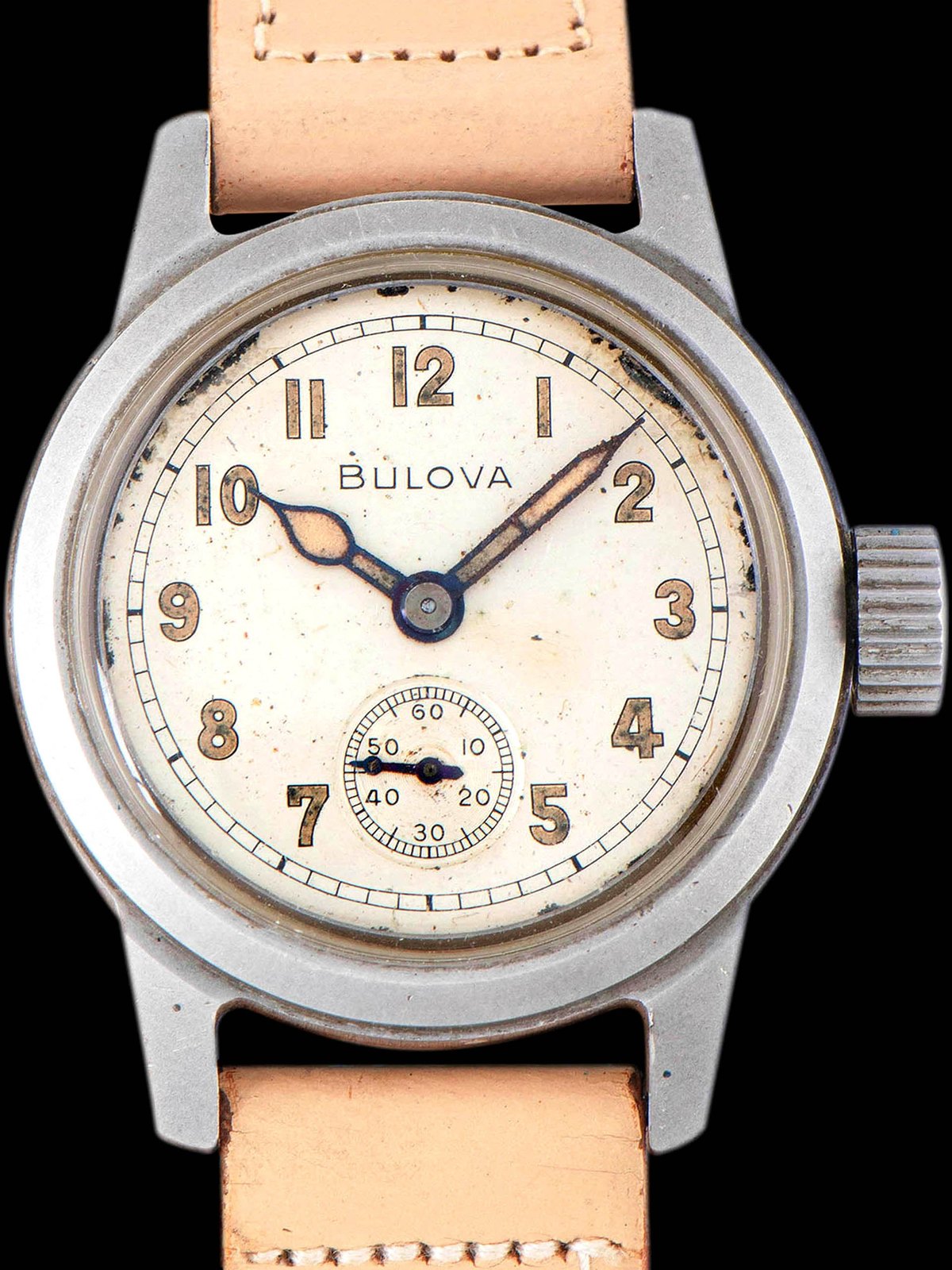
Bulova "1917-H" U.S Military Watch, 1950s
- Maker / attribution
- Bulova (maker)
- Date
- 1950s
- Historical period
- Modern Mechanical Horology (1945 – 1969)
- Country of origin
- United States
- Object type
- Wristwatch
- Stock no.
- BLV1917H
- Credit line
- Dealer listing, Craft & Tailored (BLV1917H)
- Catalogue title (original)
- 1950s Bulova "1917-H" U.S Military Watch (English)
View the source record (dealer listing) ↗ (opens another website in a new tab)Suggest a correction
Record summary
Catalogued by Craft & Tailored (dealer), Los Angeles (stock number BLV1917H), this is a wristwatch by Bulova, made in United States, dated 1950s. The Atlas places it in the Modern Mechanical Horology period (1945 – 1969) of its Wristwatches collection. The record is illustrated with 6 photographs.
Assembled from the source record's structured fields. Dates and attributions are given as the source states them; where a field is missing the Atlas leaves it blank rather than estimating.
Catalogue description
Dealer description — Craft & Tailored
The Bulova 1917-H was developed for the US Army Ordnance Dept, and bears some striking similarities with the Type A17A and MIL-W-3818A, however, with some key differences. The most obvious similarity is the case and crown, however, the silver dial and non-hacking sub-seconds hand are a big departure from the more common aforementioned models. This could be because the 1917-H was an earlier production model, some Bulova historians think its production could eclipse the end of the Second World War, though its complete origins are somewhat unknown. It's also understood that, like the MIL-W-3818A, the 1917-H was a "general use" timepiece, as its lack of a hacking function was not suitable for complex or aviation-based operations. The practical dial layout and no-nonsense design give the wearer the perfect utilitarian feeling that makes these early military watches so sought after. Although this is a smaller watch in nature, the dial layout was designed for fast legibility. SPECS Stock # BLV1917H Brand Bulova Style Military Watch Model 1917-H Serial N/A Size Men's / Unisex Material Stainless Steel Dial Silver 'Aged' Millimeters 32 Strap 2pc Pigskin Leather Strap CASE & BRACELET The sharp case is in extremely impressive condition, boasting strong factory brushing throughout with subtle signs of previous use present. The original brushed bezel shows light signs of use as well. The case retains its original large unsigned crown. The case back retains the original military "U.S. 1917-H" engraving in deep and crisp condition. The original movement dust cover remains in place as well. The watch will come supplied on a vintage 2pc pigskin leather strap. DIAL & HANDS The original silver dial features a lovely vintage aesthetic, with some light spots, a glowy warmth, and subtle marks to remind us of its age and resilience as a timepiece. The radium Arabic numerals feature a charming beige coloration and exhibit no degradation when inspected under UV light. The original blued hour and minute hands have aged a shade more creamy than the dial and exhibit no degradation. Interestingly, the sub-seconds hand also features a small lume pip, which remains intact, though it has aged much darker than the rest of the lume on the watch. ACCESSORIES None. The watch is keeping time, but the service history is unknown. A movement service can be provided upon request.
Historical context
Modern Mechanical Horology (1945 – 1969)
Tool watches for divers, pilots and astronauts; electric watches anticipate the electronic age.
The classic era of the mechanical wristwatch: dive watches, chronographs for motor racing and space flight, GMT watches for jet travel, slim dress watches, automatic calendars, and the rise of Japanese manufacturers alongside Swiss, American, German and Soviet industries.
Read the period in the timelineMore wristwatches from this periodEarlier: Golden Age of Mechanical Watchmaking
Atlas type guide
Military, pilot and travel watches
The wristwatch owes much of its adoption by men to warfare and aviation. Wristlets — small pocket watches soldered with lugs and worn on a strap — were used in colonial campaigns and became standard equipment in the First World War, with protective grilles over the crystal ('shrapnel guards'). Louis Cartier's Santos (1904), designed for the aviator Alberto Santos-Dumont, is often cited as an early purpose-made pilot's watch.
In the Second World War governments specified watches in detail: the German B-Uhr observation watches, the American A-11, and the British 'W.W.W.' (the 'Dirty Dozen' set of 1945). After the war, jet travel brought GMT and world-time watches, which show two or more time zones at once — Louis Cottier's world-time mechanism and the Rolex GMT-Master (1955) are examples.
What to look for
- Military markings on the case back: broad arrow, issue numbers, 'W.W.W.', 'A.T.P.'
- High-legibility black dials with luminous Arabic numerals; oversized crowns for gloved hands.
- 24-hour hands and rotating 24-hour bezels or city rings on GMT/world-time watches.
- Wire lugs on early wristlets converted from pocket watches.
Dating clues
- Wire-lug wristlets: c. 1900–1925.
- Military specifications of the Second World War: 1939–1945.
- GMT and world-time wristwatches: mainly after 1950.
General guidance written by the Atlas editors about this kind of object. It is not a statement about this particular piece; for that, rely on the source record above and on physical examination.
Related records
Wristwatches · c. 1969
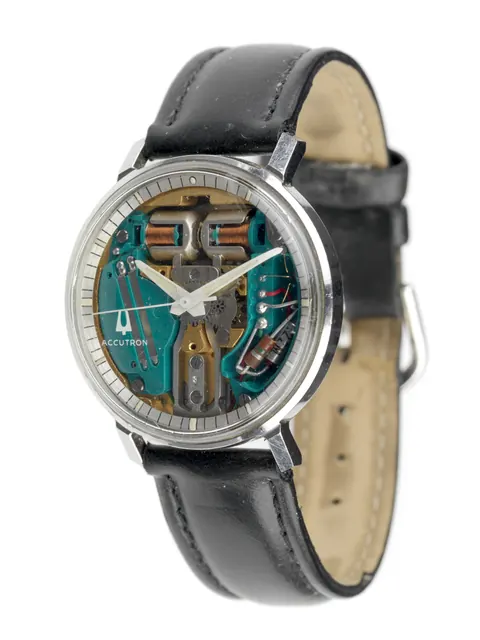
Bulova 'Accutron' tuning-fork wristwatch by Bulova
Royal Museums Greenwich
Wristwatches · c. 1965
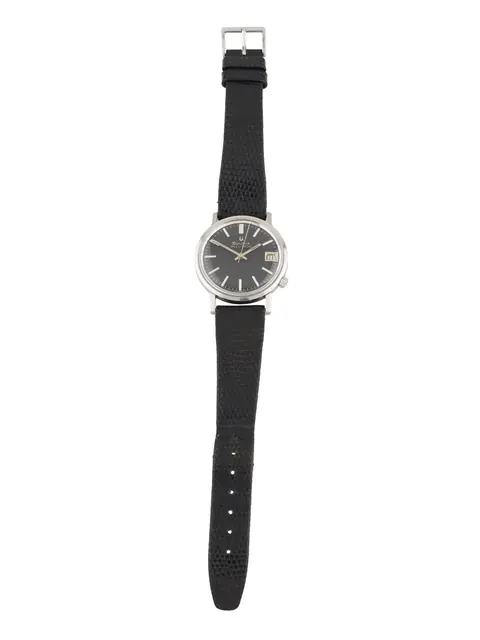
Wristwatch Accutron by Knud Geelmuyden Bull
Royal Museums Greenwich
Clocks · c. 1960s
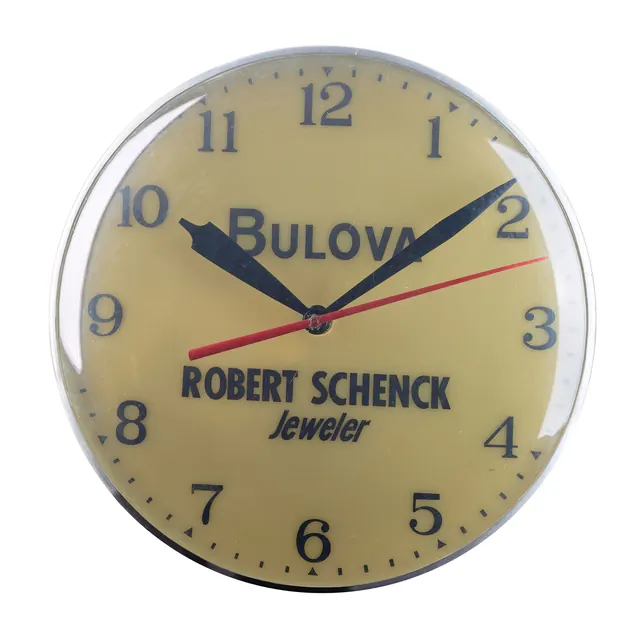
Bulova wall clock, Lighted Advertising Wall Clock for Robert Schenck Jeweler, circa 1960s
Antiquorum auction archive, Geneva
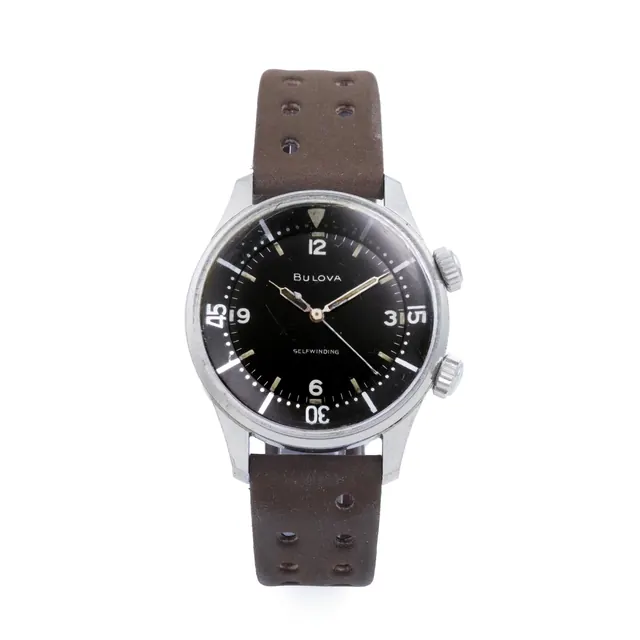
Wristwatches · 1963
Bulova wristwatch, ref. 314, Diver Super Compressor, 1963
Antiquorum auction archive, Geneva
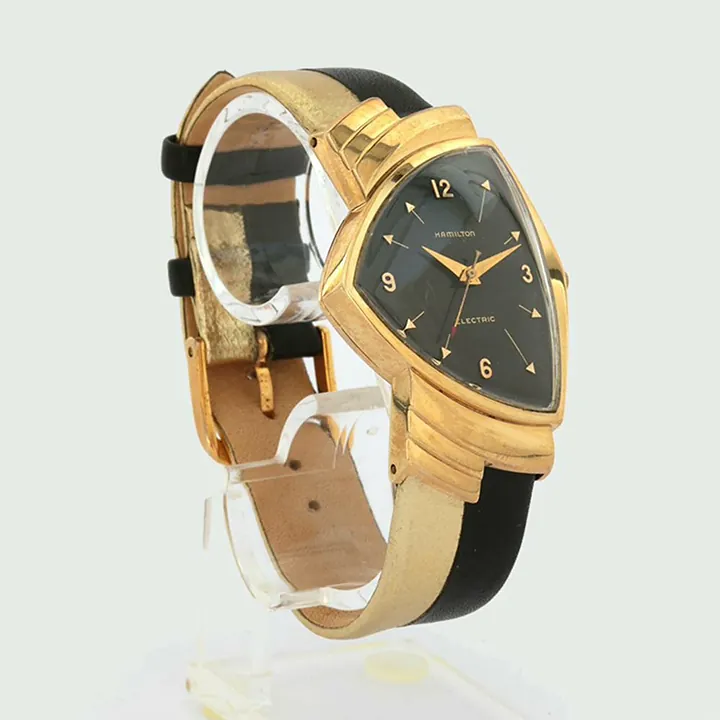
Wristwatches · c. 1957
Wristwatch by Richard H. Arbib, United States, c. 1957
German Clock Museum
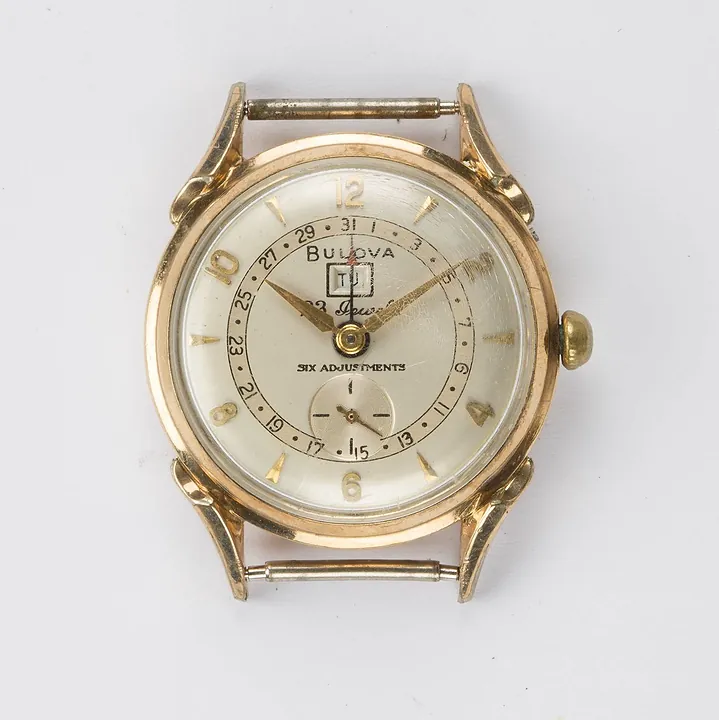
Wristwatches · 1959
Wristwatch by Josef Bulova, United States, 1959
German Clock Museum
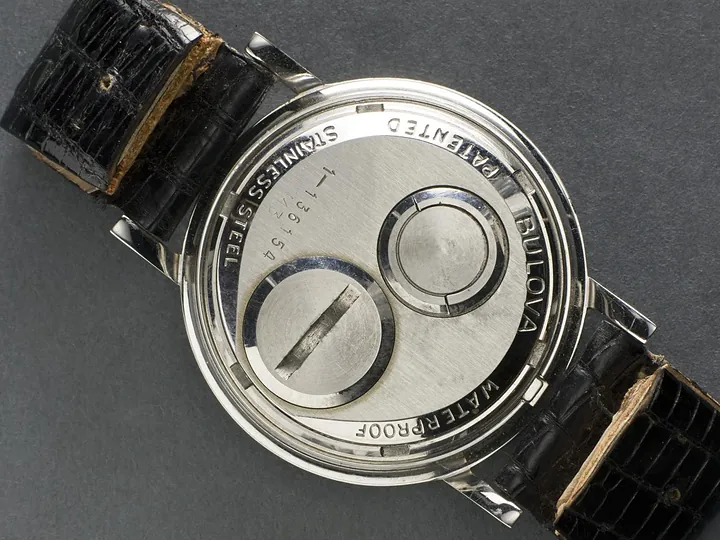
Wristwatches · 1960–1963
Bulova Accutron tuning-fork wristwatch on a demonstration stand, designed by Max Hetzel, United States, 1960–1963
Science Museum Group, London
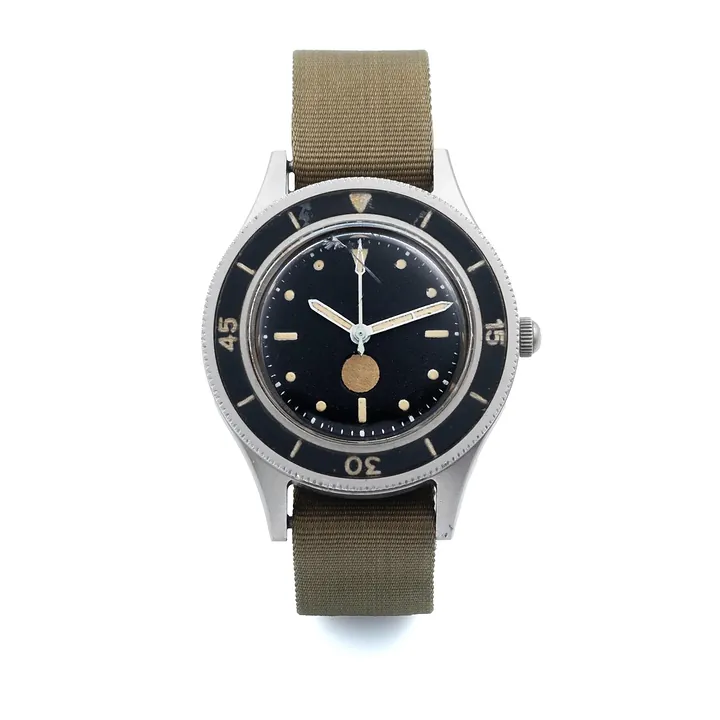
Wristwatches · 1964
Tornek-Rayville wristwatch, ref. TR 900, 1964
Antiquorum auction archive, Geneva