
Wristwatches · Wristwatch
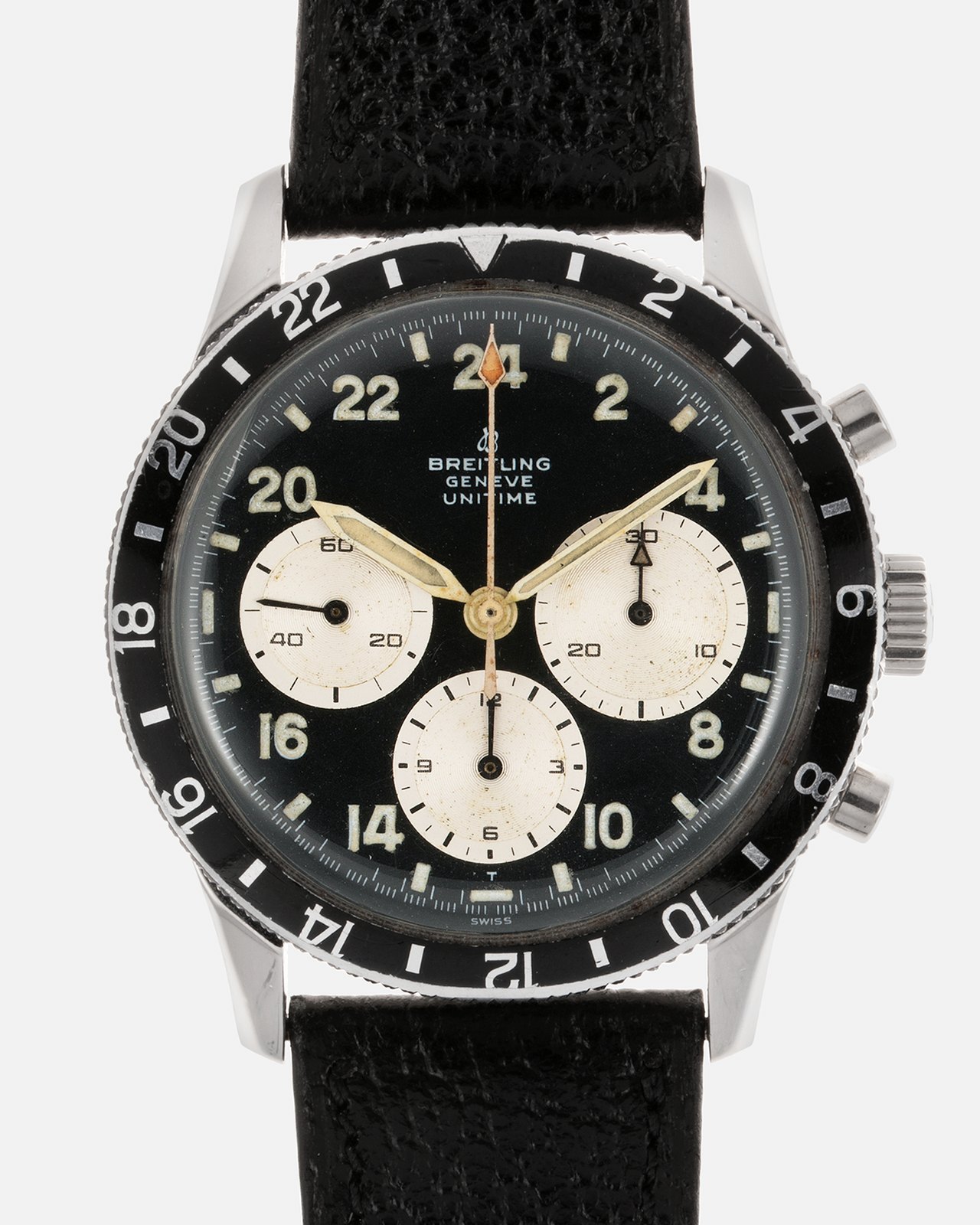
Breitling 1765 Unitime 24 Hour, 1960s
- Maker / attribution
- Breitling (maker)
- Date
- 1960s
- Historical period
- Modern Mechanical Horology (1945 – 1969)
- Country of origin
- Switzerland
- Object type
- Wristwatch
- Dimensions
- Case 41 mm
- Stock no.
- Product 6890328490071
- Credit line
- Dealer listing, S.Song Watches (product 6890328490071)
- Catalogue title (original)
- Breitling 1765 Unitime 24 Hour (English)
View the source record (dealer listing) ↗ (opens another website in a new tab)Suggest a correction
Record summary
Catalogued by S.Song Watches (dealer), Seattle (stock number Product 6890328490071), this is a wristwatch by Breitling, made in Switzerland, dated 1960s. The Atlas places it in the Modern Mechanical Horology period (1945 – 1969) of its Wristwatches collection. Recorded dimensions: Case 41 mm. The record is illustrated with 6 photographs.
Assembled from the source record's structured fields. Dates and attributions are given as the source states them; where a field is missing the Atlas leaves it blank rather than estimating.
Catalogue description
Dealer description — S.Song Watches
The origins of Breitling's 765 AVI watches can be traced back to French aviation and their close connection to the Breguet Type 20. During the 1950s, Breitling vied for a contract to supply the French Army and thus created the 765 model. However, the absence of a flyback function in the AVI led to its rejection, and the contract was awarded to Breguet, Vixa, Auricoste, and Dodane, who subsequently manufactured the Type 20 watches for the French Air Force. Nevertheless, the Breitling 765 continues to be regarded as one of the most iconic and practical timepieces produced in the 20th century, making it highly sought after among collectors. The specific model being presented here is a later variant known as the 1765 Unitime with a 24-hour dial. The dial of the Ref. 1765 Unitime is adorned with a white Breitling logo prominently displayed. Just below the logo, you will find the inscription 'Breitling Geneve Unitime' indicating the brand and model. The chronograph, minute, and hour hands are all white which contrasts the matte black dial nicely. Positioned at 3, 6, and 9 o'clock, the sub-dials serve the functions of measuring 30 minutes, 12 hours and displaying the sub-seconds respectively. Positioned at the six o'clock position, just below the 12-hour register, there is a marking denoted by the letter 'T', which signifies the use of Tritium luminescent material on the dial. Enclosed within a 41mm stainless steel case, the Ref. 1765 Unitime features a bi-directional rotating bezel with a 24-hour scale, allowing for tracking of time in different time zones. Powering the watch from within is a 17-jewelled, manual-winding Venus Cal. 178, a movement that is widely regarded as one of the most renowned column wheel-operated chronograph movements ever created. It also features a power reserve of 45 hours. The unique aspect of this column wheel chronograph movement is that instead of the typical 12-hour dial, it features a 24-hour dial whereby the hour hand would require 24 hours to complete a full rotation. I must say that vintage Breitling has been gaining significant popularity among collectors in recent times, and some of the most sought-after models within their lineup are the 765 AVI and post-AVI variants like this Ref. 1765 Unitime. Despite its seemingly large case size, I am pleased to say that the watch remains highly wearable and comfortable by modern standards. Adding to its allure is its rarity, with estimates suggesting that fewer than 1000 units were ever produced. This scarcity guarantees its status as a collectable timepiece that will continue to appreciate in value for years to come.
Historical context
Modern Mechanical Horology (1945 – 1969)
Tool watches for divers, pilots and astronauts; electric watches anticipate the electronic age.
The classic era of the mechanical wristwatch: dive watches, chronographs for motor racing and space flight, GMT watches for jet travel, slim dress watches, automatic calendars, and the rise of Japanese manufacturers alongside Swiss, American, German and Soviet industries.
Read the period in the timelineMore wristwatches from this periodEarlier: Golden Age of Mechanical Watchmaking
Atlas type guide
Wristwatches
Bracelet watches were worn by women from the early nineteenth century — Breguet made one for Caroline Murat, Queen of Naples, in 1810–12 — but the wristwatch only became a man's instrument with military use and aviation in the early twentieth century. Between the World Wars it overtook the pocket watch; the 1920s and 1930s brought rectangular Art Deco cases, water-resistant cases and the first automatic winding systems.
After 1945 the wristwatch became a carrier of identity — dress watches, sports and dive watches, chronographs, calendars — produced by Swiss, American, Japanese, German, Soviet and Chinese industries. The quartz revolution after 1969 and the mechanical renaissance since the 1990s, including the rise of independent watchmakers, complete the story.
What to look for
- The reference number (between the lugs or inside the case back) and serial number, the starting point for dating.
- The calibre: its maker and number are often stamped under the dial or on the bridge.
- Originality of dial, hands and crown — refinished ('redial') dials are common.
- Case material marks: 18K/750, 14K/585, stainless steel, gold-filled, plated.
Dating clues
- Wire-lug cases: before c. 1925.
- Water-resistant screw-down cases: from 1926.
- Quartz movements: from 1969; sapphire crystals widespread after c. 1980.
General guidance written by the Atlas editors about this kind of object. It is not a statement about this particular piece; for that, rely on the source record above and on physical examination.
Related records
Clocks · c. 1990s
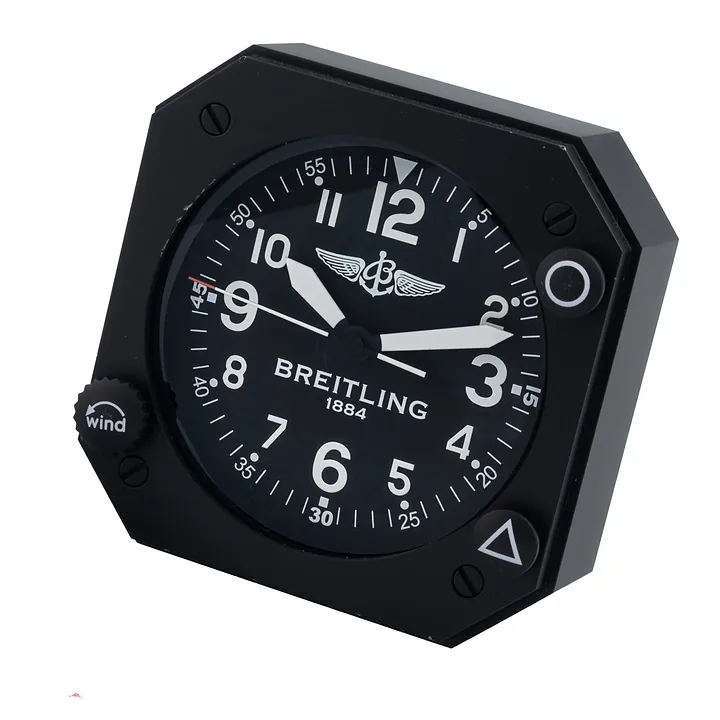
Breitling clock, c. 1990s (Antiquorum Lot 389-18)
Antiquorum auction archive, Geneva
Clocks · c. 1990s
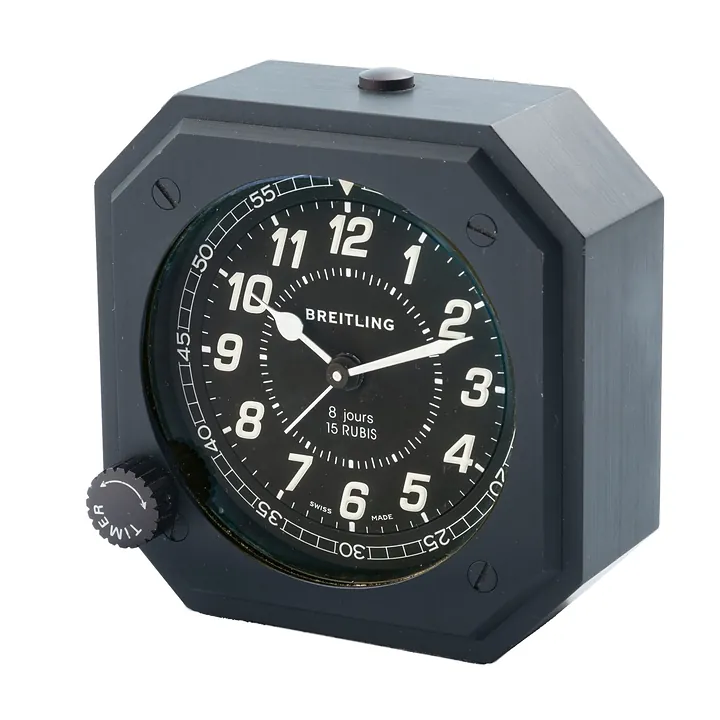
Breitling clock, c. 1990s (Antiquorum Lot 389-20)
Antiquorum auction archive, Geneva
Wristwatches · c. 1940s
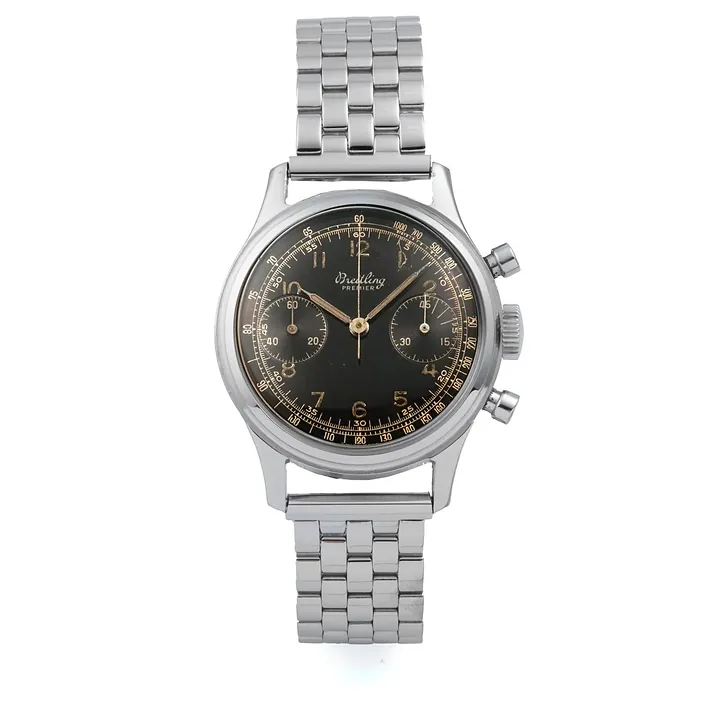
Breitling Premier, ref. 790, c. 1940s
Antiquorum auction archive, Geneva

Wristwatches · c. 1945
Breitling Premier, ref. 790, c. 1945
Antiquorum auction archive, Geneva

Wristwatches · 1945
Wristwatch by Eterna, 1945
Museum Rotterdam

Wristwatches · c. 1945
Universal Genève Uni-Compax, ref. 22492, c. 1945
Antiquorum auction archive, Geneva

Wristwatches · c. 1950s
Baume & Mercier wristwatch, c. 1950s
Antiquorum auction archive, Geneva
Wristwatches · c. 1950
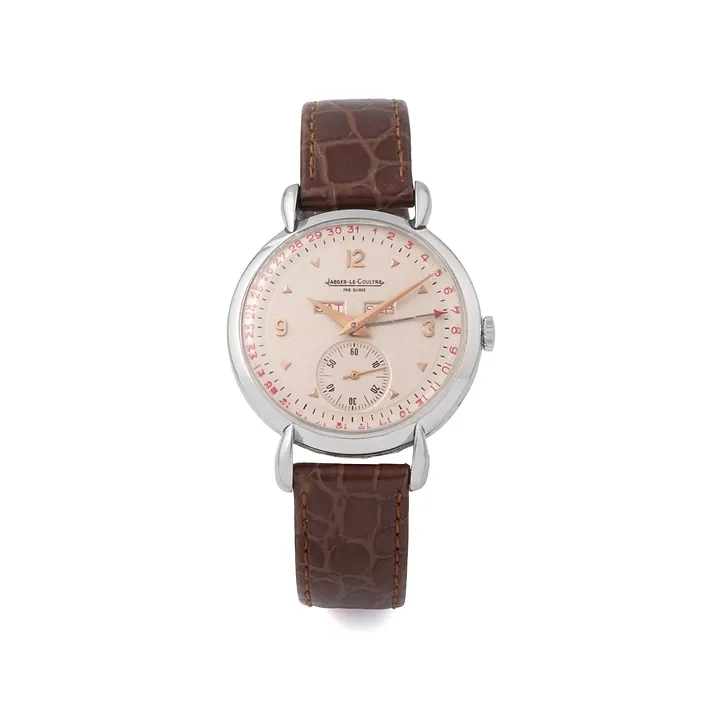
Jaeger Lecoultre Triple Calendar, c. 1950
Antiquorum auction archive, Geneva