
Wristwatches · Wristwatch
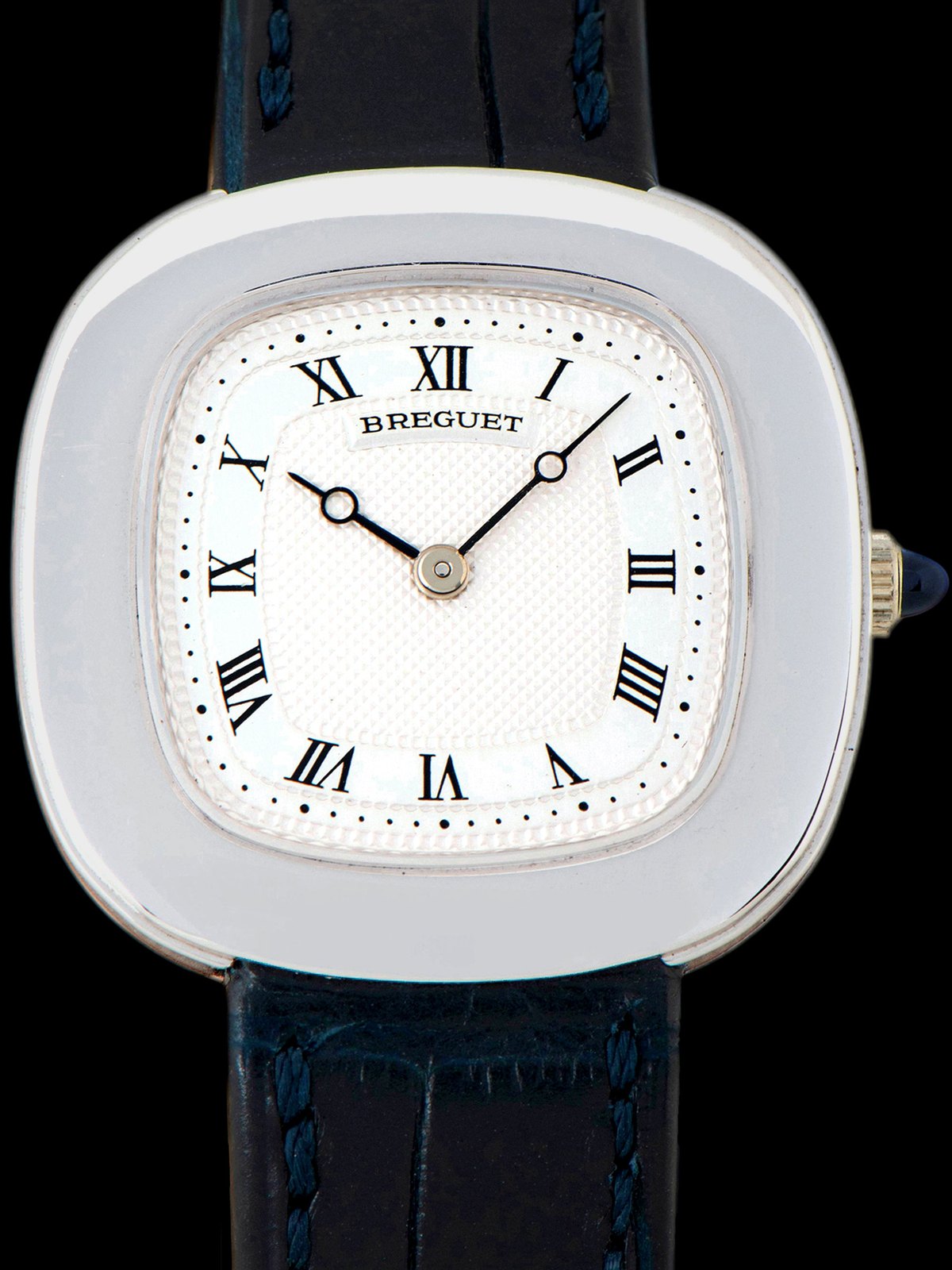
Breguet Cushion 18K WG (Ref. 4070BB), 1978
- Maker / attribution
- Breguet (maker)
- Date
- 1978
- Historical period
- Quartz Revolution (1969 – 1990)
- Country of origin
- Switzerland
- Object type
- Wristwatch
- Stock no.
- BGTC4070BB
- Credit line
- Dealer listing, Craft & Tailored (BGTC4070BB)
- Catalogue title (original)
- 1978 Breguet Cushion 18K WG (Ref. 4070BB) (English)
View the source record (dealer listing) ↗ (opens another website in a new tab)Suggest a correction
Record summary
Catalogued by Craft & Tailored (dealer), Los Angeles (stock number BGTC4070BB), this is a wristwatch by Breguet, made in Switzerland, dated 1978. The Atlas places it in the Quartz Revolution period (1969 – 1990) of its Wristwatches collection. The record is illustrated with 6 photographs.
Assembled from the source record's structured fields. Dates and attributions are given as the source states them; where a field is missing the Atlas leaves it blank rather than estimating.
Catalogue description
Dealer description — Craft & Tailored
When it comes to the names that have shaped the landscape of watchmaking as we know it today, there are few that have been more influential than Abraham-Louis Breguet. Credited with numerous horological innovations ranging from multiple different automatic winding systems to even the tourbillon itself, Breguet left an indelible mark on the watchmaking industry and his eponymous brand is one of the oldest still in operation today, with a rich history that dates all the way back to 1775. While the case shape of this Breguet ref. BB4070 is truly uncommon for the brand, this model retains all of the classic Breguet characteristics we know and love from the brand resulting in an exciting, attractive, and truly rare offering from the brand. The cushion case offers soft, more organic dimensions which are then contrasted by the intricately executed hand-engraved guilloche dial and coin-edge motif on the case sides. All these details are perfectly proportioned in an ultra-thin case with the help of the Breguet cal. 839 manual wind caliber. Very few of these models have surfaced, especially in white gold, making this specific piece not only a rare offering from Breguet, but extremely rare in general. Stock # BGTC4070BB Brand Breguet Style Cushion Model 4070BB Serial Nº2593 Size Men's / Unisex Material 18K White Gold Dial Silver "Guilloche" Millimeters 30 X 30 Strap 2pc Handmade Leather Strap CASE & BRACELET The 18K white gold cushion-shaped case is beautifully preserved, showing minimal signs of use and no notable evidence of previous polishing. The case features the classic "coin-edge" detailing to the side of the case and retains the original blue sapphire cabochon crown. The factoring markings and hallmarks remain in deep and fully present condition throughout the case and case back. The watch comes supplied on a 2pc navy blue Breguet strap along with the original 18K white gold Breguet tang buckle. DIAL & HANDS The original and beautifully crafted silver guilloche dial is virtually flawless, showing no age, oxidation, or damage. The black Breguet-style hands are in perfect condition and coordinate with the enameled Roman numerals on the dial. ACCESSORIES None. The watch is keeping time perfectly.
Historical context
Quartz Revolution (1969 – 1990)
Seiko's Astron begins mass quartz timekeeping; traditional industries contract sharply.
Quartz and digital watches transformed the market after 1969. Swiss employment collapsed, Japanese and Hong Kong production soared, and the Swatch (1983) helped the Swiss industry recover; mechanical watches survived as luxury goods.
Read the period in the timelineMore wristwatches from this periodEarlier: Modern Mechanical Horology
Atlas type guide
Wristwatches
Bracelet watches were worn by women from the early nineteenth century — Breguet made one for Caroline Murat, Queen of Naples, in 1810–12 — but the wristwatch only became a man's instrument with military use and aviation in the early twentieth century. Between the World Wars it overtook the pocket watch; the 1920s and 1930s brought rectangular Art Deco cases, water-resistant cases and the first automatic winding systems.
After 1945 the wristwatch became a carrier of identity — dress watches, sports and dive watches, chronographs, calendars — produced by Swiss, American, Japanese, German, Soviet and Chinese industries. The quartz revolution after 1969 and the mechanical renaissance since the 1990s, including the rise of independent watchmakers, complete the story.
What to look for
- The reference number (between the lugs or inside the case back) and serial number, the starting point for dating.
- The calibre: its maker and number are often stamped under the dial or on the bridge.
- Originality of dial, hands and crown — refinished ('redial') dials are common.
- Case material marks: 18K/750, 14K/585, stainless steel, gold-filled, plated.
Dating clues
- Wire-lug cases: before c. 1925.
- Water-resistant screw-down cases: from 1926.
- Quartz movements: from 1969; sapphire crystals widespread after c. 1980.
General guidance written by the Atlas editors about this kind of object. It is not a statement about this particular piece; for that, rely on the source record above and on physical examination.
Related records
Pocket Watches · 1700–1799
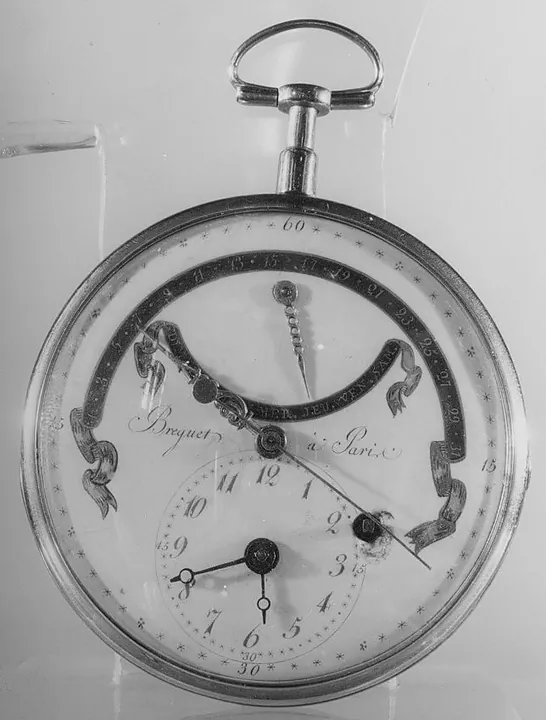
Pocket watch by Breguet, Belgium, 1700–1799
Royal Institute for Cultural Heritage
Pocket Watches · 1700–1799
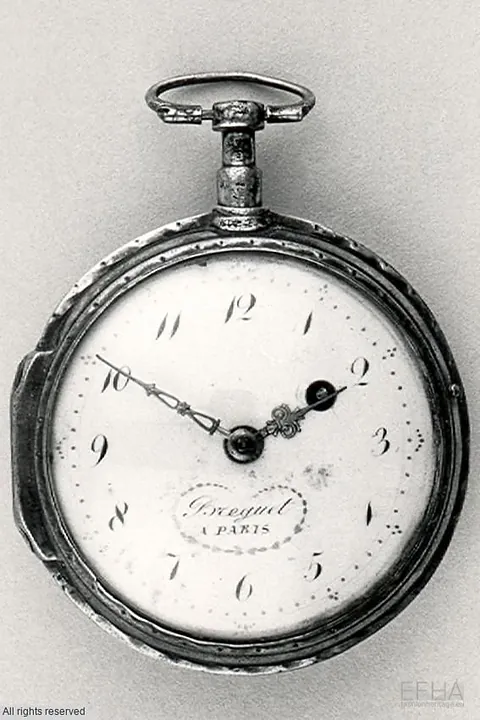
Pocket watch by Breguet, France, 1700–1799
Fashion Museum of Antwerp
Pocket Watches · c. 1790
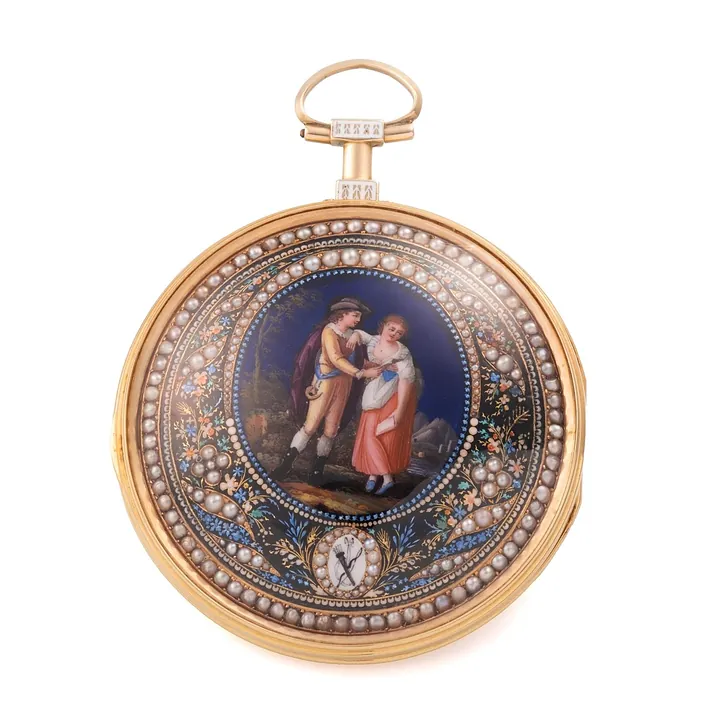
Breguet Love Letter, c. 1790
Antiquorum auction archive, Geneva
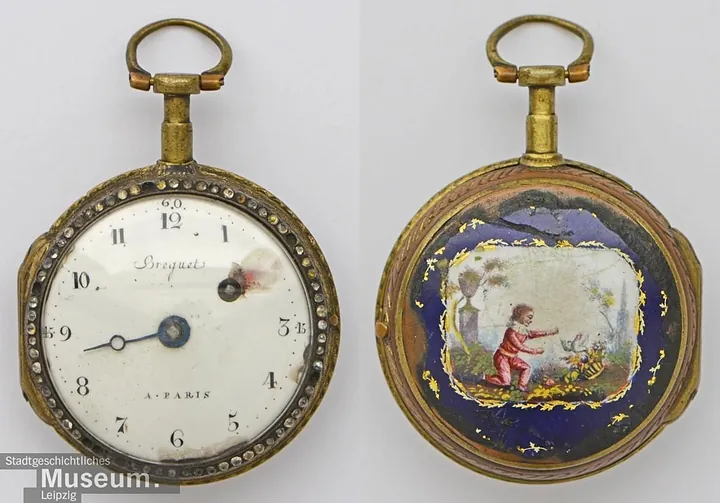
Pocket Watches · 1790
Pocket watch possibly by Breguet, France, 1790
Museum of City History Leipzig

Wristwatches · 1970
Wristwatch by Heno, Switzerland, 1970
Museum Rotterdam

Wristwatches · 1960–1986
'Tri-Compax' calendar chronograph wristwatch in gold case, by Universal, Geneva, Switzerland, 1960–1986.
Science Museum Group, London

Wristwatches · 1969–1970
Beta 21 Quartz wristwatch movement, made in Switzerland, 1970.
Science Museum Group, London

Wristwatches · c. 1969
Omega Speedmaster Moonwatch, ref. 145022-69st, c. 1969
Antiquorum auction archive, Geneva