
Wristwatches · Wristwatch
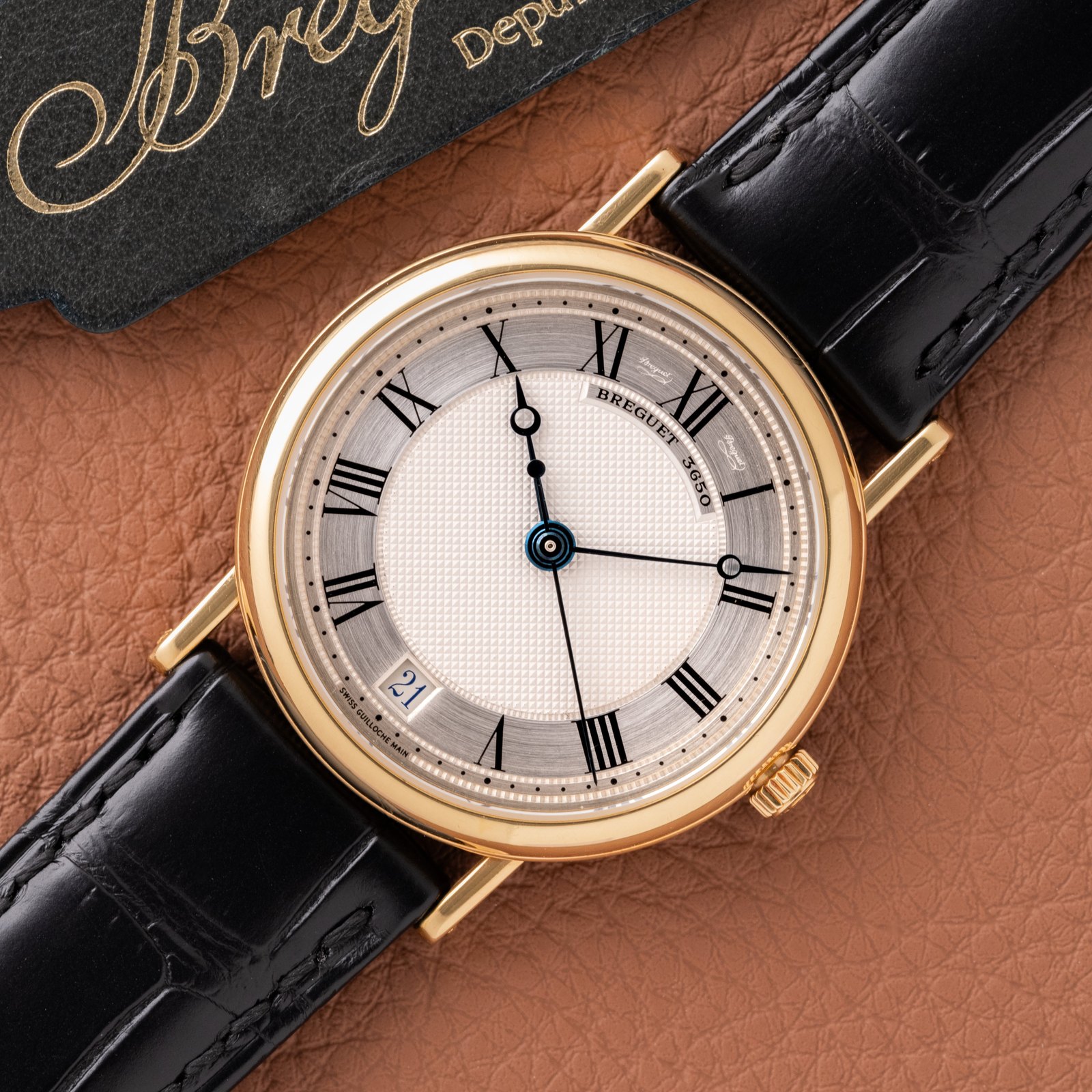
Breguet Classique Yellow Gold Automatic (Ref. 3980), 1990s
- Maker / attribution
- Breguet (maker)
- Date
- 1990s
- Historical period
- Mechanical Renaissance (1990 – 2010)
- Country of origin
- Switzerland
- Object type
- Wristwatch
- Materials / technique
- yellow gold
- Dimensions
- Case 33 mm
- Stock no.
- Product 8771622011063
- Credit line
- Dealer listing, Huntington Company (product 8771622011063)
- Catalogue title (original)
- 1990s Breguet Classique Yellow Gold Automatic (Ref. 3980) (English)
View the source record (dealer listing) ↗ (opens another website in a new tab)Suggest a correction
Record summary
Catalogued by Huntington Company (dealer) (stock number Product 8771622011063), this is a wristwatch by Breguet, made in Switzerland, dated 1990s. The Atlas places it in the Mechanical Renaissance period (1990 – 2010) of its Wristwatches collection. Materials and techniques recorded by the source: yellow gold. Recorded dimensions: Case 33 mm. The record is illustrated with 6 photographs.
Assembled from the source record's structured fields. Dates and attributions are given as the source states them; where a field is missing the Atlas leaves it blank rather than estimating.
Catalogue description
Dealer description — Huntington Company
History and Significance The reference 3980 comes from a particularly compelling period of modern Breguet, when the manufacture was rediscovering how to make watches that felt unmistakably connected to Abraham-Louis Breguet without simply recreating watches from the past. The ingredients were familiar: a finely guilloché dial, coin-edge case, straight lugs, blued hands, and that unmistakable Breguet typography. What made watches from this era successful was how naturally those details were brought together. They feel historical without feeling like reproductions. That distinction matters with Breguet. Few names in watchmaking carry as much history, but history alone does not make a compelling modern watch. References like the 3980 helped establish a visual language that could stand on its own. Even without seeing the signature, there is very little ambiguity about who made it. The dial is a particularly good example of why that language works. Guilloché is not being used simply as decoration; changes in texture create separation and depth without requiring additional color or heavy printing. The result can appear restrained from a distance and surprisingly intricate up close. It is the kind of dial that becomes more interesting through repeated viewing rather than revealing everything immediately. The reference 3980 also belongs to an era of Breguet that increasingly feels like its own collecting category. These watches sit between vintage Breguet and the larger, more contemporary pieces that followed, retaining a certain old-world quality while benefiting from modern automatic watchmaking. There is a quietness to them that feels increasingly uncommon. Nothing is oversized, nothing is there simply to attract attention, and almost every recognizable detail has a reason for being there. Writer's Thoughts Breguet is at its best when the watch looks almost too traditional at first glance. Then the details start appearing: the different guilloché patterns, the strange elegance of the straight lugs, the coin edge, the numerals, and those impossibly thin hands. The reference 3980 has that effect. It does not need a complication or an unusual dial color to become interesting. That is also what makes these earlier Breguet references so appealing. There is a seriousness to them, but never the sterility that can come with a very traditional dress watch. The design is actually full of personality; it is simply expressed through tiny details rather than obvious ones. A watch like this makes a strong argument that restraint can be every bit as distinctive as excess. Our Promise Every watch is thoroughly vetted, carefully described with complete transparency, and guaranteed authentic. Each piece is offered in honest condition, ensuring collectors receive a timepiece that reflects both originality and integrity. Specifications Brand: Breguet Model: Classique Reference: 3980 Year: 1990s Case Material: 18k yellow gold Case Size: 33mm Dial: Guilloché dial with Breguet numerals Movement: Automatic Strap/Buckle: Unworn original Breguet leather strap Buckle/Clasp: Original Breguet buckle Contents: Watch and hangtag Condition Case: The case remains unpolished and retains strong original definition throughout. Dial: The guilloché dial presents beautifully with its details remaining crisp and well defined. Hands: The blued Breguet hands present very well. Crystal: The crystal presents well overall. Strap/Buckle: Fitted to an unworn original Breguet leather strap. Buckle/Clasp: The original Breguet buckle remains with the watch.
Historical context
Mechanical Renaissance (1990 – 2010)
Mechanical watches return as cultural objects; independent watchmaking flourishes.
Mechanical watches returned as cultural and luxury objects. Complications, tourbillons and new materials proliferated; independent watchmakers such as George Daniels, F.P. Journe and Philippe Dufour revived artisanal watchmaking; collecting vintage watches became a major field.
Read the period in the timelineMore wristwatches from this periodEarlier: Quartz Revolution
Atlas type guide
Automatic (self-winding) watches
Self-winding watches use the wearer's motion to wind the mainspring. Abraham-Louis Perrelet and Breguet made 'perpétuelle' pocket watches with oscillating weights in the late eighteenth century, but the principle only became practical in the wristwatch. John Harwood patented a bumper automatic in 1923; Rolex's Perpetual rotor (1931) winding in one direction, and later bidirectional rotors (Eterna, Felsa Bidynator), established the modern form. Micro-rotors (Universal Genève, Buren) and peripheral rotors made automatic watches thinner.
What to look for
- A semicircular rotor turning 360° over the movement, or a 'bumper' weight that rebounds between springs.
- 'Automatic', 'Perpetual' or 'Self-winding' on the dial.
- A sealed screw-back case, since automatic watches are wound less often by the crown.
Dating clues
- Bumper automatics: 1923–c. 1955.
- Full rotors: from 1931 (Rolex); widespread after c. 1950.
- Micro-rotors: from 1954–1958.
General guidance written by the Atlas editors about this kind of object. It is not a statement about this particular piece; for that, rely on the source record above and on physical examination.
Related records
Pocket Watches · 1700–1799
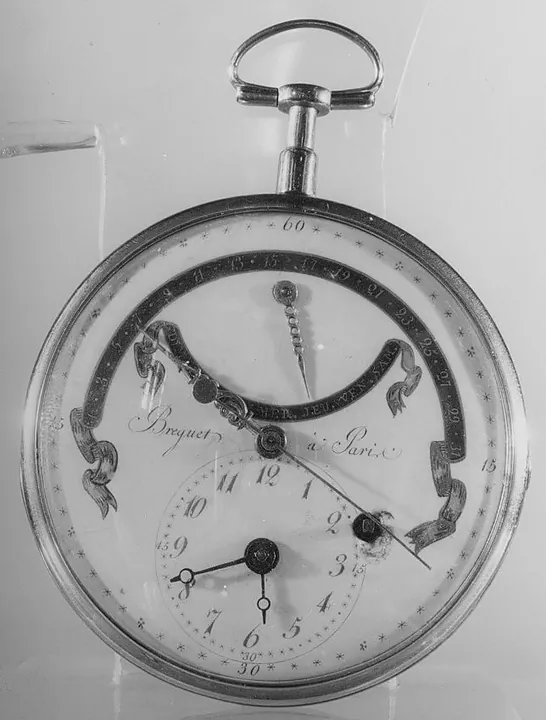
Pocket watch by Breguet, Belgium, 1700–1799
Royal Institute for Cultural Heritage
Pocket Watches · 1700–1799
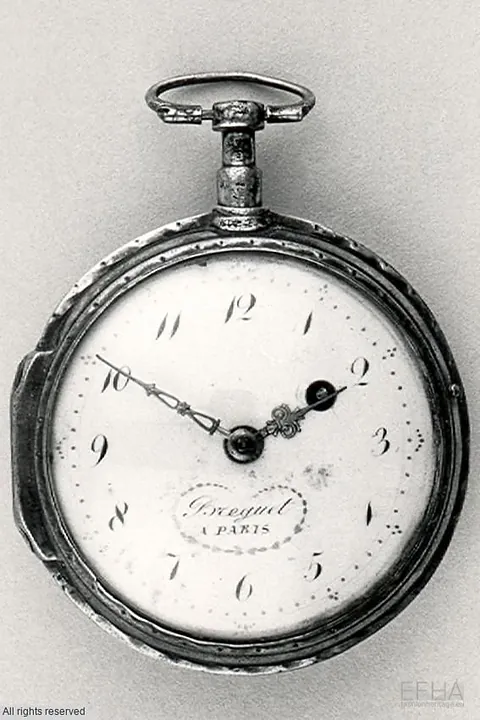
Pocket watch by Breguet, France, 1700–1799
Fashion Museum of Antwerp
Pocket Watches · c. 1790
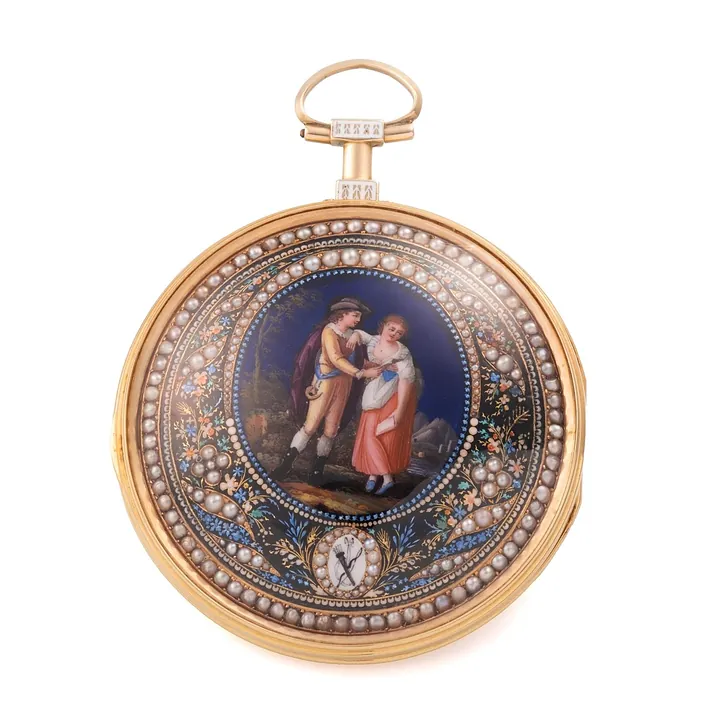
Breguet Love Letter, c. 1790
Antiquorum auction archive, Geneva
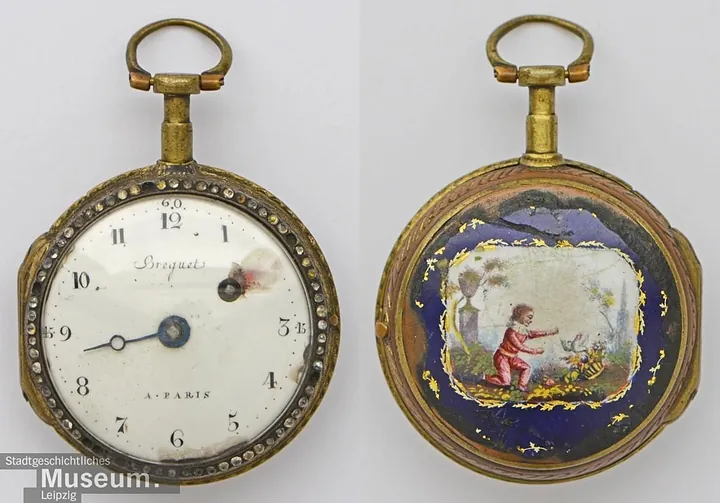
Pocket Watches · 1790
Pocket watch possibly by Breguet, France, 1790
Museum of City History Leipzig

Wristwatches · 2008
Wristwatch by Breitling?, 2008
Museum Rotterdam

Wristwatches · c. 1990s
Audemars Piguet Bamboo, c. 1990s
Antiquorum auction archive, Geneva

Wristwatches · c. 1990
Audemars Piguet Huitieme Perpetual Calendar, ref. 25696PT, c. 1990
Antiquorum auction archive, Geneva

Wristwatches · c. 1990
Breitling Chronomat, ref. b13050.1, c. 1990
Antiquorum auction archive, Geneva